The Breath of Life: Gas Exchange
The Breath of Life: Gas Exchange
Take a deep breath right now. In that single breath, you've just taken in around 500ml of air containing about 21% oxygen. Within seconds, that oxygen will be transported to every cell in your body, while carbon dioxide waste is collected and exhaled. This remarkable process happens automatically about 20,000 times every day, powered by an intricate system of airways, air sacs, and blood vessels working in perfect harmony.
The human respiratory system is a masterpiece of biological engineering. Each of your lungs contains around 300 million tiny air sacs called alveoli. If you could spread them all out flat, they would cover an area roughly the size of a tennis court - all packed into your chest cavity! This enormous surface area, combined with walls just one cell thick, makes your lungs incredibly efficient at exchanging gases with your circulatory system.
Figure: How blood transports respiratory gases. Tap a label to explore.
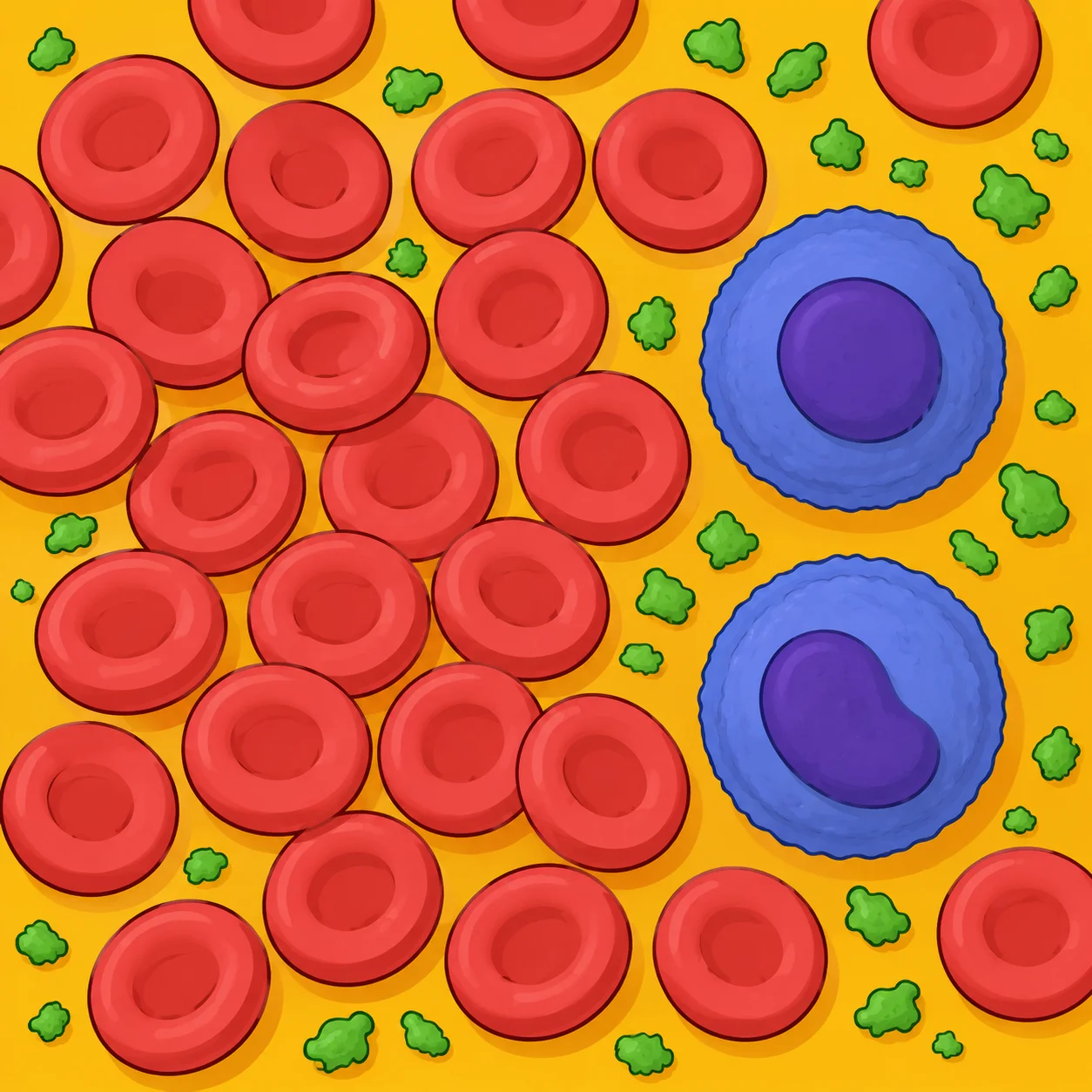
- 1Red blood cells — oxygen — Pick up oxygen in the lungs and release it at body tissues — via the protein haemoglobin.
- 2Plasma — carbon dioxide — Carries carbon dioxide from body tissues back to the lungs — dissolved in solution.
Figure: How blood transports respiratory gases. Tap a label to explore.
Biology glossary
- What are alveoli?
- Tiny air sacs in the lungs where gas exchange takes place - oxygen enters the blood and carbon dioxide leaves
- What is the trachea?
- The main airway (windpipe) that carries air from the throat to the lungs, reinforced with cartilage rings
Alveoli are perfectly adapted for efficient gas exchange through several key features:
Earn the mark scheme marks
Memory Aids
Alveoli adaptations — SLIM:
- S — Surface area (large — 70 m², like a tennis court)
- L — Lining (moist — gases dissolve before diffusing)
- I — In close contact (one cell thick — short diffusion distance)
- M — Moving blood supply (maintains the concentration gradient)
Breathing in (inspiration) — DFIC: Diaphragm Flattens, Intercostals Contract — volume increases, pressure falls, air flows in.
Breathing out (expiration) — DRIC: Diaphragm Returns (relaxes), Intercostals Relax — volume decreases, pressure rises, air flows out.
The tennis court analogy: 300 million alveoli give a total surface area of about 70 m² — roughly the area of a tennis court. This helps explain why gas exchange is so rapid even though each individual alveolus is tiny.
Concentration gradient direction: In lungs: O₂ moves from HIGH (alveoli) to LOW (blood) — into blood. CO₂ moves from HIGH (blood) to LOW (alveoli) — out of blood. In tissues: O₂ moves from HIGH (blood) to LOW (cells). CO₂ moves from HIGH (cells) to LOW (blood). The blood acts as a shuttle, constantly resetting the gradients.
Quick Check: A patient with emphysema has many of their alveoli fused together into larger, fewer air sacs. Explain why this condition severely reduces their ability to exercise, even though they still have lungs that inflate normally.
Emphysema destroys the walls between adjacent alveoli, merging them into larger spaces. This dramatically reduces the total surface area available for gas exchange (fewer, larger sacs have a much lower surface area than many, smaller ones). Less surface area means less oxygen can diffuse into the blood per breath, even if the lungs inflate to normal volume. During exercise, muscles demand much more oxygen for aerobic respiration. Because gas exchange is insufficient, the patient cannot meet this demand, so muscles fatigue rapidly and the patient becomes severely breathless at low exercise intensities.
Quick Check: The blood supplying the alveoli comes from the pulmonary artery and contains deoxygenated blood from the body. Explain why this is essential for gas exchange to work efficiently.
Gas exchange depends entirely on maintaining concentration gradients. Blood arriving at the alveolus (from the pulmonary artery) has a low oxygen concentration and a high carbon dioxide concentration, because oxygen has been used up and CO₂ has been produced by cellular respiration in body tissues. This means: (1) there is a steep gradient for oxygen to diffuse from alveolar air (high O₂) into the blood (low O₂), and (2) there is a steep gradient for CO₂ to diffuse from the blood (high CO₂) into the alveolar air (low CO₂). If already-oxygenated blood arrived instead, the O₂ gradient would be too small and gas exchange would be negligible.
Quick Check: A student measures their breathing rate before exercise (15 breaths per minute) and after 5 minutes of vigorous running (42 breaths per minute). Identify the factor that directly causes breathing rate to increase, and explain the mechanism.
The direct cause is an increase in blood carbon dioxide concentration (not a decrease in oxygen, as is commonly assumed). During vigorous exercise, muscles respire aerobically at a much higher rate, producing more CO₂. This CO₂ dissolves in blood plasma, forming carbonic acid, which lowers blood pH. Chemoreceptors in the medulla oblongata detect the fall in pH and send nerve impulses to the diaphragm and intercostal muscles, increasing their contraction rate. This increases breathing rate and tidal volume, removing the excess CO₂ and restoring blood pH towards normal.
Now try it yourself
Quiz · Question 1 of 21
Which is the correct order of structures air passes through to reach the lungs?
Tap an answer to check it
This topic in real past papers
Every real exam question we've found on gas exchange in humans, with a full worked answer.