Reflex Actions: Automatic Responses
Reflex Actions: Automatic Responses
You're cooking and accidentally touch a hot pan. Before you have even consciously registered pain, your hand has already jerked back. That gap — the fraction of a second between touching the pan and feeling the burn — is your reflex arc at work. Your nervous system has already issued the command to move before the "pain" signal has reached your brain. Reflex actions are the body's automatic defence system: fast, reliable, and completely beyond conscious control.
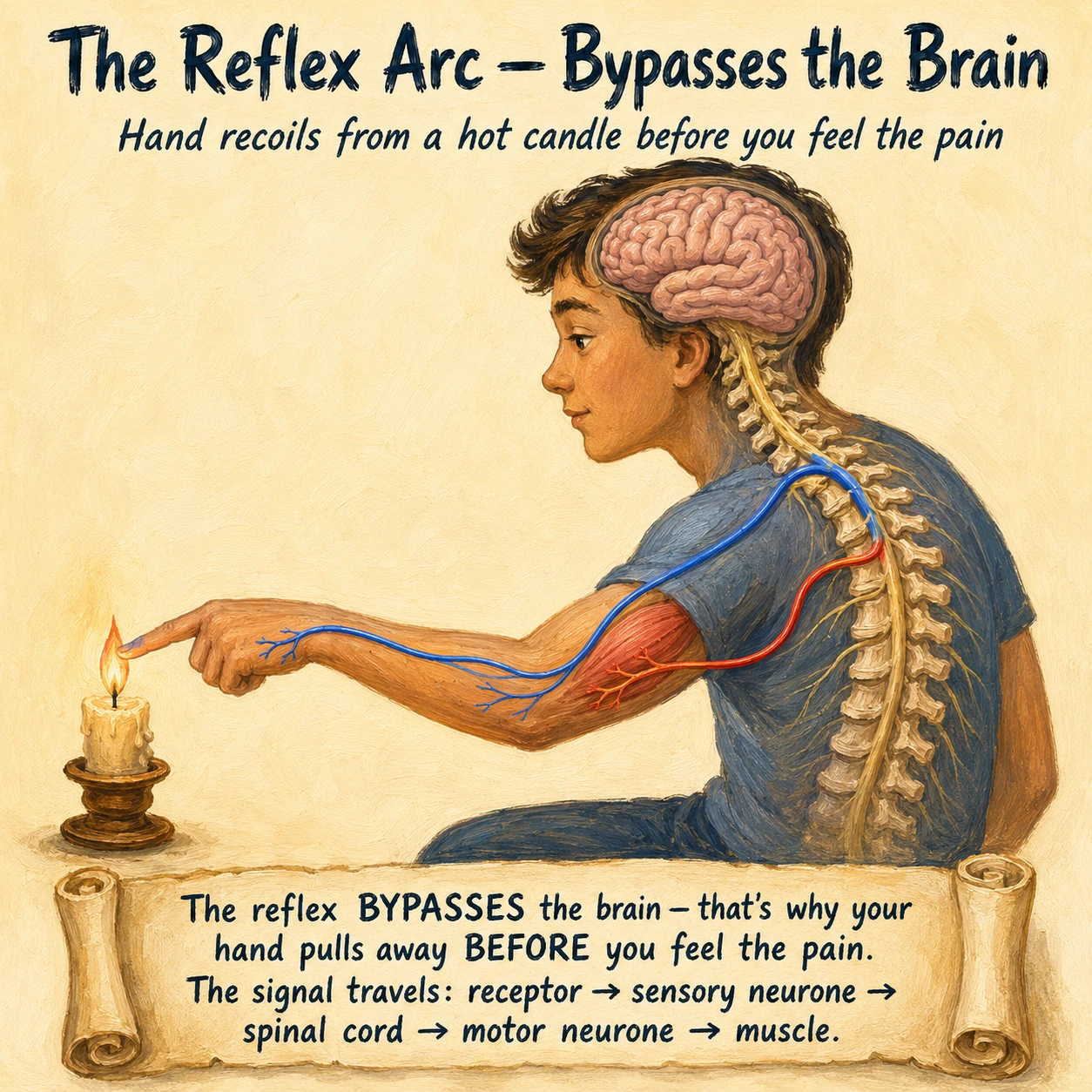
- 1Receptor — Detects the stimulus (heat / pain).
- 2Sensory neurone — Carries the impulse from receptor to spinal cord (blue line).
- 3Spinal cord — Where the relay neurone connects sensory to motor — bypassing the brain.
- 4Motor neurone — Carries the impulse from spinal cord to muscle (red line).
- 5Muscle (effector) — The bicep contracts to pull the hand away from the candle.
Biology glossary
- What is a reflex action?
- A reflex is a rapid, automatic response to a stimulus that does not involve conscious thought. Reflexes protect the body from harm.
Earn the mark scheme marks
Memory Aid: Remembering the Reflex Arc Pathway
The reflex arc follows this exact sequence: Stimulus → Receptor → Sensory neurone → Relay neurone (in spinal cord) → Motor neurone → Effector (muscle or gland) → Response. Use the mnemonic "Smelling Raspberries Requires More Mental Effort" (S-R-R-M-M-E) to remember the order. The key fact that examiners test: the relay neurone is in the spinal cord, not the brain — this is why reflex actions are faster than voluntary actions.
Use "SRRMME" to recall the correct sequence:
- S — Stimulus detected (e.g. heat from a pan)
- R — Receptor responds and generates an impulse
- R — Relay neurone in the spinal cord connects the pathways
- M — Motor neurone carries the signal to the effector
- M — Muscle (effector) contracts
- E — Effect — you pull away from the pain before you consciously feel it
Sentence to help: "Smelling Raspberries Requires More Mental Effort"
Key distinction: The relay neurone is inside the spinal cord — this is what makes the reflex fast. The impulse never needs to travel all the way to the brain before the response happens.
Now try it yourself
Quiz · Question 1 of 13
Which word best describes a reflex action?
Tap an answer to check it
This topic in real past papers
Every real exam question we've found on reflex arc, with a full worked answer.