The Story: Your Body's Water Filter
💧 The Story: Your Body's Water Filter
Your kidneys filter roughly 180 litres of blood every single day — enough to fill a bathtub. Yet you only produce about 1–2 litres of urine. What happens to the other 178 litres? The answer is selective reabsorption: your kidneys take back exactly what your body needs and discard the rest. The precision of this process is staggering. Whether you drink a litre of water or run a 10 km race without a sip, a hormone called ADH adjusts the kidneys minute-by-minute to keep your blood water concentration almost perfectly constant. This is osmoregulation — one of the most finely tuned control systems in the human body.
Figure: Kidney structure (left) and magnified nephron (right). Tap any label to explore its function.
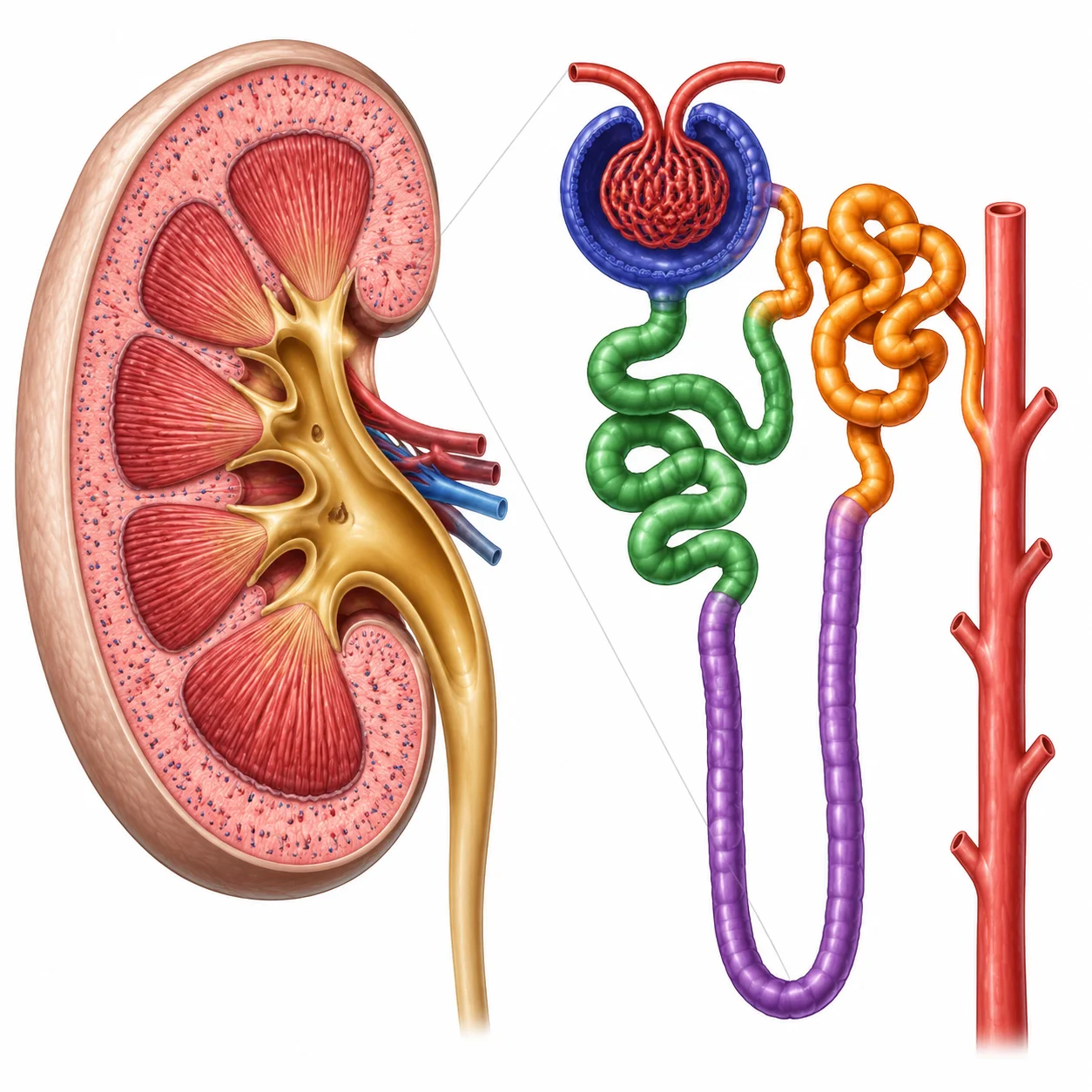
- 1Bowman's capsule — Cup-shaped capsule surrounding the glomerulus — where blood is filtered to form the filtrate.
- 2Kidney tubule — Long winding tube where useful substances are selectively reabsorbed back into the blood.
- 3Collecting duct — Final tube where ADH controls how much water is reabsorbed — determines urine concentration.
Figure: Kidney structure (left) and magnified nephron (right). Tap any label to explore its function.
Biology glossary
- What is osmoregulation?
- Osmoregulation is the control of the water content and ion concentration of the blood. The kidneys are the main organs responsible for this.
- What is ADH and what does it do?
- ADH (antidiuretic hormone) is released by the pituitary gland. It makes the kidneys reabsorb more water from the filtrate back into the blood, producing smaller amounts of more concentrated urine.
Homeostasis = the regulation of the internal conditions of a cell or organism to maintain optimum conditions for function, in response to internal and external changes.
Earn the mark scheme marks
Memory Aids
ADH = "Anti-Dilute Hormone": When you are dehydrated (blood is too concentrated), ADH stops your urine from being dilute. More ADH = more concentrated urine = less water lost. If you remember "anti-dilute" rather than "antidiuretic," you will never confuse the direction of ADH action.
The ADH feedback loop — "DRIED":
- Dehydration detected by osmoreceptors
- Released from pituitary gland into blood
- Increases permeability of collecting duct
- Extra water reabsorbed into blood
- Dark concentrated urine produced
Nephron processes — "FRE": Filtration → Reabsorption → Excretion. Three letters, three stages, in order. All glomerular filtrate starts at F; useful stuff returns at R; waste leaves at E.
Now try it yourself
Quiz · Question 1 of 12
Where does the filtration of blood take place in the kidney?
Tap an answer to check it
This topic in real past papers
Every real exam question we've found on water regulation, with a full worked answer.