The River of Life
The River of Life
Imagine a transport system that delivers oxygen and nutrients to every cell in your body, removes waste products, fights infections, and repairs damage - all while flowing through 100,000 kilometers of vessels. This is your circulatory system, where blood acts as the delivery service and blood vessels form the highway network. Understanding blood and its vessels reveals how your body maintains life at the cellular level.
Figure: The four components of blood. Tap any label to explore its function.
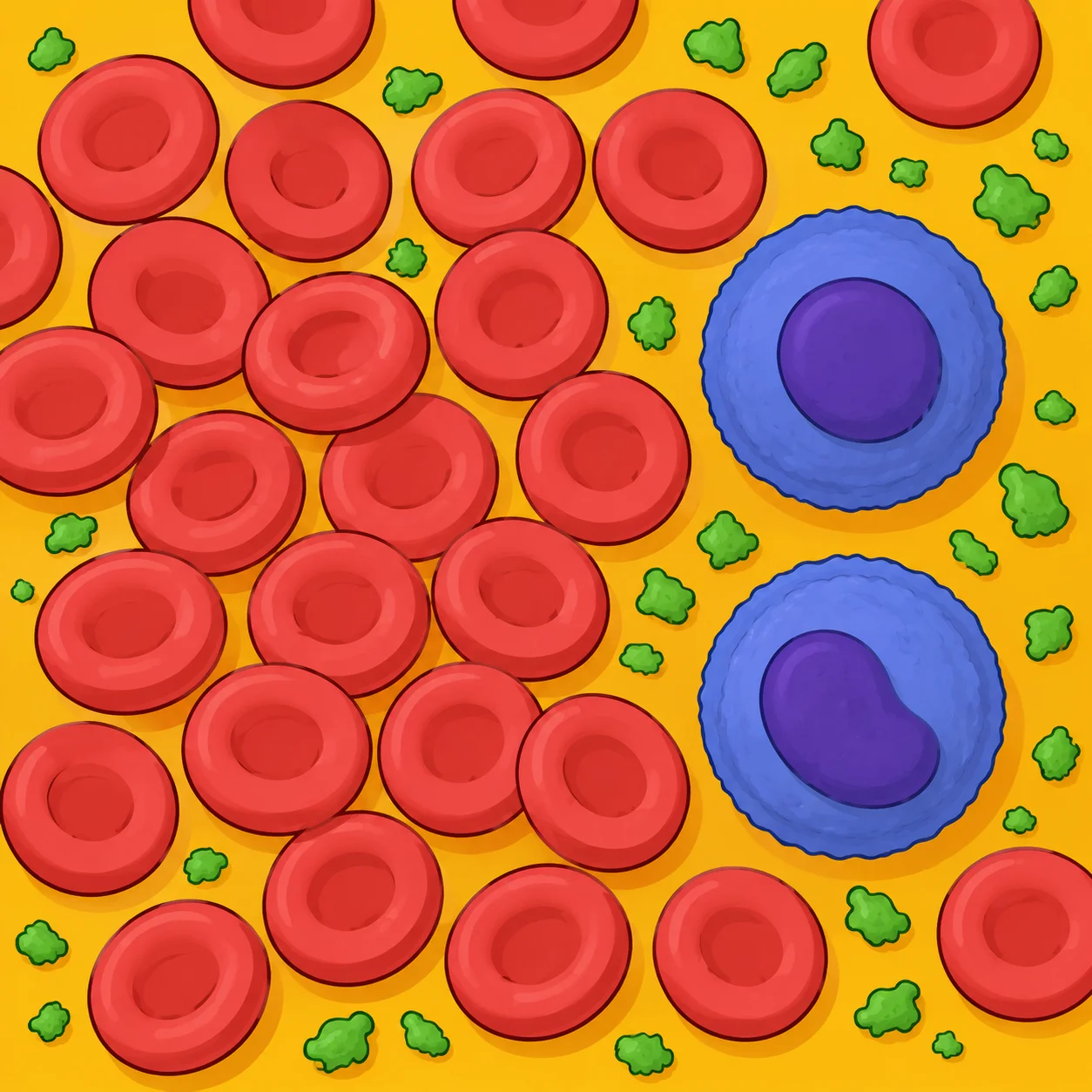
- 1Plasma — The pale yellow liquid that carries everything dissolved around the body.
- 2Red blood cells — Biconcave discs packed with haemoglobin — they carry oxygen around the body.
- 3White blood cells — The body's mobile defence force — phagocytes engulf pathogens, lymphocytes make antibodies.
- 4Platelets — Tiny cell fragments that trigger blood clotting at wound sites.
Figure: The four components of blood. Tap any label to explore its function.
Biology glossary
- What is hemoglobin?
- A protein in red blood cells containing iron that binds reversibly with oxygen to transport it around the body.
- What are platelets?
- Small cell fragments with no nucleus that help blood clot by sticking to damaged vessels and releasing clotting factors.
Blood has four main components: (1) Plasma — the liquid (mostly water) that transports dissolved substances including glucose, hormones, and urea; (2) Red blood cells — biconcave cells containing haemoglobin that carry oxygen around the body; (3) White blood cells — which defend against infection (phagocytes engulf pat
Earn the mark scheme marks
Memory Aids
The four blood components — PRWP: Plasma, Red cells, White cells, Platelets.
The blood-as-a-river analogy: Think of blood as a river system. Plasma is the water carrying everything along. Red blood cells are delivery boats, carrying oxygen parcels to cells along the bank. White blood cells are the river police — most of the time you do not notice them, but when something goes wrong (an infection arrives) they spring into action. Platelets are the repair crew who rush to any breach in the riverbank and seal it.
Red blood cell adaptations — BNF: Biconcave shape (increases surface area), No nucleus (more space for haemoglobin), Flexible membrane (squeezes through narrow capillaries).
Artery vs vein walls: Arteries carry blood Away from the heart under pressure — they need thick, muscular wAlls. Veins carry blood back — they have Valves to stop backflow (V for vein, V for valve).
Quick Check: A patient has a low red blood cell count (anaemia). Explain why they feel tired and breathless during exercise, even though their lungs are working normally.
With fewer red blood cells, less haemoglobin is available to carry oxygen from the lungs to respiring tissues. During exercise, muscle cells need more oxygen for aerobic respiration to release energy for contraction. Because oxygen delivery is insufficient, muscles may respire anaerobically, producing lactic acid and causing fatigue. The brain detects low oxygen delivery and increases breathing rate, causing breathlessness — even though the lungs can exchange gas normally, the transport capacity is reduced.
Quick Check: A capillary is described as being adapted for its function. Identify two structural adaptations and for each one explain how it helps the capillary carry out its function.
1. Walls one cell thick — this minimises the distance over which substances must diffuse, so oxygen and glucose can move rapidly from blood into cells, and carbon dioxide and urea can move rapidly out. 2. Very small diameter (5-10 micrometres) — red blood cells pass in single file, maximising contact between cell surface and capillary wall, and slowing blood flow to allow more time for diffusion to occur.
Quick Check: A student says: "Because veins have valves, they do not need thick walls." Evaluate whether this statement is scientifically accurate.
The statement is partially correct but conflates two separate adaptations. Veins have thin walls because blood pressure in veins is low (5-10 mmHg), so there is no need for thick, elastic, muscular walls to withstand high-pressure surges. Valves are a separate adaptation that prevent backflow of blood, since low pressure and gravity (especially in the legs) would otherwise cause blood to pool. The valves and thin walls are both consequences of low pressure, but they serve different purposes — one maintains direction of flow, the other provides appropriate structural support for the pressure conditions.
Now try it yourself
Quiz · Question 1 of 21
What is the main function of red blood cells?
Tap an answer to check it
This topic in real past papers
Every real exam question we've found on blood components and vessels, with a full worked answer.