The Story: Your Body's Thermostat
The Story: Your Body's Thermostat
Imagine your body as a house with the most advanced thermostat ever invented. No matter if it's freezing outside or boiling hot, your house maintains exactly 20°C inside. But your body does even more than this — it controls temperature, water levels, blood sugar, and more, all at the same time! This automatic regulation system is called homeostasis.
Tap any structure to zoom in and see how it contributes to thermoregulation.
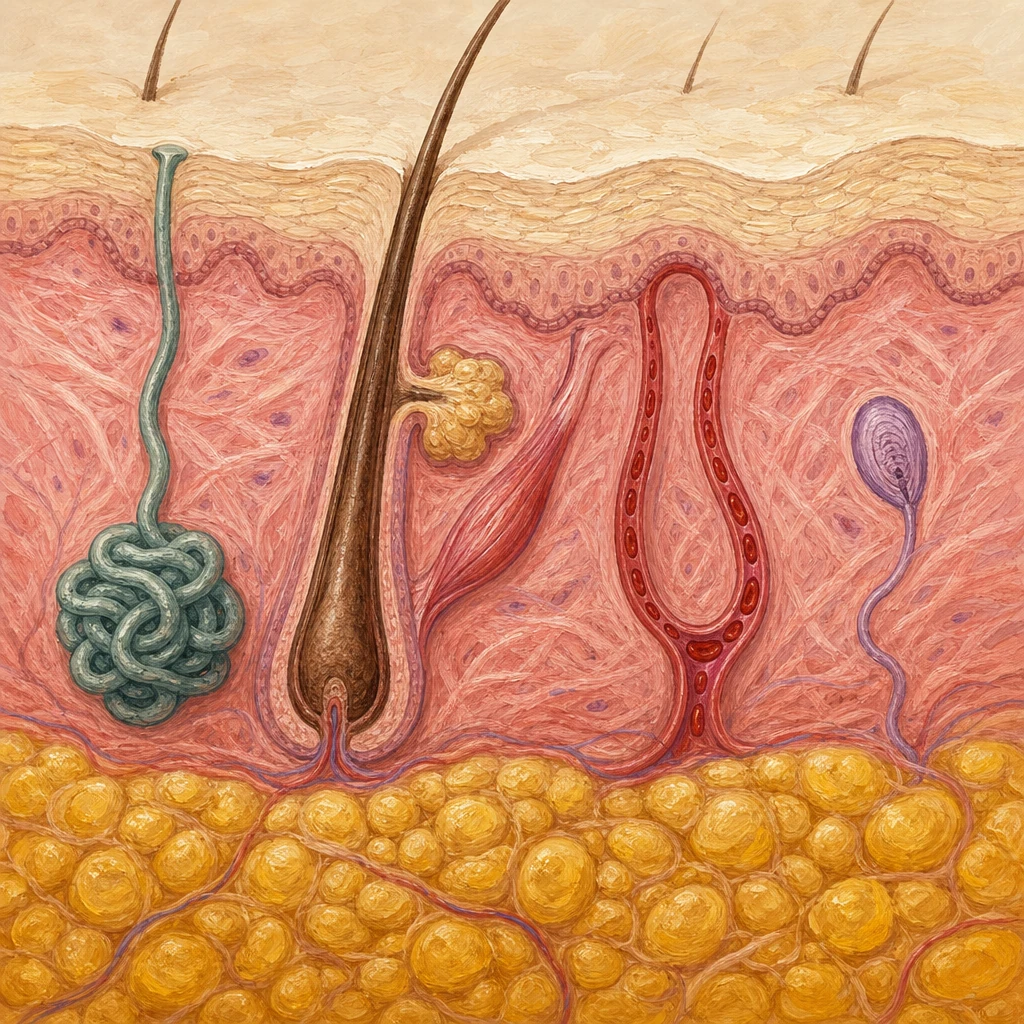
- 1Epidermis — Your body's outer wall — continuous, waterproof, protective
- 2Sweat gland — Your built-in cooling system — sweat evaporates, heat leaves
- 3Capillary loop — The radiator near the surface — wider to lose heat, narrower to keep it
- 4Hair follicle — The hair and its puller muscle — your fur coat response to cold
- 5Temperature receptor — The skin's thermometer — tells the brain how hot it is outside
- 6Subcutaneous fat — The body's insulating blanket — sits below the dermis, retains heat
Tap any structure to zoom in and see how it contributes to thermoregulation.
Biology glossary
- What is thermoregulation?
- Thermoregulation is the process of maintaining a constant core body temperature of 37°C, regardless of changes in the external environment.
Homeostasis = the regulation of the internal conditions of a cell or organism to maintain optimum conditions for function, in response to internal and external changes.
Earn the mark scheme marks
Memory Aids
"SHED" — too hot responses:
- Sweating (evaporation removes heat)
- Hairs flat (reduced insulating air layer)
- Erythema / vasodilation (more blood to skin surface, heat lost by radiation)
- Decreased metabolic activity (reduced heat generation)
Cold responses — "SVC":
- Shivering (muscle contractions generate heat via respiration)
- Vasoconstriction (less blood near skin, less heat lost)
- Curl of hairs (traps air as insulation)
Vasodilation vs Vasoconstriction: Think "DILate = DILute = spread out" — dilated vessels spread blood near the surface. Constrict = "squeeze tight" — vessels narrow to keep blood away from the cold surface.
Why evaporation cools: Picture a wet hand in a breeze — the water evaporates and the hand feels cold. The same principle explains sweating: water changing from liquid to gas takes heat energy from the skin.
Quick Check: A student says "vasodilation makes you cooler because more blood is near the skin surface." Explain the mechanism in more detail, including how heat is actually transferred from the body.
The student is on the right track but needs more detail. During vasodilation, the blood vessels supplying capillaries in the skin widen, allowing a greater volume of warm blood to flow close to the skin surface. The skin is in contact with the cooler surrounding air, so heat energy from the blood is transferred to the air by radiation and convection. This increases the rate of heat loss from the body. As more heat is lost to the surroundings, core body temperature decreases, returning it toward the normal range of 37°C. The blood vessels do not move — only their diameter changes.
Quick Check: Explain why a person exercising vigorously on a hot day sweats more heavily than someone resting in the same environment. Consider two factors that contribute to the increased sweating.
First, during vigorous exercise, muscle cells respire at a much higher rate to release energy for contraction. A significant proportion of this energy is released as heat, rapidly raising core body temperature. This greater temperature increase provides a stronger stimulus to the hypothalamus, which responds by increasing sweat production. Second, the external heat of the hot day also raises body temperature through radiation and conduction from the environment, adding to the heat load from exercise. Both factors increase the deviation from the 37°C set point, so the negative feedback response (sweating and vasodilation) must be correspondingly stronger to return temperature to normal.
Quick Check: Using your knowledge of negative feedback, describe the sequence of events when a person moves from a warm room (22°C) into cold outdoor air (2°C). Name the receptor, coordination centre, and at least two effector responses.
Stimulus: the person's skin surface temperature drops when exposed to 2°C air, and temperature receptors in the hypothalamus detect a fall in blood temperature. Receptor: thermoreceptors in the skin and the hypothalamus itself. Coordination centre: the hypothalamus detects the temperature fall and sends nerve signals to effectors. Effector responses: (1) vasoconstriction — blood vessels in the skin narrow, reducing blood flow near the surface and decreasing heat loss by radiation; (2) shivering — skeletal muscles contract rapidly, generating heat through increased respiration. Both responses oppose the original temperature fall, raising core body temperature back toward 37°C. Once normal temperature is restored, the hypothalamus reduces its signals, switching off the shivering and allowing vessels to return to normal diameter.
Now try it yourself
Quiz · Question 1 of 12
What is the normal core body temperature in humans?
Tap an answer to check it
This topic in real past papers
Every real exam question we've found on temperature regulation, with a full worked answer.