Test yourself on Genetic Inheritance with exam style questions, marked instantly.
Flashcards that come back just before you would forget them.
A revision plan that remembers what you know and shows what to do next.
See which topics you have nailed and which need another look.
Quiz yourself on Genetic InheritanceGet your flashcardsBuild my revision planTrack my progressKey Terms for Genetics
Dominant alleles are bossy — if one is present, it shows. Capital letter (B).
Recessive alleles are shy — only show up when there's no bossy allele around. Lowercase (b).
Bb = Brown eyes (bossy B wins). bb = Blue eyes (both shy, so blue shows).
| Term | Meaning |
|---|---|
| Dominant | Allele that is always expressed when present (shown with CAPITAL letter, e.g., B) |
| Recessive | Allele only expressed when there's no dominant allele (lowercase, e.g., b) |
| Homozygous | Two identical alleles (BB or bb) |
| Heterozygous | Two different alleles (Bb) |
| Genotype | The alleles an organism has (e.g., Bb) |
| Phenotype | The physical characteristic (e.g., brown eyes) |
Punnett Squares
A Punnett square shows possible offspring from two parents:
Example: Eye colour (Brown = B, Blue = b)
Parent 1: Bb (heterozygous brown)
Parent 2: Bb (heterozygous brown)
| B | b | |
| B | BB | Bb |
| b | Bb | bb |
Result: 3 Brown (BB, Bb, Bb) : 1 Blue (bb) = 3:1 ratio
Probability of blue eyes: 1 in 4 = 25%
Visual: Punnett Squares and Genetic Crosses
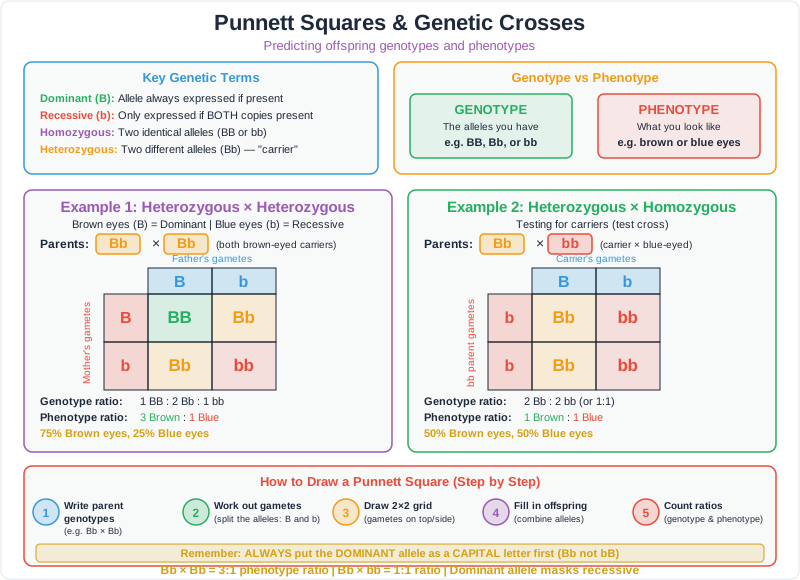
Remember: Bb x Bb = 3:1 phenotype ratio | Bb x bb = 1:1 ratio | Dominant allele (capital) masks recessive (lowercase)
How It Works: Dominant and Recessive Alleles
Every organism inherits two copies of each gene — one from each parent. These two copies are called alleles. If both alleles are the same (e.g., BB or bb), the organism is homozygous for that gene. If the alleles are different (e.g., Bb), the organism is heterozygous.
When a dominant allele is present, it is always expressed in the phenotype — even if there is only one copy. A recessive allele is only expressed in the phenotype when two copies are present (homozygous recessive, e.g., bb). In a heterozygous individual (Bb), the dominant allele "masks" the recessive allele at the molecular level — the dominant allele produces a functional protein that determines the phenotype, while the recessive allele either produces a non-functional protein or none at all.
Punnett squares are used to predict the probability of offspring genotypes. Parents contribute one allele to each gamete (egg or sperm) through meiosis, and the Punnett square maps out all possible combinations when gametes fuse at fertilisation.
Key Definitions
Common Misconceptions
Misconception: "Dominant means more common in the population."
Reality: Dominant and recessive refer to which allele is expressed when both are present — they say nothing about frequency in a population. A dominant allele can be very rare (for example, the allele for polydactyly is dominant but uncommon), and a recessive allele can be very common.
Misconception: "If both parents are carriers for a recessive condition, all their children will be carriers too."
Reality: When both parents are carriers (Ff x Ff), the Punnett square shows four possible outcomes: FF (1/4, unaffected, not a carrier), Ff (2/4, carrier), and ff (1/4, affected). Only half the children are expected to be carriers; a quarter will have the condition and a quarter will have two dominant alleles and not be carriers at all.
Misconception: "The Punnett square shows certainty — exactly 1 in 4 children will be affected."
Reality: Punnett squares show probability, not certainty. A 1 in 4 chance means that each pregnancy independently has a 25% probability of producing an affected child. A couple could have four children and none be affected, or all four be affected — the prediction is a long-run probability, not a guarantee.
Memory Aids
Homozygous vs Heterozygous: "Homozygous = Homogeneous = Same" (HH or hh — both letters are the same). "Heterozygous = Different" (Hh — the letters are different). The prefixes homo (same) and hetero (different) are the key.
How to draw a Punnett square — 4 steps: (1) Write the parents' genotypes. (2) Identify the gametes (one allele each). (3) Place gametes along the top and side of the grid. (4) Fill in the grid by combining each pair. Always show your working — examiners award method marks.
Dominant allele rule: "Capital letter = Dominant = always shows." If you see a capital letter in the genotype, that characteristic is in the phenotype. No exceptions for simple inheritance.
Probability language: Practise converting fractions to percentages: 1/4 = 25%, 1/2 = 50%, 3/4 = 75%. Exam questions may ask for ratio (3:1), fraction (3/4), or percentage (75%).
Quick Check: Two parents, both with brown eyes, have a child with blue eyes. Use a Punnett square to show this is possible, and explain what it tells us about the parents' genotypes.
For a child to have blue eyes (recessive), they must have genotype bb. This means each parent must have contributed a b allele. Since both parents have brown eyes but carry a b allele, they must both be heterozygous (Bb). Punnett square for Bb x Bb: offspring = BB, Bb, Bb, bb. Probability of blue eyes (bb) = 1 in 4 = 25%. The fact that a blue-eyed child has appeared confirms that both parents must be carriers of the recessive allele, even though neither shows the trait.
Quick Check: Explain why two individuals with the same phenotype (e.g., both with brown eyes) may have different genotypes, and state what the consequences might be for their offspring.
Brown eyes result from having at least one dominant allele (B). An individual with genotype BB and an individual with genotype Bb both have the same phenotype (brown eyes), but carry different allele combinations. If two BB individuals have children, all offspring will be BB (brown eyes, no recessive allele passed on). If two Bb individuals have children, there is a 25% chance of a bb offspring (blue eyes). The phenotype does not reveal the genotype — genetic testing would be needed to distinguish BB from Bb.
Quick Check: A genetic cross gives a 1:1 ratio of phenotypes in the offspring. What does this tell you about the genotypes of the two parent organisms?
A 1:1 phenotype ratio in offspring arises from a cross between a heterozygous parent (Bb) and a homozygous recessive parent (bb). The Punnett square gives Bb and bb in equal proportions — half the offspring express the dominant phenotype and half express the recessive phenotype. This cross is called a test cross and is used by geneticists to determine whether an organism showing a dominant phenotype is homozygous dominant (BB) or heterozygous (Bb).
Exam Focus
Frequently ExaminedGenetic crosses and Punnett squares are tested in almost every AQA Paper 2 and Edexcel 1BI0/1 (Paper 1). This is one of the highest-mark topics in Unit 7. Common question formats:
- 2-mark Punnett square: Complete a cross, state the ratio, and give the probability. Always show gametes clearly — they are method marks.
- 3-mark explanation: "Explain how two parents with a dominant phenotype can have a child with the recessive phenotype." Requires: heterozygous parents, carrier definition, recessive needs two copies.
- 1-mark probability: Convert Punnett square result to fraction or percentage. Know 1/4 = 25%, 1/2 = 50%, 3/4 = 75%.
- 6-mark extended response: Occasionally tested — describe the mechanism of dominant/recessive inheritance with reference to genotype and phenotype throughout.
Edexcel 1BI0 style: Edexcel Paper 1 (1BI0/1) frequently presents genetic inheritance questions with a stimulus — for example, a family pedigree chart, a description of a breeding programme, or data on phenotype frequencies in a population. You are expected to apply Punnett square knowledge to the specific scenario given. The command word "Suggest" is used when the context is novel — use your genetics knowledge to reason through the unfamiliar case. Edexcel mark schemes use "Allow..." to credit alternative correct allele notation, but your Punnett square method must still show gametes clearly.
Mark-scheme language: When completing a Punnett square, always state the genotype ratios AND the phenotype ratio (e.g., "3 brown : 1 blue", not just "3:1"). Examiners want to see you connect genotype to phenotype.
Exam Tips: Genetic Inheritance
Always show your gametes: Before filling in the Punnett square, write the gametes along the top and side. These carry method marks — even if you fill the grid incorrectly, you can still earn marks for correct gametes.
State both ratio and probability: After completing a Punnett square, give the genotype ratio (e.g., 1 BB : 2 Bb : 1 bb) AND the phenotype ratio (e.g., 3 brown : 1 blue). Then give the probability as a fraction and percentage.
Dominant does not mean common: This is one of the most common misconceptions — explicitly say "dominant means it is expressed when one copy is present" rather than "dominant means it is more frequent".
Carrier definition: A carrier is always heterozygous (one dominant, one recessive allele) for a recessive condition. They do not show the condition. If asked to define "carrier", include all three elements: heterozygous, does not show symptoms, can pass the recessive allele to offspring.
Letter choice matters: Use letters that look different in upper and lower case. Avoid letters like C/c, O/o, P/p where upper and lower can look similar. Good choices: B/b, T/t, F/f, H/h.
Edexcel pedigree chart questions: Edexcel 1BI0/1 regularly uses pedigree (family tree) diagrams as stimulus material. From the diagram, you may be asked to deduce whether a condition is dominant or recessive, identify carrier individuals, or calculate probability for a future child. Work through the logic step by step: if two unaffected parents have an affected child, the condition must be recessive.
Make this stick
Signing in gives access to all PrepWise features.