Test yourself on Classification with exam style questions, marked instantly.
Flashcards that come back just before you would forget them.
A revision plan that remembers what you know and shows what to do next.
See which topics you have nailed and which need another look.
Quiz yourself on ClassificationGet your flashcardsBuild my revision planTrack my progressThe Linnaean Classification System
Classification is like organising files into folders. Kingdom is the biggest folder. Inside that are Phylum folders, then Class folders, and so on until you reach Species — a single "file" representing one type of organism. Each level gets more specific!
Carl Linnaeus organised life into a hierarchy:
Kingdom → Phylum → Class → Order → Family → Genus → Species
Remember: Keep Ponds Clean Or Fish Get Sick
The Three Domain System
Carl Woese proposed classifying life into three domains based on DNA:
Ancient bacteria-like organisms
Extreme environments
True bacteria
Prokaryotes
All other life
Animals, plants, fungi, protists
Binomial Naming System
- Two-part Latin name: Genus + species
- Written in italics or underlined
- Genus has capital letter; species is lowercase
- Example: Homo sapiens (humans)
Visual: Classification of Living Organisms
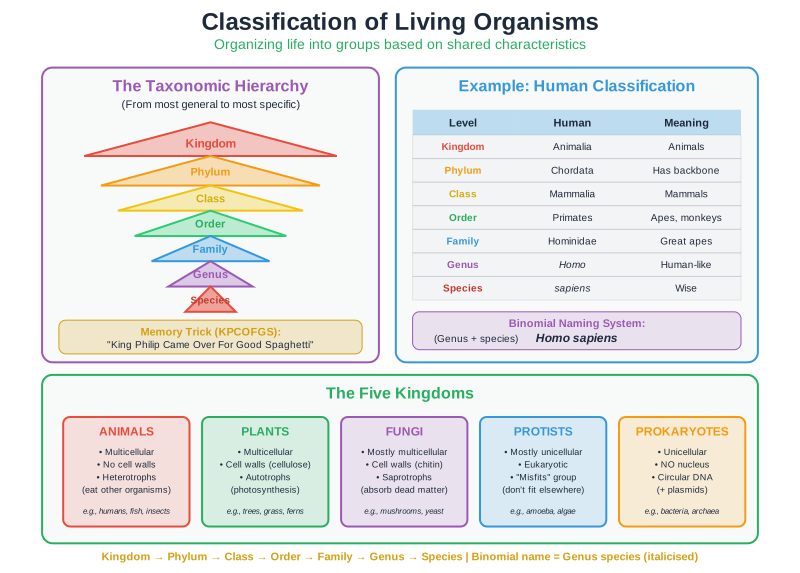
Remember: King Philip Came Over For Good Spaghetti | Binomial name = Genus species (italicised)
Visual: Evidence for Evolution

Remember: 5 types of evidence: Fossils | Comparative anatomy | DNA similarity | Embryology | Observed resistance
Visual: Speciation

Remember: Isolation → Different mutations + Different selection → Genetic changes → Can't interbreed = NEW SPECIES
How It Works: Classification and Why It Changes
Classification is the process of grouping living organisms based on their similarities and differences, making it easier for scientists to study and communicate about life on Earth. The system in use today was established by Carl Linnaeus in the 18th century and is called the Linnaean hierarchy.
Organisms are grouped at progressively finer levels — from Kingdom (broadest) down to Species (most specific). At each level, organisms share more characteristics with each other. Two organisms in the same genus are more closely related than two organisms that share only a kingdom.
Classification systems are not fixed — they change as new evidence becomes available. For most of history, organisms were classified by their physical appearance and structure (morphology). This worked for many groups but led to errors when unrelated organisms happened to look similar (convergent evolution). The development of DNA sequencing in the 20th century revolutionised classification: by comparing the DNA sequences of organisms directly, scientists can determine more accurately how closely related they are and how recently they shared a common ancestor.
Carl Woese used ribosomal RNA (rRNA) sequences to re-examine the classification of microorganisms. He discovered that organisms previously classified as bacteria fell into two fundamentally different groups — true bacteria and archaea — which are as different from each other at the molecular level as either is from eukaryotes. This led to his proposal of the three-domain system, which now supersedes the five-kingdom system for most scientific purposes.
Key Definitions
Common Misconceptions
Misconception: "Classification never changes — scientists have always agreed on how to group organisms."
Reality: Classification is a scientific model that is regularly revised as new evidence emerges. The introduction of DNA sequencing has led to many groups being reorganised. For example, Woese's three-domain system replaced the five-kingdom system because DNA analysis showed that two groups previously called bacteria were as fundamentally different from each other as they were from all other life. Classification will continue to be updated as genomics progresses.
Misconception: "A species is a group of organisms that look similar to each other."
Reality: Appearance alone does not define a species. The biological species concept defines a species as a group of organisms that can interbreed to produce fertile offspring. Very different-looking dogs — from Great Danes to Chihuahuas — all belong to the same species (Canis lupus familiaris) because they can potentially interbreed. Conversely, a horse and a donkey look fairly similar but are different species because their hybrid offspring (mules) are infertile.
Misconception: "Archaea are just ancient bacteria."
Reality: Archaea and bacteria are both prokaryotes (no nucleus, no membrane-bound organelles), and they look similar under a microscope. However, at the molecular level — ribosomal RNA sequences, cell membrane lipids, and cell wall composition — they are profoundly different. Archaea are no more closely related to bacteria than they are to eukaryotes. Woese's rRNA analysis revealed this, leading to their separation into a distinct domain.
Misconception: "Binomial names are random Latin words."
Reality: Binomial names are deliberately chosen to convey information. The genus name groups organisms with shared ancestry. The species name often describes a characteristic, the discoverer's name, or the location where it was found. Homo sapiens means "wise man" in Latin. Tyrannosaurus rex means "tyrant lizard king." The names are meaningful, internationally agreed, and allow scientists worldwide to refer to exactly the same organism without language barriers.
Memory Aids
"Kings Play Chess On Fine Green Silk" — the taxonomic hierarchy:
- Kingdom
- Phylum
- Class
- Order
- Family
- Genus
- Species
Alternative: "King Philip Came Over For Good Soup" or "King Philip Can Only Find Green Socks"
Three domains — ABE:
"ABE knows all life."
- A — Archaea (ancient organisms, extreme environments)
- B — Bacteria (true bacteria, prokaryotes)
- E — Eukaryota (animals, plants, fungi, protists — all have a nucleus)
Binomial naming rules — "Capital genus, lowercase species, always in italics":
Examples: Homo sapiens (human), Felis catus (domestic cat), Panthera leo (lion), Escherichia coli (gut bacterium).
Memory trick: "The Genus is the big boss — it gets a capital. The species is specific — it stays lowercase."
Quick Check: Two organisms look very similar but scientists classify them as different species. Explain what evidence scientists could use to determine whether they belong to the same species or not.
The biological species concept defines a species as a group that can interbreed to produce fertile offspring. Scientists could attempt to breed the two organisms together — if they produce fertile offspring, they are the same species; if they cannot breed or their offspring are infertile (like mules from horses and donkeys), they are different species. Modern classification also uses DNA analysis: if the DNA sequences of the two organisms are very similar, they are likely the same or closely related species. Scientists would also compare ribosomal RNA sequences, protein structures, and morphological (structural) features. DNA evidence is now considered the most reliable indicator of relatedness.
Quick Check: Explain why Carl Woese's three-domain system replaced the five-kingdom system as the standard classification for all living organisms.
The five-kingdom system was based largely on physical features (morphology). Woese analysed the sequences of ribosomal RNA (rRNA) — molecular sequences that evolve slowly and are present in all organisms, making them ideal for comparing evolutionary relationships. His analysis revealed that organisms previously grouped together as "bacteria" (prokaryotes in the five-kingdom system) actually fell into two fundamentally distinct groups: true bacteria and archaea. Archaea differ from bacteria in their ribosomal RNA sequences, membrane lipid chemistry, and absence of a peptidoglycan cell wall. At the molecular level, archaea are as different from bacteria as either group is from eukaryotes. Because the three-domain system is based on molecular (DNA/RNA) evidence rather than appearance alone, it is considered more accurate in reflecting true evolutionary relationships.
Quick Check: Write the binomial name for the domestic cat (Felis catus) and the lion (Panthera leo). Explain what it means that these two organisms are in different genera but both in the family Felidae.
The domestic cat is Felis catus and the lion is Panthera leo. Both names must be in italics (or underlined), with the genus capitalised and the species in lower case. Being in different genera (Felis vs Panthera) means these organisms are less closely related than two organisms in the same genus — they diverged more recently in evolutionary terms. However, both being in the family Felidae means they share a common ancestor more recently than either does with animals in other families (e.g., dogs in Canidae). The family-level grouping reflects shared characteristics such as retractable claws, carnivorous dentition, and similar body plan — inherited from their common feline ancestor.
Higher The Three-Domain System and Woese's RNA Analysis
Carl Woese's revision of the classification system in the 1970s–1990s represents one of the most significant changes in biology. Before Woese, the five-kingdom system divided life into: Prokaryotae (all prokaryotes), Protoctista, Fungi, Plantae, and Animalia. This system treated all prokaryotes as one group.
Woese's method: He sequenced the 16S ribosomal RNA (rRNA) gene from a wide variety of organisms. Ribosomal RNA was chosen because:
- All living organisms have ribosomes, so rRNA sequences can be compared across all life.
- rRNA changes very slowly through evolution (it is "highly conserved"), making it a reliable molecular clock for deep evolutionary comparisons.
- Small differences in rRNA sequence reflect millions of years of divergence.
The discovery: Woese found that organisms living in extreme environments (high salt, high temperature, no oxygen — e.g., methane-producing microbes in marshes) had rRNA sequences as different from true bacteria as either group is from eukaryotes. He named these organisms Archaea. This gave rise to the three-domain system: Archaea, Bacteria, and Eukaryota.
Why this matters: The three-domain system replaced the five-kingdom model because it is based on molecular evidence and more accurately reflects evolutionary relationships. It shows that the deepest division in life is not between single-celled and multi-celled organisms, but between prokaryotes with bacterial-type rRNA (Bacteria) and those with archaeal-type rRNA (Archaea), with all eukaryotes forming a third, more recently diverged domain.
Exam Focus
Frequently ExaminedClassification questions appear regularly in AQA Biology Paper 2. These are the highest-value areas:
- Taxonomic hierarchy (1-2 marks): Be able to list the 7 levels in order from broadest to most specific: Kingdom, Phylum, Class, Order, Family, Genus, Species. Use "Kings Play Chess On Fine Green Silk" to remember the order.
- Why classification changes (2-3 marks): Examiners frequently ask why scientists have changed classification systems. The answer must include: new evidence (specifically DNA/RNA analysis), which revealed evolutionary relationships more accurately than physical appearance alone.
- Three-domain system (Higher, 2-3 marks): Know the names of the three domains, why Woese proposed them (ribosomal RNA analysis), and what the key difference is: Archaea and Bacteria are both prokaryotes but have fundamentally different molecular biology.
- Binomial naming (1 mark): Name the rules — two parts, Genus capitalised, species lowercase, italicised. Often tested with a simple "state the rules" question.
- Species definition (2 marks): A species = organisms that can interbreed to produce fertile offspring. Know this precisely and include "fertile offspring" — just "interbreed" is not complete.
Exam Tips: Classification
Learn the 7 hierarchy levels in order: Use "Kings Play Chess On Fine Green Silk." Examiners regularly ask for these in order, and losing sequence marks is avoidable with this mnemonic.
Species definition must include "fertile offspring": "Can interbreed" alone is incomplete. A horse and donkey can interbreed but produce infertile mules — they are still different species. Always write "can interbreed to produce fertile offspring."
Why classification changes — always link to DNA evidence: The standard mark scheme answer is that new evidence, particularly from DNA and RNA analysis, has shown that some organisms previously grouped together are not closely related, so scientists have revised the classification. Naming Woese and the three-domain system at Higher tier earns extra marks.
Binomial naming — check italics and capitalisation: In written answers, underline rather than italicise. Genus capital, species lower case. Students lose easy marks by getting capitalisation wrong: homo sapiens is wrong; Homo sapiens is correct.
Three-domain vs five-kingdom: The five-kingdom system grouped all prokaryotes together. The three-domain system separates Archaea from Bacteria based on molecular evidence. Know both systems and why the three-domain system is now preferred.
Make this stick
Signing in gives access to all PrepWise features.