Definition and Mechanism
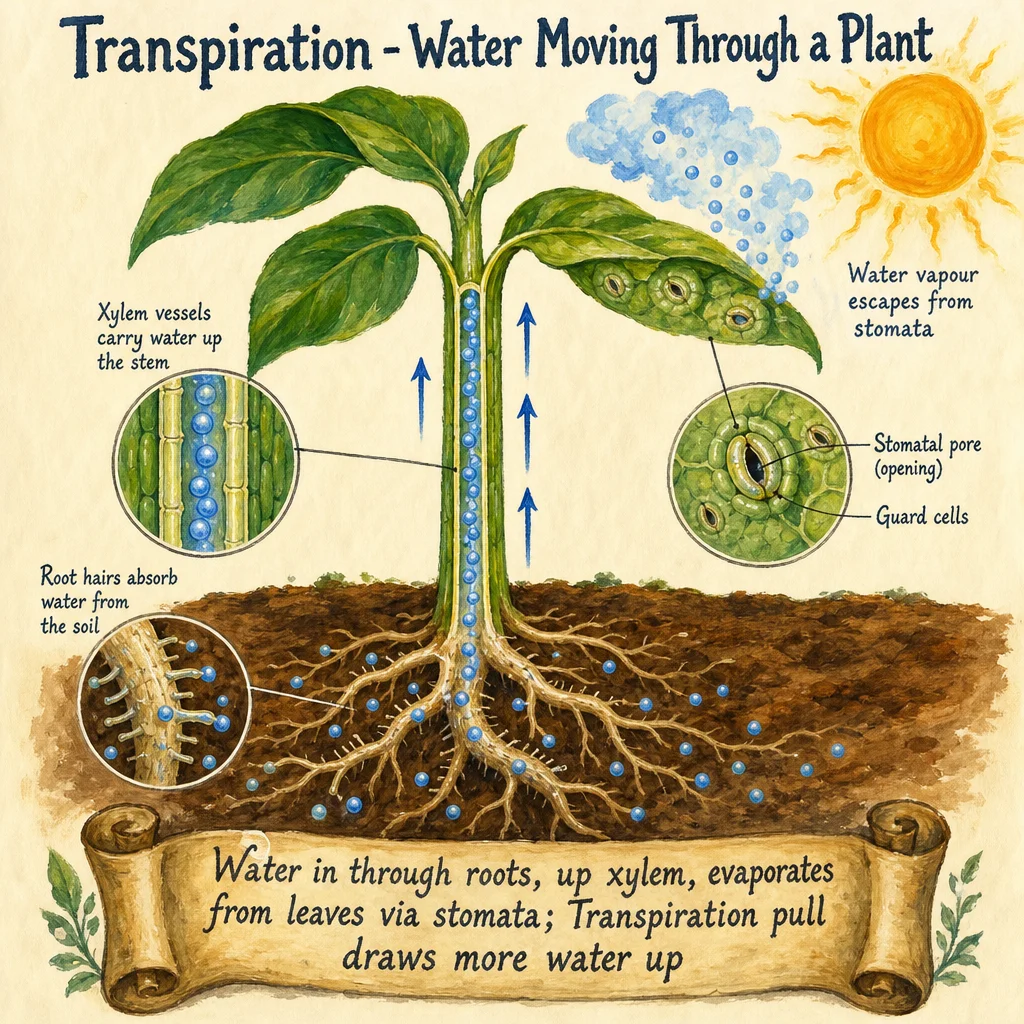
Transpiration is the evaporation of water from plant leaves through stomata. This process is both inevitable (a consequence of gas exchange) and essential (driving water and mineral transport).
The process occurs in three stages:
- Evaporation: Water evaporates from mesophyll cell surfaces into air spaces
- Diffusion: Water vapor diffuses through air spaces to stomata
- Loss: Water vapor exits through open stomata to atmosphere
The Transpiration Stream
The transpiration stream is the continuous movement of water through a plant:
- Root hair cells absorb water by osmosis
- Water moves across root cortex to xylem
- Transpiration creates negative pressure (tension) in xylem
- Water pulled up xylem vessels by cohesion-tension
- Water moves from xylem to mesophyll cells
- Water evaporates from cell surfaces and exits via stomata
This deep dive covers The Transpiration Process within Transpiration for GCSE Biology. Transpiration process, stomatal control, factors affecting rate, plant adaptations, measuring transpiration, and practical investigations It is section 4 of 21 in this topic. Use this deep dive to connect the idea to the wider topic before moving on to questions and flashcards.
Practice questions for Transpiration
What is transpiration?
Describe the three stages of transpiration in a leaf.
Quick recall flashcards
What is a xerophyte?
A plant adapted to survive in dry/arid conditions with limited water availability (e.g., cacti, marram grass).
What is a potometer?
An apparatus that measures the rate of water uptake by a plant shoot. Used to estimate transpiration rate (though actually measures uptake, not loss).