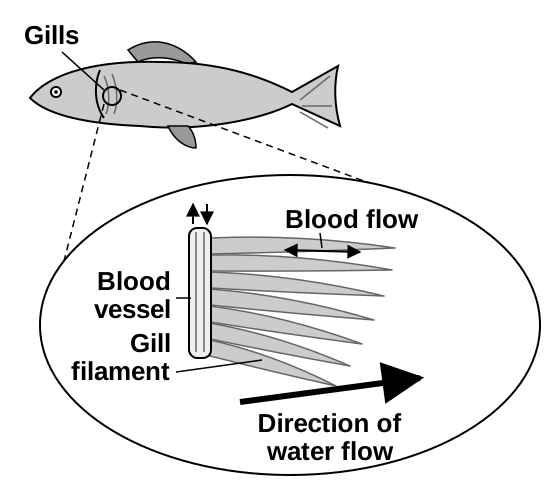
This question is about gas exchange in fish. Figure 8 shows a fish with one enlarged part of a gill. Some fish spend time resting on the sea floor.
State what is meant by diffusion.
Our own questions on this topic, marked straight away, so you see what to revise. Free now.
Show model answer for 06.1Hide model answer for 06.1
Diffusion is the spreading out of particles from a region of higher concentration to a region of lower concentration, down a concentration gradient.
How the marks are earned
- Particles spread out, moving down a concentration gradient from where there are more of them to where there are fewer. Substances, chemicals, gases or liquids are accepted in place of particles. Mentioning a membrane is ignored. Movement against the concentration gradient is not accepted.
Explain how the gill in Figure 8 is built to move as much oxygen as possible from water into blood.
See how you would score on Gas Exchange in HumansShow model answer for 06.2Hide model answer for 06.2
The gill has many thin filaments, which give a large surface area for oxygen to diffuse into the blood.
Each filament has a network of capillaries, a good blood supply. The blood carries the oxygen away, which keeps a steep concentration gradient.
The walls of the filaments and capillaries are very thin, only one cell thick, so the diffusion distance is short.
The blood supply is right next to the water at the gill surface, so oxygen has only a short way to diffuse.
How the marks are earned
- One mark: the gills, or the gill filaments, give a large surface area for diffusion (or absorption).
- One mark: a good blood supply, or a network of capillaries, keeps up the concentration gradient, for example by carrying oxygen away. Blood vessels are accepted for capillaries, but arteries or veins are not.
- One mark: the walls of the filaments or capillaries are thin, or one cell thick, giving a short diffusion distance or time. Blood vessels are accepted for capillaries, but arteries or veins are not. Saying that membranes, filaments or capillaries themselves (not their walls) are one cell thick is ignored. Cell walls are not accepted.
- One mark: the water passes close to the blood supply, giving a short diffusion distance or time. Blood supply close to the gill surface is also accepted. Blood flowing the opposite way to the water, which keeps the concentration gradient up, is also accepted for this mark.
Why it scores
A larger surface area lets more oxygen cross at once.
Keeping the oxygen concentration low in the blood means diffusion carries on.
A short distance means faster diffusion.
Closeness of blood and water is a separate mark from thin walls.
Revise Gas Exchange in HumansExplain why metabolic rate rises when a fish swims instead of resting.
See how you would score on RespirationShow model answer for 06.3Hide model answer for 06.3
A swimming fish moves its body much more than a resting fish.
Its muscles contract more, and contracting muscles need more energy.
That energy is released by respiration, so more respiration takes place in the muscle cells.
Metabolic rate is the rate of all the chemical reactions in the body, including respiration, so it is higher when the fish swims.
How the marks are earned
- One mark: movement (more movement is fine). Swimming named on its own is ignored. For every mark in this part, the opposite argument is accepted if it is clearly about the resting fish.
- One mark: movement needs energy (saying more energy is fine), or energy is provided, for example by respiration. Not accepted: energy produced, made or created; energy for respiration.
- One mark: more respiration takes place (the word so is not needed).
- One mark: muscle contraction, with or without the word increased (muscles contracting is accepted). It does not have to be linked to the energy.
Why it scores
Increased movement is the first mark. Saying only that it is swimming earns nothing.
Muscle contraction and the need for more energy are two further marks.
Say energy is released by respiration, never made or created.
Ties the extra respiration back to the question about metabolic rate.
Revise Respiration