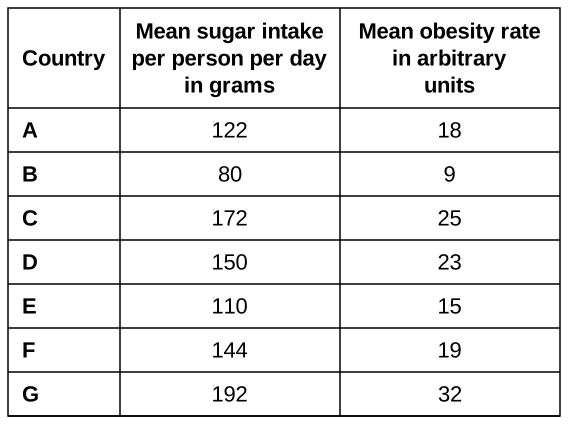
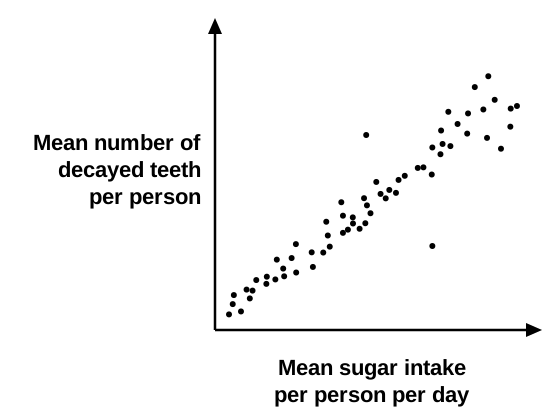
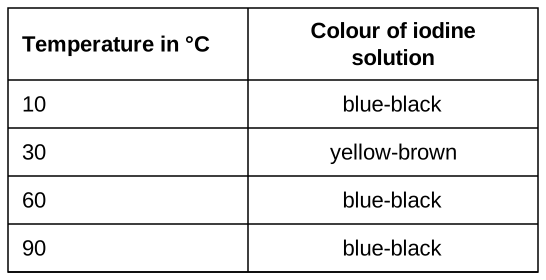
This question links diet, obesity and enzymes. Table 1 lists sugar intake and obesity rate in seven countries, and Figure 3 relates sugar intake to tooth decay. A student mixed starch with amylase at four temperatures. Five minutes later, iodine solution, yellow-brown to begin with, was added to each mixture.
Obesity raises the risk of certain diseases. Give one of them.
Our own questions on this topic, marked straight away, so you see what to revise. Free now.
Show model answer for 02.1Hide model answer for 02.1
Type 2 diabetes. Being obese raises the chance of it, and of heart disease and some cancers.
How the marks are earned
- Diabetes, specifically its type 2 form.
- Also credited: high blood pressure, heart disease or CHD (the word coronary is optional), cardiovascular disease (CVD), stroke, heart attack, arthritis (including osteoarthritis), cancer, sleep apnoea, liver disease, or any other disease that obesity is truly linked to.
- Diabetes with no type named earns nothing, and type 1 diabetes is not accepted.
- High cholesterol and heart failure earn nothing.
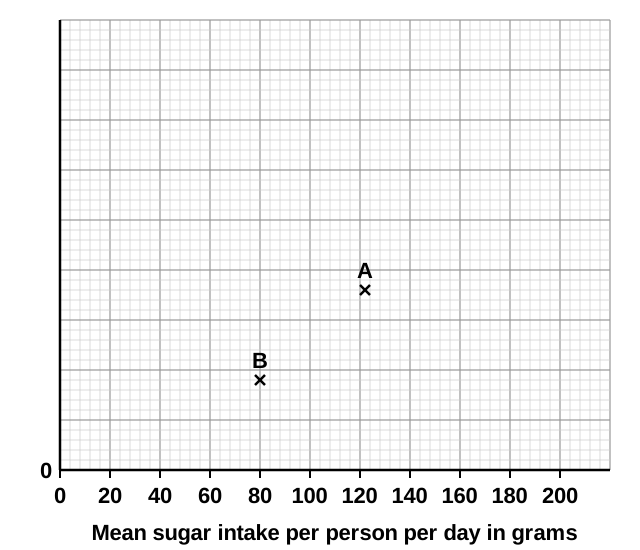
Finish Figure 2 from Table 1: title and number the vertical axis, plot countries C to G, add a best-fit line.
See how you would score on Cell Biology Practical InvestigationsShow model answer for 02.2Hide model answer for 02.2
Mean obesity rate, arbitrary units
scale 0, 5, 10, 15, 20, 25, 30, 35: one large square for 5, one small square for 1
Plot a cross at each of (172, 25), (150, 23), (110, 15), (144, 19) and (192, 32).
Line of best fit: one ruled straight line through the middle of all seven crosses, about 9 at 80 g and about 30 at 192 g
How the marks are earned
- One mark: the vertical axis labelled mean obesity rate and the unit, arbitrary units, together with a correct even scale that suits the data. The crosses already drawn for A and B must sit at their Table 1 values.
- Two marks for placing the five new crosses (C to G) accurately, each within half a small square of its true spot. Three or four placed correctly earn one mark.
- Letters beside the points are ignored.
- One mark: a line of best fit. A line carried on past the first and last point is ignored.
- A line joining the points one to the next with straight sections earns nothing.
Why it scores
The label for the vertical axis names the measure and its unit. With a sensible even scale, it earns the first mark.
The scale has to match crosses A and B, which are already drawn, and has to reach the highest value.
In each pair the first number is sugar intake across and the second is obesity rate up. Correct plotting of all five new points earns two marks. Each cross must be within half a small square, and three or four right points earn one mark.
The line of best fit earns the last mark. It is a single straight line through the trend, not a line joined from point to point.
Revise Cell Biology Practical InvestigationsWhat kind of graph is Figure 3?
See how you would score on Cell Biology Practical InvestigationsShow model answer for 02.3Hide model answer for 02.3
A scatter graph. Each dot is one measurement of the two variables, and the dots are not joined.
How the marks are earned
- The word scatter is the essential part. Graph or diagram after it is optional, and scattergram is accepted.
From Figure 3, say how the amount of sugar eaten is related to the number of decayed teeth. Tick one box.
See how you would score on Cell Biology Practical InvestigationsShow model answer for 02.4Hide model answer for 02.4
Positive correlation. As the mean sugar intake rises, the mean number of decayed teeth rises too.
How the marks are earned
- Tick positive correlation: both variables rise together.
Table 2 gives the iodine colour for each temperature. Give the reason for the colour seen with the 30 °C and 90 °C mixtures.
See how you would score on Enzymes in DigestionShow model answer for 02.5Hide model answer for 02.5
30 °C: the iodine stayed yellow-brown, so no starch was left. The amylase was working well at this temperature and broke all the starch down.
90 °C: the iodine turned blue-black, so starch was still there. The high temperature denatured the amylase, because its active site changed shape, so it could not break the starch down.
How the marks are earned
- 30 °C, first mark: no starch remained, so the iodine stayed yellow-brown. Also credited: starch was broken down, with or without the word all.
- 30 °C, second mark: because amylase or the enzyme broke the starch down. Also credited: the amylase or enzyme was active or working, or this was the optimum or best temperature, or close to it, for the enzyme.
- 90 °C, third mark: blue-black iodine, because starch was still present. Also credited: the starch was not broken down, or the amylase or enzyme had no effect on the starch.
- 90 °C, fourth mark: because the amylase or enzyme had denatured. A description of denaturing is credited, and so is saying it was destroyed or damaged.
- Saying the enzyme was killed is not accepted.
Why it scores
Two marks: the colour shows the starch was gone, and the cause is the enzyme breaking it down near its best temperature.
Two marks: the colour shows the starch was not broken down, and the cause is a denatured enzyme. Blue-black means starch is present.
Revise Enzymes in DigestionWhich change to the investigation would find a more precise best temperature for amylase? Tick one box.
See how you would score on Enzymes in DigestionShow model answer for 02.6Hide model answer for 02.6
Add readings across the range from 10 °C up to 60 °C. Only the 30 °C mixture kept the iodine yellow-brown, so the best temperature lies in the gap around it, and closer readings there narrow it down.
How the marks are earned
- Tick the option whose extra readings span 10 °C up to 60 °C.
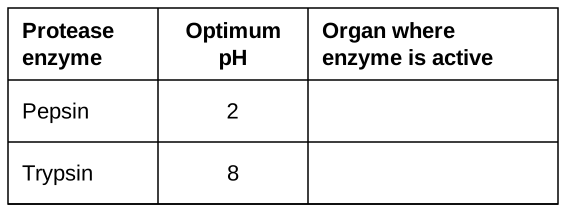
Fill in Table 3: name the part of the digestive system in which pepsin works and the part in which trypsin works.
See how you would score on The Human Digestive SystemShow model answer for 02.7Hide model answer for 02.7
Pepsin: the stomach, where the pH is about 2.
Trypsin: the small intestine, where the pH is about 8.
How the marks are earned
- One mark: pepsin works in the stomach.
- One mark: trypsin works in the small intestine. The ileum or the duodenum is also accepted.
Why it scores
Pepsin has an acid optimum, which matches the acid conditions in the stomach.
Trypsin has an alkaline optimum, which matches the small intestine, where the conditions are alkaline.
Revise The Human Digestive System