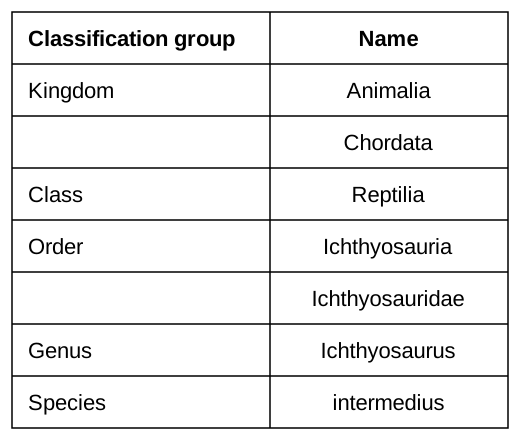
Ichthyosaurs, now extinct, were reptiles of the ancient seas. Figure 1 is the fossil of one individual, and Table 1 sets out how it is classified, with two groups left blank.
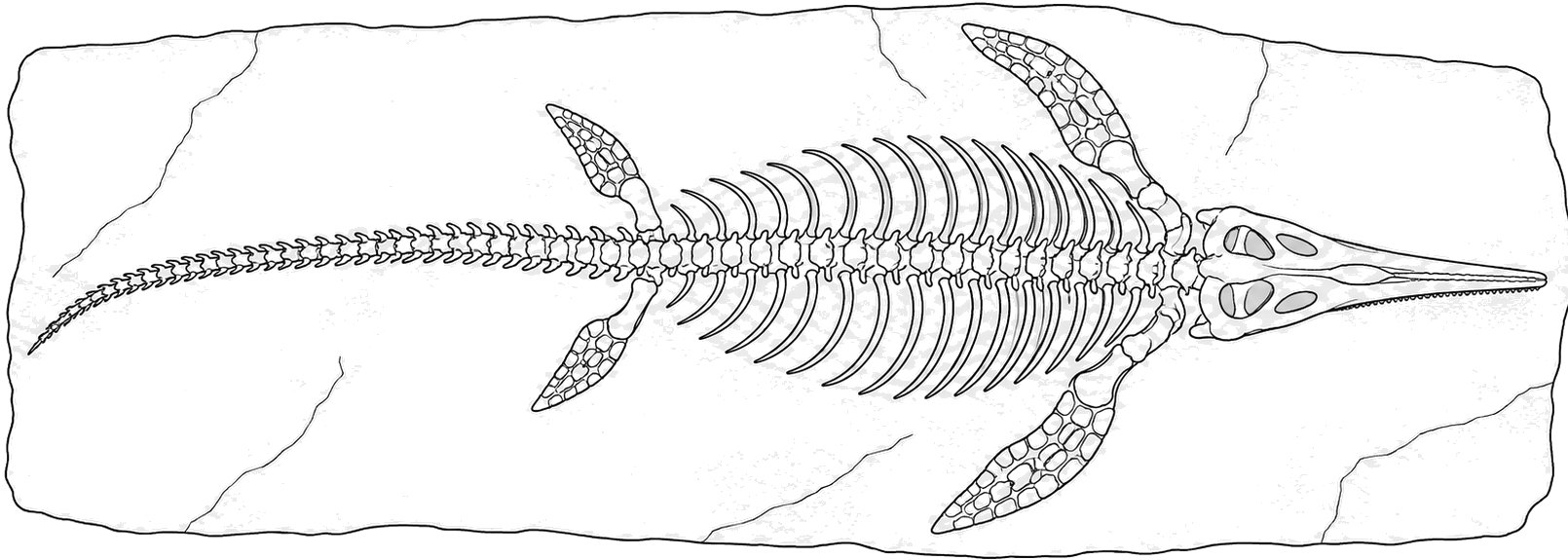
Suggest how the ichthyosaur remains in Figure 1 became a fossil after the animal died.
See how you would score on EvolutionShow model answer for 01.1Hide model answer for 01.1
When it died, the ichthyosaur sank to the sea floor and was soon buried under layers of mud and sand.
The soft parts rotted away or were eaten, but the hard skeleton was left behind.
Over millions of years minerals slowly replaced the bone, so the skeleton was preserved as a fossil.
How the marks are earned
- Any two ideas, one mark each: the dead animal was buried in sediment such as sand, mud or silt; the soft parts decayed or were eaten (the word only is not needed), or the bones were not decayed or eaten (either form earns the mark); the bones or remains were replaced by minerals.
- Skeleton or hard parts is accepted in place of bones throughout. Also credited, for the minerals mark only (not as a separate mark): mineralisation of the bones, or the bones leaving an imprint in mud, sand or sediment (that this later hardened into rock is not needed). Saying the bones turned to stone or rock is ignored.
- Saying the animal was buried in rock is not accepted, and under the board's general rule for not-accepted answers it stays wrong even when sediment is named as well. Saying the sediment later hardened into rock is fine.
- Compression and any mention of oxygen are ignored.
Why it scores
This is the burial mark. Say sediment, mud, sand or silt. Do not write that it was buried in rock. Writing that the sediment later hardened into rock is fine.
Only the soft tissue decays quickly, so the bones are left to be preserved. This is a second mark.
Replacement of bone by minerals is the third idea. Any two of the three give full marks, so three correct ideas is a safe answer.
Revise EvolutionIn Figure 1 the image is 120 mm long. The real ichthyosaur was 17 times longer. Find its real length in metres.
See how you would score on EvolutionShow model answer for 01.2Hide model answer for 01.2
real length = 120 × 17 = 2040 mm
2040 ÷ 1000 = 2.04 m
How the marks are earned
- One mark: multiply the length of the image by 17, set out as 120 × 17, or as 0.12 × 17 if the length is converted to metres first. Converting to metres at any stage of the working is accepted.
- One mark: 2040. The unit mm is not needed.
- One mark: 2.04. The word metres is not needed. A correct conversion to metres of a wrongly worked length also earns this mark.
- The board's general rule for calculations applies: a correct numerical answer, 2.04, with no working shown earns all 3 marks.
Why it scores
The first two marks: multiply the image length by 17 to get the real length in millimetres.
The third mark is the change to metres. There are 1000 mm in 1 m, so divide the millimetres by 1000.
Revise EvolutionFill in the two missing classification groups in Table 1, choosing from the word box.
See how you would score on ClassificationShow model answer for 01.3Hide model answer for 01.3
Phylum
Family
How the marks are earned
- One mark: phylum, for the blank row between kingdom and class, which holds Chordata.
- One mark: family, for the blank row between order and genus, which holds Ichthyosauridae.
- The words must be in this order only: phylum first and family second.
Why it scores
The groups run kingdom, phylum, class, order, family, genus, species, so the first blank, after kingdom, is phylum.
The second blank sits between order and genus, which is family. Community and population are ecology words. Mammal is a class, and the class row is already given as Reptilia.
Revise ClassificationSuggest two further causes of ichthyosaur extinction, apart from rivals taking their prey.
See how you would score on EvolutionShow model answer for 01.4Hide model answer for 01.4
1. An ice age, which made the sea too cold for the ichthyosaurs to survive.
2. A new disease that spread through the whole population.
How the marks are earned
- Any two causes, one mark each: an ice age or global warming; volcanic activity or an asteroid collision, where a named example is accepted; new predators, where hunters are accepted; a disease or pathogen, where the word new is not needed and a named disease is accepted; competition for mates, where a lack of mates is accepted; lack of habitat, or a change in habitat.
- If neither an ice age nor global warming is given, climate change earns one mark. Weather is ignored.
- If neither volcanic activity nor an asteroid collision is given, a catastrophic event or a natural disaster earns one mark. A named example is accepted.
- Competition unqualified is ignored, but competition between ichthyosaurs for food is accepted.
- Environment change, isolation, pollution and lack of food are ignored.
Why it scores
A named change of climate earns one mark. Climate change alone would also be accepted only when neither an ice age nor global warming is named.
A disease or pathogen is a second, separate cause, so it earns the second mark.
Revise Evolution