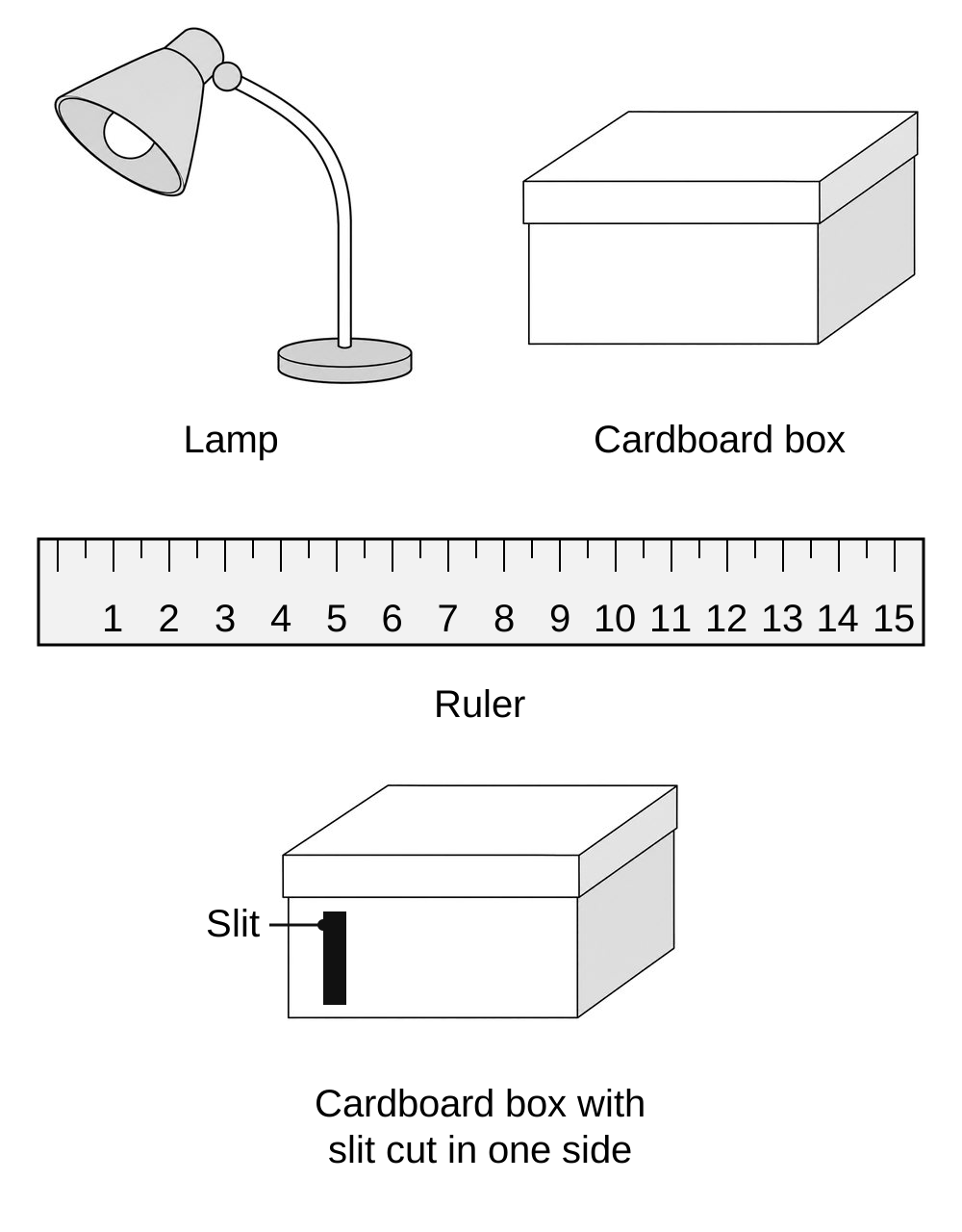
Tropisms help plants survive, and plant hormones control plant responses. Figure 3 shows equipment you may use to plan an investigation.
Define geotropism.
Our own questions on this topic, marked straight away, so you see what to revise. Free now.
Show model answer for 03.1Hide model answer for 03.1
Geotropism is the way a plant grows in response to gravity. Roots grow downwards, with gravity, and shoots grow upwards, against it.
How the marks are earned
- One mark: growth (the word response is not needed).
- One mark: the growth is due to gravity.
- Direction of growth is ignored.
Why it scores
One mark is for growth and one is for gravity as the stimulus. The roots and shoots are only an example.
Revise Plant HormonesPlan an investigation into how the direction of light changes seedling growth, using the Figure 3 equipment and anything else you need.
See how you would score on Plant HormonesShow model answer for 03.2Hide model answer for 03.2
Use two groups of seedlings of the same species and the same age, with the same number of seedlings in each pot, planted in the same type and volume of soil.
Measure the height of every shoot with a ruler before starting. Put one pot in a cardboard box with a slit cut in one side and shine the lamp through the slit, so light comes from one direction only. Put the other pot in a plain closed cardboard box, so it is in darkness.
Keep both pots at the same temperature, give them the same volume of water each day and leave them for the same time, for example one week.
Then measure the height of each shoot again. Lay a thread along any bent shoot and straighten it against the ruler. Note which way the shoots have grown.
Work out the mean increase in height for each condition from the several seedlings, and compare the two means.
How the marks are earned
- This is level marked. For 5 to 6 marks, the method would give a valid result, with the key steps present and in a sensible order. A level 3 plan compares seedlings given light from one side with seedlings in all-round light or in darkness, and also keeps the other variables the same.
- For 3 to 4 marks, most steps are present but the order is not fully logical, so the result would not necessarily be valid. For 1 to 2 marks, some relevant steps are given but the links between them are not made clear, and the method would not give a valid result. An answer with nothing relevant earns no marks.
- Setting up: put seedlings in a cardboard box with a slit so that light enters from one side; put other seedlings in darkness or in light from all around.
- Measuring: note each shoot's height at the start; note its height at the end, or find the growth, for instance with a ruler; or note a named feature of the seedlings' appearance; give detail of how a bent shoot is measured, such as laying thread along it or straightening it.
- Analysing: repeat with several seedlings; work out the mean increase in height for each condition; compare the results for each condition.
- Variables kept the same: the number of seedlings per pot or condition, the temperature, the volume of water, the type and volume of soil, the age of the seedlings, the species of plant, and the length of time they are left.
Why it scores
These are control variables from the indicative content: number of seedlings, species, age and soil. Level 3 needs the other variables kept the same.
This gives the starting heights and the comparison level 3 requires: light from one direction against darkness.
More control variables: temperature, water and time. Controlling them makes the outcome valid.
Final heights, a clear method for measuring bent shoots, and a named feature of appearance, the direction of growth. All three are in the indicative content.
Repeats, a mean and a comparison finish the plan. With the comparison and the controls, this answer reaches level 3, which is 5 to 6 marks.
Revise Plant HormonesName the plant hormone that makes shoots respond to where light comes from.
See how you would score on Plant HormonesShow model answer for 03.3Hide model answer for 03.3
Auxin. It is made in the tip of the shoot and spreads down it.
How the marks are earned
- Auxin.
Why it scores
Auxin is the plant hormone that controls growth in response to light and gravity.
Revise Plant HormonesSay how the hormone named in 03.3 controls the response to light direction. Tick one box.
See how you would score on Plant HormonesShow model answer for 03.4Hide model answer for 03.4
The hormone is spread unevenly. In a shoot, auxin collects on the shaded side and makes those cells grow longer, so the shoot bends towards the light.
How the marks are earned
- Tick the option saying the hormone is spread unevenly through the plant.
Why it scores
Unequal amounts on the two sides give unequal growth, and that bends the shoot. Equal amounts everywhere would give straight growth.
Revise Plant HormonesExplain how a plant responding to light improves its chance of survival.
See how you would score on Plant HormonesShow model answer for 03.5Hide model answer for 03.5
Shoots grow towards the light, so the leaves receive more light.
With more light, the plant can carry out more photosynthesis.
So it makes more glucose, which it uses for respiration and for growth.
How the marks are earned
- One mark: the plant, or its leaves, receives or absorbs more light.
- One mark: so more photosynthesis takes place.
- One mark: so more glucose is produced. Also accepted: more starch, carbohydrate or sugar; more organic material, named or not; or another named organic substance.
- If no other mark is earned, one mark is given for any two of these three points even when more is not mentioned.
Why it scores
The first mark is for more light reaching the leaves.
The second mark links the extra light to more photosynthesis.
The third mark is for the extra glucose. Starch, sugar or another organic substance also earns it.
Revise Plant Hormones