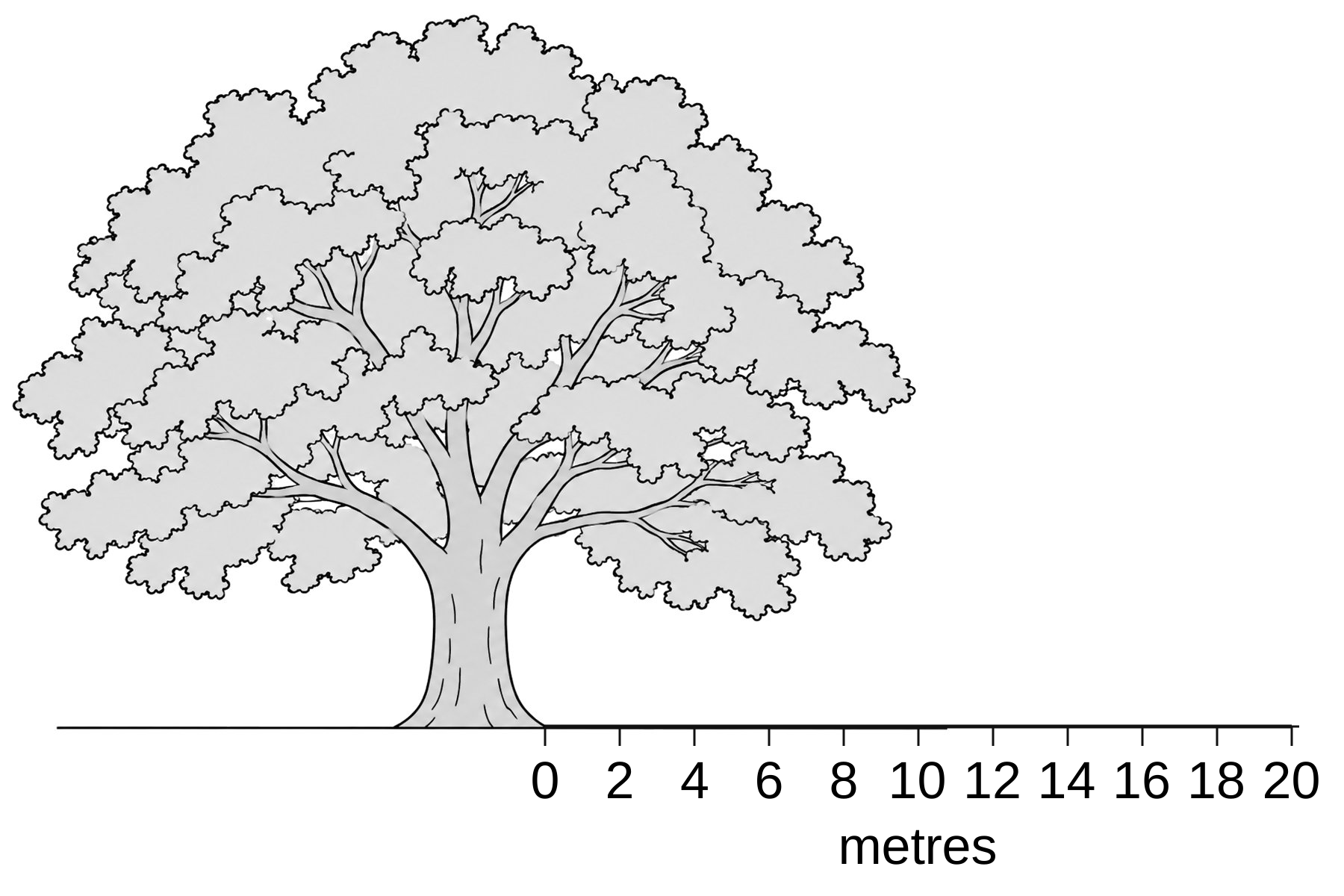
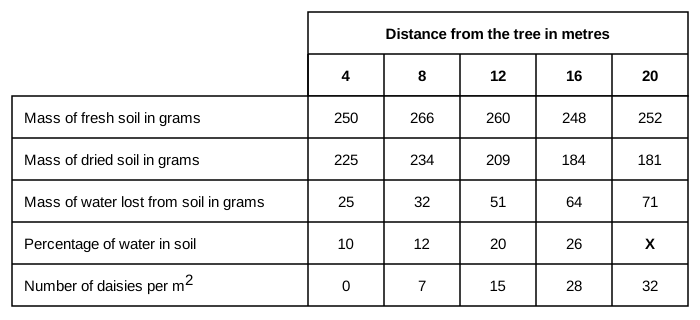
Students counted daisies in a field at increasing distances from a tree. Quadrats of 1 m2 were laid every 4 m along a 20 m tape that began at the tree (Figure 2), and a soil sample was taken at each quadrat. To find the soil water, each sample was weighed, dried in a 100 °C oven for several hours, cooled and weighed again, and the drying was repeated until the mass stopped changing. Table 2 gives the results.
Suggest why the drying and weighing were repeated until the soil mass stopped changing.
Our own questions on this topic, marked straight away, so you see what to revise. Free now.
Show model answer for 02.1Hide model answer for 02.1
Each time the soil is heated, cooled and weighed, its mass falls if water remains. Once the mass stops changing, all the water has been driven off and the soil is completely dry.
How the marks are earned
- Any one idea, one mark: to remove all the water (the water is also credited); so that no water is left; so that the soil is (completely) dry.
- Saying only to remove water, unqualified, is ignored.
Why it scores
The mark is for making sure no water is left. Saying only that water is removed is ignored, because the point is that none remains.
Revise Ecosystems CommunitiesWork out percentage X in Table 2, the water in the 20 m soil, to the nearest whole number.
See how you would score on Ecosystems CommunitiesShow model answer for 02.2Hide model answer for 02.2
percentage of water = 71 ÷ 252 × 100
percentage = 28.17...
percentage = 28 % (nearest whole number)
How the marks are earned
- One mark: the water lost at 20 m as a share of the fresh soil mass, set out as 71 ÷ 252 × 100.
- One mark: the unrounded value, 28.1 or any longer form such as 28.1746.
- One mark: 28 (%), rounded to a whole number. Also credited: a wrongly worked percentage from the 20 m masses, rounded correctly to a whole number.
- A correct 28 on its own earns all 3 marks with no working shown.
Why it scores
First mark. 71 g is the water lost and 252 g is the fresh soil, both from the 20 m column. The water lost is shared out over the starting mass, then scaled to 100.
Second mark, for the unrounded value from the calculator.
Third mark, for rounding to a whole number. The digit after the decimal point is 1, so round down.
Revise Ecosystems CommunitiesUse Table 2 to describe how distance from the tree affects soil water between 4 m and 16 m.
See how you would score on Ecosystems CommunitiesShow model answer for 02.3Hide model answer for 02.3
The further from the tree, the wetter the soil. Its water percentage rises from 10% at 4 m to 26% at 16 m.
How the marks are earned
- Between 4 m and 16 m, the further from the tree, the higher the water percentage in the soil.
- Saying there is a positive correlation, or that when one rises the other rises, or that when one falls the other falls, is also accepted.
- Saying directly proportional is ignored.
Why it scores
Table 2 shows the water percentage going up at every step, 10, 12, 20 and 26. One mark is for the direction of the pattern, and quoting values supports it.
Revise Ecosystems CommunitiesDescribe two changes that would make the conclusion that more soil water means more daisies more valid.
See how you would score on Ecosystems CommunitiesShow model answer for 02.4Hide model answer for 02.4
At each distance, repeat the daisy count and the soil test, then work out a mean. This shows up any anomalies.
Take readings around several different trees, not just one.
How the marks are earned
- Any two changes, one mark each: repeat and work out a mean (at each distance is not needed), where spotting or removing anomalies is accepted in place of the mean; test at intermediate or further distances; test around more or different trees; sample at different angles around the tree (saying the same tree is not needed).
- Testing more areas is also accepted.
Why it scores
Repeating at each distance and finding a mean is the first change. It makes the pattern more likely to be real, so the conclusion is more valid.
A second, different change. The pattern might only belong to one tree, so more trees test whether the conclusion holds in general.
Revise Ecosystems CommunitiesSoil water is one abiotic factor. Suggest three others, not water, that could explain more daisies far from the tree.
See how you would score on Ecosystems CommunitiesShow model answer for 02.5Hide model answer for 02.5
1. Light intensity, because the tree casts shade near its trunk.
2. Temperature.
3. Mineral ions in the soil, which tree roots take up.
How the marks are earned
- Any three factors, one mark each: light (the word intensity is not needed); temperature; the type of soil; pH, where of the soil is not needed and acidity or alkalinity of the soil is accepted; minerals or ions (in the soil is not needed), where salts, a named ion such as nitrate, or fertiliser is accepted; wind (intensity or direction is not needed); oxygen in the soil.
- If neither light nor temperature is given, shade earns one mark. Sun is ignored.
- Nitrogen or nutrients, the availability of space, and carbon dioxide are ignored.
Why it scores
Light is an abiotic factor, and a tree makes the ground under it darker. This is one mark.
A second abiotic factor, which can differ between shaded and open ground. This is one mark.
A third factor that is not water, so it earns the third mark.
Revise Ecosystems Communities