Paper 1 Higher

PrepWiseGuide to a real paper

Edexcel GCSE Biology

Paper 1 Higher

June 2025
100 marks · 1 hour 45 minutes · 10 questions

A real paper, in its real order. Each description and answer is ours, so you can see how each mark is earned. Not made or approved by Edexcel.

PrepWise guide: Edexcel GCSE Biology Paper 1 HigherQuestion 1

Figure 1 is a growth chart, a set of percentile curves for the height of boys through childhood. The later parts ask about testing for fat, digesting it and measuring the energy in food.
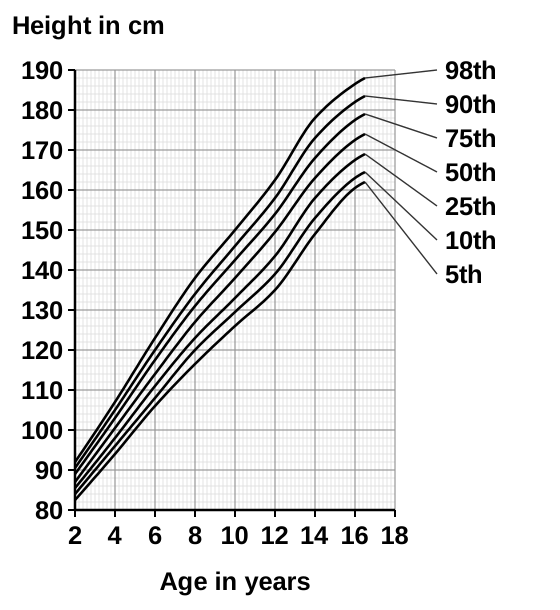
Figure 1
Squared-grid chart of height in centimetres against age in years, with seven smooth curves, each labelled with a percentile at its right-hand end.
01.1[1 mark]

Read Figure 1: how tall is a boy of eight who sits on the 10th percentile curve? Tick one box.

See how you would score on Cell Biology Practical Investigations
118 cm
120 cm
128 cm
130 cm
Show model answer for 01.1Hide model answer for 01.1

120 cm. Follow the 10th percentile curve to age 8 and read across to the height axis.

1 mark

How the marks are earned

  1. Tick 120 cm, the height where the 10th percentile curve meets age 8.
Revise Cell Biology Practical Investigations
01.2[2 marks]

A boy was 94 cm at age 4 and 106 cm at age 6. What does Figure 1 show about his growth?

See how you would score on Cell Biology Practical Investigations
Show model answer for 01.2Hide model answer for 01.2

His growth is normal and healthy for a boy on his percentile.

His height sits on the 5th percentile curve at age 4 and still on that curve at age 6, so he has not moved up or down.

2 marks

How the marks are earned

  1. One mark: his growth is as expected. Healthy growth is credited too.
  2. One mark: the reason, that he stays on one percentile curve, the 5th, from age 4 to age 6. Quoting the 5th percentile at 6, or just the same percentile, is enough.
  3. Both marks need one linked idea: growth as expected, because he keeps to the same percentile.

Why it scores

The first mark is for the conclusion about his growth.

The second mark is for the evidence from Figure 1, tied to the conclusion.

Revise Cell Biology Practical Investigations
01.3[2 marks]

How could you show that a food sample holds fat? Describe a test.

See how you would score on The Human Digestive System
Show model answer for 01.3Hide model answer for 01.3

Shake a little of the food with ethanol, then pour the liquid into water.

If the water turns white and cloudy, an emulsion has formed, so the food holds fat.

2 marks

How the marks are earned

  1. Route one: mix the food with ethanol and water (1 mark); a milky white emulsion forms (1 mark). A cloudy result is credited, and so is calling it the emulsion test.
  2. Route two, as an alternative: press the food on to paper (1 mark); a grease spot is left (1 mark).
  3. Either route earns both marks by itself.

Why it scores

Using ethanol and then water earns the first mark. Fat dissolves in ethanol but not in water.

The observed result earns the second mark. It must say what is seen.

Revise The Human Digestive System
01.4[1 mark]

Digesting fat releases which product? Tick one box.

See how you would score on Enzymes in Digestion
Amino acids
Fatty acids
Glucose
Starch
Show model answer for 01.4Hide model answer for 01.4

Fatty acids. Fats are digested into fatty acids and glycerol. Amino acids come from proteins, and glucose comes from starch.

1 mark

How the marks are earned

  1. Tick fatty acids. Lipase digests fats into fatty acids and glycerol.
Revise Enzymes in Digestion
01.5[1 mark]

What quantity does a calorimeter determine?

See how you would score on The Human Digestive System
Show model answer for 01.5Hide model answer for 01.5

The energy stored in a food. The food is burned and the energy released is measured in joules.

1 mark

How the marks are earned

  1. The energy a food contains. Calories or joules both count.
  2. A temperature or a temperature change on its own earns nothing.
Revise The Human Digestive System
Edexcel owns the copyright in its exam questions, so we cannot copy their wording. These descriptions and answers are ours. Not made or approved by Edexcel.[7 marks]
PrepWise guide: Edexcel GCSE Biology Paper 1 HigherQuestion 2

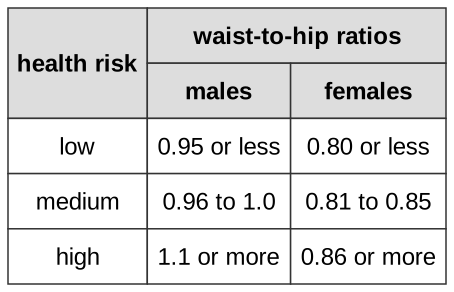
Obesity raises the chance of some non-communicable diseases. Tuberculosis, by contrast, passes between people in droplets in the air. Figure 2 sorts waist-to-hip ratios into bands of health risk.

Figure 2
Drawn table with a heading row and three body rows, one each for low, medium and high risk, and one column for males and one for females holding ratio bands.
02.1[2 marks]

Tuberculosis passes between people in droplets in the air. Name two actions that would limit its spread.

See how you would score on Pathogens and Disease Transmission
Show model answer for 02.1Hide model answer for 02.1

1. Cover the mouth when coughing or sneezing. 2. Keep infected people apart from others.

2 marks

How the marks are earned

  1. Any two of: antibiotics; vaccination or immunisation; covering the mouth when coughing or sneezing, or wearing a face mask; keeping infected people apart, or avoiding them; washing hands or disinfecting surfaces.
  2. Also credited: avoiding mixing in groups, better ventilation, air filters.
  3. Vague answers such as take medicine or take drugs earn nothing, and so does PPE.

Why it scores

Each action earns one mark. Both stop droplets carrying the bacteria from reaching other people.

Revise Pathogens and Disease Transmission
02.2[1 mark]

Why is liver disease classed as non-communicable?

See how you would score on Pathogens and Disease Transmission
Show model answer for 02.2Hide model answer for 02.2

No pathogen causes it, so nobody can catch it from another person.

1 mark

How the marks are earned

  1. It cannot be passed between people, or no pathogen causes it.
  2. A link to drinking alcohol is also credited.
  3. The words cannot spread, with nothing more, earn nothing.
Revise Pathogens and Disease Transmission
02.3[2 marks]

Waist 80 cm, hips 90 cm. Find the ratio of waist to hips, giving two decimal places.

See how you would score on Cell Biology Practical Investigations
Show model answer for 02.3Hide model answer for 02.3

ratio of waist to hip: 80 ÷ 90 = 0.8888

rounded value: 0.89

2 marks

How the marks are earned

  1. One mark: divide waist by hip, 80 ÷ 90 = 0.8888.
  2. One mark: the final value, 0.89.
  3. A correct 0.89 earns both marks even when no working is given.
  4. One mark only for 1.13, which is hip divided by waist, or for a rounding of 0.90, 0.9, 0.8 or 0.88.

Why it scores

Dividing the waist by the hip earns the first mark.

Giving two decimal places earns the final mark. A correct 0.89 with no working still earns both.

Revise Cell Biology Practical Investigations
02.4[2 marks]

A female has a ratio of 0.75. Use Figure 2 to explain what this means for her health risk.

See how you would score on Cell Biology Practical Investigations
Show model answer for 02.4Hide model answer for 02.4

Her risk is low.

0.75 falls under the 0.80 limit for women, so excess fat is not stored round her waist or vital organs.

2 marks

How the marks are earned

  1. One mark: her risk is low. Saying there is no risk earns nothing.
  2. One mark: the extra weight is not round the waist, or not round the vital organs (either earns it; saying it is extra mass is not needed), or 0.75 is below 0.80.

Why it scores

The first mark is for naming the risk band, read from Figure 2.

The second mark is for the reason. Either the comparison with 0.80 or the idea about the waist and organs earns it.

Revise Cell Biology Practical Investigations
02.5[2 marks]

Mitosis goes wrong in cancer. What are the features of the cells that mitosis makes?

See how you would score on Mitosis and the Cell Cycle
Show model answer for 02.5Hide model answer for 02.5

Each division gives two daughter cells. They are genetically identical body cells with two sets of chromosomes, so they are diploid.

2 marks

How the marks are earned

  1. Any two of: two (the word cells is not needed); diploid, or two sets of chromosomes; genetically identical; body cells.
  2. A full set of chromosomes is fine for diploid, and somatic cells for body cells. Haploid is rejected. Doubling or duplicating alone earns nothing.

Why it scores

Any two of the listed features earn the two marks. This answer covers all of them.

Revise Mitosis and the Cell Cycle
Edexcel owns the copyright in its exam questions, so we cannot copy their wording. These descriptions and answers are ours. Not made or approved by Edexcel.[9 marks]
PrepWise guide: Edexcel GCSE Biology Paper 1 HigherQuestion 3

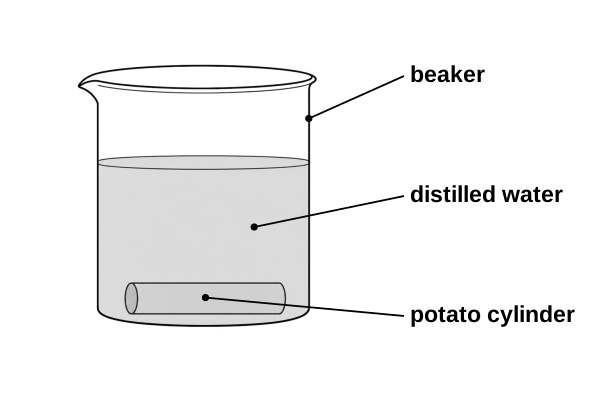
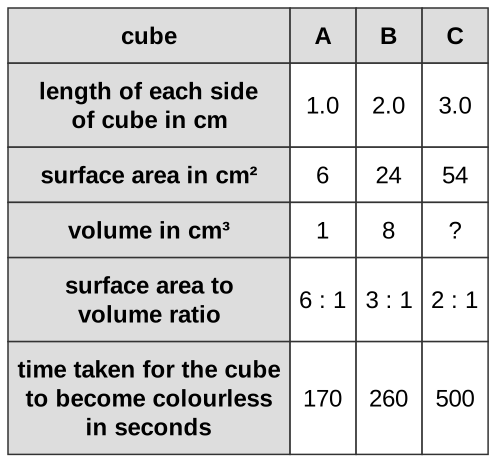
A potato cylinder lies in a beaker of distilled water (Figure 3). Three agar cubes of different size, each holding an indicator that goes from pink to colourless in acid, were put into acid (Figure 4).

Figure 3
Side view of a glass beaker filled about two thirds with water, with one potato cylinder lying flat on the bottom, fully under the water. Labels: beaker, distilled water and potato cylinder.
Figure 4
Table with a column for each of three cubes lettered A to C and a row for each measurement, the last row holding colour-change times. The volume cell for cube C holds a question mark.
03.1[3 marks]

Figure 3 shows a potato cylinder lying in distilled water. Give the reasons its mass will not stay constant.

See how you would score on Cell Transport
Show model answer for 03.1Hide model answer for 03.1

The potato gets heavier.

Osmosis carries water into the cells through their partially permeable membranes.

The water starts in the distilled water, where its concentration is higher, and moves to the cells, where it is lower.

3 marks

How the marks are earned

  1. Any three of: the mass rises; water enters the potato cells; it crosses a partially permeable (semi-permeable) membrane; this is osmosis; water travels from a high to a low water concentration.
  2. Credited: weight for mass; the potato takes in water; down a water concentration gradient; or moving from a low to a high solute concentration (a named solute is fine).
  3. Two marks at most if the stated change in mass, or the direction of water movement, is wrong.

Why it scores

The first mark is for the right direction of change. A loss of mass would cap the answer at two marks.

These are the second and third marks: the water enters the potato, and the process is osmosis across a partially permeable membrane.

This gives the direction of travel. It must run from high to low water concentration.

Revise Cell Transport
03.2[2 marks]

Cube C has sides of 3.0 cm (Figure 4). Work out its volume.

See how you would score on Cell Transport
Show model answer for 03.2Hide model answer for 03.2

volume = 3 × 3 × 3

volume = 27 cm3

2 marks

How the marks are earned

  1. One mark: 3 × 3 × 3, or 33.
  2. One mark: the result, 27 (cm3). Working with 54 ÷ 2 is also credited.
  3. A correct 27 on its own earns both marks.

Why it scores

Cubing the side length earns the first mark.

The value earns the second mark. A correct 27 with no working earns both marks.

Revise Cell Transport
03.3[2 marks]

Cubes A and B take different times to turn colourless. Account for the difference.

See how you would score on Cell Transport
Show model answer for 03.3Hide model answer for 03.3

Cube A reaches colourless sooner than cube B.

A is smaller, so its surface area to volume ratio is bigger and the acid has a shorter way to diffuse into its centre.

2 marks

How the marks are earned

  1. Any two linked ideas: A is quicker; A is smaller, or has less volume, or a larger surface area to volume ratio; A gives a shorter distance for diffusion.
  2. The argument reversed for B scores against any of the three. A has less surface area, on its own, earns nothing.

Why it scores

This states the difference. It scores once it is tied to a reason.

Any one reason (size, ratio or distance) linked to the quicker change earns the second mark.

Revise Cell Transport
Edexcel owns the copyright in its exam questions, so we cannot copy their wording. These descriptions and answers are ours. Not made or approved by Edexcel.[7 marks]
PrepWise guide: Edexcel GCSE Biology Paper 1 HigherQuestion 4

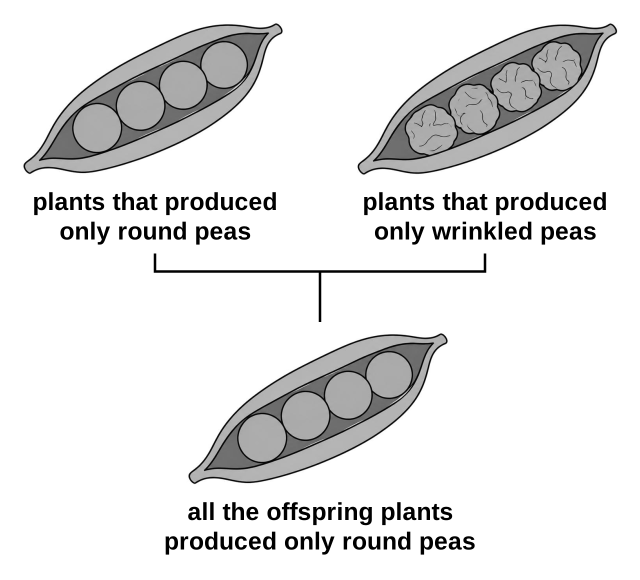
In the 1800s Mendel bred pea plants, and Figure 5 summarises one of his crosses for pea shape. Later, a scientist bred together two pea plants that each carried one round allele and one wrinkled allele.

Figure 5
Diagram of a cross. Top left, an open pod of smooth round peas, labelled as the plant that gave round peas every time. Top right, an open pod of wrinkled peas, labelled as the plant that gave wrinkled peas every time. Lines join the two parents and lead down to an open pod of smooth round peas, labelled as the offspring, all of which gave round peas.
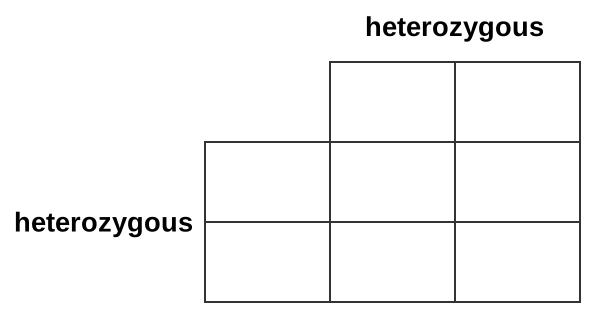
Punnett square
Empty two by two grid with the word heterozygous above the columns and down the left side, and an empty header box above each column and beside each row.
04.1[1 mark]

Today, what is the name for the units Mendel proposed? Tick one box.

See how you would score on DNA Genome
Chloroplasts
Enzymes
Genes
Mitochondria
Show model answer for 04.1Hide model answer for 04.1

Genes. A gene is a section of DNA that codes for a characteristic.

1 mark

How the marks are earned

  1. Tick genes.
Revise DNA Genome
04.2[1 mark]

From Figure 5, what can Mendel conclude about wrinkled peas?

See how you would score on Genetic Inheritance
Show model answer for 04.2Hide model answer for 04.2

Wrinkled is recessive: when the round characteristic is also present, the wrinkled one does not show.

1 mark

How the marks are earned

  1. Wrinkled is recessive. Not passed on is credited too.
Revise Genetic Inheritance
04.3[3 marks]

Cross two plants heterozygous for pea shape (R round, r wrinkled). Complete the Punnett square; state the percentage chance of wrinkled peas.

See how you would score on Genetic Inheritance
Show model answer for 04.3Hide model answer for 04.3

gametes from the first parent: R and r, across the top gametes from the second parent: R and r, down the side

row R: RR and Rr row r: Rr and rr

Only rr has wrinkled peas, 1 box out of 4 chance of wrinkled peas = 25%

3 marks

How the marks are earned

  1. One mark: each parent shown making R and r gametes along the edges of the square.
  2. One mark: the four offspring genotypes RR, Rr, Rr and rr.
  3. One mark: a 25% chance of wrinkled peas.
  4. rR is credited for Rr, and other letters are credited.
  5. Error carried forward from wrong parent genotypes, and from a wrong Punnett square.
  6. Table filled in: columns R and r, rows R and r; row R gives RR and Rr; row r gives Rr and rr.

Why it scores

Each heterozygous parent makes R gametes and r gametes. This earns the first mark.

Filling the four boxes gives RR, Rr, Rr and rr. This earns the second mark.

One box in four is rr, so the chance is 25%. This earns the third mark.

Revise Genetic Inheritance
04.4[2 marks]

Give two ways to keep the surroundings of plants steady when they are grown for an inheritance study.

See how you would score on Cell Biology Practical Investigations
Show model answer for 04.4Hide model answer for 04.4

1. Grow the plants in a greenhouse at one steady temperature, using a heater. 2. Give every plant the same soil and the same watering.

2 marks

How the marks are earned

  1. Any two of: a greenhouse; the soil; the temperature, or a heater; the light, or a lamp; the watering, or rain; keeping out organisms (the prefix micro is not needed) or insects. The word same is not needed.
  2. Also credited: an enclosed space, the carbon dioxide level, a named soil factor such as pH, the best temperature, the same humidity, pathogens or a named pathogen, using pesticides, or control of abiotic or biotic factors.

Why it scores

Each controlled condition earns one mark. Keeping them steady means only the genes differ between the plants.

Revise Cell Biology Practical Investigations
04.5[3 marks]

For asexual and for sexual reproduction, write yes or no against: offspring that are clones, need for male and female gametes, quick reproductive cycle.

See how you would score on Variation
Show model answer for 04.5Hide model answer for 04.5

clones: asexual yes, sexual no

both gamete types needed: asexual no, sexual yes

quick reproductive cycle: asexual yes, sexual no

3 marks

How the marks are earned

  1. Each row filled in correctly earns a mark.
  2. Offspring that are clones: yes for asexual, no for sexual.
  3. Both male and female gametes needed: no for asexual, yes for sexual.
  4. Quick reproductive cycle: yes for asexual, no for sexual.
  5. Y, a tick or true is credited for yes. N, a cross or false is credited for no.

Why it scores

One mark. Asexual reproduction copies the parent, while sexual reproduction mixes genes from two parents.

One mark. Only sexual reproduction joins gametes from two parents.

One mark. Asexual reproduction needs no partner, so it is faster.

Revise Variation
04.6[1 mark]

What does it mean to say that the nucleus of a zygote is diploid?

See how you would score on Genetic Inheritance
Show model answer for 04.6Hide model answer for 04.6

A nucleus holding two copies of each chromosome, one from each parent.

1 mark

How the marks are earned

  1. Two of each chromosome (pairs), or a full set of chromosomes.
  2. 46 chromosomes, or one chromosome from each parent, also earns the mark.
  3. Answers such as twice as many chromosomes, all the chromosomes or all the genetic material earn nothing.
Revise Genetic Inheritance
Edexcel owns the copyright in its exam questions, so we cannot copy their wording. These descriptions and answers are ours. Not made or approved by Edexcel.[11 marks]
PrepWise guide: Edexcel GCSE Biology Paper 1 HigherQuestion 5

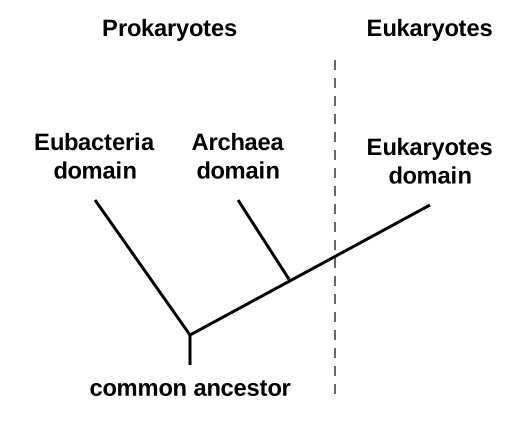
Homo habilis is a hominin species that existed from 2.4 million to 1.5 million years ago. Lucy is a fossil of Australopithecus afarensis. Figure 6 traces how scientists came to use three domains.

Figure 6
Tree diagram with the common ancestor at the bottom. A line rises and forks: one branch runs up-left to the Eubacteria domain and the other continues up-right to the Eukaryotes domain. The branch to the Archaea domain leaves that right-hand line part-way up, just before a dashed vertical line. The group names Prokaryotes and Eukaryotes sit along the top.
05.1[1 mark]

Homo habilis lived from 2.4 million to 1.5 million years ago. For how many years did it live?

See how you would score on Evolution
Show model answer for 05.1Hide model answer for 05.1

2.4 million − 1.5 million = 900 000 years

1 mark

How the marks are earned

  1. 900 000 years, or 0.9 million, nine hundred thousand, 900 thousand or 9 × 10⁵.
  2. A bare 0.9 earns nothing.
Revise Evolution
05.2[1 mark]

Fossils suggest that Homo habilis used tools. Name one job these tools could do.

See how you would score on Evolution
Show model answer for 05.2Hide model answer for 05.2

Hunting animals, or skinning them for food.

1 mark

How the marks are earned

  1. Any one of: hunting; skinning; making more tools; preparing food or cooking; fighting, weapons or defence; building shelters; making fire.
  2. Credit any other sensible use, such as breaking rocks or dating fossils. Protection on its own earns nothing.
Revise Evolution
05.3[2 marks]

Compare the body Lucy is thought to have had with the body suggested for Homo habilis.

See how you would score on Evolution
Show model answer for 05.3Hide model answer for 05.3

Lucy was shorter than Homo habilis, and she had a smaller skull.

2 marks

How the marks are earned

  1. Any two of: Lucy was shorter; she had a smaller skull; she stood less upright; she had longer arms, or shorter legs.
  2. Reverse statements about Homo habilis count for every point.
  3. A smaller brain, a change in skull or jaw shape, or changed teeth are other ways of making the smaller-skull point, so together they earn one mark only. A bigger big toe or longer fingers is a further point of its own. Bipedal or upright walking, alone, is ignored.

Why it scores

Any two differences earn the two marks.

Revise Evolution
05.4[3 marks]

Suggest, with reasons, how Australopithecus afarensis might have died out.

See how you would score on Evolution
Show model answer for 05.4Hide model answer for 05.4

The environment may have changed, for example food could have become scarce, which would put the species under selection pressure.

Australopithecus afarensis may have had no helpful adaptations for the new conditions, so it could not adapt.

A better adapted species could have outcompeted it, so it died out.

3 marks

How the marks are earned

  1. One mark: a selection pressure, or a change in the environment. Either earns the mark.
  2. One mark: the species had no adaptations that gave an advantage.
  3. One mark: so it could not compete, or it was outcompeted.
  4. Examples such as disease, a predator, a food shortage or a natural disaster are credited, as are could not adapt, another species was better adapted, and there was competition.

Why it scores

The first mark is for the change or the selection pressure.

The second mark is for the lack of adaptations, tied to the change.

The third mark is for being unable to compete, which leads to extinction.

Revise Evolution
05.5[3 marks]

Describe what sets prokaryote cells apart from eukaryote cells, and give the reason scientists moved to three domains (Figure 6 shows the change).

See how you would score on Classification
Show model answer for 05.5Hide model answer for 05.5

A prokaryotic cell has no nucleus and no membrane-bound organelles, mitochondria for example. A eukaryotic cell has them.

Three domains were introduced because scientists learned more about genetics. Comparing DNA showed that the Archaea are not the same as the Eubacteria.

3 marks

How the marks are earned

  1. Two of: prokaryotes lack a nucleus; they lack membrane-bound organelles; they lack mitochondria or chloroplasts. The reverse for eukaryotes is also credited.
  2. PLUS one mark: new knowledge of genetics, such as genetic analysis, or a system based on DNA or RNA.
  3. Also credited: prokaryotes hold chromosomal DNA or plasmids; DNA analysis showing the Archaea resemble eukaryotes; unused sections of DNA.

Why it scores

Any two differences earn two marks.

This earns the last mark, for the reason behind the new system. It must refer to genetics, DNA or RNA.

Revise Classification
Edexcel owns the copyright in its exam questions, so we cannot copy their wording. These descriptions and answers are ours. Not made or approved by Edexcel.[10 marks]
PrepWise guide: Edexcel GCSE Biology Paper 1 HigherQuestion 6

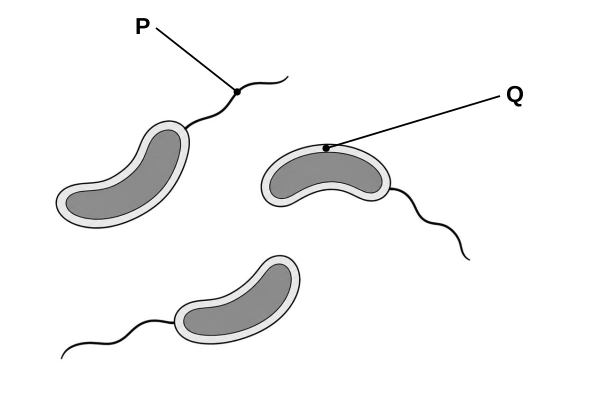
Vibrio cholerae is the pathogen behind cholera. Figure 7 is a line drawing of the bacteria, and part 06.2 gives the length of one cell on the original picture.

Figure 7
Drawing of three curved rod-shaped bacteria, each with one long thin whip-like tail at one end and a pale outer layer round a grey inside. Label P points to a tail and label Q points to the pale outer layer.
06.1[2 marks]

In the table, say what structure P does and what structure Q does (Figure 7).

See how you would score on Cell Structure
Show model answer for 06.1Hide model answer for 06.1

P: lets the cell swim Q: protects the cell and holds its shape so it does not burst

2 marks

How the marks are earned

  1. One mark: P allows movement, by swimming.
  2. One mark: Q protects the cell, keeps its form, or stops it bursting.
  3. For Q, controlling what goes into and out of the cell, or sticking to other cells, is also credited.
  4. Table filled in: P, movement (swimming); Q, protection and keeping the cell shape.

Why it scores

Each correct job earns one mark. P is the tail and Q is the outer boundary layer.

Revise Cell Structure
06.2[2 marks]

A bacterial cell is 12 mm long in the picture and 2.0 µm long in reality. What is the magnification?

See how you would score on Microscopy
Show model answer for 06.2Hide model answer for 06.2

12 mm in µm: 12 × 1000 = 12 000 µm

magnification = 12 000 ÷ 2.0 = 6000

2 marks

How the marks are earned

  1. One mark: change the units so both lengths match, 12 × 1000, or 12 000, or 2.0 ÷ 1000, or 0.002.
  2. One mark: divide the picture length by the real length, 12 000 ÷ 2.0, or 12 ÷ 0.002, giving 6000.
  3. A correct 6000 earns both marks, with or without working.
  4. One mark for the right digits with a power of ten wrong.
  5. Error carried forward from a wrong unit conversion.
  6. Units written after the answer are ignored.

Why it scores

Both lengths must be in the same unit. Converting earns the first mark.

Dividing the image length by the real length earns the second mark. A correct 6000 with no working earns both marks.

Revise Microscopy
06.3[1 mark]

Name one symptom of cholera.

See how you would score on Pathogens and Disease Transmission
Show model answer for 06.3Hide model answer for 06.3

Diarrhoea.

1 mark

How the marks are earned

  1. Diarrhoea.
  2. Nausea, vomiting, dehydration or stomach pain are also credited.
Revise Pathogens and Disease Transmission
06.4[1 mark]

How does cholera spread to people?

See how you would score on Pathogens and Disease Transmission
Show model answer for 06.4Hide model answer for 06.4

By drinking contaminated water.

1 mark

How the marks are earned

  1. Spread by water. The word contaminated is not needed.
  2. Spread by food, by the oral-faecal route or being water-borne also earns the mark.
Revise Pathogens and Disease Transmission
06.5[3 marks]

Describe what the body does in its specific immune response to an invading pathogen.

See how you would score on Adaptive Immunity and Antibodies
Show model answer for 06.5Hide model answer for 06.5

The pathogen has antigens on its surface.

The antigens stimulate lymphocytes to make antibodies that fit them.

Memory lymphocytes are formed, so the antibodies can be made faster if the same pathogen returns.

3 marks

How the marks are earned

  1. One mark: the pathogen carries antigens.
  2. One mark: antibodies (the words about triggering their production are not needed). Antitoxins are credited too.
  3. One mark: lymphocytes make them, or memory lymphocytes are formed. Memory cells are credited.
  4. Phagocytosis, or phagocytes destroying the pathogens, is credited as a mark point.
  5. Any three of these points earn the three marks.

Why it scores

The first mark is for the antigens, which are specific to that pathogen.

The second mark is for antibodies being made by lymphocytes.

The third mark is for memory lymphocytes. A description of phagocytes destroying the pathogen would also earn a mark.

Revise Adaptive Immunity and Antibodies
Edexcel owns the copyright in its exam questions, so we cannot copy their wording. These descriptions and answers are ours. Not made or approved by Edexcel.[9 marks]
PrepWise guide: Edexcel GCSE Biology Paper 1 HigherQuestion 7

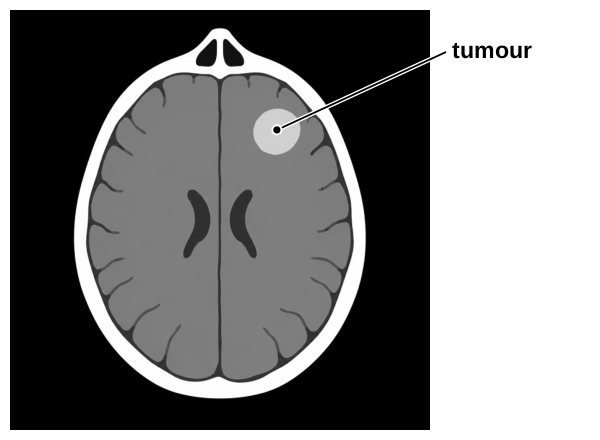
Figure 8 is a CT image of a head with a brain tumour. PET scans are another way to find tumours, and monoclonal antibodies can be used to locate blood clots.

Figure 8
Greyscale drawing in the style of a CT scan: a slice through a head seen from above on a black background, with a white skull ring, grey brain tissue and one brighter round patch in the upper right of the brain, labelled tumour.
07.1[2 marks]

Why does a CT scan show up a tumour?

See how you would score on Cancer and Cell Division Control
Show model answer for 07.1Hide model answer for 07.1

A CT scan sends X-rays through the head. The tumour absorbs the X-rays.

This happens because a tumour is a dense mass of cells, so it looks different from the tissue around it.

2 marks

How the marks are earned

  1. Three linked ideas, of which two earn the marks: X-rays are used; the tumour absorbs them; a tumour is a mass of cells, or is dense (either earns it).
  2. Saying that tumours absorb the radiation is credited.
  3. The statement tumours absorb X-rays, alone, earns both marks.

Why it scores

These are the first two points. The single idea of a tumour absorbing X-rays earns both marks.

This is the reason, and it explains why the tumour can be seen on the image.

Revise Cancer and Cell Division Control
07.2[1 mark]

Which region of the brain deals with sight? Name it.

See how you would score on Nervous System
Show model answer for 07.2Hide model answer for 07.2

The cerebral cortex, which is part of the cerebrum.

1 mark

How the marks are earned

  1. Cerebrum, cerebral hemispheres or cerebral cortex.
  2. Also credited as printed: hippocampus; occipital lobe; cerebellum; frontal lobe.
Revise Nervous System
07.3[2 marks]

A PET scan starts with an injection of radioactive glucose. Why is it injected?

See how you would score on Cancer and Cell Division Control
Show model answer for 07.3Hide model answer for 07.3

The radioactive glucose gathers in the tumour, so the tumour shows up on the scan.

Tumour cells divide quickly and use a lot of glucose for respiration.

2 marks

How the marks are earned

  1. One mark: the glucose ends up in the tumour.
  2. One mark: tumour cells are dividing (rapidly is not needed), or the glucose is used for respiration (only for respiration is needed).
  3. Cancer cells may stand in for tumour. A faster metabolism, a need for energy or quick growth is also credited.

Why it scores

The first mark is for the glucose going to the tumour.

The second mark is for the reason the tumour takes up more glucose.

Revise Cancer and Cell Division Control
07.4[6 marks]

How are monoclonal antibodies made, and how do they help to diagnose blood clots?

See how you would score on Monoclonal Antibodies
Show model answer for 07.4Hide model answer for 07.4

Start by taking an antigen found on a blood clot and injecting it into a mouse or another small mammal.

The animal's immune system responds and its lymphocytes make antibodies. The lymphocyte that makes the complementary antibody is picked out.

The chosen lymphocyte is fused with a myeloma cell, which is a tumour cell, giving a hybridoma. This hybrid cell keeps dividing and makes large amounts of identical monoclonal antibody.

To diagnose, the antibodies are given a radioisotope label and injected into the person's blood.

The antibodies match the antigen on the clot, so they bind to it. The marker's radioactivity builds up there, which shows where the clot is.

Levels of response, 6 marks

How the marks are earned

  1. Level marked. Level 3 (5 to 6 marks): both production and diagnosis are explained in detail, the stages are linked using key scientific terms correctly, and the structure is clear and logical. Level 2 (3 to 4 marks): both are described briefly, or one is explained in detail, with some linking. Level 1 (1 to 2 marks): one of the two is described briefly, with more than one stage.
  2. Production runs: an antigen from the clot goes into a small mammal; the animal mounts an immune response; the lymphocyte making the matching antibody is picked out; it is fused with a myeloma (tumour or cancer) cell; the resulting hybridoma divides and releases monoclonal antibody.
  3. Diagnosis runs: the antibody carries a radioisotope, a radioactive marker; it is injected into the patient's blood; it matches and binds the antigen of the clot; the radioactivity shows where the clot is.

Why it scores

This starts production. The antigen is why the antibodies will match a blood clot.

This links the injection to the cell that is needed. A top answer links each stage to the next.

This completes production, with myeloma, hybridoma and monoclonal antibody used correctly.

This starts the diagnosis. The radioactive marker is what lets the clot be located.

This links production to use. For Level 3 both parts are explained, in order, with the links between them.

Revise Monoclonal Antibodies
Edexcel owns the copyright in its exam questions, so we cannot copy their wording. These descriptions and answers are ours. Not made or approved by Edexcel.[11 marks]
PrepWise guide: Edexcel GCSE Biology Paper 1 HigherQuestion 8

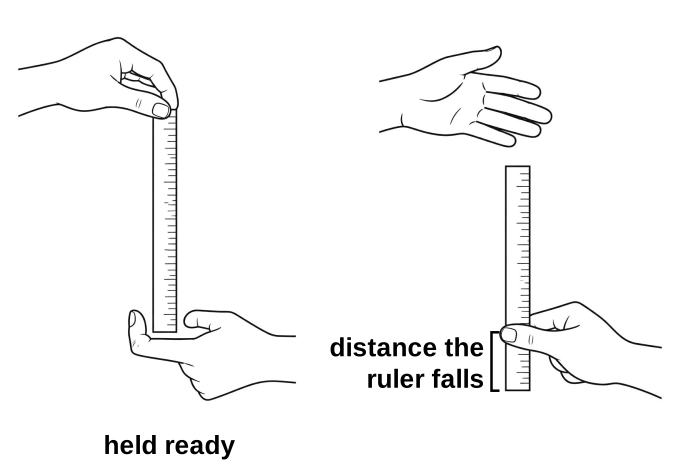
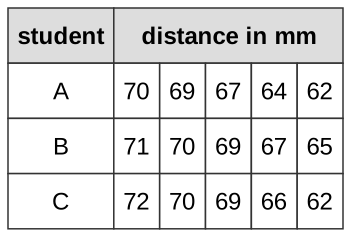
A ruler is held so that it hangs between a student's open thumb and finger. It is let go and caught, and the fall distance is recorded (Figure 9). Three students repeated the test five times. Figures 11 and 12 deal with a sensory neurone and with impulse speed.

Figure 9
Two drawings of a ruler drop test. Left: one hand holds a ruler by its top end, and the bottom of the ruler hangs between the open thumb and finger of a second hand, labelled held ready. Right: the top hand has let go, the ruler is lower and the second hand has caught it between thumb and finger; a bracket beside the ruler, from the level of the catching hand to the bottom of the ruler, is labelled distance the ruler falls.
Figure 10
Table of ruler fall distances in millimetres: three students labelled A, B and C, with five readings for each.
Figure 11
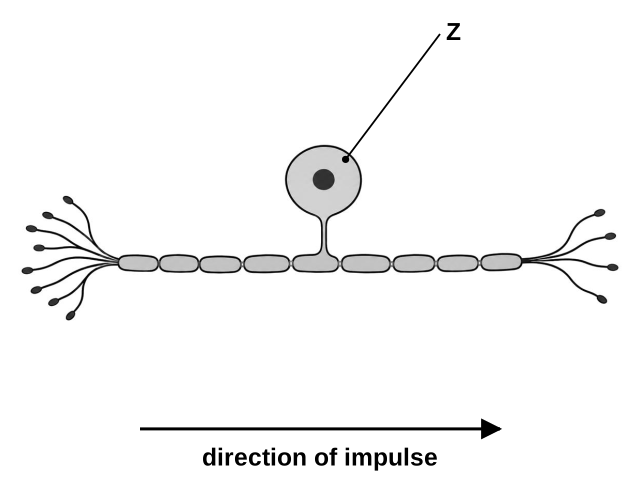
Drawing of a sensory neurone lying across the picture: fine branched endings at the left, a long fibre wrapped in separate short sheath segments, and branched endings at the right. A round part with a dark spot inside sits above the middle of the fibre on a short stalk; label Z points to the round part. An arrow below points from left to right, labelled direction of impulse.
Figure 12
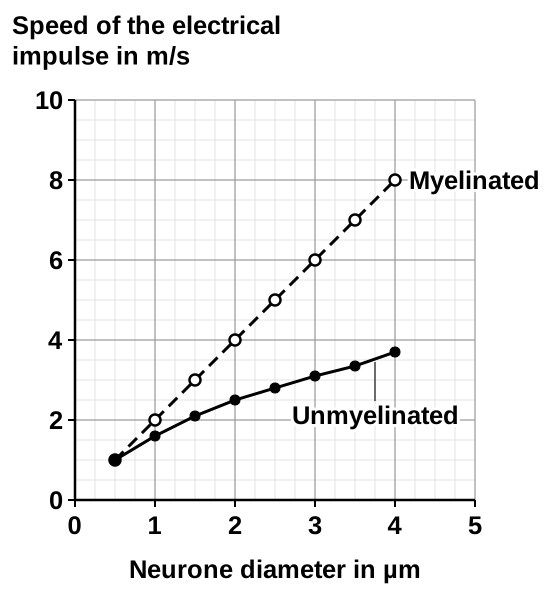
Gridded line chart with neurone width along the bottom and impulse speed up the side, showing a dashed line and a solid line, each labelled.
08.1[1 mark]

Five results are recorded for each student. How do you get one student's median?

See how you would score on Cell Biology Practical Investigations
Show model answer for 08.1Hide model answer for 08.1

Put the five results in order, then take the middle one, the third value.

1 mark

How the marks are earned

  1. Find the middle value (ordering not needed), or put the results in order and take the third value. The third value with no ordering earns nothing.
Revise Cell Biology Practical Investigations
08.2[2 marks]

Name one variable to keep constant in the test, and say why it must be kept constant.

See how you would score on Nervous System
Show model answer for 08.2Hide model answer for 08.2

The height the ruler is held at, which is its start point.

Keeping it constant makes the test valid, so the students' results can be compared.

2 marks

How the marks are earned

  1. One mark: a controlled variable, one of: the ruler's starting height; where the catching hand begins; the gap between thumb and fingers; use of the same hand; food, drink, drugs or sleep. Tiredness also counts.
  2. AND one mark: so that the test is valid, or the results are comparable.

Why it scores

The first mark is for a variable that must be controlled.

The second mark is for why it is controlled: valid, comparable results.

Revise Nervous System
08.3[2 marks]

Figure 10 shows five distances for each of three students. Explain one conclusion about reaction time that the results support.

See how you would score on Nervous System
Show model answer for 08.3Hide model answer for 08.3

Student A reacted fastest.

For A the ruler fell least, a mean of 66.4 mm, against 67.8 mm for C and 68.4 mm for B. A shorter fall means a quicker catch.

2 marks

How the marks are earned

  1. Route one: A responds soonest (1), since A's ruler fell the smallest distances, mean 66.4 mm (1).
  2. Route two, as an alternative: B responds latest (1), since B's ruler fell the biggest distances, mean 68.4 mm (1).
  3. Route three, as an alternative: the reaction time, or fall distance, shrinks with repeats (1), because the student gets used to, or practised at, the test (1).
  4. Any one route earns the two marks.
  5. Credited: A caught it faster; B caught it more slowly; the time to catch falls.

Why it scores

The first mark is for the conclusion.

The second mark is for evidence from Figure 10 tied back to the conclusion. The means come from the five distances.

Revise Nervous System
08.4[3 marks]

Plan an investigation, using the ruler method, into how two different caffeine drinks change reaction time.

See how you would score on Nervous System
Show model answer for 08.4Hide model answer for 08.4

Each student does the ruler test before having any drink, as a control. Then one student has the first caffeine drink and another has the second.

Give both students the same volume of drink, and test them again after the same wait.

Do it again with more students for each drink and work out the mean fall distance per drink.

3 marks

How the marks are earned

  1. Any three of four: one student per different caffeine drink; test before and after the drink, or have a control; control a variable; repeat with more students (per drink is not needed), or calculate the mean.
  2. Using the same student with a gap in time is also credited. The same drink volume, or the same wait between drinking and testing, is also credited.

Why it scores

Tests before and after let the effect of the drink show, and different drinks go to different students.

This controls variables, so the only difference is the drink.

Repeating and finding the mean makes the results more reliable.

Revise Nervous System
08.5[1 mark]

Name structure Z shown in Figure 11.

See how you would score on Nervous System
Show model answer for 08.5Hide model answer for 08.5

The cell body.

1 mark

How the marks are earned

  1. Cell body.
Revise Nervous System
08.6[3 marks]

Look at Figure 12 and comment on what happens to impulse speed as neurone width changes.

See how you would score on Nervous System
Show model answer for 08.6Hide model answer for 08.6

Wider neurones carry impulses faster, in myelinated and unmyelinated neurones alike.

Past 0.5 µm the myelinated speed climbs more steeply and is higher. The myelinated line is a straight line.

For instance from 1 to 4 µm the myelinated speed rises from 2 to 8 m/s, while the unmyelinated speed rises from about 1.6 to 3.7 m/s.

3 marks

How the marks are earned

  1. Any three of: wider neurones carry impulses faster; beyond 0.5 µm myelinated neurones show a greater increase in speed (the phrase after 0.5 µm is not needed); a correct data comparison taken from the graph.
  2. Myelinated neurones being faster than unmyelinated ones is credited.
  3. Credited: the myelinated rise is linear; the reverse argument for unmyelinated neurones.
  4. A speed quoted for only one width is ignored.

Why it scores

The first mark is for the link between width and speed.

The second mark is for the bigger rise in myelinated neurones.

The third mark needs speeds read at two widths to show the effect of width. A speed quoted for one width only is ignored.

Revise Nervous System
Edexcel owns the copyright in its exam questions, so we cannot copy their wording. These descriptions and answers are ours. Not made or approved by Edexcel.[12 marks]
PrepWise guide: Edexcel GCSE Biology Paper 1 HigherQuestion 9

Changes in the DNA of a gene, called mutations, may lead to inherited disorders. Figure 13 is a pedigree of one family affected by cystic fibrosis, which is recessive. Huntington's disease arises from a dominant allele.

Figure 13
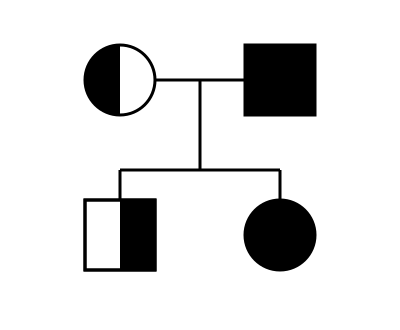
Family pedigree with a mother shown as a circle and a father shown as a square joined by a line, and two children below them, a son shown as a square and a daughter shown as a circle. The shading differs between the symbols.
Punnett square
Empty two by two grid with an empty header box above each column and beside each row.
09.1[1 mark]

Using the pedigree in Figure 13, choose the row that gives the correct status of mother, father and son. Tick one box.

See how you would score on Inherited Disorders
Mother affected, father unaffected, son carrier
Mother carrier, father affected, son affected
Mother carrier, father affected, son carrier
Mother affected, father affected, son unaffected
Show model answer for 09.1Hide model answer for 09.1

Mother carrier, father affected, son carrier. The father is a solid symbol, so he is affected. The mother and the son are half shaded, so they are carriers.

1 mark

How the marks are earned

  1. Tick the row: mother carrier, father affected, son carrier.
Revise Inherited Disorders
09.2[2 marks]

Thick, sticky mucus builds up in cystic fibrosis. What does it do to the airways?

See how you would score on Inherited Disorders
Show model answer for 09.2Hide model answer for 09.2

The cilia cannot shift the thick mucus, so it blocks the airways and makes breathing hard.

Bacteria and other pathogens get stuck in the mucus, so the chance of a lung infection goes up.

2 marks

How the marks are earned

  1. Any two of: the mucus cannot be moved (the word cilia is not needed); bacteria, pathogens (a named pathogen counts) or dust get trapped; infection (a higher chance of it is not needed); a narrower airway, coughing or breathing difficulty.
  2. Credited: unable to move pathogens; a blocked airway; less gas exchange.

Why it scores

The first mark is for the mucus staying put and the narrower airway or breathing difficulty.

The second mark is for the trapped pathogens, or the infection that follows.

Revise Inherited Disorders
09.3[4 marks]

Huntington's is dominant. Use the Punnett square to explain the phenotypes of children from a heterozygous parent and an unaffected parent.

See how you would score on Inherited Disorders
Show model answer for 09.3Hide model answer for 09.3

parents: Hh (affected) and hh (unaffected) gametes from Hh: H and h, across the top gametes from hh: h and h, down the side

row h: Hh and hh row h: Hh and hh offspring: Hh, hh, Hh, hh

There is a 50% chance of an affected child and a 50% chance of an unaffected child.

Hh gives the disease, since one dominant allele is enough. hh is healthy: both alleles are recessive and there is no dominant allele.

4 marks

How the marks are earned

  1. One mark: correct parent genotypes Hh and hh (any letter); the gametes may go either way round the square.
  2. One mark: four offspring Hh, Hh, hh and hh in the square.
  3. One mark: 50% of the children affected, or 50% unaffected. Either statement earns it. 2/4, ½, 1 in 2 or 1:1 are credited for 50%. Half are carriers is rejected.
  4. One mark: one dominant allele is enough to be affected, or unaffected because there are two recessive alleles, or no dominant allele (naming Hh or hh is not needed). Either statement earns it. Heterozygous affected and homozygous recessive unaffected, both together, is credited.
  5. The first and second marks can be awarded from the Punnett square alone.
  6. The offspring mark carries an error forward from wrong parent gametes.

Why it scores

First mark: the parent genotypes and gametes are set out correctly on the square.

Second mark: the four offspring in the square are right.

Third mark. Two of the four boxes are Hh and two are hh.

Fourth mark, which ties each genotype to its phenotype.

Revise Inherited Disorders
09.4[6 marks]

Explain the steps for getting DNA out of strawberries and why each is done, then describe what a DNA molecule looks like.

See how you would score on DNA Genome
Show model answer for 09.4Hide model answer for 09.4

Crush the strawberry to give a bigger surface area and break up the tissue. Then add detergent to dissolve the membranes and let the DNA out.

Protease digests the proteins. A warm water bath makes this go faster.

Salt makes the DNA clump together, and filtering removes the insoluble bits. Adding ice-cold ethanol makes the DNA come out of solution as a visible solid.

DNA is a polymer of nucleotides, arranged in a double helix of two strands, with a sugar-phosphate backbone.

The bases link the two strands. A always pairs with T and C with G, and weak hydrogen bonds hold each complementary pair.

Levels of response, 6 marks

How the marks are earned

  1. Level marked. Level 3 (5 to 6 marks): the extraction and the DNA structure are both described in detail, with reasons for at least three extraction stages AND complementary base pairs joined by hydrogen bonds, in a clear, logical order. Level 2 (3 to 4 marks): both are described briefly, or one in detail, with reasons for at least two stages. Level 1 (1 to 2 marks): a brief account of the structure or the extraction, with a reason for one stage, or two extraction stages (no reasons needed), or two ideas about structure.
  2. Extraction steps with reasons: crush the fruit (more surface area, breaks up tissue); add detergent (breaks membranes); add protease (digests proteins); warm in a water bath (speeds up the reaction); add salt (DNA clumps); filter (removes insoluble material); add ice-cold ethanol (DNA comes out of solution and is visible).
  3. Structure: two strands twisted into a double helix, each a chain of nucleotides; sugar and phosphate form the backbone; bases face inwards and join the strands; adenine matches thymine and cytosine matches guanine (A with T, C with G); weak hydrogen bonds hold each pair.

Why it scores

Two stages, each with a reason. Level 3 needs reasons for three or more stages.

More stages with reasons build a detailed account.

These last stages finish the process in order, each with its reason.

This begins the structure, using the correct key terms.

Complementary pairs held by hydrogen bonds are needed for the top level, 5 to 6 marks.

Revise DNA Genome
Edexcel owns the copyright in its exam questions, so we cannot copy their wording. These descriptions and answers are ours. Not made or approved by Edexcel.[13 marks]
PrepWise guide: Edexcel GCSE Biology Paper 1 HigherQuestion 10

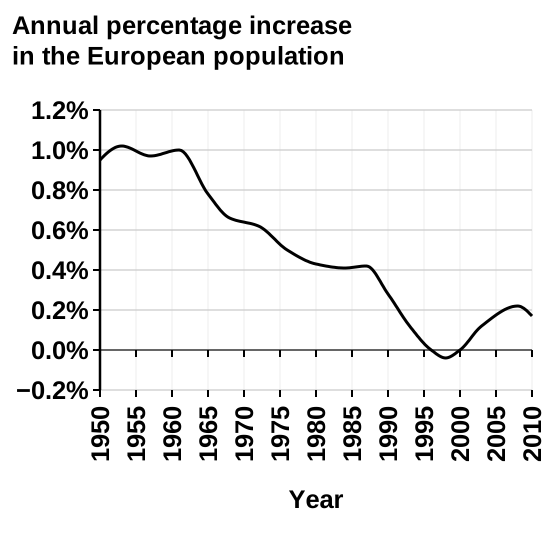
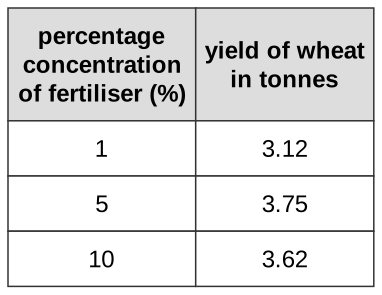
Figure 14 charts how fast Europe's population grew each year from 1950 to 2010. A farmer tried three fertiliser strengths on equal-sized wheat fields and recorded the yields (Figure 15).

Figure 14
Line chart on a grid: years along the bottom, yearly percentage growth up the side, with a flat reference line at zero and a single curve.
Figure 15
Three-row table pairing each fertiliser strength with the wheat harvested, in tonnes.
10.1[1 mark]

In how many years did Europe's population show no yearly growth, according to Figure 14?

See how you would score on Biodiversity and Human Impacts
Show model answer for 10.1Hide model answer for 10.1

4 years. From about 1996 to 2000 the curve sits at or under 0%.

1 mark

How the marks are earned

  1. Four, or 4.
Revise Biodiversity and Human Impacts
10.2[2 marks]

Name one benefit and one drawback of farmers using fertiliser.

See how you would score on Biodiversity and Human Impacts
Show model answer for 10.2Hide model answer for 10.2

Benefit: it raises the crop yield. Drawback: it washes into rivers and pollutes the water, which can cause algal growth.

2 marks

How the marks are earned

  1. One benefit: a higher yield, or more profit. Increased or faster growth, or mineral ions for growth, is also credited.
  2. One drawback: eaten by herbivores or consumers; pollutes rivers, or runs off into water; costs money; encourages weeds.
  3. Also credited: bioaccumulation, entering the food chain, harm to animals, eutrophication, algal growth. Harms the environment, alone, earns nothing.

Why it scores

One mark is for a benefit and one is for a drawback.

Revise Biodiversity and Human Impacts
10.3[1 mark]

Using Figure 15, find the percentage rise in wheat yield for 5% fertiliser compared with 1%. Tick one box.

See how you would score on Cell Biology Practical Investigations
4%
17%
20%
83%
Show model answer for 10.3Hide model answer for 10.3

increase in yield = 3.75 − 3.12 = 0.63 tonnes

percentage increase = 0.63 ÷ 3.12 × 100 = 20.2, so 20%

1 mark

How the marks are earned

  1. Tick 20%. The working is (3.75 − 3.12) ÷ 3.12 × 100 = 20.2, which is 20%.
Revise Cell Biology Practical Investigations
10.4[2 marks]

The farmer says 5% is the best strength. Suggest two changes to the trial that would test this properly.

See how you would score on Cell Biology Practical Investigations
Show model answer for 10.4Hide model answer for 10.4

1. Try extra strengths between 1% and 10%, so the best one can be pinpointed. 2. Repeat at every strength on more fields, to make the results reliable.

2 marks

How the marks are earned

  1. Any two of: more strengths between 1% and 10%; a control field with no fertiliser; repeats at each strength, or on each field; one variable controlled, such as the same place, crop density, crop variety or volume of fertiliser.
  2. Credited: a different spread of strengths anywhere from 0 to 10%; finer steps between strengths; testing over more fields or a bigger area; soil pH, watering, the slope or direction the fields face, polytunnels; putting every strength on one field.
  3. Controlling the area, the temperature, the light intensity or the greenhouse earns nothing.

Why it scores

Each change earns one mark. A control field, or keeping the crop variety constant, would also earn a mark.

Revise Cell Biology Practical Investigations
10.5[1 mark]

Ladybirds released to eat aphids replace pesticides in a greenhouse. What is this method called? Tick one box.

See how you would score on Ecosystems Communities
Distribution analysis
Selective breeding
Biological control
Genetic engineering
Show model answer for 10.5Hide model answer for 10.5

Biological control. A living predator, here the ladybird, is used to reduce a pest, here the aphids.

1 mark

How the marks are earned

  1. Tick biological control.
Revise Ecosystems Communities
10.6[4 marks]

How is tissue culture used to make plants that are genetically identical?

See how you would score on Cloning
Show model answer for 10.6Hide model answer for 10.6

Take a few cells from the plant being copied, such as a snip of shoot tip.

Use aseptic technique, so that no microorganisms grow on the sample.

Place the sample on sterile agar containing nutrients, in a dish.

Give hormones so that the cells develop into roots and shoots, and plantlets form.

4 marks

How the marks are earned

  1. One mark: take a sample of cells or tissue from the plant (the word parent is not needed). Leaf discs, cuttings, meristems or explants are credited.
  2. One mark: aseptic technique is used. A description of aseptic technique is credited.
  3. One mark: place it on a growth medium. The words sterile and nutrient are optional. Agar or a Petri dish is credited.
  4. One mark: hormones are applied. The idea that plantlets develop is optional. Differentiation or specialisation, or roots, shoots, leaves, plantlets or callus forming, is credited.

Why it scores

The sample comes from one parent, which is why the new plants are clones.

The second mark is for aseptic technique.

The third mark is for the growth medium.

The fourth mark is for the hormones and the growth of plantlets.

Revise Cloning
Edexcel owns the copyright in its exam questions, so we cannot copy their wording. These descriptions and answers are ours. Not made or approved by Edexcel.[11 marks]
END OF QUESTIONS100 marks total
See how you would score on Cell Biology Practical Investigations

Our own questions on this topic, marked straight away, so you see what to revise. Free now.