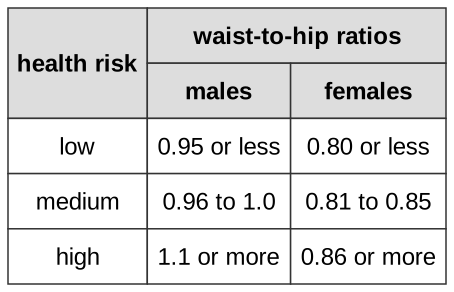
Obesity raises the chance of some non-communicable diseases. Tuberculosis, by contrast, passes between people in droplets in the air. Figure 2 sorts waist-to-hip ratios into bands of health risk.
Tuberculosis passes between people in droplets in the air. Name two actions that would limit its spread.
Our own questions on this topic, marked straight away, so you see what to revise. Free now.
Show model answer for 02.1Hide model answer for 02.1
1. Cover the mouth when coughing or sneezing. 2. Keep infected people apart from others.
How the marks are earned
- Any two of: antibiotics; vaccination or immunisation; covering the mouth when coughing or sneezing, or wearing a face mask; keeping infected people apart, or avoiding them; washing hands or disinfecting surfaces.
- Also credited: avoiding mixing in groups, better ventilation, air filters.
- Vague answers such as take medicine or take drugs earn nothing, and so does PPE.
Why it scores
Each action earns one mark. Both stop droplets carrying the bacteria from reaching other people.
Revise Pathogens and Disease TransmissionWhy is liver disease classed as non-communicable?
See how you would score on Pathogens and Disease TransmissionShow model answer for 02.2Hide model answer for 02.2
No pathogen causes it, so nobody can catch it from another person.
How the marks are earned
- It cannot be passed between people, or no pathogen causes it.
- A link to drinking alcohol is also credited.
- The words cannot spread, with nothing more, earn nothing.
Waist 80 cm, hips 90 cm. Find the ratio of waist to hips, giving two decimal places.
See how you would score on Cell Biology Practical InvestigationsShow model answer for 02.3Hide model answer for 02.3
ratio of waist to hip: 80 ÷ 90 = 0.8888
rounded value: 0.89
How the marks are earned
- One mark: divide waist by hip, 80 ÷ 90 = 0.8888.
- One mark: the final value, 0.89.
- A correct 0.89 earns both marks even when no working is given.
- One mark only for 1.13, which is hip divided by waist, or for a rounding of 0.90, 0.9, 0.8 or 0.88.
Why it scores
Dividing the waist by the hip earns the first mark.
Giving two decimal places earns the final mark. A correct 0.89 with no working still earns both.
Revise Cell Biology Practical InvestigationsA female has a ratio of 0.75. Use Figure 2 to explain what this means for her health risk.
See how you would score on Cell Biology Practical InvestigationsShow model answer for 02.4Hide model answer for 02.4
Her risk is low.
0.75 falls under the 0.80 limit for women, so excess fat is not stored round her waist or vital organs.
How the marks are earned
- One mark: her risk is low. Saying there is no risk earns nothing.
- One mark: the extra weight is not round the waist, or not round the vital organs (either earns it; saying it is extra mass is not needed), or 0.75 is below 0.80.
Why it scores
The first mark is for naming the risk band, read from Figure 2.
The second mark is for the reason. Either the comparison with 0.80 or the idea about the waist and organs earns it.
Revise Cell Biology Practical InvestigationsMitosis goes wrong in cancer. What are the features of the cells that mitosis makes?
See how you would score on Mitosis and the Cell CycleShow model answer for 02.5Hide model answer for 02.5
Each division gives two daughter cells. They are genetically identical body cells with two sets of chromosomes, so they are diploid.
How the marks are earned
- Any two of: two (the word cells is not needed); diploid, or two sets of chromosomes; genetically identical; body cells.
- A full set of chromosomes is fine for diploid, and somatic cells for body cells. Haploid is rejected. Doubling or duplicating alone earns nothing.
Why it scores
Any two of the listed features earn the two marks. This answer covers all of them.
Revise Mitosis and the Cell Cycle