A potato cylinder lies in a beaker of distilled water (Figure 3). Three agar cubes of different size, each holding an indicator that goes from pink to colourless in acid, were put into acid (Figure 4).
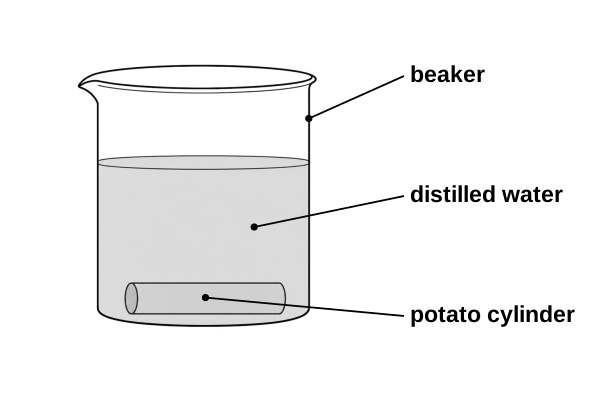
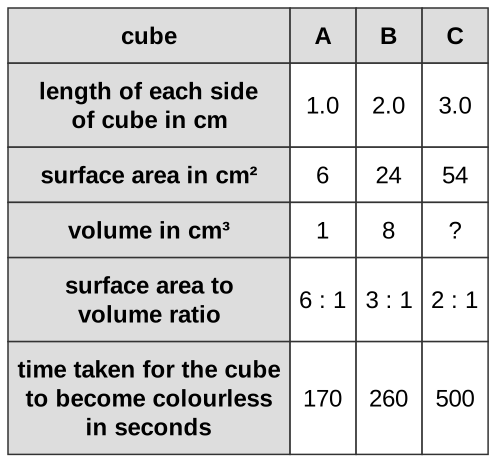
Figure 3 shows a potato cylinder lying in distilled water. Give the reasons its mass will not stay constant.
Our own questions on this topic, marked straight away, so you see what to revise. Free now.
Show model answer for 03.1Hide model answer for 03.1
The potato gets heavier.
Osmosis carries water into the cells through their partially permeable membranes.
The water starts in the distilled water, where its concentration is higher, and moves to the cells, where it is lower.
How the marks are earned
- Any three of: the mass rises; water enters the potato cells; it crosses a partially permeable (semi-permeable) membrane; this is osmosis; water travels from a high to a low water concentration.
- Credited: weight for mass; the potato takes in water; down a water concentration gradient; or moving from a low to a high solute concentration (a named solute is fine).
- Two marks at most if the stated change in mass, or the direction of water movement, is wrong.
Why it scores
The first mark is for the right direction of change. A loss of mass would cap the answer at two marks.
These are the second and third marks: the water enters the potato, and the process is osmosis across a partially permeable membrane.
This gives the direction of travel. It must run from high to low water concentration.
Revise Cell TransportCube C has sides of 3.0 cm (Figure 4). Work out its volume.
See how you would score on Cell TransportShow model answer for 03.2Hide model answer for 03.2
volume = 3 × 3 × 3
volume = 27 cm3
How the marks are earned
- One mark: 3 × 3 × 3, or 33.
- One mark: the result, 27 (cm3). Working with 54 ÷ 2 is also credited.
- A correct 27 on its own earns both marks.
Why it scores
Cubing the side length earns the first mark.
The value earns the second mark. A correct 27 with no working earns both marks.
Revise Cell TransportCubes A and B take different times to turn colourless. Account for the difference.
See how you would score on Cell TransportShow model answer for 03.3Hide model answer for 03.3
Cube A reaches colourless sooner than cube B.
A is smaller, so its surface area to volume ratio is bigger and the acid has a shorter way to diffuse into its centre.
How the marks are earned
- Any two linked ideas: A is quicker; A is smaller, or has less volume, or a larger surface area to volume ratio; A gives a shorter distance for diffusion.
- The argument reversed for B scores against any of the three. A has less surface area, on its own, earns nothing.
Why it scores
This states the difference. It scores once it is tied to a reason.
Any one reason (size, ratio or distance) linked to the quicker change earns the second mark.
Revise Cell Transport