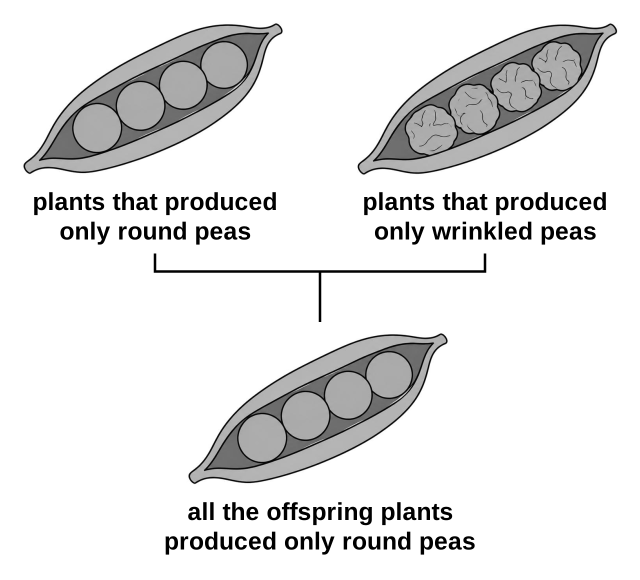
In the 1800s Mendel bred pea plants, and Figure 5 summarises one of his crosses for pea shape. Later, a scientist bred together two pea plants that each carried one round allele and one wrinkled allele.
Today, what is the name for the units Mendel proposed? Tick one box.
Our own questions on this topic, marked straight away, so you see what to revise. Free now.
Show model answer for 04.1Hide model answer for 04.1
Genes. A gene is a section of DNA that codes for a characteristic.
From Figure 5, what can Mendel conclude about wrinkled peas?
See how you would score on Genetic InheritanceShow model answer for 04.2Hide model answer for 04.2
Wrinkled is recessive: when the round characteristic is also present, the wrinkled one does not show.
How the marks are earned
- Wrinkled is recessive. Not passed on is credited too.
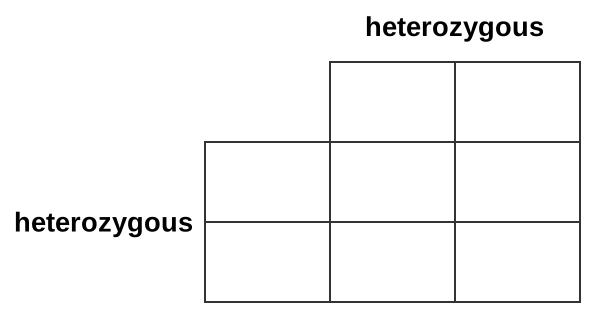
Cross two plants heterozygous for pea shape (R round, r wrinkled). Complete the Punnett square; state the percentage chance of wrinkled peas.
See how you would score on Genetic InheritanceShow model answer for 04.3Hide model answer for 04.3
gametes from the first parent: R and r, across the top gametes from the second parent: R and r, down the side
row R: RR and Rr row r: Rr and rr
Only rr has wrinkled peas, 1 box out of 4 chance of wrinkled peas = 25%
How the marks are earned
- One mark: each parent shown making R and r gametes along the edges of the square.
- One mark: the four offspring genotypes RR, Rr, Rr and rr.
- One mark: a 25% chance of wrinkled peas.
- rR is credited for Rr, and other letters are credited.
- Error carried forward from wrong parent genotypes, and from a wrong Punnett square.
- Table filled in: columns R and r, rows R and r; row R gives RR and Rr; row r gives Rr and rr.
Why it scores
Each heterozygous parent makes R gametes and r gametes. This earns the first mark.
Filling the four boxes gives RR, Rr, Rr and rr. This earns the second mark.
One box in four is rr, so the chance is 25%. This earns the third mark.
Revise Genetic InheritanceGive two ways to keep the surroundings of plants steady when they are grown for an inheritance study.
See how you would score on Cell Biology Practical InvestigationsShow model answer for 04.4Hide model answer for 04.4
1. Grow the plants in a greenhouse at one steady temperature, using a heater. 2. Give every plant the same soil and the same watering.
How the marks are earned
- Any two of: a greenhouse; the soil; the temperature, or a heater; the light, or a lamp; the watering, or rain; keeping out organisms (the prefix micro is not needed) or insects. The word same is not needed.
- Also credited: an enclosed space, the carbon dioxide level, a named soil factor such as pH, the best temperature, the same humidity, pathogens or a named pathogen, using pesticides, or control of abiotic or biotic factors.
Why it scores
Each controlled condition earns one mark. Keeping them steady means only the genes differ between the plants.
Revise Cell Biology Practical InvestigationsFor asexual and for sexual reproduction, write yes or no against: offspring that are clones, need for male and female gametes, quick reproductive cycle.
See how you would score on VariationShow model answer for 04.5Hide model answer for 04.5
clones: asexual yes, sexual no
both gamete types needed: asexual no, sexual yes
quick reproductive cycle: asexual yes, sexual no
How the marks are earned
- Each row filled in correctly earns a mark.
- Offspring that are clones: yes for asexual, no for sexual.
- Both male and female gametes needed: no for asexual, yes for sexual.
- Quick reproductive cycle: yes for asexual, no for sexual.
- Y, a tick or true is credited for yes. N, a cross or false is credited for no.
Why it scores
One mark. Asexual reproduction copies the parent, while sexual reproduction mixes genes from two parents.
One mark. Only sexual reproduction joins gametes from two parents.
One mark. Asexual reproduction needs no partner, so it is faster.
Revise VariationWhat does it mean to say that the nucleus of a zygote is diploid?
See how you would score on Genetic InheritanceShow model answer for 04.6Hide model answer for 04.6
A nucleus holding two copies of each chromosome, one from each parent.
How the marks are earned
- Two of each chromosome (pairs), or a full set of chromosomes.
- 46 chromosomes, or one chromosome from each parent, also earns the mark.
- Answers such as twice as many chromosomes, all the chromosomes or all the genetic material earn nothing.