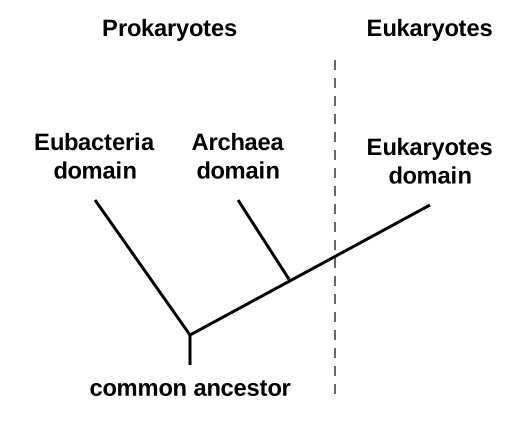
Homo habilis is a hominin species that existed from 2.4 million to 1.5 million years ago. Lucy is a fossil of Australopithecus afarensis. Figure 6 traces how scientists came to use three domains.
Homo habilis lived from 2.4 million to 1.5 million years ago. For how many years did it live?
Our own questions on this topic, marked straight away, so you see what to revise. Free now.
Show model answer for 05.1Hide model answer for 05.1
2.4 million − 1.5 million = 900 000 years
How the marks are earned
- 900 000 years, or 0.9 million, nine hundred thousand, 900 thousand or 9 × 10⁵.
- A bare 0.9 earns nothing.
Fossils suggest that Homo habilis used tools. Name one job these tools could do.
See how you would score on EvolutionShow model answer for 05.2Hide model answer for 05.2
Hunting animals, or skinning them for food.
How the marks are earned
- Any one of: hunting; skinning; making more tools; preparing food or cooking; fighting, weapons or defence; building shelters; making fire.
- Credit any other sensible use, such as breaking rocks or dating fossils. Protection on its own earns nothing.
Compare the body Lucy is thought to have had with the body suggested for Homo habilis.
See how you would score on EvolutionShow model answer for 05.3Hide model answer for 05.3
Lucy was shorter than Homo habilis, and she had a smaller skull.
How the marks are earned
- Any two of: Lucy was shorter; she had a smaller skull; she stood less upright; she had longer arms, or shorter legs.
- Reverse statements about Homo habilis count for every point.
- A smaller brain, a change in skull or jaw shape, or changed teeth are other ways of making the smaller-skull point, so together they earn one mark only. A bigger big toe or longer fingers is a further point of its own. Bipedal or upright walking, alone, is ignored.
Why it scores
Any two differences earn the two marks.
Revise EvolutionSuggest, with reasons, how Australopithecus afarensis might have died out.
See how you would score on EvolutionShow model answer for 05.4Hide model answer for 05.4
The environment may have changed, for example food could have become scarce, which would put the species under selection pressure.
Australopithecus afarensis may have had no helpful adaptations for the new conditions, so it could not adapt.
A better adapted species could have outcompeted it, so it died out.
How the marks are earned
- One mark: a selection pressure, or a change in the environment. Either earns the mark.
- One mark: the species had no adaptations that gave an advantage.
- One mark: so it could not compete, or it was outcompeted.
- Examples such as disease, a predator, a food shortage or a natural disaster are credited, as are could not adapt, another species was better adapted, and there was competition.
Why it scores
The first mark is for the change or the selection pressure.
The second mark is for the lack of adaptations, tied to the change.
The third mark is for being unable to compete, which leads to extinction.
Revise EvolutionDescribe what sets prokaryote cells apart from eukaryote cells, and give the reason scientists moved to three domains (Figure 6 shows the change).
See how you would score on ClassificationShow model answer for 05.5Hide model answer for 05.5
A prokaryotic cell has no nucleus and no membrane-bound organelles, mitochondria for example. A eukaryotic cell has them.
Three domains were introduced because scientists learned more about genetics. Comparing DNA showed that the Archaea are not the same as the Eubacteria.
How the marks are earned
- Two of: prokaryotes lack a nucleus; they lack membrane-bound organelles; they lack mitochondria or chloroplasts. The reverse for eukaryotes is also credited.
- PLUS one mark: new knowledge of genetics, such as genetic analysis, or a system based on DNA or RNA.
- Also credited: prokaryotes hold chromosomal DNA or plasmids; DNA analysis showing the Archaea resemble eukaryotes; unused sections of DNA.
Why it scores
Any two differences earn two marks.
This earns the last mark, for the reason behind the new system. It must refer to genetics, DNA or RNA.
Revise Classification