Vibrio cholerae is the pathogen behind cholera. Figure 7 is a line drawing of the bacteria, and part 06.2 gives the length of one cell on the original picture.
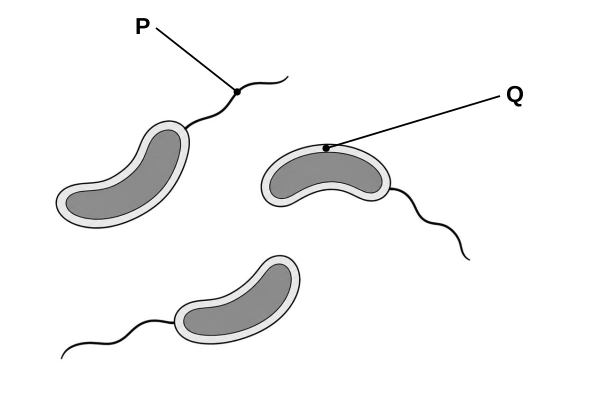
In the table, say what structure P does and what structure Q does (Figure 7).
Our own questions on this topic, marked straight away, so you see what to revise. Free now.
Show model answer for 06.1Hide model answer for 06.1
P: lets the cell swim Q: protects the cell and holds its shape so it does not burst
How the marks are earned
- One mark: P allows movement, by swimming.
- One mark: Q protects the cell, keeps its form, or stops it bursting.
- For Q, controlling what goes into and out of the cell, or sticking to other cells, is also credited.
- Table filled in: P, movement (swimming); Q, protection and keeping the cell shape.
Why it scores
Each correct job earns one mark. P is the tail and Q is the outer boundary layer.
Revise Cell StructureA bacterial cell is 12 mm long in the picture and 2.0 µm long in reality. What is the magnification?
See how you would score on MicroscopyShow model answer for 06.2Hide model answer for 06.2
12 mm in µm: 12 × 1000 = 12 000 µm
magnification = 12 000 ÷ 2.0 = 6000
How the marks are earned
- One mark: change the units so both lengths match, 12 × 1000, or 12 000, or 2.0 ÷ 1000, or 0.002.
- One mark: divide the picture length by the real length, 12 000 ÷ 2.0, or 12 ÷ 0.002, giving 6000.
- A correct 6000 earns both marks, with or without working.
- One mark for the right digits with a power of ten wrong.
- Error carried forward from a wrong unit conversion.
- Units written after the answer are ignored.
Why it scores
Both lengths must be in the same unit. Converting earns the first mark.
Dividing the image length by the real length earns the second mark. A correct 6000 with no working earns both marks.
Revise MicroscopyName one symptom of cholera.
See how you would score on Pathogens and Disease TransmissionShow model answer for 06.3Hide model answer for 06.3
Diarrhoea.
How the marks are earned
- Diarrhoea.
- Nausea, vomiting, dehydration or stomach pain are also credited.
How does cholera spread to people?
See how you would score on Pathogens and Disease TransmissionShow model answer for 06.4Hide model answer for 06.4
By drinking contaminated water.
How the marks are earned
- Spread by water. The word contaminated is not needed.
- Spread by food, by the oral-faecal route or being water-borne also earns the mark.
Describe what the body does in its specific immune response to an invading pathogen.
See how you would score on Adaptive Immunity and AntibodiesShow model answer for 06.5Hide model answer for 06.5
The pathogen has antigens on its surface.
The antigens stimulate lymphocytes to make antibodies that fit them.
Memory lymphocytes are formed, so the antibodies can be made faster if the same pathogen returns.
How the marks are earned
- One mark: the pathogen carries antigens.
- One mark: antibodies (the words about triggering their production are not needed). Antitoxins are credited too.
- One mark: lymphocytes make them, or memory lymphocytes are formed. Memory cells are credited.
- Phagocytosis, or phagocytes destroying the pathogens, is credited as a mark point.
- Any three of these points earn the three marks.
Why it scores
The first mark is for the antigens, which are specific to that pathogen.
The second mark is for antibodies being made by lymphocytes.
The third mark is for memory lymphocytes. A description of phagocytes destroying the pathogen would also earn a mark.
Revise Adaptive Immunity and Antibodies