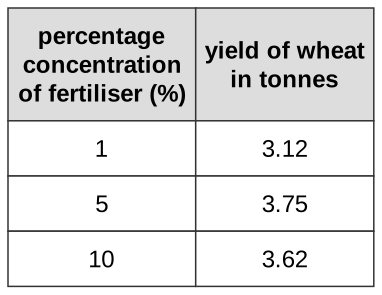
Figure 14 charts how fast Europe's population grew each year from 1950 to 2010. A farmer tried three fertiliser strengths on equal-sized wheat fields and recorded the yields (Figure 15).
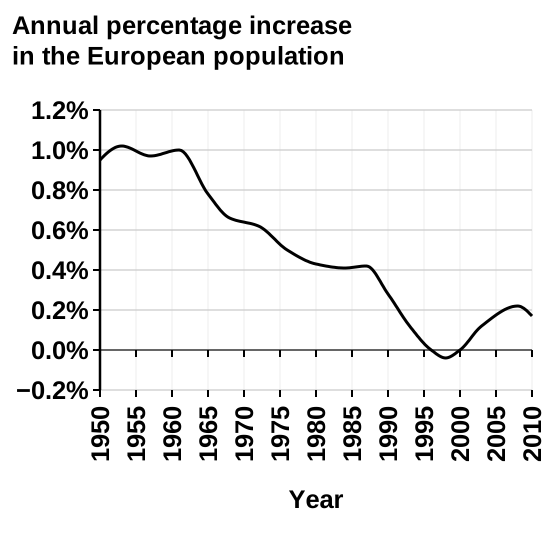
In how many years did Europe's population show no yearly growth, according to Figure 14?
Our own questions on this topic, marked straight away, so you see what to revise. Free now.
Show model answer for 10.1Hide model answer for 10.1
4 years. From about 1996 to 2000 the curve sits at or under 0%.
Name one benefit and one drawback of farmers using fertiliser.
See how you would score on Biodiversity and Human ImpactsShow model answer for 10.2Hide model answer for 10.2
Benefit: it raises the crop yield. Drawback: it washes into rivers and pollutes the water, which can cause algal growth.
How the marks are earned
- One benefit: a higher yield, or more profit. Increased or faster growth, or mineral ions for growth, is also credited.
- One drawback: eaten by herbivores or consumers; pollutes rivers, or runs off into water; costs money; encourages weeds.
- Also credited: bioaccumulation, entering the food chain, harm to animals, eutrophication, algal growth. Harms the environment, alone, earns nothing.
Why it scores
One mark is for a benefit and one is for a drawback.
Revise Biodiversity and Human ImpactsUsing Figure 15, find the percentage rise in wheat yield for 5% fertiliser compared with 1%. Tick one box.
See how you would score on Cell Biology Practical InvestigationsShow model answer for 10.3Hide model answer for 10.3
increase in yield = 3.75 − 3.12 = 0.63 tonnes
percentage increase = 0.63 ÷ 3.12 × 100 = 20.2, so 20%
How the marks are earned
- Tick 20%. The working is (3.75 − 3.12) ÷ 3.12 × 100 = 20.2, which is 20%.
The farmer says 5% is the best strength. Suggest two changes to the trial that would test this properly.
See how you would score on Cell Biology Practical InvestigationsShow model answer for 10.4Hide model answer for 10.4
1. Try extra strengths between 1% and 10%, so the best one can be pinpointed. 2. Repeat at every strength on more fields, to make the results reliable.
How the marks are earned
- Any two of: more strengths between 1% and 10%; a control field with no fertiliser; repeats at each strength, or on each field; one variable controlled, such as the same place, crop density, crop variety or volume of fertiliser.
- Credited: a different spread of strengths anywhere from 0 to 10%; finer steps between strengths; testing over more fields or a bigger area; soil pH, watering, the slope or direction the fields face, polytunnels; putting every strength on one field.
- Controlling the area, the temperature, the light intensity or the greenhouse earns nothing.
Why it scores
Each change earns one mark. A control field, or keeping the crop variety constant, would also earn a mark.
Revise Cell Biology Practical InvestigationsLadybirds released to eat aphids replace pesticides in a greenhouse. What is this method called? Tick one box.
See how you would score on Ecosystems CommunitiesShow model answer for 10.5Hide model answer for 10.5
Biological control. A living predator, here the ladybird, is used to reduce a pest, here the aphids.
How is tissue culture used to make plants that are genetically identical?
See how you would score on CloningShow model answer for 10.6Hide model answer for 10.6
Take a few cells from the plant being copied, such as a snip of shoot tip.
Use aseptic technique, so that no microorganisms grow on the sample.
Place the sample on sterile agar containing nutrients, in a dish.
Give hormones so that the cells develop into roots and shoots, and plantlets form.
How the marks are earned
- One mark: take a sample of cells or tissue from the plant (the word parent is not needed). Leaf discs, cuttings, meristems or explants are credited.
- One mark: aseptic technique is used. A description of aseptic technique is credited.
- One mark: place it on a growth medium. The words sterile and nutrient are optional. Agar or a Petri dish is credited.
- One mark: hormones are applied. The idea that plantlets develop is optional. Differentiation or specialisation, or roots, shoots, leaves, plantlets or callus forming, is credited.
Why it scores
The sample comes from one parent, which is why the new plants are clones.
The second mark is for aseptic technique.
The third mark is for the growth medium.
The fourth mark is for the hormones and the growth of plantlets.
Revise Cloning