Changes in the DNA of a gene, called mutations, may lead to inherited disorders. Figure 13 is a pedigree of one family affected by cystic fibrosis, which is recessive. Huntington's disease arises from a dominant allele.
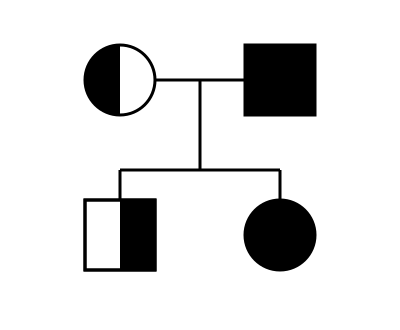
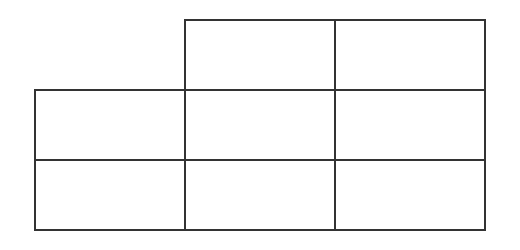
Using the pedigree in Figure 13, choose the row that gives the correct status of mother, father and son. Tick one box.
Our own questions on this topic, marked straight away, so you see what to revise. Free now.
Show model answer for 09.1Hide model answer for 09.1
Mother carrier, father affected, son carrier. The father is a solid symbol, so he is affected. The mother and the son are half shaded, so they are carriers.
How the marks are earned
- Tick the row: mother carrier, father affected, son carrier.
Thick, sticky mucus builds up in cystic fibrosis. What does it do to the airways?
See how you would score on Inherited DisordersShow model answer for 09.2Hide model answer for 09.2
The cilia cannot shift the thick mucus, so it blocks the airways and makes breathing hard.
Bacteria and other pathogens get stuck in the mucus, so the chance of a lung infection goes up.
How the marks are earned
- Any two of: the mucus cannot be moved (the word cilia is not needed); bacteria, pathogens (a named pathogen counts) or dust get trapped; infection (a higher chance of it is not needed); a narrower airway, coughing or breathing difficulty.
- Credited: unable to move pathogens; a blocked airway; less gas exchange.
Why it scores
The first mark is for the mucus staying put and the narrower airway or breathing difficulty.
The second mark is for the trapped pathogens, or the infection that follows.
Revise Inherited DisordersHuntington's is dominant. Use the Punnett square to explain the phenotypes of children from a heterozygous parent and an unaffected parent.
See how you would score on Inherited DisordersShow model answer for 09.3Hide model answer for 09.3
parents: Hh (affected) and hh (unaffected) gametes from Hh: H and h, across the top gametes from hh: h and h, down the side
row h: Hh and hh row h: Hh and hh offspring: Hh, hh, Hh, hh
There is a 50% chance of an affected child and a 50% chance of an unaffected child.
Hh gives the disease, since one dominant allele is enough. hh is healthy: both alleles are recessive and there is no dominant allele.
How the marks are earned
- One mark: correct parent genotypes Hh and hh (any letter); the gametes may go either way round the square.
- One mark: four offspring Hh, Hh, hh and hh in the square.
- One mark: 50% of the children affected, or 50% unaffected. Either statement earns it. 2/4, ½, 1 in 2 or 1:1 are credited for 50%. Half are carriers is rejected.
- One mark: one dominant allele is enough to be affected, or unaffected because there are two recessive alleles, or no dominant allele (naming Hh or hh is not needed). Either statement earns it. Heterozygous affected and homozygous recessive unaffected, both together, is credited.
- The first and second marks can be awarded from the Punnett square alone.
- The offspring mark carries an error forward from wrong parent gametes.
Why it scores
First mark: the parent genotypes and gametes are set out correctly on the square.
Second mark: the four offspring in the square are right.
Third mark. Two of the four boxes are Hh and two are hh.
Fourth mark, which ties each genotype to its phenotype.
Revise Inherited DisordersExplain the steps for getting DNA out of strawberries and why each is done, then describe what a DNA molecule looks like.
See how you would score on DNA GenomeShow model answer for 09.4Hide model answer for 09.4
Crush the strawberry to give a bigger surface area and break up the tissue. Then add detergent to dissolve the membranes and let the DNA out.
Protease digests the proteins. A warm water bath makes this go faster.
Salt makes the DNA clump together, and filtering removes the insoluble bits. Adding ice-cold ethanol makes the DNA come out of solution as a visible solid.
DNA is a polymer of nucleotides, arranged in a double helix of two strands, with a sugar-phosphate backbone.
The bases link the two strands. A always pairs with T and C with G, and weak hydrogen bonds hold each complementary pair.
How the marks are earned
- Level marked. Level 3 (5 to 6 marks): the extraction and the DNA structure are both described in detail, with reasons for at least three extraction stages AND complementary base pairs joined by hydrogen bonds, in a clear, logical order. Level 2 (3 to 4 marks): both are described briefly, or one in detail, with reasons for at least two stages. Level 1 (1 to 2 marks): a brief account of the structure or the extraction, with a reason for one stage, or two extraction stages (no reasons needed), or two ideas about structure.
- Extraction steps with reasons: crush the fruit (more surface area, breaks up tissue); add detergent (breaks membranes); add protease (digests proteins); warm in a water bath (speeds up the reaction); add salt (DNA clumps); filter (removes insoluble material); add ice-cold ethanol (DNA comes out of solution and is visible).
- Structure: two strands twisted into a double helix, each a chain of nucleotides; sugar and phosphate form the backbone; bases face inwards and join the strands; adenine matches thymine and cytosine matches guanine (A with T, C with G); weak hydrogen bonds hold each pair.
Why it scores
Two stages, each with a reason. Level 3 needs reasons for three or more stages.
More stages with reasons build a detailed account.
These last stages finish the process in order, each with its reason.
This begins the structure, using the correct key terms.
Complementary pairs held by hydrogen bonds are needed for the top level, 5 to 6 marks.
Revise DNA Genome