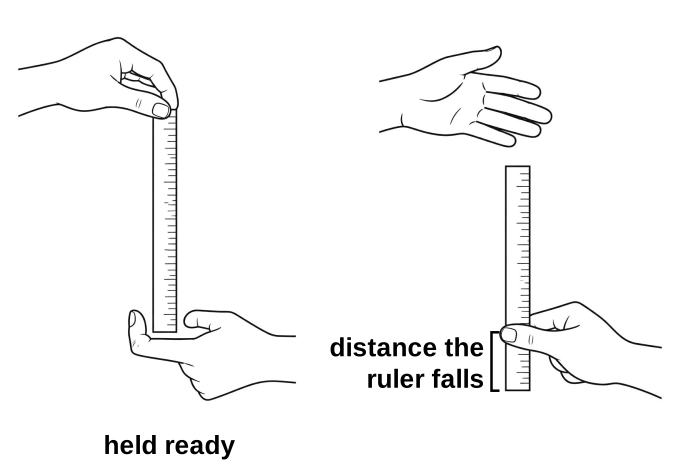
A ruler is held so that it hangs between a student's open thumb and finger. It is let go and caught, and the fall distance is recorded (Figure 9). Three students repeated the test five times. Figures 11 and 12 deal with a sensory neurone and with impulse speed.
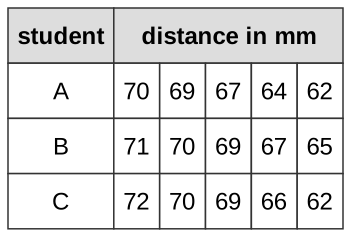
Five results are recorded for each student. How do you get one student's median?
Our own questions on this topic, marked straight away, so you see what to revise. Free now.
Show model answer for 08.1Hide model answer for 08.1
Put the five results in order, then take the middle one, the third value.
How the marks are earned
- Find the middle value (ordering not needed), or put the results in order and take the third value. The third value with no ordering earns nothing.
Name one variable to keep constant in the test, and say why it must be kept constant.
See how you would score on Nervous SystemShow model answer for 08.2Hide model answer for 08.2
The height the ruler is held at, which is its start point.
Keeping it constant makes the test valid, so the students' results can be compared.
How the marks are earned
- One mark: a controlled variable, one of: the ruler's starting height; where the catching hand begins; the gap between thumb and fingers; use of the same hand; food, drink, drugs or sleep. Tiredness also counts.
- AND one mark: so that the test is valid, or the results are comparable.
Why it scores
The first mark is for a variable that must be controlled.
The second mark is for why it is controlled: valid, comparable results.
Revise Nervous SystemFigure 10 shows five distances for each of three students. Explain one conclusion about reaction time that the results support.
See how you would score on Nervous SystemShow model answer for 08.3Hide model answer for 08.3
Student A reacted fastest.
For A the ruler fell least, a mean of 66.4 mm, against 67.8 mm for C and 68.4 mm for B. A shorter fall means a quicker catch.
How the marks are earned
- Route one: A responds soonest (1), since A's ruler fell the smallest distances, mean 66.4 mm (1).
- Route two, as an alternative: B responds latest (1), since B's ruler fell the biggest distances, mean 68.4 mm (1).
- Route three, as an alternative: the reaction time, or fall distance, shrinks with repeats (1), because the student gets used to, or practised at, the test (1).
- Any one route earns the two marks.
- Credited: A caught it faster; B caught it more slowly; the time to catch falls.
Why it scores
The first mark is for the conclusion.
The second mark is for evidence from Figure 10 tied back to the conclusion. The means come from the five distances.
Revise Nervous SystemPlan an investigation, using the ruler method, into how two different caffeine drinks change reaction time.
See how you would score on Nervous SystemShow model answer for 08.4Hide model answer for 08.4
Each student does the ruler test before having any drink, as a control. Then one student has the first caffeine drink and another has the second.
Give both students the same volume of drink, and test them again after the same wait.
Do it again with more students for each drink and work out the mean fall distance per drink.
How the marks are earned
- Any three of four: one student per different caffeine drink; test before and after the drink, or have a control; control a variable; repeat with more students (per drink is not needed), or calculate the mean.
- Using the same student with a gap in time is also credited. The same drink volume, or the same wait between drinking and testing, is also credited.
Why it scores
Tests before and after let the effect of the drink show, and different drinks go to different students.
This controls variables, so the only difference is the drink.
Repeating and finding the mean makes the results more reliable.
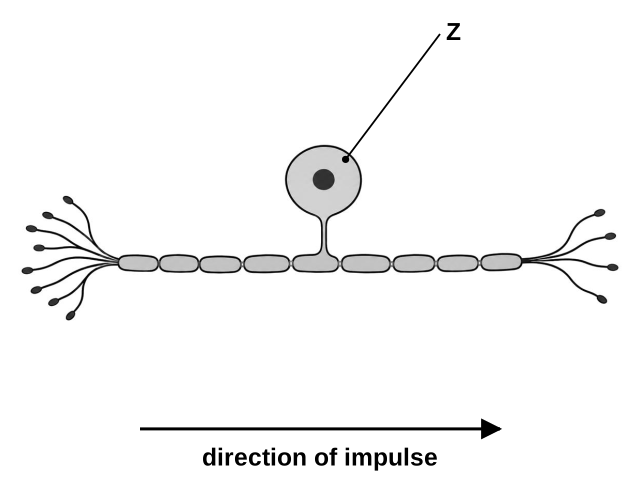
Revise Nervous SystemName structure Z shown in Figure 11.
See how you would score on Nervous SystemShow model answer for 08.5Hide model answer for 08.5
The cell body.
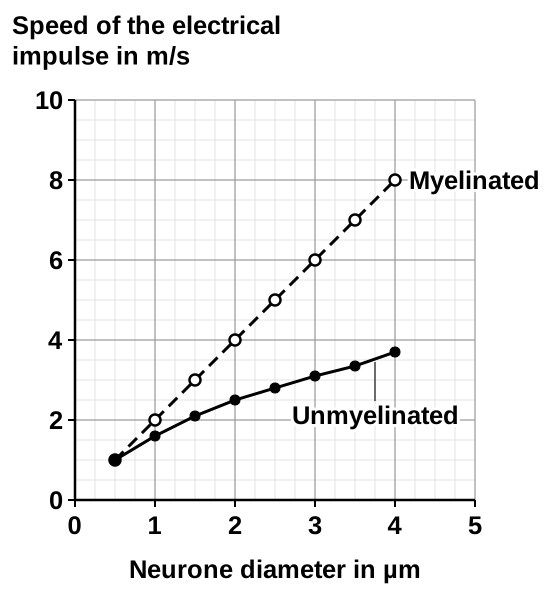
Look at Figure 12 and comment on what happens to impulse speed as neurone width changes.
See how you would score on Nervous SystemShow model answer for 08.6Hide model answer for 08.6
Wider neurones carry impulses faster, in myelinated and unmyelinated neurones alike.
Past 0.5 µm the myelinated speed climbs more steeply and is higher. The myelinated line is a straight line.
For instance from 1 to 4 µm the myelinated speed rises from 2 to 8 m/s, while the unmyelinated speed rises from about 1.6 to 3.7 m/s.
How the marks are earned
- Any three of: wider neurones carry impulses faster; beyond 0.5 µm myelinated neurones show a greater increase in speed (the phrase after 0.5 µm is not needed); a correct data comparison taken from the graph.
- Myelinated neurones being faster than unmyelinated ones is credited.
- Credited: the myelinated rise is linear; the reverse argument for unmyelinated neurones.
- A speed quoted for only one width is ignored.
Why it scores
The first mark is for the link between width and speed.
The second mark is for the bigger rise in myelinated neurones.
The third mark needs speeds read at two widths to show the effect of width. A speed quoted for one width only is ignored.
Revise Nervous System