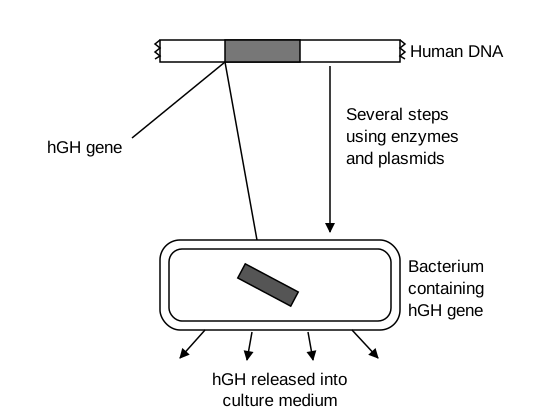
The pituitary gland makes human growth hormone (hGH), a protein. A child lacking hGH can be given it by injection. Genetic engineering can make hGH, and Figure 4 summarises the process. Farm animal urine is another source of growth hormone (GH).
Name one pituitary hormone other than hGH.
Our own questions on this topic, marked straight away, so you see what to revise. Free now.
Show model answer for 04.1Hide model answer for 04.1
ADH, antidiuretic hormone. It acts on the kidneys to control the water level of the blood.
How the marks are earned
- Any correct pituitary hormone other than hGH, for example ADH (antidiuretic hormone), FSH, LH or TSH.
- Saying what the hormone does is ignored.
Why it scores
ADH is one correct answer. FSH, LH and TSH are also made in the pituitary gland.
Revise Human Endocrine SystemSay what would happen to hGH in a swallowed tablet, given that hGH is a protein.
See how you would score on Enzymes in DigestionShow model answer for 04.2Hide model answer for 04.2
The hGH would be digested. Protease enzymes in the stomach and small intestine would break the protein down into amino acids, so little or no hGH would reach the blood.
How the marks are earned
- Any one idea: the protein is broken down into amino acids (digested is accepted for broken down); protease would digest it; digestion in the stomach, or in the small intestine, would break it down (saying that enzymes do it is not needed); it would be digested so that it is not absorbed.
- Broken down is accepted in place of digested throughout.
Why it scores
A protein is digested by protease, so a swallowed tablet would be broken down before it could be absorbed. This is why hGH is injected.
Revise Enzymes in DigestionDescribe how the hGH gene gets from human cells into bacteria, using Figure 4.
See how you would score on Genetic EngineeringShow model answer for 04.3Hide model answer for 04.3
Use an enzyme to cut the hGH gene out of the human DNA. This isolates the gene.
Join the gene into a plasmid, using an enzyme to insert it, so the plasmid now carries the hGH gene.
Put the plasmid containing the gene into a bacterium. The bacterium then makes hGH, which is released into the culture medium.
How the marks are earned
- One mark: isolate the hGH gene from the human DNA or chromosome. Cutting the gene out of the DNA or chromosome is also accepted.
- One mark: join the gene to a plasmid (the word cut is not needed).
- One mark: put the plasmid into a bacterium (saying that it contains the gene is not needed).
- One mark: an enzyme is used at a suitable stage, either to cut the hGH gene out of the human DNA or an enzyme used to insert or join the gene into the plasmid (or into bacterial DNA). Naming an enzyme used in genetic engineering is also accepted.
Why it scores
This earns the isolating mark. It also brings in an enzyme at a sensible point, the one that cuts the gene free.
This is the mark for joining the gene to a plasmid. The enzyme that inserts the gene is a second suitable use, so the enzyme mark is safe from either sentence. It is given once only.
The last mark is for getting the plasmid into the bacterium. Figure 4 shows the hGH leaving the bacterium.
Revise Genetic EngineeringGive two reasons genetically engineered hGH beats GH from animal urine, with no ethical or religious reasons.
See how you would score on Genetic EngineeringShow model answer for 04.4Hide model answer for 04.4
1. The hGH is the human hormone, so there is much less chance of the patient's immune system reacting to it.
2. Hormone from animal urine could carry animal pathogens, but hGH made by bacteria cannot pass an animal disease to people.
How the marks are earned
- Any two reasons, one mark each: it is easier to isolate, purify or extract; larger quantities can be produced; an immune response is less likely or impossible, and rejection is accepted in its place; animal pathogens or infection are less likely, or unable, to pass to people, and a named animal disease such as BSE is accepted; antibiotics, urea or other drugs are less likely to be present, or absent; it is the human hormone itself, so it may work better in the body, and saying animal GH may have the wrong shape is accepted.
- The opposite is accepted where it is clearly about GH from animals.
- Speed of production, side effects, ethical reasons, religious reasons and cost are ignored.
Why it scores
One mark for a lower chance of an immune reaction or rejection. Rejection is also accepted.
A different second reason: diseases of the animals cannot reach patients through the product.
Revise Genetic Engineering