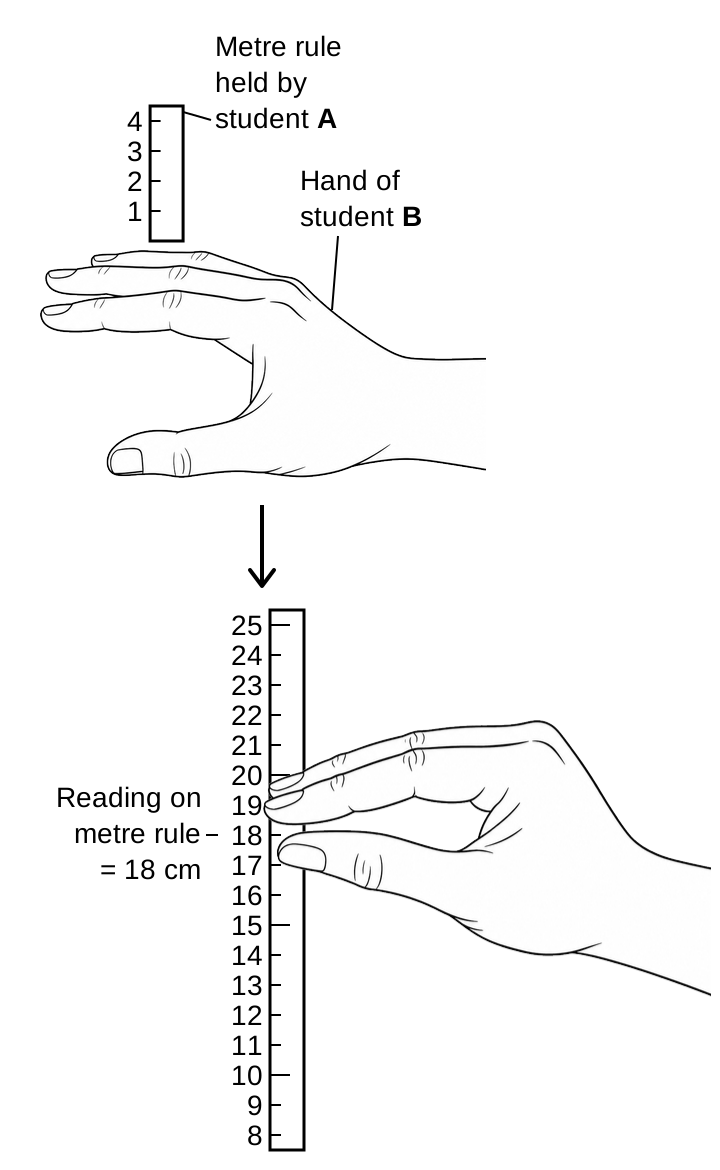
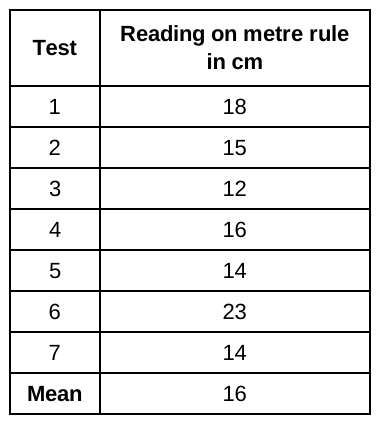
Two students tested reaction time. One student, A, dangles a metre rule over the open hand of the other, B, lets go, and B catches it as fast as possible. A reads the scale where B's hand closed, and the test is done seven times (Figure 7, Table 3). Reaction time t in seconds comes from the mean distance d in centimetres by the equation t = √(2d ÷ 980), with all of 2d ÷ 980 under the square root.
Find the median of the readings in Table 3. Tick one box.
Our own questions on this topic, marked straight away, so you see what to revise. Free now.
Show model answer for 07.1Hide model answer for 07.1
Readings in order: 12, 14, 14, 15, 16, 18, 23 The middle value of the seven is 15 cm.
How the marks are earned
- Tick 15 cm, the middle of the seven readings once they are put in order.
Why it scores
The median is the middle value of an ordered list. 16 cm is the mean, not the median.
Revise Nervous SystemUse the equation and the mean reading in Table 3 to find B's mean reaction time in milliseconds, to 3 significant figures.
See how you would score on Nervous SystemShow model answer for 07.2Hide model answer for 07.2
t = √((2 × 16) ÷ 980)
t = 0.1807... s
0.1807 s × 1000 = 180.7 ms
t = 181 ms (3 s.f.)
How the marks are earned
- One mark: substitute the mean distance into the equation, set out as √(2 × 16 ÷ 980) or √(32 ÷ 980), giving a time in seconds.
- One mark: the time in seconds, 0.1807 and so on.
- One mark: convert to milliseconds, 180.7.
- One mark: 180.7 written with 3 significant figures, which is 181 ms.
- Under the board's general rule for calculations, a correct numerical answer of 181 milliseconds, with no working shown, earns full marks. The change to milliseconds may be made at any step. Later marks can follow from a student's own wrong value, and the last mark is also earned by a student's seconds value that was never converted, so long as it is rounded correctly to three digits that count.
Why it scores
First mark: put d = 16 cm into the equation. 16 is the mean in Table 3, since 112 ÷ 7 = 16. √(32 ÷ 980) is also accepted.
Second mark: the time in seconds from the calculator.
Third mark: there are 1000 ms in 1 s, so multiply by 1000.
Fourth mark: rounded to 3 significant figures. The next digit is 7, so the 0 rounds up to 1.
Revise Nervous SystemDescribe two ways to improve this investigation, apart from repeating readings.
See how you would score on Nervous SystemShow model answer for 07.3Hide model answer for 07.3
1. Use a ruler marked in millimetres, so the readings are more precise.
2. Line up the 0 cm mark with the top of B's thumb each time, so the ruler always starts from the same position.
How the marks are earned
- Any two improvements, one mark each: use a ruler with finer divisions such as millimetres, where a more precise scale or a better resolution is accepted; line up the 0 cm mark with the top or bottom of B's thumb, where the same starting position of the ruler above B's hand is accepted; keep the same gap between B's fingers and thumb; B supports the arm, hand, wrist or elbow on the bench or table, where making sure the hand is stationary is accepted; always use the same hand, dominant or not; convert the distance to a time; drop the ruler with no warning, or at random time intervals.
- A ruler described only as more accurate is ignored.
- Also credited: a mechanical or electronic holder and dropper for the ruler; managing distraction, caffeine, sleep or alcohol; software that measures reaction time.
Why it scores
A scale with finer divisions gives a better resolution, so small differences in reaction time can be measured. This is one mark.
A fixed starting position makes the distance fallen the same kind of measurement every time. This is a second mark.
Revise Nervous SystemDescribe how the nervous system coordinated student B's catch of the falling ruler.
See how you would score on Nervous SystemShow model answer for 07.4Hide model answer for 07.4
Receptors in the retina of the eye detect the ruler moving. This movement is the stimulus.
The receptors generate electrical impulses, which travel along the optic nerve to the brain.
Sensory neurones in the optic nerve carry impulses to the brain, then a relay neurone passes them on to a motor neurone.
At each gap between neurones, a synapse, a chemical crosses to pass the signal on.
The motor neurone sends impulses to the muscles in the fingers, hand and arm. These effectors contract and the ruler is caught.
How the marks are earned
- One mark: receptors (the words in the eye are not needed), or the retina, detect the stimulus or the movement of the ruler.
- One mark, any one of: impulses (or electrical signals) are generated, transmitted or travel. Messages or information is ignored.
- One mark: impulses pass from a sensory neurone to a motor neurone, with or without a relay neurone between them.
- One mark: the optic nerve to the brain (the word along is not needed). The CNS or the spinal cord is ignored.
- One mark: a chemical crosses the synapses between neurones.
- One mark: an effector, or a muscle in the fingers, hand or arm, contracts (the reason, to catch the ruler, is not needed).
Why it scores
First mark: receptors in the eye detect the stimulus.
Two marks: impulses are generated and travel, and they reach the brain along the optic nerve.
Another mark: the pathway of neurones, sensory then relay then motor.
Another mark: chemicals cross the synapses.
The last mark: the effector contracts. Six separate points are covered, so all 6 marks can be earned.
Revise Nervous System