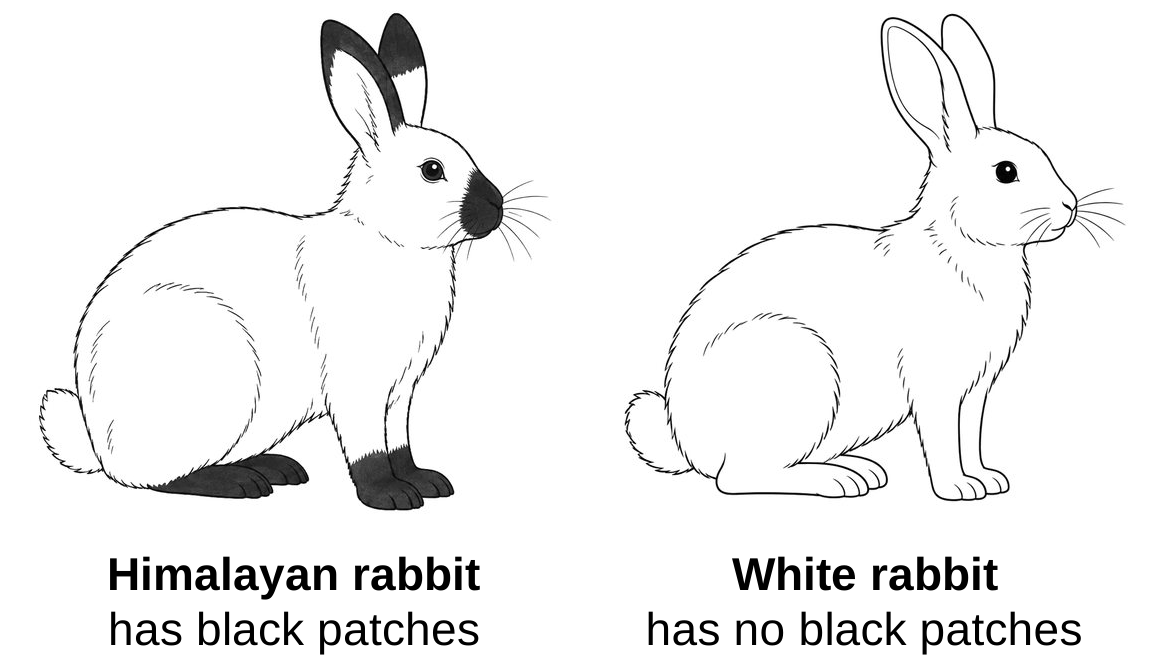
An adult Himalayan rabbit is mostly white but dark at its nose, ears and feet, while a white rabbit has no dark patches (Figure 8). A dominant allele, H, gives the Himalayan pattern and a recessive allele, h, gives white fur. A heterozygous Himalayan male was bred repeatedly with two Himalayan females, A and B. All 210 offspring with A were Himalayan. With B, the 240 offspring included both Himalayan and white rabbits. The black colour is melanin, which is made from tyrosine in two stages, the first using the enzyme tyrosinase (Figure 9). White rabbits have one base changed in the gene for tyrosinase. Young Himalayan rabbits are white all over for four weeks, which they spend in the nest beside their mother, and the dark areas then develop. Rabbits keep their bodies at 39 °C. Tyrosinase works best from 15 °C to 25 °C and not at all above 35 °C. Human skin also makes melanin, which soaks up ultraviolet (UV) light from the Sun before it gets far into the skin, and UV counts as ionising radiation.

Give female A's genotype and the reason for your answer.
Our own questions on this topic, marked straight away, so you see what to revise. Free now.
Show model answer for 08.1Hide model answer for 08.1
Genotype: HH
All 210 offspring were Himalayan and none were white, so A passes on an H allele every time and carries no h allele.
How the marks are earned
- One mark: the genotype is HH. Homozygous dominant is also accepted.
- One mark, which needs HH to have been given: every offspring inherited an H; or A hands an H on to each young rabbit; or not one young rabbit was white, so A carries no h.
Why it scores
First mark. Female A is homozygous dominant.
Second mark, which depends on HH. If A carried an h allele, about a quarter of the offspring would be hh and white.
Revise Genetic InheritanceDraw a Punnett square using H and h for the cross with female B: gametes, genotypes, appearance of each, and the chance of white.
See how you would score on Genetic InheritanceShow model answer for 08.2Hide model answer for 08.2
Some offspring were white (hh), and the male is Hh, so female B must be Hh as well. Gametes from each parent: H or h
The four boxes of the Punnett square, one for each pairing: H from female with H from male: HH H from female with h from male: Hh h from female with H from male: Hh h from female with h from male: hh
HH and Hh are Himalayan hh is white
probability of a white offspring = 1 ÷ 4 = 0.25
How the marks are earned
- One mark: the gametes shown correctly for both parents, H and h from each.
- One mark: the four offspring genotypes worked out correctly, HH, Hh, Hh and hh. Correct genotypes worked out from wrong gametes are also credited.
- One mark: the right appearance for each genotype, HH and Hh Himalayan and hh white. Correct appearances for the genotypes the student has written are also credited.
- One mark: the probability of a white offspring, correct for the offspring genotypes the student has written, for example 1 in 4, 25%, ¼ or 0.25. A ratio of 1:3 is also accepted. Not accepted: 1 in 3, a ratio of 1:4, a ratio of 3:1, 0, or 100%.
Why it scores
First mark. Both parents are heterozygous, so each makes H gametes and h gametes.
Second mark: the four offspring genotypes. A Punnett square is the usual way to show them, as a 2 by 2 grid with H and h across the top and down the side, and the four pairings here are its four boxes.
Third mark: the dominant allele H gives the Himalayan pattern, so only hh is white.
Fourth mark: one of the four boxes is hh. 25% and 1 in 4 are also accepted.
Revise Genetic InheritanceExplain how a one-base change in the tyrosinase gene could stop the enzyme working.
See how you would score on DNA GenomeShow model answer for 08.3Hide model answer for 08.3
A change of one base changes the group of three bases that codes for one amino acid.
So a different amino acid is put into the protein chain.
That changes the way the chain folds, so the shape of the active site of tyrosinase changes.
Tyrosine no longer fits the active site, so no enzyme-substrate complex forms and tyrosinase cannot work.
How the marks are earned
- One mark: the base change gives a different group of three bases, which can also be called a different triplet. The word codon on its own is ignored.
- One mark: a different amino acid is therefore specified by that group.
- One mark: the active site of the enzyme is altered in shape, or the site stops being complementary (naming tyrosine or the substrate is not needed).
- One mark: so tyrosine, or the substrate, no longer fits, or no enzyme-substrate complex can form.
Why it scores
First mark: a different set of three bases.
Second mark: the altered triplet specifies another amino acid.
Third mark: the enzyme's shape, and so its active site, is altered.
Fourth mark: the substrate cannot bind, so the enzyme cannot do its job.
Revise DNA GenomeExplain what causes the nose, ears and feet to be white during the rabbit's first four weeks.
See how you would score on Enzymes in DigestionShow model answer for 08.4Hide model answer for 08.4
In the nest the young rabbit is with its mother, whose body temperature is 39 °C, so the temperature in the nest is above 35 °C.
Above 35 °C tyrosinase is not active, so no melanin can be made and the fur stays white.
How the marks are earned
- One mark: the temperature inside the mother's body, or inside the nest, is above 35 °C. The mother's body temperature being 39 °C is also accepted.
- One mark: so tyrosinase, the enzyme, does not work. Saying it is inactive is also accepted. Saying the enzyme is denatured is not accepted.
Why it scores
First mark: the temperature in the nest and in the mother's body is above 35 °C.
Second mark: the enzyme is not working. Write that it is inactive or does not work, because denatured is not accepted here.
Revise Enzymes in DigestionFrom four weeks the rabbits live outside the nest. Explain why dark fur now develops at the nose, ears and feet.
See how you would score on Temperature RegulationShow model answer for 08.5Hide model answer for 08.5
Outside the nest the environment is cooler than 35 °C.
The ears, nose and feet lose heat easily, so their temperature drops more than the rest of the body.
At these lower temperatures tyrosinase is active, so melanin is made and the fur turns black.
How the marks are earned
- One mark: the outside environment is cooler, or is below 35 °C (a comparison with the nest is not needed).
- One mark: the ears, nose or feet lose heat, or their temperature falls. Extremities is accepted in place of ears, nose or feet. The comparison with the rest of the body is not needed.
- One mark: so tyrosinase is active, or more active.
Why it scores
First mark: a cooler environment than the nest.
Second mark: the extremities lose heat, which is why only those parts go black.
Third mark: the enzyme works below 35 °C, so melanin can form.
Revise Temperature RegulationExplain why making melanin helps human skin that is exposed to bright sunlight.
See how you would score on Cancer and Cell Division ControlShow model answer for 08.6Hide model answer for 08.6
Melanin absorbs UV radiation, so less of it reaches deep skin cells and causes mutations in their DNA.
A mutation can make a cell divide in an uncontrolled way, which can lead to a tumour and skin cancer.
How the marks are earned
- One mark: melanin stops UV or ionising radiation causing mutations (the words in skin cells are not needed). Saying that UV or ionising radiation can cause mutations is also accepted.
- One mark: mutations can lead to cancer (the word skin is not needed). Describing cancer, for example tumours or uncontrolled cell division, is also accepted.
Why it scores
First mark: melanin protects the DNA of skin cells from mutation.
Second mark: the link from mutation to skin cancer.
Revise Cancer and Cell Division Control