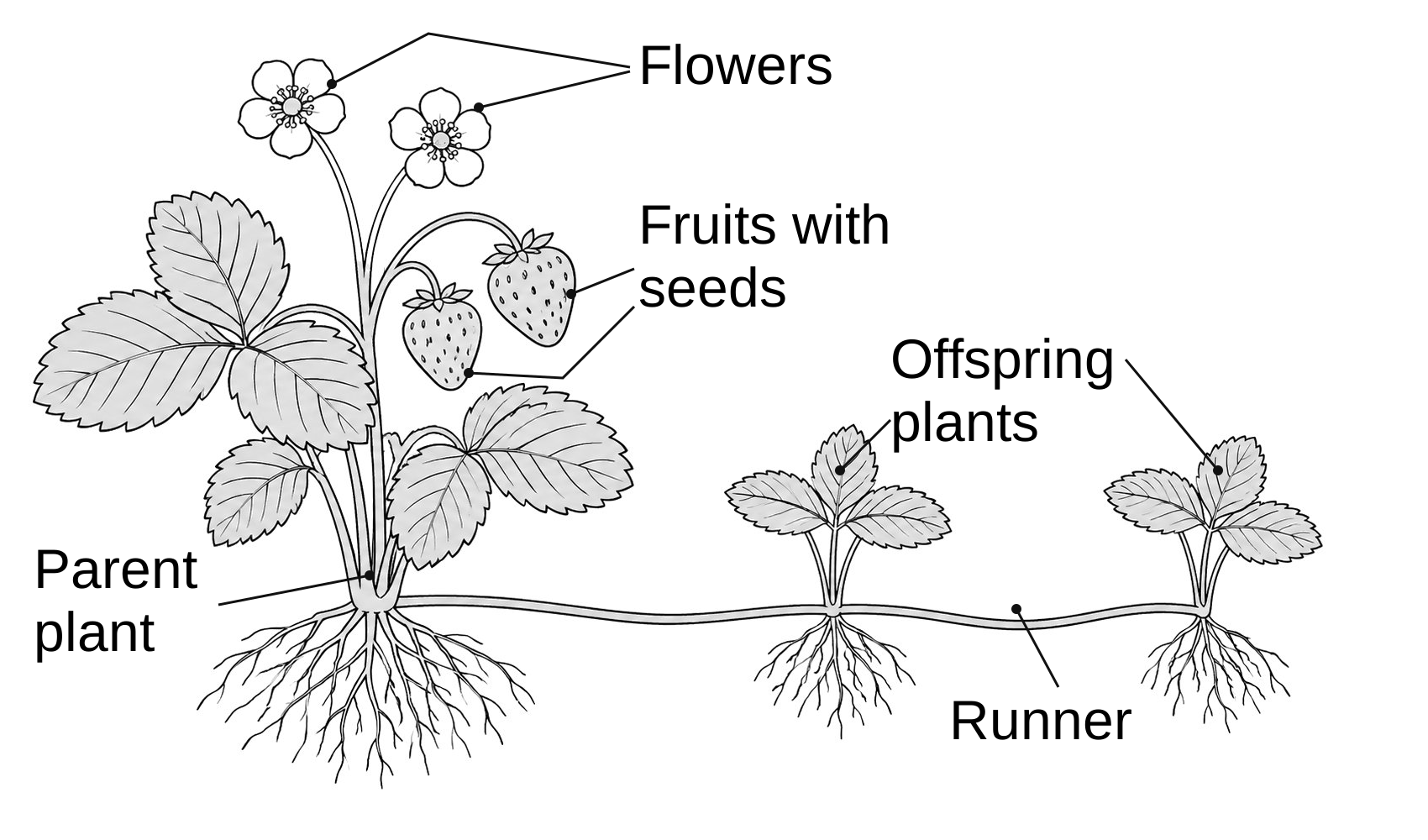
Figure 5 follows cells dividing to make human sperm, with cells lettered and divisions numbered. Strawberry plants reproduce sexually and asexually: by flowers, fruits and seeds, and by runners, which are horizontal stems (Figure 6).
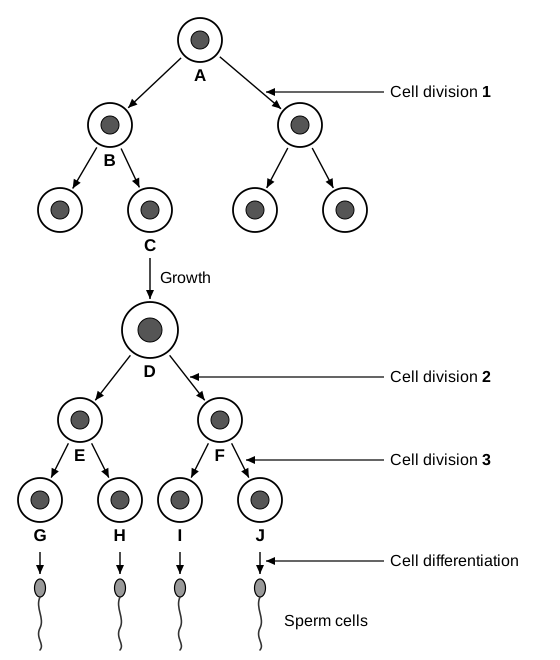
Pick the cell division in Figure 5 that is mitosis. Tick one box.
Our own questions on this topic, marked straight away, so you see what to revise. Free now.
Show model answer for 06.1Hide model answer for 06.1
Division 1, the division of cell A. It makes identical cells for growth, and the cells grow afterwards. Divisions 2 and 3 end in sperm cells, which come from meiosis.
How the marks are earned
- Tick division 1, the division of cell A.
Why it scores
Mitosis gives identical body cells for growth. Sperm cells are gametes, and gametes are made by meiosis.
Revise Mitosis and the Cell CycleChoose the pair of cells in Figure 5 that carry identical genetic information. Tick one box.
See how you would score on Mitosis and the Cell CycleShow model answer for 06.2Hide model answer for 06.2
Cells A and C. Cell C comes from cell A only through mitosis, which copies the DNA exactly, so the two cells are genetically identical.
How the marks are earned
- Tick cells A and C.
Why it scores
Cells made by mitosis match their parent cell. The cells in the pairs F and J, and G and H, were made by meiosis, so they differ.
Revise Mitosis and the Cell CycleState the chromosome number of cell J in Figure 5.
See how you would score on Sex DeterminationShow model answer for 06.3Hide model answer for 06.3
23. Cell J is made by meiosis and will become a sperm cell, so it has 23 chromosomes, half the usual 46.
How the marks are earned
- Cell J has 23 chromosomes, which may be written as a number or in words.
- 23 pairs is not accepted.
Why it scores
A human body cell has 23 pairs, which is 46 chromosomes. A gamete has 23 single chromosomes, so writing 23 pairs would be wrong.
Revise Sex DeterminationIn Figure 5, count the lettered cells from C to J that carry a Y chromosome.
See how you would score on Sex DeterminationShow model answer for 06.4Hide model answer for 06.4
5 cells: C, D, one of E and F, and the two cells that come from it.
How the marks are earned
- Five, or six. Reference to letters is ignored.
Why it scores
C and D each have 46 chromosomes, including an X and a Y. Only one of E and F receives the Y, and it passes the Y to its two daughter cells. Six is also accepted, but the biology gives five, because only one of E and F receives the Y.
Revise Sex DeterminationExplain why offspring grown from runners are genetically identical.
See how you would score on Mitosis and the Cell CycleShow model answer for 06.5Hide model answer for 06.5
Offspring from runners are made by mitosis only.
Mitosis copies all the DNA, so every new cell gets a full set of chromosomes, with a copy of every gene and allele from the parent.
How the marks are earned
- One mark: mitosis (the word only is not needed). Meiosis, and the misspellings meitosis and metosis, are not accepted.
- One mark: so each new cell is given every allele or gene of the parent. Credited too: each cell getting a duplicate of all the DNA, a duplicate of every chromosome, or a full set of chromosomes.
Why it scores
First mark. Runners are asexual reproduction, which uses mitosis and no gametes.
Second mark: every cell receives all the parent's alleles, so the offspring match the parent and each other.
Revise Mitosis and the Cell CycleExplain why offspring grown from seeds are not all genetically identical.
See how you would score on VariationShow model answer for 06.6Hide model answer for 06.6
Sexual reproduction uses gametes, and gametes are made by meiosis.
Meiosis shuffles the alleles at random, and fertilisation joins two gametes, so each seed gets a new, different mix of alleles from its two parents.
How the marks are earned
- One mark: the gametes are made by meiosis.
- One mark: so the offspring receive unique, different or random combinations of alleles, genes or chromosomes from each parent or gamete. Saying the gametes fuse to give unique, different or random combinations in the offspring is also accepted.
Why it scores
First mark, for meiosis as the way gametes are made.
Second mark: random combinations of alleles from each parent, so the offspring differ from one another.
Revise VariationGive two ways asexual reproduction by runners helps strawberry plants survive.
See how you would score on CloningShow model answer for 06.7Hide model answer for 06.7
1. Only one parent is needed, so the plant does not rely on bees or other pollinators.
2. The offspring are genetically identical to a parent that already suits the conditions, so they are well adapted to them too.
How the marks are earned
- Any two advantages, one mark each: it is faster than sexual reproduction; many offspring are made, to colonise the local area or to out-compete other species; the offspring are genetically identical to the parent, so they are well adapted to the current conditions or environment; only one parent is needed, so no pollinators or bees are required; the parent passes water to the offspring together with sugars, minerals, ions or salts (water is needed along with at least one of the others; sugars or minerals alone is not enough); less energy or fewer materials are used because no gametes, flowers, seeds or fruits have to be made (either one is enough).
Why it scores
Only one parent is needed, so no pollinators or bees are needed. This is one mark.
A second, separate advantage: identical offspring keep the features that work in the present environment.
Revise CloningGive two ways sexual reproduction by flowers and seeds helps strawberry plants survive.
See how you would score on VariationShow model answer for 06.8Hide model answer for 06.8
1. The offspring show genetic variation, so some may be better adapted if the environment changes.
2. Seeds are scattered over a wide area, so the young plants do not compete with the parent plant for space, water and minerals.
How the marks are earned
- Any two advantages, one mark each: new combinations of alleles give genetic variation, or the variation gives a selective advantage. Also accepted: variation gives a chance for the species to evolve; variation lets the species adjust to new or altered surroundings.
- Seeds are dispersed to a new or wider area, so the plants face less risk from loss of habitat, or avoid competing for space, water or minerals (naming the parent or offspring plants is not needed).
- A larger number of offspring is produced, so the population increases quickly. Also accepted: a larger number of offspring improves the survival of the species.
Why it scores
New combinations of alleles give variation, which gives a selective advantage. This is one mark.
A second advantage, which is not about variation: dispersal avoids competition and reduces the risk from habitat loss.
Revise Variation