The lining of the lung airways has two kinds of cell side by side, goblet cells and ciliated cells (Figure 2). Later, a respirometer measures how fast maggots respire (Figure 4): they sit on a wire mesh over soda lime in a sealed tube, and a coloured drop in a narrow side tube moves along a millimetre scale. Figure 5 is that scale with no drop drawn.
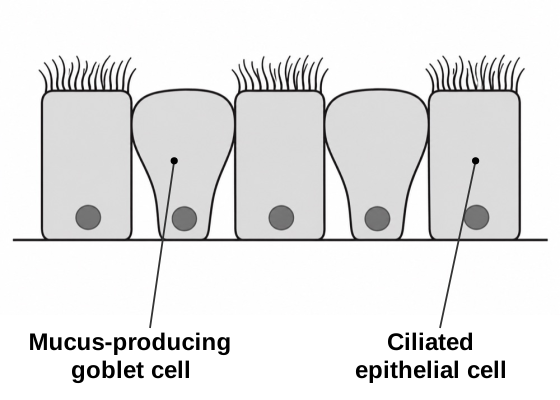
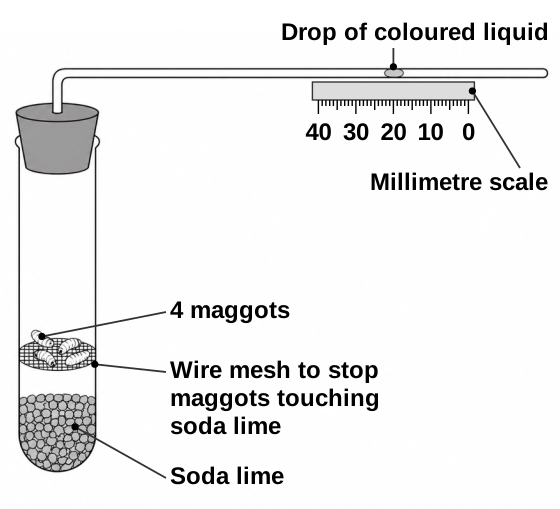
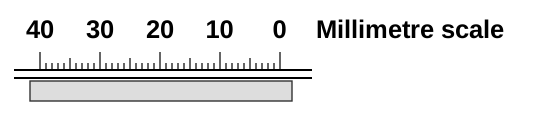
Figure 2 shows goblet cells and ciliated cells lining an airway. Describe how these cells clear pathogens out of the airways.
Our own questions on this topic, marked straight away, so you see what to revise. Free now.
Show model answer for 02.1Hide model answer for 02.1
Goblet cells make sticky mucus, and pathogens in the air we breathe get trapped in it.
The cilia on the ciliated cells beat and waft the mucus up the trachea to the throat, where it is swallowed.
How the marks are earned
- Any two of: pathogens stuck in mucus (naming pathogens is not needed); hairs or cilia moving or wafting the mucus or the pathogens (naming cilia or hairs is needed); mucus moved up the trachea, up a bronchiole, on to the throat, or swallowed.
- Micro-organisms is credited in place of pathogens.
- Hairs is credited in place of cilia.
- Away from the lungs is credited for the third point.
Why it scores
The first mark is for the pathogens being caught in the mucus.
The second mark is for the cilia moving the mucus, and the third idea, where it goes, also earns a mark. Any two of the three points earn both marks.
Revise Human Defense Systems - Non-specificIn a race, a runner's muscles respire with and without oxygen. Explain how the aerobic process supplies energy to run.
See how you would score on RespirationShow model answer for 02.2Hide model answer for 02.2
In the mitochondria of the muscle cells, glucose reacts with oxygen to make carbon dioxide and water.
The reaction is exothermic, so it releases energy that the muscles use to contract while running.
How the marks are earned
- Any two linked points: glucose reacts with oxygen; carbon dioxide and water are made; the reaction is exothermic; it takes place in the mitochondria.
- C6H12O6 and O2 are credited for glucose and oxygen.
- CO2 and H2O are credited for carbon dioxide and water.
- A correct equation for aerobic respiration earns both marks.
Why it scores
This gives the reactants, the products and where it happens. Any two of these points already earn both marks.
Exothermic is the link to energy, and it is a further mark point.
Revise RespirationIn the apparatus of Figure 4, why is soda lime put in the test tube?
See how you would score on RespirationShow model answer for 02.3Hide model answer for 02.3
To absorb the carbon dioxide the maggots give out, so the drop moves only because oxygen is used up.
The drop starts at 20 mm and moves 2 mm each minute. Mark on Figure 5 where it will be after 5 minutes.
See how you would score on RespirationShow model answer for 02.4Hide model answer for 02.4
distance moved: 2 × 5 = 10 mm new position: 20 + 10 = 30 mm Draw the drop at 30 mm, towards the test tube.
How the marks are earned
- The drop drawn at 30 mm on the scale: it moves 2 × 5, or 10 mm, towards the test tube, from 20 mm.
The test is run again with 2 maggots instead of 4. Explain what difference this makes to the way the drop moves.
See how you would score on RespirationShow model answer for 02.5Hide model answer for 02.5
With fewer maggots the drop creeps along at a lower speed and covers less of the scale in the same time.
Two maggots carry out less respiration than four, so they use up less oxygen and the pressure in the tube falls less.
How the marks are earned
- Any two linked points: the drop moves more slowly, or a shorter distance; because less oxygen is used; because less respiration takes place.
- Less carbon dioxide made or absorbed is credited in place of less oxygen used.
Why it scores
The first mark is for the effect on the drop.
The second mark is for the reason. Less respiration and less oxygen used are both mark points.
Revise RespirationGive one change that would make the results of this investigation more reliable.
See how you would score on Cell Biology Practical InvestigationsShow model answer for 02.6Hide model answer for 02.6
Repeat the whole investigation three times and calculate a mean distance moved.
How the marks are earned
- Repeat the investigation, or work out a mean.