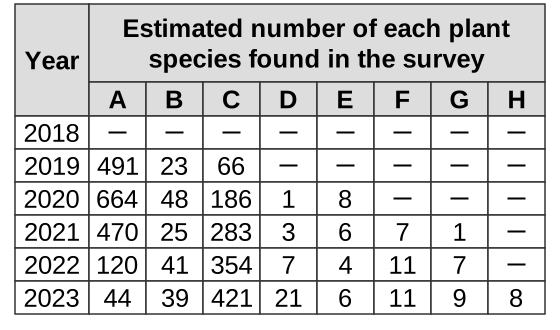
In 2018 every plant was cleared from 1000 m2 of soil, and a wall was put round the plot so people could not get in. By 2019 three plant species were growing there, two of them indigenous. The plot was surveyed each year after that, and Figure 6 gives the estimated number of plants of species A to H.
Two of the three species growing there in 2019 were indigenous. What does indigenous mean?
Our own questions on this topic, marked straight away, so you see what to revise. Free now.
Show model answer for 03.1Hide model answer for 03.1
Native: the species lives naturally in this country, where it first came from.
How the marks are earned
- Native, or coming from that country originally. The word species is not needed.
Give one item of equipment a student could use to sample how many indigenous plants grow in the plot.
See how you would score on Ecosystems CommunitiesShow model answer for 03.2Hide model answer for 03.2
A quadrat, for example a 1 m by 1 m square frame.
How the marks are earned
- A quadrat, or a square area of a stated size, for example 1 m by 1 m.
- A belt transect, a line transect or a grid is also credited.
Use Figure 6 to state the trend in the number of species C plants between 2019 and 2023.
See how you would score on Ecosystems CommunitiesShow model answer for 03.3Hide model answer for 03.3
The number of species C plants increases every year.
How the marks are earned
- It increases. Goes up or rises is credited too.
Species B fell in number in 2021, perhaps through competition. Using Figure 6, which species most likely outcompeted it? Tick one box.
See how you would score on Competition AdaptationsShow model answer for 03.4Hide model answer for 03.4
Species C. It kept growing in number while B fell. Species A was falling itself, species D stayed tiny, and species H had not yet arrived.
Suggest and explain one way in which the species you chose might have beaten species B in competition.
See how you would score on Competition AdaptationsShow model answer for 03.5Hide model answer for 03.5
Species C could have grown taller than species B, with bigger leaves.
Its leaves would shade species B, so C absorbed more light for photosynthesis and B got less.
How the marks are earned
- One mark: the species was bigger in some way, such as taller, with larger leaves or with larger roots.
- Growing more, reproducing more, taking up more space or having a higher population is also credited for this mark.
- One mark, linked to it: so it got more of a resource, such as light, water, minerals or nutrients, or it photosynthesised more.
- A named mineral is credited in place of minerals.
- The reverse argument about species B is credited, for example B was shorter so it got less light.
- Species B being hit by disease, or eaten by animals, is credited for one mark.
Why it scores
The first mark is for a feature that gave species C the advantage.
The second mark links the feature to the resource that was won.
Revise Competition AdaptationsSpecies H later got into the walled plot. Suggest one way it could have arrived.
See how you would score on Ecosystems CommunitiesShow model answer for 03.6Hide model answer for 03.6
Its seeds were blown over the wall by the wind.
How the marks are earned
- Any one of: carried in by the wind; brought in by animals; roots or shoots growing under the wall (the word growing is needed). For the wind and the animals, the word seeds is not needed.
Plants need water as well. Explain how water from the soil gets into a plant.
See how you would score on Plant Transport SystemsShow model answer for 03.7Hide model answer for 03.7
Water enters the root hair cells from the soil by osmosis.
It crosses the partially permeable cell membrane, moving from the soil, where the water concentration is higher, into the cell, where it is lower.
How the marks are earned
- Any two of: through the root hair cells (the word cells is not needed, and roots counts); by osmosis (the word osmosis is needed); across a partially permeable membrane (semi-permeable is credited); from a high to a low water concentration.
- Down a concentration gradient is credited for the last point.
Why it scores
Root hair cells and osmosis are each a mark point, so this line already earns both marks.
The membrane and the direction of movement are further mark points that make the explanation complete.
Revise Plant Transport Systems