Lactobacillus acidophilus is a bacterium that lives in cow's milk. Figure 7 is a drawing of it magnified 18 000 times, with a millimetre scale beside the cell labelled A. Figure 8 plots how fast two kinds of bacteria grow across a range of pH. In a decay study, a student kept beakers of milk in water baths at four temperatures for 72 hours and read the pH with a probe once a day; Figure 9 holds the readings.
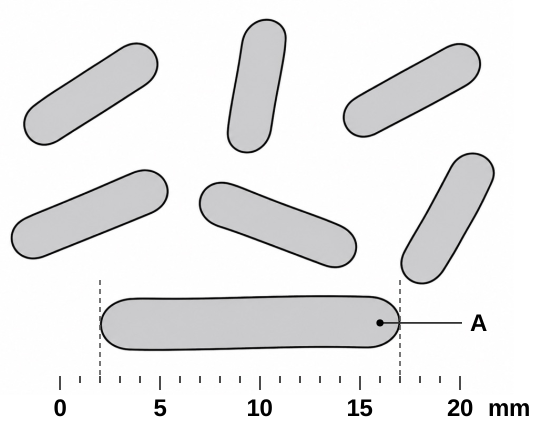
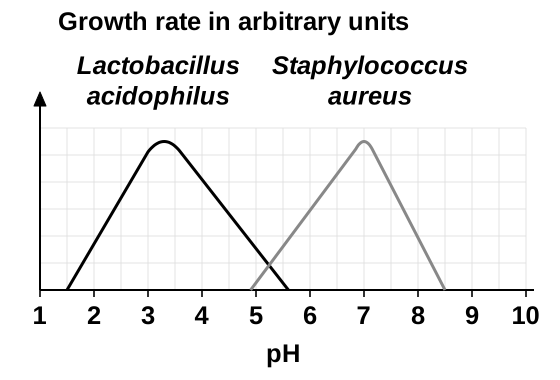
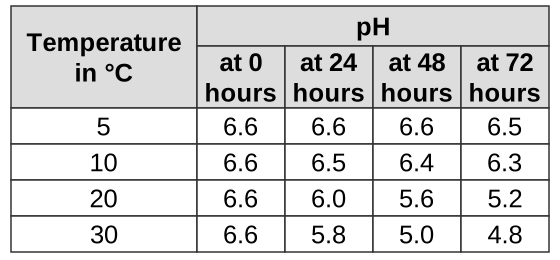
Figure 7 is magnified ×18 000. Measure bacterium A on the drawn scale, then give its real length in mm, in standard form.
Our own questions on this topic, marked straight away, so you see what to revise. Free now.
Show model answer for 04.1Hide model answer for 04.1
Bacterium A runs from 2 mm to 17 mm on the scale. length of A = 17 − 2 = 15 mm
real length = 15 ÷ 18 000 = 0.00083 mm
real length = 8.3 × 10⁻⁴ mm
How the marks are earned
- One mark: measuring A as 15 mm. Any reading from 14 mm to 16 mm is credited, and so is the reading given in cm.
- One mark: dividing the measured length by the magnification, 15 ÷ 18 000 = 0.00083 mm.
- 0.00078, 0.00086 or 0.00089 is also credited for this mark.
- One mark: the answer in standard form, 8.3 × 10⁻⁴ mm.
- 7.8 × 10⁻⁴, 8.6 × 10⁻⁴ or 8.9 × 10⁻⁴ is also credited for this mark.
- A correct answer earns all three marks with no working.
Why it scores
The first mark is for the measurement. Any reading from 14 mm to 16 mm is credited.
Dividing the image length by the magnification earns the second mark.
Writing the answer in standard form earns the third mark. A correct answer alone earns all three.
Revise MicroscopyUsing Figure 8, give one pH at which both species of bacteria can grow.
See how you would score on DecompositionShow model answer for 04.2Hide model answer for 04.2
pH 5.2, where both lines are above zero.
How the marks are earned
- A value from pH 5 up to pH 5.4, given as a whole number or to one decimal place, for example 5.2.
Use Figure 8 to describe how pH affects how fast Staphylococcus aureus grows.
See how you would score on DecompositionShow model answer for 04.3Hide model answer for 04.3
Staphylococcus aureus starts to grow at about pH 5, and its growth rate increases as the pH rises to 7.
Growth is fastest at pH 7, its optimum, then decreases until it stops at about pH 8.5.
How the marks are earned
- Any two of: growth rises as the pH goes from 5 to 7; pH 7 is the optimum; growth falls as the pH goes from 7 to 8.5.
Why it scores
The first mark is for growth getting faster between pH 5 and 7.
The optimum at 7, and growth slowing between 7 and 8.5, are each a further mark point.
Revise DecompositionWhich variable must the student keep the same in the milk investigation? Tick one box.
See how you would score on Cell Biology Practical InvestigationsShow model answer for 04.4Hide model answer for 04.4
The volume of milk. The pH is what is measured, the temperature is what is changed, and time is what the readings are taken against, every 24 hours.
How the marks are earned
- Tick how much milk is in each beaker, the volume of milk.
Use Figure 9 to describe what happened to the pH of the milk kept at 30 °C during the 72 hours.
See how you would score on DecompositionShow model answer for 04.5Hide model answer for 04.5
The pH fell at every reading, so the milk became more acidic.
It started at 6.6 and ended at 4.8, so it fell 1.8 in total, mostly within the first 48 hours.
How the marks are earned
- One mark: the pH decreases. Becoming more acidic is also credited.
- One mark: it ends at 4.8, or falls by 1.8. Giving the start value of 6.6 is not needed.
Why it scores
The first mark is for the direction of change.
The second mark is for quoting the data, either the end value or the size of the fall.
Revise DecompositionUse Figure 9 to work out the rate of decay at 20 °C over the 72 hours. Rate = change in pH ÷ time taken.
See how you would score on DecompositionShow model answer for 04.6Hide model answer for 04.6
change in pH = 6.6 − 5.2 = 1.4
rate of decay = 1.4 ÷ 72 = 0.019 change in pH per hour
How the marks are earned
- One mark: the change in pH, 6.6 − 5.2 = 1.4.
- One mark: that change ÷ 72, so 1.4 ÷ 72 = 0.019 change in pH per hour.
- 0.0194 or 0.02 is also credited.
- A correct answer alone earns both marks.
Why it scores
Finding the change in pH over the 72 hours earns the first mark.
Dividing by the time earns the second mark. A correct answer with no working earns both.
Revise Decomposition