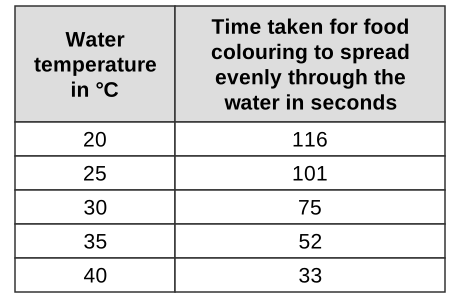
A teacher dripped a food colouring into a beaker of water, five drops in all, and timed how long the colour took to become even all through it. Figure 10 shows the stages. The teacher then did the same at five water temperatures, and Figure 11 holds the times.
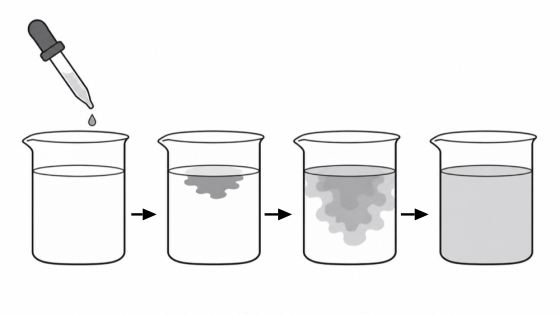

Name the process the teacher's food colouring demonstration shows (Figure 10).
Our own questions on this topic, marked straight away, so you see what to revise. Free now.
Show model answer for 05.1Hide model answer for 05.1
Diffusion.
How the marks are earned
- Diffusion. A spelling that sounds like diffusion is credited.
A student wants to compare different food colourings. Give two variables that must be kept the same.
See how you would score on Cell Biology Practical InvestigationsShow model answer for 05.2Hide model answer for 05.2
1. The same volume of water each time, for example 250 cm3. 2. The water kept at one temperature, for example 20 °C.
How the marks are earned
- Any two of: the volume of water; the beaker; the temperature; the volume or the concentration of food colouring (keeping the count of colouring drops the same is credited here too); the pipette, or the volume or size of each drop (the word drop is needed).
- The word amount on its own earns nothing, for the water or for the food colouring.
Why it scores
Each controlled variable earns one mark. The food colouring is the only thing that should change.
Revise Cell Biology Practical InvestigationsPlot the data in Figure 11 as a line graph on the grid.
See how you would score on Cell Biology Practical InvestigationsShow model answer for 05.3Hide model answer for 05.3
x-axis label: water temperature in °C y-axis label: time taken in s
x-axis scale: 20 to 40, 5 °C for each large square y-axis scale: 0 to 120, 20 s for each large square
Plot all five crosses, warmest first: (40, 33) (35, 52) (30, 75) (25, 101) (20, 116) Join the crosses with straight lines using a ruler.
How the marks are earned
- One mark: both axes labelled, each with its unit.
- One mark: water temperature along the x-axis and time up the y-axis.
- One mark: a linear scale on each axis.
- One mark: all five points plotted correctly and a correct line drawn through them.
Why it scores
Labels with units earn one mark, and putting temperature along the bottom and time up the side earns another.
Equal steps on each axis make the scale linear, which earns a mark. The points then fill more than half the grid.
The last mark needs every point in the right place and the line drawn through them correctly.
Revise Cell Biology Practical InvestigationsExplain why the spreading time became shorter.
See how you would score on Cell TransportShow model answer for 05.4Hide model answer for 05.4
As the water temperature goes up, its particles and the food colouring particles gain more kinetic energy.
The particles move faster, so the food colouring diffuses and mixes through the water more quickly.
How the marks are earned
- Any two linked points: the temperature rises; the particles move faster, collide more often or diffuse faster; because they have more kinetic energy (the word kinetic is needed).
- Particles spreading out or mixing faster is credited for the second point (the word faster is needed).
Why it scores
The rise in temperature and the extra kinetic energy are each a mark point.
This links the energy to faster movement and faster diffusion, which completes the explanation.
Revise Cell Transport