Figure 12 is a drawing of cells on the underside of a leaf, the lower epidermis. One of the pores in it carries the label stoma.
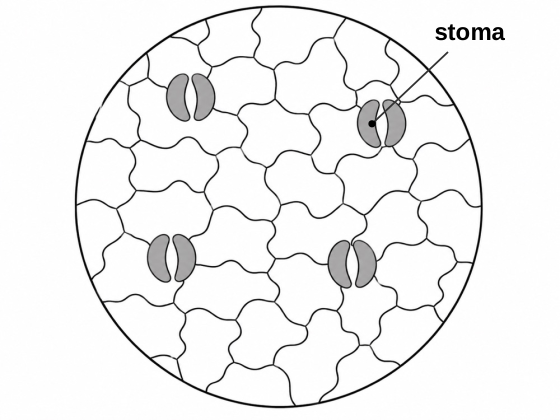
Count the guard cells drawn in Figure 12.
Our own questions on this topic, marked straight away, so you see what to revise. Free now.
Show model answer for 06.1Hide model answer for 06.1
8. Every stoma in Figure 12 has a pair of guard cells round it, and there are four stomata.
In daylight, name one gas that passes out of a leaf through its stomata and one gas that passes in.
See how you would score on PhotosynthesisShow model answer for 06.2Hide model answer for 06.2
Leaving: oxygen Entering: carbon dioxide
How the marks are earned
- One mark, gas out: oxygen, or water vapour. The formula O2 or H2O is accepted.
- One mark, gas in: carbon dioxide. The formula CO2 is accepted.
Why it scores
Each gas earns one mark. In light, photosynthesis uses carbon dioxide and makes oxygen. Water vapour would also earn the mark for the gas going out.
Revise PhotosynthesisGive the reason stomata close.
See how you would score on TranspirationShow model answer for 06.3Hide model answer for 06.3
Closing the stomata stops water escaping from the leaf, so the plant does not lose too much water and dry out.
How the marks are earned
- To stop the plant losing water, or to stop it drying out.
A prepared slide holds a thin cross-section of a leaf. Describe how to look at it with a light microscope.
See how you would score on MicroscopyShow model answer for 06.4Hide model answer for 06.4
Put the slide on the microscope stage and clip it in place.
Turn the nosepiece so the lowest power objective lens is over the slide, and turn the focusing wheel until the leaf cells look sharp.
Then swap to a higher power objective lens and focus again to see the cells in more detail.
How the marks are earned
- Any three from the four below, linked. One mark each.
- The slide is placed on the stage.
- The lowest power objective lens is used first. Starting at the lowest magnification is accepted.
- The focusing wheel is turned to get a sharp image. Focus, alone, is accepted.
- A higher power objective lens is then chosen. Raising the magnification is accepted.
Why it scores
The first step earns one mark.
Starting on the lowest power lens and using the focusing wheel each earn a mark.
Moving up to a higher magnification is the fourth point. Any three of the four earn full marks.
Revise MicroscopyLeaves make sugars that are needed all over the plant. Explain how the plant moves them.
See how you would score on Plant Transport SystemsShow model answer for 06.5Hide model answer for 06.5
The sugar is turned into sucrose, which moves through the phloem tubes.
This movement is translocation. It takes sugar both upwards and downwards, to the growing tips and to the roots.
How the marks are earned
- Any two from the five below. One mark each.
- The sugar is carried as sucrose.
- It moves in the phloem. Naming xylem is rejected.
- The process is translocation. Calling it transpiration is rejected.
- Active transport is involved.
- It flows both up and down the plant, in two directions.
Why it scores
Sucrose and phloem are one mark each.
Translocation, and flow in both directions, are further marking points. Any two points earn both marks.
Revise Plant Transport Systems