Figure 13 is a food chain that starts with rose plants and ends with bluebirds. The biomass, in grams, of each population is written under its name.
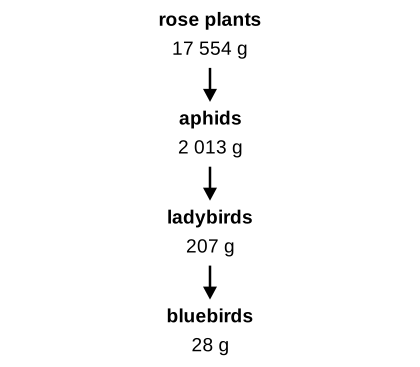
Using Figure 13, find the percentage efficiency from aphids to ladybirds: higher level biomass ÷ previous level biomass × 100. Round to a whole number.
Our own questions on this topic, marked straight away, so you see what to revise. Free now.
Show model answer for 07.1Hide model answer for 07.1
share passed on = 207 ÷ 2013 = 0.1028
percentage efficiency = 0.1028 × 100 = 10.28
rounded to a whole number, the efficiency is 10%
How the marks are earned
- One mark: ladybird biomass over aphid biomass, 207 ÷ 2013.
- One mark: that value × 100 (10.28 or 10.3).
- One mark: the final answer, 10%.
- A correct 10% earns all three marks even with no working.
- Two marks for 10.28 or 10.3, a right value that is not rounded to a whole number.
Why it scores
Dividing the ladybird biomass by the aphid biomass earns the first mark.
Multiplying by 100 earns the second mark.
Rounding to a whole number earns the third mark. A correct 10% alone earns all three.
Revise Ecosystems CommunitiesIn Figure 13 the ladybirds have less biomass than the aphids they feed on. Give two reasons.
See how you would score on Ecosystems CommunitiesShow model answer for 07.2Hide model answer for 07.2
1. The aphids use much of their food in respiration, and the energy released is used for movement or lost as heat, so it does not become new body mass. 2. The ladybirds do not eat all of every aphid, and some of what they eat is not digested.
How the marks are earned
- Any two from the five below. One mark each.
- Energy used to keep warm. Thermoregulation is accepted.
- Respiration.
- Excretion.
- Not all of each aphid is eaten, or not all of it is digested.
- Movement.
Why it scores
Each reason earns one mark. Excretion would also earn a mark.
Revise Ecosystems CommunitiesRose growers lose leaves to aphids. Explain how releasing ladybirds could bring the aphid population down.
See how you would score on Ecosystems CommunitiesShow model answer for 07.3Hide model answer for 07.3
Ladybirds are predators that eat aphids, so releasing them among the roses lowers the number of aphids.
With fewer aphids, less damage is done to the leaves and the roses stay healthy. Using a living predator like this is called biological control.
How the marks are earned
- Any two from the three below, linked. One mark each.
- Ladybirds eat the aphids. Preying on aphids is accepted.
- So the aphids no longer harm the roses. The roses staying healthy is accepted.
- Using a living predator this way is biological control.
Why it scores
Ladybirds eating aphids earns the first mark.
The effect on the roses, or naming biological control, earns the second mark.
Revise Ecosystems CommunitiesThe world's population keeps growing. Name three factors that cut the amount of food people can get.
See how you would score on Biodiversity and Human ImpactsShow model answer for 07.4Hide model answer for 07.4
1. Pests and plant diseases destroy crops. 2. Climate change brings droughts and floods that ruin harvests. 3. Land is used for biofuel crops or for building houses instead of growing food.
How the marks are earned
- Any three from the list below. One mark each.
- People eating more meat (the word more, or increased, is needed).
- More animal farming (the word more, or increased, is needed). Overfishing, or over farming of animals, is accepted.
- Changes to the environment, or climate change. Pollution or global warming is accepted.
- Pests, pathogens or disease in crops or livestock.
- Crops grown for biofuels, or crops grown to feed animals.
- Less land left for farming: houses built on farmland, or deforestation. Solar farms or landfill are accepted.
- Drought, floods, famine or wildfires.
- War or conflict.
- More food being wasted is also accepted for a mark.
Why it scores
Each different factor earns one mark.
Revise Biodiversity and Human Impacts