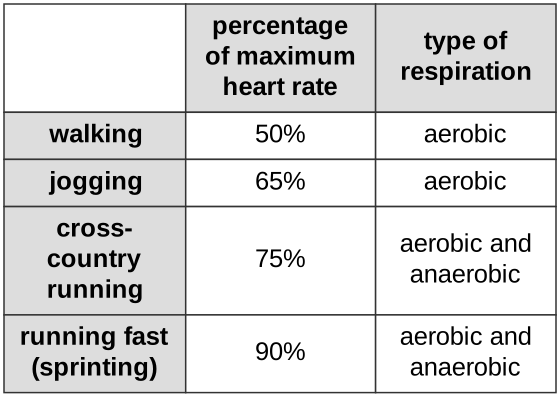
Figure 14 is a drawing of a section through a human heart, with its four chambers lettered P, Q, R and S. Figure 15 is a table that gives, for four activities, the share of maximum heart rate each needs and the kind of respiration used.
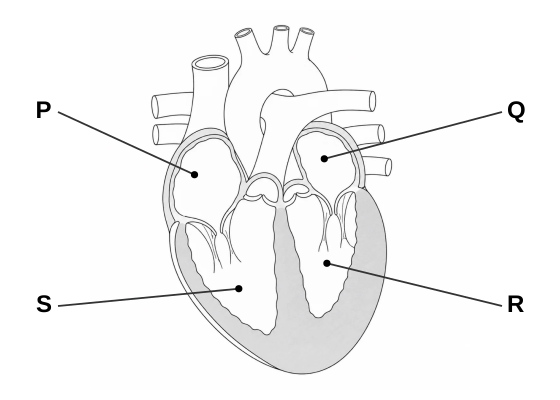
Which two chambers in Figure 14 hold nothing but oxygen-rich blood? Tick one box.
Our own questions on this topic, marked straight away, so you see what to revise. Free now.
Show model answer for 08.1Hide model answer for 08.1
Q and R. They are the left atrium and left ventricle, which take blood from the lungs. P and S, on the right side of the heart, hold deoxygenated blood from the body.
The bicuspid valve lies between chambers Q and R in Figure 14. Explain what it does.
See how you would score on The Heart and CirculationShow model answer for 08.2Hide model answer for 08.2
When the left ventricle, R, contracts, the bicuspid valve shuts.
This stops blood flowing backwards from the ventricle into the left atrium, Q, so the blood can only go one way, out through the aorta.
How the marks are earned
- One mark: it stops blood flowing backwards. Keeping blood moving one way is accepted.
- One mark: the backflow it stops is into the atrium, or into Q (the word left is not needed). Flow from the left ventricle back to the left atrium is accepted.
Why it scores
This sets up when the valve works.
Preventing backflow earns one mark, and naming the atrium, Q, as where the blood would go earns the other.
Revise The Heart and CirculationYour heart beats faster when you exercise. Explain why.
See how you would score on The Heart and CirculationShow model answer for 08.3Hide model answer for 08.3
A faster heart rate pumps blood round the body faster.
More oxygen and glucose reach the working muscles, so they can carry out more aerobic respiration and release more energy for contraction.
The faster flow also carries away the extra carbon dioxide, and it helps stop lactic acid building up from anaerobic respiration.
How the marks are earned
- Any three from the five below, linked. One mark each.
- The heart pumps blood faster. Pumping more blood is accepted.
- To deliver more oxygen, or more glucose.
- For more respiration.
- To release more energy for the muscles (the word muscles is needed).
- To take away carbon dioxide. Avoiding an oxygen debt, a build-up of lactic acid, or anaerobic respiration is accepted for this point.
Why it scores
This is the first mark.
Extra oxygen or glucose, and more respiration, each earn a mark. More energy for the muscles is a further point.
Removing carbon dioxide is another marking point. Any three points earn full marks.
Revise The Heart and CirculationSomeone's maximum is 190 beats per minute. Use Figure 15 to work out their heart rate while jogging, to 3 significant figures.
See how you would score on The Heart and CirculationShow model answer for 08.4Hide model answer for 08.4
Jogging uses 65% of maximum heart rate. heart rate = 65 ÷ 100 × 190 = 123.5
rounded to 3 significant figures, the rate is 124 beats each minute
How the marks are earned
- One mark: the jogging percentage applied to 190, as 190 ÷ 100 × 65 or 0.65 × 190.
- One mark: the unrounded value, 123.5.
- One mark: rounded to 3 significant figures, 124 beats per minute.
- A correct 124 earns all three marks even with no working.
- Two marks for 123 or for 123.5.
Why it scores
Taking 65% from Figure 15 and applying it to 190 earns the first mark. The correct unrounded value, 123.5, earns the second.
Rounding correctly earns the third mark. A correct 124 alone earns all three.
Revise The Heart and CirculationRed blood cells, or erythrocytes, take oxygen to respiring cells. Explain the features that help them pick up and give out oxygen.
See how you would score on Blood Components and VesselsShow model answer for 08.5Hide model answer for 08.5
Red blood cells are packed with haemoglobin, which binds to oxygen in the lungs and lets it go in the tissues. They have no nucleus, so there is more room for haemoglobin and more oxygen can be carried.
Their biconcave shape gives a large surface area, so oxygen diffuses in and out quickly.
They are small, thin and flexible, so they can squeeze through narrow capillaries, and the oxygen has only a short distance to diffuse.
How the marks are earned
- Any three from the five below, each feature linked to its use. One mark each.
- No nucleus (the reason, more room for oxygen, is not needed).
- Biconcave shape, giving a bigger surface area or faster diffusion. A large surface area to volume ratio for more diffusion is accepted.
- Flexible, small or thin, so they can squeeze through capillaries (the word capillaries is needed).
- Full of haemoglobin, which binds to oxygen.
- Thin, so oxygen has only a short distance to diffuse.
Why it scores
Haemoglobin binding oxygen earns one mark, and no nucleus earns another.
Biconcave linked to surface area or diffusion earns a mark.
Either fitting through capillaries or the short diffusion distance is a further point. Any three earn full marks.
Revise Blood Components and Vessels