Figure 18 is a drawing of one nephron from a human kidney. Five parts carry the letters P, Q, R, S and T, and arrows show which way the filtrate flows.
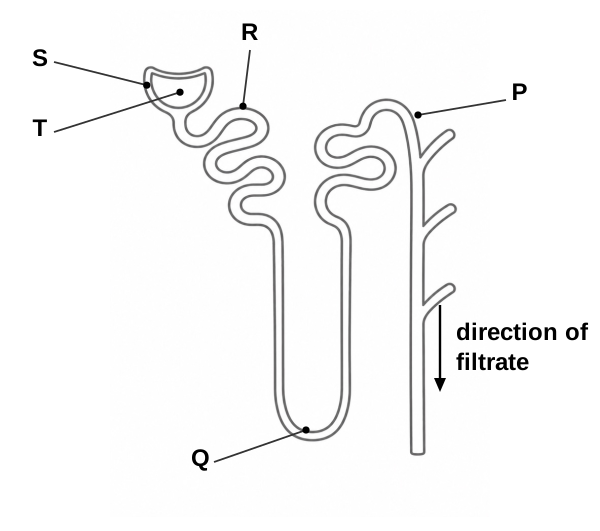
In Figure 18, which letter marks the glomerulus? Tick one box.
Our own questions on this topic, marked straight away, so you see what to revise. Free now.
Show model answer for 10.1Hide model answer for 10.1
T. The glomerulus is the knot of capillaries at the start of the nephron, where blood is filtered. S is the Bowman's capsule round it, Q is the loop of Henle and P is the collecting duct.
In Figure 18, which letter marks the Bowman's capsule? Tick one box.
See how you would score on Water RegulationShow model answer for 10.2Hide model answer for 10.2
S. The Bowman's capsule is the cup that surrounds the glomerulus, T, and collects the filtrate. R is the first coiled tubule and P is the collecting duct.
The PCT is the first coiled tubule after the Bowman's capsule. Describe what happens to the filtrate there.
See how you would score on Water RegulationShow model answer for 10.3Hide model answer for 10.3
In the PCT, useful substances are taken back from the filtrate into the blood. This is selective reabsorption.
All of the glucose is reabsorbed here, using active transport.
How the marks are earned
- Any two from the three below. One mark each.
- Selective reabsorption takes place (the word selective is needed).
- Of glucose. Glucose is reabsorbed is accepted (the words back into the blood are not needed).
- By active transport.
Why it scores
Naming selective reabsorption earns one mark.
Glucose, or active transport, earns the second mark.
Revise Water RegulationGive the job of the ureters and the job of the bladder.
See how you would score on Water RegulationShow model answer for 10.4Hide model answer for 10.4
Ureters: they carry urine away from each kidney down to the bladder. Bladder: it stores the urine until it is released.
How the marks are earned
- One mark, ureters: carry urine to the bladder from the kidney (both the words kidney and bladder are needed). Waste material or urea is accepted for urine.
- One mark, bladder: stores urine. Waste material or urea is accepted for urine.
Why it scores
One mark for each organ's job.
Revise Water RegulationSomeone has drunk a lot of water and now has too much water in their blood. Explain how the body brings it back to normal.
See how you would score on Water RegulationShow model answer for 10.5Hide model answer for 10.5
Drinking a large volume of water makes the blood too dilute. The hypothalamus in the brain detects that the water level of the blood is too high.
It sends a signal to the pituitary gland, which then releases less ADH into the blood. So less ADH is carried in the bloodstream to the kidneys.
ADH makes the walls of the collecting duct more permeable to water. With less ADH, the protein channels that carry water through those walls close, so the walls let far less water through.
So less water is reabsorbed from the filtrate back into the blood. The extra water stays in the nephron and passes on into the urine.
The kidneys make lots of dilute urine, so the blood's water level returns to normal. This is an example of negative feedback.
How the marks are earned
- Level marked. Level 3 (5 to 6 marks): a full, detailed account in a clear order. It says the collecting duct lets less water through, or takes none back, and links this to ADH and to either the pituitary gland or the hypothalamus.
- Level 2 (3 to 4 marks): a brief account of how the nephron changes the amount of water it takes back, tied to the hormone ADH.
- Level 1 (1 to 2 marks): a brief account of how the blood's water level is controlled, linked to a hormone (the hormone need not be named).
- Points that build the answer: the hypothalamus detects the water level and controls the response; it signals the pituitary gland; the pituitary releases less ADH; less ADH is carried in the blood to the kidneys; ADH acts on the collecting duct, or the loop of Henle; the duct becomes less permeable to water; the protein channels that let water through the duct wall close; less water is reabsorbed into the blood; the water is not reabsorbed and stays in the nephron; more urine is made, and it is more dilute.
Why it scores
The hypothalamus detecting the change is one of the links Level 3 needs.
Naming ADH and the pituitary gland, and saying less is released, ties the response to the hormone.
A collecting duct that lets less water out is the nephron detail needed for the top level.
This links the change in the duct to the effect on the blood.
Ending with more, dilute urine completes a detailed, ordered account, which earns 6 of 6.
Revise Water Regulation