Edexcel GCSE Chemistry Paper 2, Higher Tier (1CH0/2H)Paper 2: every question, answered
We read the real Higher Tier papers Edexcel has published for Chemistry Paper 2 in June 2022 and June 2023, plus the mark schemes examiners actually used to grade them. June 2019 is no longer published on Pearson's live archive, so we have not included it. Below is what real sub-questions on each recurring topic have asked, what a full mark answer looks like against that year's mark scheme, and what tripped candidates up.
Questions © Pearson Education Ltd, quoted for analysis. Diagrams, tables and apparatus described in our own words, not reproduced. Mark scheme content translated into plain English, not copied. PrepWise is independent and not endorsed by Pearson or Edexcel.
The paper is a template
Same 10 question types, every sitting“Use bond energy data to calculate the overall energy change for a reaction”
Every sitting we have gives you a balanced equation and a table of bond energies, then asks for the overall energy change with the correct sign.
1×asked“Hydrogen reacts with fluorine. H2 + F2 -> 2HF. Figure 12 shows the bond energies for the bonds in the three molecules in the equation. Calculate the energy change for this reaction.”
“Hydrogen reacts with fluorine. H2 + F2 -> 2HF. Figure 12 shows the bond energies for the bonds in the three molecules in the equation. Calculate the energy change for this reaction.”
What it’s really asking
You are given the bond energies for H-H, F-F and H-F and asked to work out the overall energy change for the reaction, including whether it is exothermic or endothermic.
What the sources actually showed — June 2022
A small table giving the bond energy in kJ per mole for the H-H bond, the F-F bond and the H-F bond, alongside the balanced equation H2 + F2 -> 2HF printed above the table.
| Bond | Bond energy (kJ/mol) |
|---|---|
| H-H | 436 |
| F-F | 158 |
| H-F | 562 |
The full worked answer — June 2022
Energy to break bonds in reactants = H-H + F-F = 436 + 158 = 594 kJ/mol. Energy released making bonds in products = 2 x H-F = 2 x 562 = 1124 kJ/mol. Overall energy change = 594 - 1124 = -530 kJ/mol. Since the value is negative, the reaction is exothermic.
Could you have written this? Every fact in this answer is drilled in our quizzes — the writing is the easy part once the evidence is automatic.
Practise bond energy calculationsWhat the sources actually showed — June 2023
A small table giving the bond energy in kJ per mole for the triple bond in nitrogen, the H-H bond and the H-N bond, alongside the balanced equation for nitrogen reacting with hydrogen to form ammonia, N2 + 3H2 -> 2NH3, shown with a displayed structure of ammonia.
| Bond | Bond energy (kJ/mol) |
|---|---|
| N≡N (triple bond) | 944 |
| H-H | 436 |
| H-N | 388 |
The full worked answer — June 2023
Energy to break bonds in reactants = N-N triple bond + (3 x H-H) = 944 + (3 x 436) = 2252 kJ/mol. Energy released making bonds in products = 2 x (3 x H-N) = 2 x (3 x 388) = 2328 kJ/mol. Overall energy change = 2252 - 2328 = -76 kJ/mol.
Could you have written this? Every fact in this answer is drilled in our quizzes — the writing is the easy part once the evidence is automatic.
Practise bond energy calculationsWhat the mark scheme rewarded
- Correctly totalling the bond energies for every bond broken in the reactants, using the correct number of each bond from the balanced equation
- Correctly totalling the bond energies for every bond made in the products
- Finding the difference between the two totals (bonds broken minus bonds made)
- Giving the correct sign, since a negative answer means the reaction is exothermic and a positive answer means it is endothermic
- Energy change = total energy to break bonds in reactants minus total energy released making bonds in products
- Breaking bonds takes in energy (endothermic), so it is added as a positive value
- Making bonds releases energy (exothermic), so it is subtracted from the bonds broken total
- A negative overall energy change means the reaction is exothermic, a positive value means it is endothermic
- Always check how many of each bond are actually present using the balanced equation, not just the displayed formula of one molecule
Traps examiners saw
- Forgetting to multiply a bond energy by the number of that bond present, for example only using one H-H bond energy when the equation needs three
- Adding bonds broken and bonds made instead of subtracting them
- Losing the negative sign, or stating a positive number is exothermic when it is actually endothermic
Full-mark self-check 0 of 4
The method for every Q9 — same every sittingMark bands, steps, timing
What this question type rewards
The topic changes by sitting — the mark scheme never does. Learn this once, then open your question above for that sitting’s sources and a full worked answer.
- Adding up the energy needed to break all the bonds in the reactants
- Adding up the energy released making all the bonds in the products
- Subtracting bonds made from bonds broken and giving the correct sign for exothermic or endothermic
The steps
- Use the balanced equation to count how many of each bond are broken in the reactants and add up their bond energies
- Count how many of each bond are made in the products and add up their bond energies
- Subtract energy released making bonds from energy used breaking bonds
- State whether the reaction is exothermic (negative) or endothermic (positive) based on your answer
Which statement correctly describes the energy change when chemical bonds are broken?
This calculation appears on every paper we analysed, always as a full multi-step calculation worth 4 marks. Learn the method (bonds broken minus bonds made) cold and always check your final sign.
Practise bond energy calculations“Discuss what catalysts do and their effect on activation energy, using named examples”
In the sitting we have this question in, you are shown a reaction profile for an uncatalysed exothermic reaction and asked to discuss catalysts in general using named examples from the course.
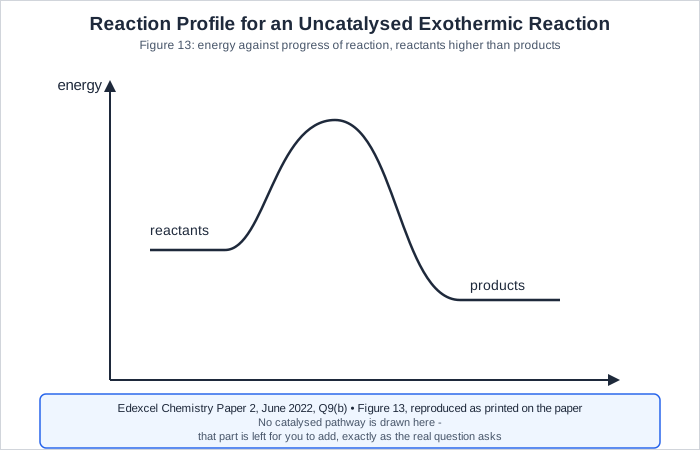
1×asked“The reaction profile for an uncatalysed exothermic reaction is shown in Figure 13. Using some examples of catalysts you have met in chemistry, discuss what catalysts do and their effect on the activation energy of a reaction. You can use Figure 13 to illustrate your answer.”
“The reaction profile for an uncatalysed exothermic reaction is shown in Figure 13. Using some examples of catalysts you have met in chemistry, discuss what catalysts do and their effect on the activation energy of a reaction. You can use Figure 13 to illustrate your answer.”
What it’s really asking
This is question 9(b) on the June 2022 paper. It wants a general discussion of what catalysts do and why, backed up by named catalysed reactions from the specification, ideally shown on an amended or newly drawn reaction profile.
What the sources actually showed — June 2022
A reaction profile for an uncatalysed exothermic reaction, showing the energy axis against the progress of reaction, with the reactants starting at a lower energy level, a labelled peak in between, and the products ending at a lower energy level than the reactants.
The full worked answer — June 2022
A catalyst is a substance that increases the rate of a reaction without being used up or changing chemically itself, and without changing the products formed, so its own mass stays the same at the end of the reaction as at the start.
For a reaction to happen, particles must collide with at least a minimum amount of energy called the activation energy. A catalyst works by providing an alternative reaction pathway that has a lower activation energy than the uncatalysed route, so a greater proportion of collisions between particles have enough energy to be successful and go on to form products.
On the reaction profile in Figure 13, the catalysed version of this reaction would start and finish at exactly the same energy levels as the uncatalysed profile, since the reactants and products are chemically identical either way, but the new profile would show a lower peak in the middle, representing the lower activation energy of the catalysed pathway.
Two examples of catalysts I have met in chemistry are the iron catalyst used in the Haber process to make ammonia from nitrogen and hydrogen, and the enzymes contained in yeast that catalyse the fermentation of glucose to produce ethanol. Both increase the rate of their reaction without being consumed by it.
Could you have written this? Every fact in this answer is drilled in our quizzes — the writing is the easy part once the evidence is automatic.
Practise reaction profile questionsWhat the mark scheme rewarded
- A correct description that a catalyst increases rate without being used up and without changing the products
- A correct explanation of activation energy and how a catalyst provides an alternative route with a lower activation energy
- Reference to or amendment of a reaction profile, showing the same start and end energy but a lower peak
- At least one named catalysed reaction from the specification, such as the Haber process, cracking, fermentation, hydrogen peroxide decomposition, catalytic converters, or biological enzymes
- A catalyst increases the rate of reaction without being used up and without being chemically changed
- Activation energy is the minimum energy particles need for a collision to result in a reaction
- A catalyst provides an alternative reaction pathway with a lower activation energy
- This means a greater proportion of collisions have enough energy to be successful
- The Haber process uses an iron catalyst to make ammonia from nitrogen and hydrogen
- Cracking uses a catalyst to break down long-chain hydrocarbons into smaller, more useful molecules
- Fermentation uses enzymes in yeast as a biological catalyst to convert glucose into ethanol
- Catalytic converters in cars use catalysts to convert harmful exhaust gases into less harmful ones
Traps examiners saw
- Saying a catalyst 'speeds up the reaction' without explaining activation energy or the alternative pathway, which limits you to the lower level
- Forgetting to state that the start and end energy levels stay the same on a catalysed profile, only the peak changes
- Naming only one example, or naming something that is not actually a catalyst from the specification
- Confusing a catalyst with a reactant, implying it gets used up or changes the products
Full-mark self-check 0 of 4
The method for every Q9 — same every sittingMark bands, steps, timing
What this question type rewards
The topic changes by sitting — the mark scheme never does. Learn this once, then open your question above for that sitting’s sources and a full worked answer.
- Describing that a catalyst increases the rate of reaction without being used up or changing the products
- Explaining that a catalyst provides an alternative reaction pathway with a lower activation energy, so a greater proportion of collisions are successful
- Illustrating this with a reaction profile showing a lower peak but the same start and end energy
- Naming specific catalysed reactions from the course, such as the Haber process or cracking
The steps
- State what a catalyst does: increases the rate of reaction, is not used up, and does not change the products
- Explain the function: particles need a minimum amount of energy (activation energy) to react; a catalyst provides an alternative pathway with a lower activation energy, so a greater proportion of collisions have enough energy to be successful
- Add to or amend the reaction profile: a catalysed profile has the same reactant and product energy levels, but a lower peak
- Give at least one named example, such as the iron catalyst in the Haber process, or an enzyme catalyst in fermentation
What does activation energy represent on a reaction profile?
This extended response wants named examples, not just a generic definition of a catalyst. Learn the Haber process, cracking and fermentation as your go-to catalysed reactions.
Practise reaction profile questions“Explain why the rate of reaction changes as the reaction proceeds”
Both sittings we have give you a rate-of-reaction investigation with a metal or marble chips reacting with acid, then ask you to explain why the rate falls away over time in terms of particles being used up.
1×asked“State and explain what happens to the rate of reaction as the acid reacts with the marble chips in this experiment.”
“State and explain what happens to the rate of reaction as the acid reacts with the marble chips in this experiment.”
What it’s really asking
This is question 2(b)(ii) on the June 2023 paper. Using the gas volume against time data given, you need to explain why the reaction rate falls as marble chips react with hydrochloric acid, in terms of reactants being used up and collision frequency.
What the sources actually showed — June 2023
A table of the volume of gas produced each minute for six minutes as marble chips react with dilute hydrochloric acid.
| time in minutes | 0 | 1 | 2 | 3 | 4 | 5 | 6 |
|---|---|---|---|---|---|---|---|
| volume of gas in cm3 | 0 | 52 | 78 | 91 | 97 | 100 | 100 |
A second table showing the rate of reaction calculated for each one-minute time interval from the Figure 4 results, which decreases steadily from the first interval to the last. The rate for the 2 to 3 minute interval is the value you are asked to calculate, so it is left blank here exactly as it is on the real exam paper.
| time interval | 0 to 1 minute | 1 to 2 minutes | 2 to 3 minutes | 3 to 4 minutes | 4 to 5 minutes |
|---|---|---|---|---|---|
| rate of reaction in cm3/min | 52 | 26 | ? | 6 | 3 |
The full worked answer — June 2023
The rate of reaction decreases as the reaction proceeds. This is because the reactants, the acid and the marble chips, are gradually used up as the reaction happens, so there are fewer acid particles and less marble chip surface available over time. With fewer reactant particles present, collisions between them become less frequent, so the rate of reaction falls.
Could you have written this? Every fact in this answer is drilled in our quizzes — the writing is the easy part once the evidence is automatic.
Practise rate of reaction questionsWhat the sources actually showed — June 2022
A graph of the volume of hydrogen gas produced against time as metal pieces react with dilute hydrochloric acid, with the curve rising steeply at first and levelling off to a constant volume after about eight minutes.
The full worked answer — June 2022
The measurements could have been stopped at 9 minutes because the volume of gas had become constant, meaning the reaction had stopped producing any more hydrogen. This is shown on the graph by the curve levelling off (reaching zero gradient) rather than continuing to rise.
Could you have written this? Every fact in this answer is drilled in our quizzes — the writing is the easy part once the evidence is automatic.
Practise rate of reaction questionsWhat the mark scheme rewarded
- Stating the rate of reaction decreases or the reaction slows down as it proceeds
- Linking the decrease to the reactants (acid or marble chips) being used up
- Explaining that fewer reactant particles present leads to less frequent collisions
- Rate of reaction depends on how frequently particles collide with enough energy to react
- As a reaction proceeds, reactants are converted into products, so there is less reactant available over time
- Fewer reactant particles in the same volume means collisions happen less often
- A rate-time graph that levels off (reaches zero gradient) shows the reaction has stopped, usually because a reactant has been fully used up
Traps examiners saw
- Describing the rate speeding up at the very start of the reaction instead of addressing the overall slowing trend the question asks about
- Stating reactants 'run out' without explaining the collision-frequency consequence
- Confusing a levelling-off graph with the reaction becoming faster
Full-mark self-check 0 of 3
The method for every Q2 — same every sittingMark bands, steps, timing
What this question type rewards
The topic changes by sitting — the mark scheme never does. Learn this once, then open your question above for that sitting’s sources and a full worked answer.
- Stating that the rate of reaction decreases as the reaction proceeds
- Linking this to reactants (acid or marble chips) being used up
- Explaining that fewer particles present means less frequent collisions
The steps
- State that the rate of reaction decreases (slows down) as the reaction proceeds
- Explain that this is because the reactants are being used up as the reaction happens
- Link this to particles: fewer reactant particles present means less frequent collisions between them
- Do not describe the rate speeding up at the very start, since this question is about the whole reaction slowing overall
Which of the following factors does NOT affect the rate of a chemical reaction?
This is really a collision theory question wearing a graph-reading disguise. Always link decreasing rate back to fewer particles colliding less often as reactants are used up.
Practise rate of reaction questions“Explain the effect of opening and closing a Bunsen burner air-hole on the products of combustion and the harm large quantities of the fuel can cause”
In the sitting we have this question in, you are shown a Bunsen burner and asked to link the air-hole setting to complete or incomplete combustion, and then to the harmful effects of burning large quantities of methane.
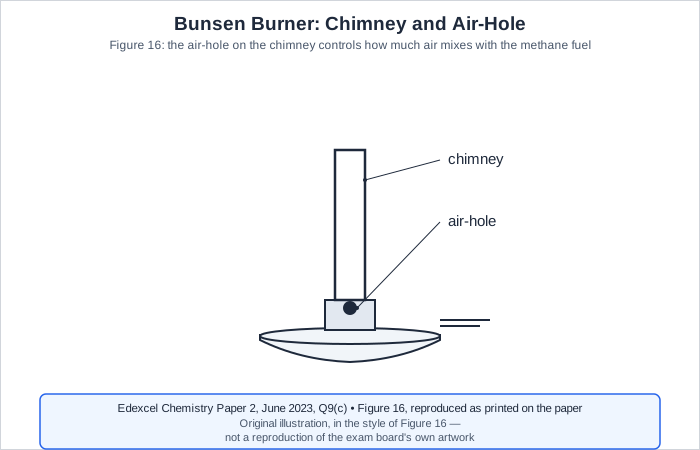
1×asked“Large quantities of methane are used as a fuel. Figure 16 shows a Bunsen burner. Methane can be used as fuel for the Bunsen burner. The air-hole on the chimney of the Bunsen burner can be opened and closed. Explain the effect of opening and closing the air-hole of the Bunsen burner on the products of combustion of methane and the harm that using large quantities of methane as a fuel can cause.”
“Large quantities of methane are used as a fuel. Figure 16 shows a Bunsen burner. Methane can be used as fuel for the Bunsen burner. The air-hole on the chimney of the Bunsen burner can be opened and closed. Explain the effect of opening and closing the air-hole of the Bunsen burner on the products of combustion of methane and the harm that using large quantities of methane as a fuel can cause.”
What it’s really asking
This is question 9(c) on the June 2023 paper. It wants you to connect the air-hole setting to complete versus incomplete combustion, name the different products in each case, and explain the harm both carbon monoxide and greenhouse gases can cause.
What the sources actually showed — June 2023
A diagram of a Bunsen burner, with the chimney and the air-hole on the chimney both labelled, showing where air enters to mix with the gas fuel before combustion.
The full worked answer — June 2023
When the air-hole is open, a large amount of oxygen can mix with the methane gas, so complete combustion takes place: CH4 + 2O2 -> CO2 + 2H2O. Only carbon dioxide and water are produced.
When the air-hole is closed, less oxygen is able to mix with the methane, so incomplete combustion takes place instead, for example 2CH4 + 3O2 -> 2CO + 4H2O. This time carbon monoxide is produced instead of carbon dioxide, and soot (carbon) can also form if there is very little oxygen available.
Carbon monoxide from incomplete combustion is harmful because it is a colourless and odourless gas, so people cannot detect it, and it combines with haemoglobin in red blood cells in place of oxygen, which reduces the blood's capacity to carry oxygen around the body and makes it toxic. Separately, both carbon dioxide and water vapour from complete combustion are greenhouse gases: they absorb heat energy radiated from the Earth's surface and re-radiate it, which increases the greenhouse effect, raises global temperatures, and contributes to climate change, including melting polar ice and rising sea levels.
Could you have written this? Every fact in this answer is drilled in our quizzes — the writing is the easy part once the evidence is automatic.
Practise combustion questionsWhat the mark scheme rewarded
- Correctly explaining that an open air-hole gives complete combustion, producing carbon dioxide and water
- Correctly explaining that a closed air-hole gives incomplete combustion, producing carbon monoxide and/or soot
- Explaining carbon monoxide's toxicity through binding to haemoglobin in place of oxygen
- Explaining that carbon dioxide and water vapour are greenhouse gases that increase the greenhouse effect and contribute to global warming and climate change
- Complete combustion needs plenty of oxygen and produces only carbon dioxide and water
- Incomplete combustion happens with a limited oxygen supply and can produce carbon monoxide, carbon (soot), and water
- Carbon monoxide is toxic because it binds to haemoglobin in red blood cells more readily than oxygen does, reducing the blood's capacity to transport oxygen
- Soot can aggravate respiratory problems and makes buildings dirty
- Carbon dioxide and water vapour are greenhouse gases that absorb and re-radiate heat energy from the Earth
- Increased greenhouse gas levels increase the greenhouse effect, contributing to global warming and climate change
Traps examiners saw
- Only describing one air-hole setting instead of contrasting both open and closed
- Naming carbon monoxide as a greenhouse gas, when the greenhouse gas point applies to carbon dioxide and water vapour from complete combustion
- Forgetting to explain WHY carbon monoxide is harmful (the haemoglobin link), rather than just stating it is toxic
- Missing the connection between opening the air-hole and the amount of oxygen mixing with the fuel
Full-mark self-check 0 of 4
The method for every Q9 — same every sittingMark bands, steps, timing
What this question type rewards
The topic changes by sitting — the mark scheme never does. Learn this once, then open your question above for that sitting’s sources and a full worked answer.
- Explaining that an open air-hole allows complete combustion, producing carbon dioxide and water
- Explaining that a closed air-hole starves the flame of oxygen, causing incomplete combustion and producing carbon monoxide (and/or soot)
- Explaining the harm caused: carbon monoxide is toxic because it binds to haemoglobin, and carbon dioxide/water vapour are greenhouse gases that increase the greenhouse effect and contribute to global warming
The steps
- State that with the air-hole open, plenty of oxygen mixes with the methane, so complete combustion occurs, producing carbon dioxide and water only
- State that with the air-hole closed, less oxygen is available, so incomplete combustion occurs, producing carbon monoxide (and/or carbon, as soot) as well as water
- Explain that carbon monoxide is toxic because it combines with haemoglobin in the blood in place of oxygen, reducing the blood's capacity to carry oxygen
- Explain that carbon dioxide and water vapour are greenhouse gases that absorb and re-radiate heat energy from the Earth, increasing the greenhouse effect and contributing to global warming and climate change
What are the only products formed during the complete combustion of a hydrocarbon?
This question wants both combustion equations AND the harm they cause. Learn complete and incomplete combustion equations for methane cold, and know exactly why carbon monoxide is dangerous.
Practise combustion questions“Explain why the viscosity of fractions from crude oil changes with fraction position”
In the sitting we have this question in, you are shown a fractionating column and told the fractions get more viscous further down the column, then asked to explain why.
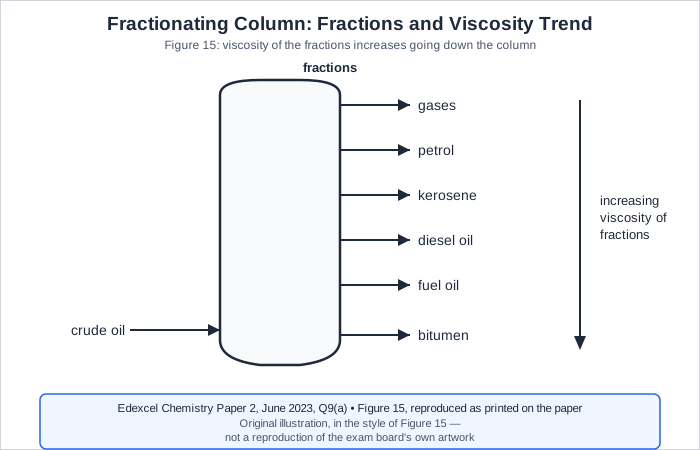
1×asked“Figure 15 shows a fractionating column, the fractions obtained and the trend in viscosity of the fractions. Explain the trend in the viscosity of the fractions.”
“Figure 15 shows a fractionating column, the fractions obtained and the trend in viscosity of the fractions. Explain the trend in the viscosity of the fractions.”
What it’s really asking
This is question 9(a)(ii) on the June 2023 paper. It wants an explanation linking the size of hydrocarbon molecules in each fraction to the strength of intermolecular forces and therefore viscosity.
What the sources actually showed — June 2023
A diagram of a fractionating column with crude oil entering at the bottom, and six labelled outlet pipes for gases, petrol, kerosene, diesel oil, fuel oil and bitumen going from top to bottom, alongside an arrow showing viscosity increases going down the column.
The full worked answer — June 2023
Viscosity increases down the column because the hydrocarbon molecules in each fraction get larger, containing more carbon atoms, the further down the column the fraction is collected. Larger molecules have stronger intermolecular forces of attraction between them, which makes the liquid flow less easily, so the fraction is more viscous.
Could you have written this? Every fact in this answer is drilled in our quizzes — the writing is the easy part once the evidence is automatic.
Practise crude oil questionsWhat the mark scheme rewarded
- Stating that molecules get larger, longer or contain more carbons further down the fractionating column
- Linking this to stronger intermolecular forces (or forces of attraction) between the larger molecules, which increases viscosity
- Crude oil is separated by fractional distillation, based on the different boiling points of hydrocarbons of different chain length
- Fractions collected further down the column contain longer hydrocarbon chains with higher boiling points
- Larger hydrocarbon molecules have greater surface area of contact and stronger intermolecular forces of attraction
- Stronger intermolecular forces mean a liquid resists flowing, making it more viscous
Traps examiners saw
- Explaining boiling point trends instead of the viscosity trend the question actually asks about
- Saying molecules are 'bigger' without explaining why bigger molecules are more viscous (the intermolecular force link)
- Confusing intermolecular forces between molecules with the covalent bonds within a molecule
Full-mark self-check 0 of 3
The method for every Q9 — same every sittingMark bands, steps, timing
What this question type rewards
The topic changes by sitting — the mark scheme never does. Learn this once, then open your question above for that sitting’s sources and a full worked answer.
- Stating that molecules get larger (more carbon atoms/longer chains) further down the column
- Linking larger molecules to stronger intermolecular forces of attraction and higher viscosity
The steps
- State that viscosity increases down the column because the hydrocarbon molecules in each fraction get larger (more carbon atoms) further down
- Explain that larger molecules have stronger intermolecular forces of attraction between them
- Link this to viscosity: stronger intermolecular forces make the liquid flow less easily, so it is more viscous
A hydrocarbon is a compound that contains only:
Trend questions like this always want the size-of-molecule link to intermolecular forces, not just a restated observation. Learn this two-step chain for viscosity and boiling point trends alike.
Practise crude oil questions“Complete the equation for an alkene reacting with bromine, or draw the repeating unit of its addition polymer”
Both sittings we have give you a displayed alkene structure and ask you to either complete an addition reaction with bromine or draw the polymer repeating unit it forms.
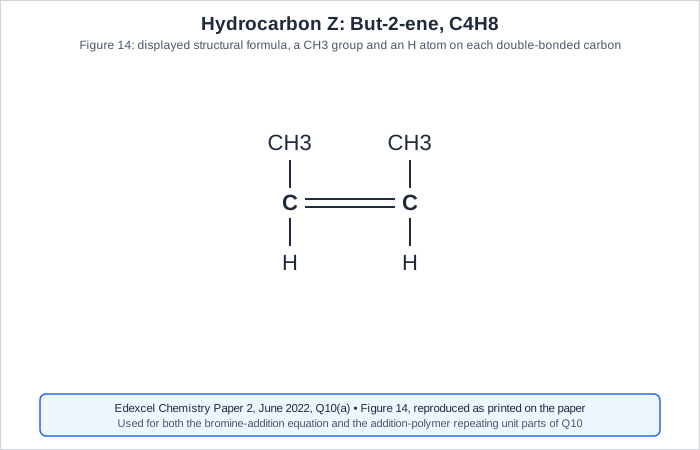
1×asked“Figure 14 shows the structure of a molecule of hydrocarbon Z, C4H8. Complete the balanced equation for the reaction of hydrocarbon Z, C4H8, with bromine.”
“Figure 14 shows the structure of a molecule of hydrocarbon Z, C4H8. Complete the balanced equation for the reaction of hydrocarbon Z, C4H8, with bromine.”
What it’s really asking
This is question 10(a)(ii) on the June 2022 paper. You need to add the formula for bromine and the correct product formula to complete the equation for the addition reaction of but-2-ene with bromine.
What the sources actually showed — June 2022
A displayed structural formula of but-2-ene, C4H8, showing a central C=C double bond with a CH3 group and an H atom attached to each of the two double-bonded carbons.
The full worked answer — June 2022
C4H8 + Br2 -> C4H8Br2. Bromine's formula, Br2, is added on the left, and the double bond in but-2-ene opens up so that one bromine atom attaches to each of the two carbons that were double bonded, giving C4H8Br2 as the single addition product.
Could you have written this? Every fact in this answer is drilled in our quizzes — the writing is the easy part once the evidence is automatic.
Practise alkene and polymer questionsWhat the sources actually showed — June 2023
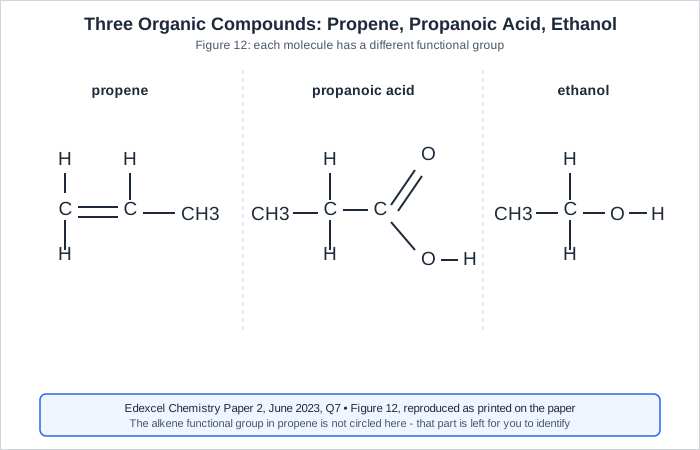
A table showing the displayed structures of propene, propanoic acid and ethanol side by side, with propene reacting with bromine water later in the same question, drawn as a displayed structural formula showing a C=C double bond with H atoms attached.
The full worked answer — June 2023
The product is 1,2-dibromopropane, drawn with a single bond between the three carbon atoms, a bromine atom attached to each of the first two carbons, and hydrogen atoms filling every other bond, since the C=C double bond in propene opens up to accept one bromine atom on each previously double-bonded carbon.
Could you have written this? Every fact in this answer is drilled in our quizzes — the writing is the easy part once the evidence is automatic.
Practise alkene and polymer questionsWhat the mark scheme rewarded
- Correctly identifying bromine as Br2 or drawing it as Br-Br
- Showing the C=C double bond becoming a single bond in the product
- Attaching one bromine atom to each of the two carbons that were part of the double bond
- Keeping every other atom in the structure unchanged
- Alkenes contain a carbon-carbon double bond (C=C), which is more reactive than the single bonds in alkanes
- In an addition reaction, atoms are added across the double bond, turning it into a single bond
- Bromine water is used as a test for alkenes: it turns from orange to colourless as bromine adds across the double bond
- The general rule: one atom (or group) is added to each of the two carbons that were part of the C=C double bond
Traps examiners saw
- Forgetting to change the C=C double bond to a single bond in the product structure
- Adding bromine to the wrong carbons, rather than the two that were part of the double bond
- Missing the second bromine atom, only showing addition of one Br
Full-mark self-check 0 of 3
1×asked“Draw the repeating unit of the addition polymer formed when hydrocarbon Z undergoes polymerisation.”
“Draw the repeating unit of the addition polymer formed when hydrocarbon Z undergoes polymerisation.”
What it’s really asking
This is question 10(a)(iii) on the June 2022 paper. You need to draw the repeating unit of poly(but-2-ene), showing the double bond opened to a single bond with continuation bonds on either side.
What the sources actually showed — June 2022
The same displayed structural formula of but-2-ene, C4H8, used in the earlier part of the question, showing the C=C double bond with a CH3 group and an H atom on each double-bonded carbon.
The full worked answer — June 2022
The repeating unit shows two neighbouring carbon atoms joined by a single bond, each with a CH3 group and a hydrogen atom attached exactly as in the original but-2-ene structure, with continuation bonds extending outward from each carbon to show the unit repeats indefinitely, and crucially no C=C double bond remaining anywhere in the unit.
Could you have written this? Every fact in this answer is drilled in our quizzes — the writing is the easy part once the evidence is automatic.
Practise alkene and polymer questionsWhat the sources actually showed — June 2023
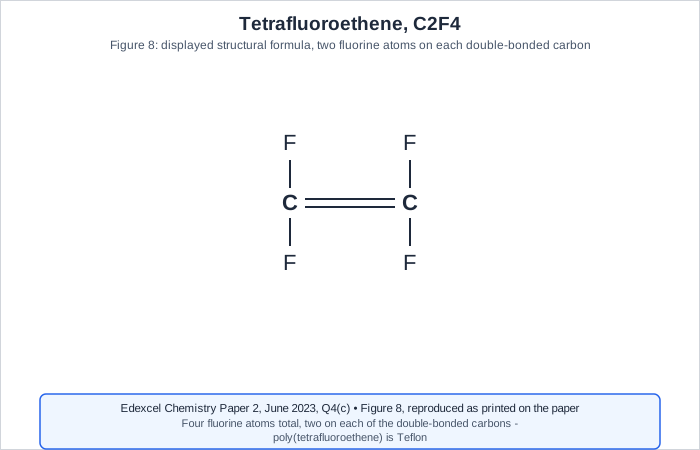
A displayed structural formula of tetrafluoroethene, showing a C=C double bond with two fluorine atoms attached to each of the double-bonded carbons.
The full worked answer — June 2023
The repeating unit of poly(tetrafluoroethene) shows two carbon atoms joined by a single bond, each carbon carrying two fluorine atoms exactly as in the original tetrafluoroethene monomer, with continuation bonds shown on both ends of the unit and no C=C double bond present.
Could you have written this? Every fact in this answer is drilled in our quizzes — the writing is the easy part once the evidence is automatic.
Practise alkene and polymer questionsWhat the mark scheme rewarded
- Showing the C=C double bond has become a single bond in the repeating unit
- Keeping the rest of the monomer's atoms and bonds unchanged in the repeating unit
- Adding continuation bonds on both sides of the repeating unit to show it repeats
- Addition polymerisation joins many alkene monomers together by opening their C=C double bonds
- The repeating unit of an addition polymer contains the same atoms as the monomer, but with a single bond instead of a double bond
- Continuation bonds (short lines extending beyond the unit) show that the unit repeats many times in the full polymer
- The general name pattern is poly(monomer name), for example poly(ethene) from ethene
Traps examiners saw
- Leaving the C=C double bond in the repeating unit, which is not allowed since polymerisation opens it up
- Forgetting the continuation bonds, which are needed to show the structure repeats
- Changing the side groups on the carbons instead of keeping them exactly as they were in the monomer
Full-mark self-check 0 of 3
The method for every Q10/Q7 — same every sittingMark bands, steps, timing
What this question type rewards
The topic changes by sitting — the mark scheme never does. Learn this once, then open your question above for that sitting’s sources and a full worked answer.
- Correctly showing the C=C double bond becoming a single bond with the added atoms attached
- Drawing the repeating unit with continuation bonds and no C=C double bond remaining
The steps
- Identify the C=C double bond in the alkene, since this is the reactive site
- For an addition reaction, break the double bond to a single bond and attach the new atoms (for example Br to each carbon)
- For a polymer repeating unit, break the double bond to a single bond and add continuation bonds either side, keeping all other atoms the same
- Check the total number of bonds around each carbon is still four
What is the general formula for alkenes?
Alkene structural questions always come down to one move: open the C=C double bond. Practise both the addition-reaction version and the polymer-repeating-unit version of this move.
Practise alkene and polymer questions“Describe how glucose is fermented to ethanol and how the dilute ethanol produced is concentrated by fractional distillation”
In the sitting we have this question in, you are given the formula of glucose and asked to describe both the fermentation process and the fractional distillation process used to concentrate the ethanol produced.
1×asked“Glucose, C6H12O6, is a carbohydrate. A dilute solution of ethanol can be produced from glucose by fermentation. The dilute solution of ethanol can then be processed to form a concentrated solution of ethanol. Describe how the fermentation of glucose is carried out and how the dilute solution of ethanol produced can then be processed to form a concentrated solution of ethanol. You may include diagrams in your answer.”
“Glucose, C6H12O6, is a carbohydrate. A dilute solution of ethanol can be produced from glucose by fermentation. The dilute solution of ethanol can then be processed to form a concentrated solution of ethanol. Describe how the fermentation of glucose is carried out and how the dilute solution of ethanol produced can then be processed to form a concentrated solution of ethanol. You may include diagrams in your answer.”
What it’s really asking
This is question 7(b) on the June 2023 paper. It wants a full method for both fermenting glucose into dilute ethanol and then concentrating that ethanol using fractional distillation, in a clear logical order.
What the sources actually showed — June 2023
The question text itself, stating glucose is a carbohydrate with the formula C6H12O6, and that a dilute ethanol solution made by fermenting it is later processed to become more concentrated, with no additional diagram or apparatus provided.
The full worked answer — June 2023
To ferment the glucose, first dissolve the glucose in water to make a glucose solution, then place this solution into a suitable flask and add yeast. The flask is kept warm, at a temperature of around 25 to 35 degrees Celsius, since yeast enzymes work best in this range, and an air lock is fitted into the neck of the flask to let carbon dioxide escape while keeping oxygen out, since oxygen would allow the yeast to respire aerobically instead of fermenting the glucose anaerobically. The reaction is left until bubbles of carbon dioxide stop being produced, showing fermentation has finished, and then the dilute ethanol solution is decanted away from the solid yeast, or the yeast is filtered out.
To concentrate the dilute ethanol solution, fractional distillation is used. The dilute ethanol is placed in a round bottomed flask connected to a fractionating column, with a thermometer positioned at the top of the column, and the column is connected to a condenser with water running through its outer jacket. The flask is heated to a temperature above the boiling point of ethanol but below the boiling point of water, so mostly ethanol vapour rises up the fractionating column, is cooled and condensed back to a liquid in the condenser, and concentrated ethanol is collected as it drips out from the end of the condenser, leaving most of the water behind in the original flask.
Could you have written this? Every fact in this answer is drilled in our quizzes — the writing is the easy part once the evidence is automatic.
Practise alcohol and fermentation questionsWhat the mark scheme rewarded
- Dissolving glucose in water and adding yeast to start fermentation
- Keeping the mixture warm, ideally specifying a temperature range around 25 to 40 degrees Celsius
- Fitting an air lock (or equivalent) to exclude oxygen while letting carbon dioxide escape
- Recognising the reaction is complete when bubbling stops, then decanting or filtering to remove yeast
- Using fractional distillation with a fractionating column, thermometer and condenser
- Heating to a temperature between the boiling points of ethanol and water, and collecting the concentrated ethanol from the condenser
- Fermentation is the anaerobic respiration of glucose by yeast, producing ethanol and carbon dioxide
- An air lock allows carbon dioxide to escape while preventing oxygen from entering, since oxygen would allow aerobic respiration instead
- Yeast fermentation works best at a warm temperature, typically 25 to 40 degrees Celsius; too hot and the enzymes are denatured
- Fractional distillation separates liquids with different boiling points using a fractionating column
- Ethanol boils at a lower temperature than water, so it evaporates first and is collected separately when the mixture is heated within the right temperature range
Traps examiners saw
- Describing only fermentation or only fractional distillation, missing the marks available for the other half of the process
- Forgetting the air lock and its purpose, which is a commonly missed marking point
- Giving a temperature for distillation without specifying it must be between the two boiling points
- Confusing fractional distillation with simple distillation, missing the fractionating column
Full-mark self-check 0 of 4
The method for every Q7 — same every sittingMark bands, steps, timing
What this question type rewards
The topic changes by sitting — the mark scheme never does. Learn this once, then open your question above for that sitting’s sources and a full worked answer.
- Describing fermentation: glucose solution, yeast added, warm temperature, an air lock to keep oxygen out, reaction stops when bubbles stop, then decanting or filtering
- Describing fractional distillation: the dilute ethanol placed in a flask with a fractionating column and thermometer, heated to a temperature between the boiling points of ethanol and water, then concentrated ethanol collected from the condenser
- Presenting both processes in a clear, logically ordered sequence
The steps
- Dissolve glucose in water to form a solution and add yeast
- Keep the mixture warm (around 25 to 40 degrees Celsius) and fit an air lock to the flask to exclude oxygen
- Leave until bubbles of carbon dioxide stop, then decant the ethanol solution away from the yeast
- Place the dilute ethanol in a flask with a fractionating column and thermometer at the top, connected to a condenser
- Heat above the boiling point of ethanol but below the boiling point of water, so ethanol vapour rises and is condensed and collected, leaving most of the water behind
What is the functional group present in all alcohols?
This question rewards a genuinely detailed method for at least one of the two processes, not a vague summary of both. Learn the air lock's purpose and the exact apparatus for fractional distillation.
Practise alcohol and fermentation questions“Identify metal ions from flame test colours, and explain how to improve an invalid flame test method”
Both sittings we have use a flame test, either asking you to identify unknown compounds from their flame colours or to spot and fix a flaw in the method that makes a conclusion invalid.
1×asked“Figure 7 shows the results of the flame tests on three compounds, P, Q and R. Use Figure 7 to identify the metal ions in compounds P, Q and R.”
“Figure 7 shows the results of the flame tests on three compounds, P, Q and R. Use Figure 7 to identify the metal ions in compounds P, Q and R.”
What it’s really asking
This is question 4(b)(ii) on the June 2022 paper. You are given the flame colours (red, lilac, blue-green) for three unknown compounds and need to name the correct metal ion for each based on standard flame test colours.
What the sources actually showed — June 2022
A small table listing three compounds, P, Q and R, alongside the flame colour observed for each: red for P, lilac for Q, and blue-green for R.
| Compound | Flame colour observed |
|---|---|
| P | red |
| Q | lilac |
| R | blue-green |
The full worked answer — June 2022
P contains lithium ions, since lithium compounds produce a red flame colour. Q contains potassium ions, since potassium compounds produce a lilac flame colour. R contains copper ions, since copper compounds produce a blue-green flame colour.
Could you have written this? Every fact in this answer is drilled in our quizzes — the writing is the easy part once the evidence is automatic.
Practise flame test questionsWhat the mark scheme rewarded
- Correctly identifying lithium from a red flame colour
- Correctly identifying potassium from a lilac flame colour
- Correctly identifying copper from a blue-green flame colour
- Lithium compounds produce a red flame
- Sodium compounds produce a yellow-orange flame
- Potassium compounds produce a lilac flame
- Calcium compounds produce an orange-red (brick red) flame
- Copper compounds produce a blue-green flame
Traps examiners saw
- Confusing lithium's red flame with calcium's orange-red flame
- Confusing sodium's yellow-orange flame with potassium's lilac flame
- Giving the compound's full name instead of just identifying the metal ion, which is what the question actually asks for
Full-mark self-check 0 of 2
1×asked“A student carried out a flame test on a sample of solid potassium chloride. The student made the following observation and conclusion: 'I saw that the flame colour was yellow so the sample must contain sodium ions.' Due to the way the student carried out the experiment, this is not a valid conclusion. Explain one improvement that the student could make to their method to obtain a valid conclusion.”
“A student carried out a flame test on a sample of solid potassium chloride. The student made the following observation and conclusion: 'I saw that the flame colour was yellow so the sample must contain sodium ions.' Due to the way the student carried out the experiment, this is not a valid conclusion. Explain one improvement that the student could make to their method to obtain a valid conclusion.”
What it’s really asking
This is question 10(a)(i) on the June 2023 paper. You need to spot that the student's method (dipping a wooden splint into water then the solid, then into a Bunsen flame) risks contamination or an unreliable colour, and suggest a specific fix.
What the sources actually showed — June 2023
A student's stated method for a flame test on potassium chloride using a wooden splint dipped first in water, then in the solid sample, then held in a roaring Bunsen burner flame, alongside the student's observation of a yellow flame and their (incorrect) conclusion that this shows sodium ions.
The full worked answer — June 2023
The student should use a (nichrome) metal wire instead of a wooden splint, because a wooden splint itself burns in the flame, and the flame produced by the burning wood can interfere with or mask the true flame colour of the metal ions being tested, making the yellow colour unreliable evidence for sodium.
Could you have written this? Every fact in this answer is drilled in our quizzes — the writing is the easy part once the evidence is automatic.
Practise flame test questionsWhat the mark scheme rewarded
- Suggesting a specific improvement, such as using a metal (nichrome) wire instead of a wooden splint
- Linking the improvement to the correct reason: the wood itself burning interferes with the flame colour observed
- A flame test uses a clean wire (traditionally nichrome or platinum) dipped in acid, then in the sample, then held in a roaring Bunsen flame
- A wooden splint can burn and produce its own flame colour, contaminating the observation
- Contamination between samples (using the same unclean wire for different substances) is another common source of invalid flame test conclusions
Traps examiners saw
- Suggesting an unrelated improvement, such as changing the Bunsen burner setting, without addressing the wooden splint issue
- Giving an improvement without explaining why it fixes the specific flaw in the described method
Full-mark self-check 0 of 2
The method for every Q4/Q10 — same every sittingMark bands, steps, timing
What this question type rewards
The topic changes by sitting — the mark scheme never does. Learn this once, then open your question above for that sitting’s sources and a full worked answer.
- Matching flame colours to the correct metal ions from memory (lithium red, sodium yellow-orange, potassium lilac, calcium orange-red/brick red, copper blue-green)
- Identifying a genuine flaw in a described method (for example, contamination or the wrong part of the flame used) and explaining a specific fix
The steps
- Learn the standard flame colours: lithium (red), sodium (yellow-orange), potassium (lilac), calcium (orange-red/brick red), copper (blue-green)
- Match each compound in the data to its ion based on the flame colour observed
- If asked to evaluate a method, check for contamination risks (for example testing multiple samples with the same wire without cleaning it) or technique errors (holding the wire in the wrong part of the flame)
- Suggest a specific fix, such as cleaning the wire between tests or using a different piece of equipment, and explain why this removes the flaw
Which type of wire is used to carry out a flame test?
Flame test questions test two different skills: memorising the standard colours, and spotting practical flaws in a described method. Practise both versions.
Practise flame test questions“Describe how to test a solution for a named ion using a precipitate reaction”
In the sitting we have this question in, you are asked to describe the standard test for chloride ions, which uses acidified silver nitrate solution and a colour-coded precipitate.
1×asked“A sample of the potassium chloride was also tested for chloride ions. Describe the test for chloride ions.”
“A sample of the potassium chloride was also tested for chloride ions. Describe the test for chloride ions.”
What it’s really asking
This is question 10(b) on the June 2023 paper. It wants the full standard method for testing halide ions: acidifying with nitric acid, adding silver nitrate, and stating the correct precipitate colour for chloride specifically.
What the sources actually showed — June 2023
The question text stating a sample of potassium chloride, already used in the flame test earlier in the question, was also tested for chloride ions, with no additional apparatus diagram provided.
The full worked answer — June 2023
Add a few drops of dilute nitric acid to the sample of potassium chloride solution, then add silver nitrate solution. A white precipitate forms, which confirms the presence of chloride ions.
Could you have written this? Every fact in this answer is drilled in our quizzes — the writing is the easy part once the evidence is automatic.
Practise ion test questionsWhat the mark scheme rewarded
- Adding dilute nitric acid to the sample before testing
- Adding silver nitrate solution
- Stating that a white precipitate forms, confirming chloride ions
- Dilute nitric acid is added first to remove other ions (such as carbonate) that could otherwise produce a false positive precipitate
- Silver nitrate solution reacts with halide ions to form an insoluble silver halide precipitate
- Chloride ions give a white precipitate (silver chloride)
- Bromide ions give a cream precipitate (silver bromide)
- Iodide ions give a yellow precipitate (silver iodide)
Traps examiners saw
- Forgetting to acidify with nitric acid before adding silver nitrate
- Stating the wrong precipitate colour, for example cream (bromide) or yellow (iodide) instead of white for chloride
- Testing with sulfuric or hydrochloric acid instead of nitric acid, which would introduce more of the ion you are trying to identify
Full-mark self-check 0 of 3
The method for every Q10 — same every sittingMark bands, steps, timing
What this question type rewards
The topic changes by sitting — the mark scheme never does. Learn this once, then open your question above for that sitting’s sources and a full worked answer.
- Adding the correct acid (dilute nitric acid) before testing
- Adding silver nitrate solution
- Correctly stating the precipitate colour produced for the ion being tested
The steps
- Add a few drops of dilute nitric acid to the sample first, to remove other ions that could interfere with the test
- Add silver nitrate solution to the acidified sample
- Observe the precipitate: chloride ions give a white precipitate, bromide ions give a cream precipitate, and iodide ions give a yellow precipitate
Which reagents are used to test for carbonate ions in a solution?
Ion test questions want the full sequence in order, not just the final colour. Learn nitric acid first, then silver nitrate, then the specific colour for each halide.
Practise ion test questions“Explain how impurities in fossil fuels can result in acid rain”
In the sitting we have this question in, you are asked to explain the full chain from a sulfur impurity in a fossil fuel to acid rain forming.
1×asked“Acid rain is caused by some pollutant gases present in the atmosphere. Explain how impurities in fossil fuels can result in acid rain.”
“Acid rain is caused by some pollutant gases present in the atmosphere. Explain how impurities in fossil fuels can result in acid rain.”
What it’s really asking
This is question 5(c) on the June 2023 paper. It wants the full chain of reasoning from a sulfur impurity in fossil fuel, through combustion to sulfur dioxide, to that gas dissolving in water to form acid rain.
What the sources actually showed — June 2023
The question text alone, stating that acid rain is caused by pollutant gases present in the atmosphere, with no additional diagram or data provided.
The full worked answer — June 2023
Some fossil fuels contain sulfur as an impurity. When the fuel is burned, this sulfur impurity is also burned, reacting with oxygen in the air to form sulfur dioxide gas. Sulfur dioxide then dissolves in water in rain or clouds, forming an acidic solution, which falls to the ground as acid rain.
Could you have written this? Every fact in this answer is drilled in our quizzes — the writing is the easy part once the evidence is automatic.
Practise atmospheric pollution questionsWhat the mark scheme rewarded
- Identifying sulfur as the impurity present in the fossil fuel
- Explaining that the impurity is burned (oxidised/combusted) to form sulfur dioxide
- Explaining that sulfur dioxide dissolves in rain or cloud water to form an acidic solution
- Fossil fuels such as coal and oil often contain sulfur as a natural impurity
- When the fuel is burned, sulfur reacts with oxygen: S + O2 -> SO2
- Sulfur dioxide is a pollutant gas that dissolves in atmospheric water
- Dissolved sulfur dioxide forms sulfurous or sulfuric acid, making rain more acidic than normal, causing damage to buildings, plants and aquatic life
Traps examiners saw
- Mentioning nitrogen oxides instead of sulfur, which is a different pollutant with a different formation route (from high engine temperatures, not fuel impurities)
- Stopping the explanation at 'sulfur dioxide is formed' without explaining how this actually becomes acid rain
- Saying sulfur dioxide 'mixes with' rain instead of the more precise chemistry of dissolving to form an acidic solution
Full-mark self-check 0 of 3
The method for every Q5 — same every sittingMark bands, steps, timing
What this question type rewards
The topic changes by sitting — the mark scheme never does. Learn this once, then open your question above for that sitting’s sources and a full worked answer.
- Identifying sulfur as the impurity present in the fuel
- Explaining that the sulfur burns (reacts with oxygen) to form sulfur dioxide
- Explaining that sulfur dioxide dissolves in rain/cloud water to form an acidic solution (acid rain)
The steps
- State that sulfur is present as an impurity in some fossil fuels
- Explain that when the fuel is burned, the sulfur impurity also burns (reacts with oxygen) to form sulfur dioxide
- Explain that sulfur dioxide dissolves in rain water (or moisture in clouds), forming an acidic solution, which falls as acid rain
Which of these gases is NOT a greenhouse gas?
This is a three-step chain question: name the impurity, explain the combustion reaction, then explain how the gas becomes acidic. Miss any one link and you lose a mark.
Practise atmospheric pollution questionsThe topics that keep coming up
Across the 2 sittings we have full papers for (June 2019 is no longer publicly available), these are the recurring question types and marks at stake on Paper 2.
Not the primary focus in the 2 sittings we have full papers for
The Haber process as a standalone extended response topic in these two papers · Chromatography and Rf value calculations as a standalone question in these two papers · Water treatment and life cycle assessment as standalone extended response topics in these two papers
These topics have not carried a full extended response question in the papers we analysed, but can still appear as shorter structured questions, so do not skip them entirely.
Before you revise
Are these real mark scheme answers?
The data, tables and apparatus are described in our own words, not reproduced, and the worked answers are written entirely by us, aimed at the actual level descriptors and mark points of the real Edexcel mark schemes for each sitting. They are not copied from Edexcel's own exemplar materials, since that would breach copyright, but they are built to hit exactly what the real mark scheme rewarded that year. PrepWise is independent of Pearson and Edexcel and not endorsed by them.
Why is June 2019 missing from this page?
We only build these pages from real past papers we can verify directly against Pearson's own published mark scheme. June 2019 is no longer available on Pearson's live public archive, so rather than guess at its content we have left it out entirely. We will add it if Pearson republishes it.
Will the exact same questions come up again this year?
Bond energy calculations, rate of reaction explanations, flame tests and alkene structures return in some form in every single sitting we analysed, and the 6-mark extended response often falls on catalysts, combustion or fermentation. But you cannot rely on repeats alone, since the exact substance, numbers and context change every time even when the question type is similar. Use this page to see which QUESTION TYPES keep returning and make sure you know the underlying chemistry cold, whatever the exact wording turns out to be.
Is PrepWise free to use for this?
Yes, PrepWise is free now. You can practise every topic on this page without paying anything.
Stop guessing, start practising the actual questions
Every topic on this page has practice questions waiting in the app, scored the way Edexcel actually marks them.
Start revising free