Test yourself on River Processes and Landforms with exam style questions, marked instantly.
Flashcards that come back just before you would forget them.
A revision plan that remembers what you know and shows what to do next.
See which topics you have nailed and which need another look.
Quiz yourself on River Processes and LandformsGet your flashcardsBuild my revision planTrack my progress⛓️ How V-Shaped Valleys and Interlocking Spurs Form
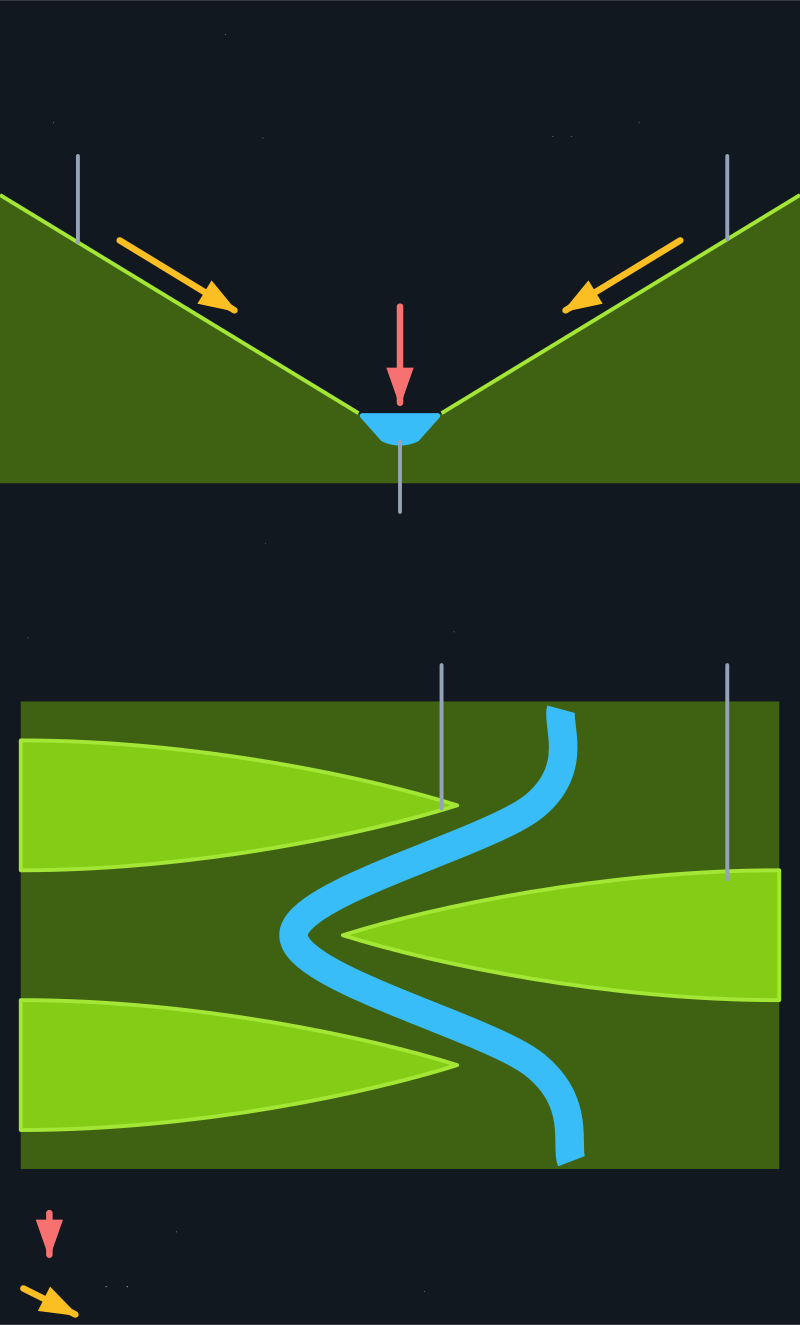
Figure 2: How a V-shaped valley forms. Vertical erosion deepens the channel, then weathering and mass movement widen the sides.
Not to scale. The top picture is a cross-section across the valley. The bottom picture looks down on the valley from above.
V-shaped valleys are the defining landform of the upper course. They are not simply the result of erosion — they form through a specific sequence of interacting processes that must be understood in the correct order for a Level 3 exam answer.
In the upper course, the river descends steeply from high moorland or mountain. This steep gradient converts potential energy into kinetic energy — the water flows fast, with high turbulence, and has great erosive power.
The fast-flowing water uses hydraulic action and abrasion to erode downward into the bedrock. This is called vertical erosion (or downcutting). The river cuts a narrow, steep-sided channel into the landscape.
As the river cuts downward, the rock on either side of the channel is left exposed above the water level. These valley walls are no longer protected by the river — they are exposed to sub-aerial (surface) processes.
Freeze-thaw weathering shatters the exposed rock in the valley walls (water enters joints, freezes, expands by 9%, widens cracks over repeated cycles). Gravity then pulls the loosened material down the slopes through mass movement processes — soil creep, slumping, and rockfalls.
The debris that falls from the valley walls enters the river channel. This adds to the load the river carries, increasing its capacity for abrasion and providing additional material for attrition downstream.
The river cannot always erode in a perfectly straight line — it is deflected by resistant (hard) rock outcrops. It curves around these obstacles, cutting on one side and then the other. The projecting ridges of hard rock that the river winds between are called interlocking spurs — they interlock like the teeth of a zip when viewed from above.
The combination of vertical erosion cutting the floor, weathering and mass movement lowering the walls, and the river weaving between spurs produces the characteristic narrow, V-shaped valley with interlocking spurs typical of upland UK rivers. Named example: River Severn upper course on Plynlimon, mid-Wales; River Swale, Yorkshire Dales.
Make this stick
Signing in gives access to all PrepWise features.