Test yourself on Tectonic Hazards with exam style questions, marked instantly.
Flashcards that come back just before you would forget them.
A revision plan that remembers what you know and shows what to do next.
See which topics you have nailed and which need another look.
Quiz yourself on Tectonic HazardsGet your flashcardsBuild my revision planTrack my progress🔍 How Tectonic Hazards Form

Figure 1: The three types of plate boundary. Arrows show the way each plate moves.
Constructive boundaries are also called divergent, destructive are convergent and conservative are transform. The blocks are not to scale.
The Earth's outermost layer, the crust and the rigid top of the mantle, is not a single solid shell. It is broken into roughly 12 large tectonic plates and several smaller ones, all moving slowly across the surface of the planet. This movement is driven by convection currents in the hot, slowly flowing rock of the mantle below: hot rock rises, spreads outward, cools, and sinks again in a slow churning cycle. The plates move at roughly 5 cm per year — about the speed your fingernails grow. Over millions of years, these tiny movements build mountains, open oceans, and generate the world's most destructive natural events.
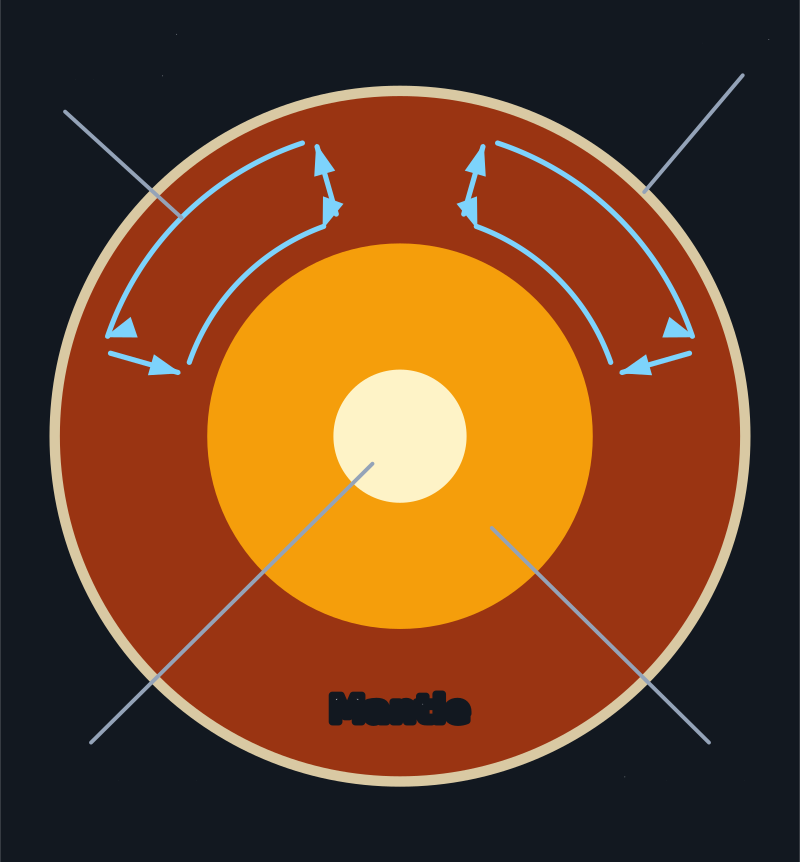
Figure 2: Earth's layers. Heat from the core drives convection currents in the mantle, which move the plates.
The layers are drawn to scale except the crust, which is drawn a little thicker so you can see it. The crust is about 5 km thick under the oceans and up to about 70 km under mountains. The mantle is nearly 3,000 km thick.
Almost all earthquakes and volcanoes occur at or near plate margins — the boundaries where two plates meet. There are three types, each producing different hazards:
When an oceanic plate meets a continental plate, the denser oceanic plate is forced downward into the mantle in a process called subduction. As it descends, friction between the plates generates enormous pressure. When that pressure is released suddenly, it sends seismic waves through the crust — an earthquake. The subducting plate also melts as it descends into the hot mantle, producing magma that rises to form volcanoes above. Example: The Nazca Plate subducting beneath the South American Plate produces both the Andes mountain range and Chile's devastating earthquakes.
When two continental plates converge, neither can subduct (both are too light). Instead they crumple upward, forming mountain ranges. The immense pressure still produces powerful earthquakes, but without subduction there is no magma and therefore no volcanoes. Example: The Indian Plate crashing into the Eurasian Plate has pushed up the Himalayas over 50 million years — and still generates Nepal's earthquakes today.
Here, two plates grind sideways past each other. No crust is created or destroyed, so there are no volcanoes. But the friction as plates lock and then suddenly release generates powerful earthquakes. Example: The San Andreas Fault in California, where the Pacific Plate slides northward past the North American Plate.
As plates pull away from each other, magma rises to fill the gap, creating new oceanic crust and forming volcanoes. Earthquakes here tend to be shallower and less powerful than at destructive margins. Example: The Mid-Atlantic Ridge, where the Eurasian and North American plates separate — Iceland sits on this boundary and experiences both regular earthquakes and volcanic eruptions.
When an earthquake occurs, energy radiates outward from the focus — the underground point of origin — as seismic waves. The point on the surface directly above the focus is the epicentre, which usually experiences the most intense shaking. Shallow-focus earthquakes (less than 70 km deep) cause more surface damage than deep-focus ones because the energy has less distance to travel before reaching buildings and people.
Quick Check: Name the plate margin type that produces earthquakes but NOT volcanoes, and give a named example.
Conservative (transform) margins produce earthquakes but no volcanoes because plates slide past each other — no crust is subducted and no magma is generated. Example: the San Andreas Fault, California, where the Pacific Plate slides past the North American Plate. Collision margins (e.g. Himalayas / Nepal) also produce earthquakes without volcanoes for the same reason — no subduction means no magma.
Make this stick
Signing in gives access to all PrepWise features.