This deep dive covers Pressure in Liquids — Depth and Upthrust within Gas Pressure & Temperature for GCSE Physics. Revise Gas Pressure & Temperature in Particle Model for GCSE Physics with 19 exam-style questions and 30 flashcards. This topic appears regularly enough that it should still be part of a steady revision cycle. It is section 4 of 12 in this topic. Use this deep dive to connect the idea to the wider topic before moving on to questions and flashcards.
🔬 Pressure in Liquids — Depth and Upthrust
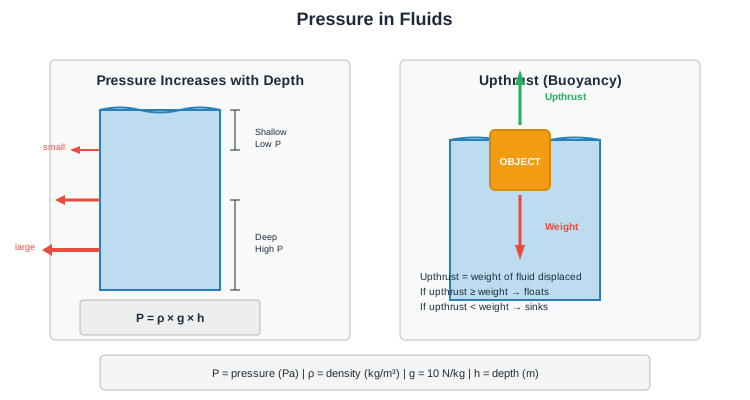
Figure 2: Pressure increases with depth in a fluid. Greater depth means more liquid above pushing down.
P = ρ × g × h — Pressure in a liquid increases with depth. At greater depths, more liquid above pushes down. Upthrust (buoyancy) is the upward force on an object in a fluid, equal to the weight of fluid displaced. If upthrust ≥ weight, the object floats!
Quick Check: A gas is heated in a sealed, rigid container. Explain, using the particle model, why the pressure increases.
Heating the gas increases the kinetic energy of the particles, so they move faster. This causes more frequent collisions with the container walls, and each collision is harder (more force). The increased rate and force of collisions means greater pressure on the walls.
Practice questions for Gas Pressure & Temperature
A sealed gas container is heated. What happens to the pressure of the gas inside?
A sealed gas cylinder is heated. Explain, using particle theory, why the pressure of the gas increases when the temperature increases.