Atomic StructureDiagram

Half-Life Decay Curve

Part of Half-LifeGCSE Physics

This diagram covers Half-Life Decay Curve within Half-Life for GCSE Physics. Revise Half-Life in Atomic Structure for GCSE Physics with 13 exam-style questions and 23 flashcards. This topic appears regularly enough that it should still be part of a steady revision cycle. It is section 3 of 13 in this topic. Focus on the labels, the relationships between parts, and the explanation that turns the diagram into an exam-ready answer.

Topic position

Section 3 of 13

Practice

13 questions

Recall

23 flashcards

📊 Half-Life Decay Curve

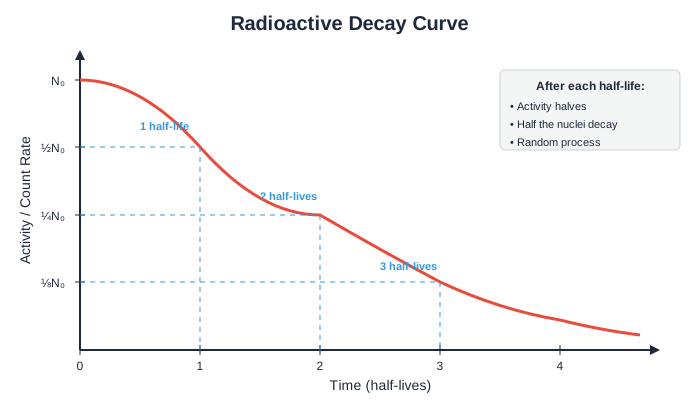
Radioactive decay curve showing exponential decrease in activity over time, with markers at each half-life showing the activity halving from N0 to half-N0 to quarter-N0 to eighth-N0

Figure 1: Exponential decay curve. At each half-life interval, the activity (or number of undecayed nuclei) halves. The curve never reaches zero.

KEY PATTERN: After each half-life, exactly HALF of the radioactive atoms remain. The curve never reaches zero — there's always some radioactive material left. To find half-life from a graph: find when the activity halves (e.g., 800 → 400 Bq) and read the time taken.

Keep building this topic

Read this section alongside the surrounding pages in Half-Life. That gives you the full topic sequence instead of a single isolated revision point.

Practice Questions for Half-Life

What is the definition of half-life?

  • A. The time taken for all of the radioactive nuclei to decay
  • B. The time taken for half of the radioactive nuclei in a sample to decay
  • C. The time taken for the activity of a sample to double
  • D. Half of the time for a nucleus to become stable
1 markfoundation

Explain what is meant by saying radioactive decay is 'random and spontaneous'.

2 marksstandard

Quick Recall Flashcards

What is half-life?
Half-life is the time taken for half the unstable nuclei in a radioactive sample to decay, or the time for the activity of a radioactive source to fall to half its original value.
Why is radioactive decay described as random?
Radioactive decay is random because we cannot predict when any individual nucleus will decay. We can only predict the probability of decay and the average behaviour of large numbers of nuclei.

Want to test your knowledge?

PrepWise has 13 exam-style questions and 23 flashcards for Half-Life — with adaptive difficulty and instant feedback.

Join Alpha