WavesDiagram

P-Waves vs S-Waves

Part of Seismic WavesGCSE Physics

This diagram covers P-Waves vs S-Waves within Seismic Waves for GCSE Physics. Revise Seismic Waves in Waves for GCSE Physics with 13 exam-style questions and 15 flashcards. This is a high-frequency topic, so it is worth revising until the explanation feels precise and repeatable. It is section 3 of 14 in this topic. Focus on the labels, the relationships between parts, and the explanation that turns the diagram into an exam-ready answer.

Topic position

Section 3 of 14

Practice

13 questions

Recall

15 flashcards

📊 P-Waves vs S-Waves

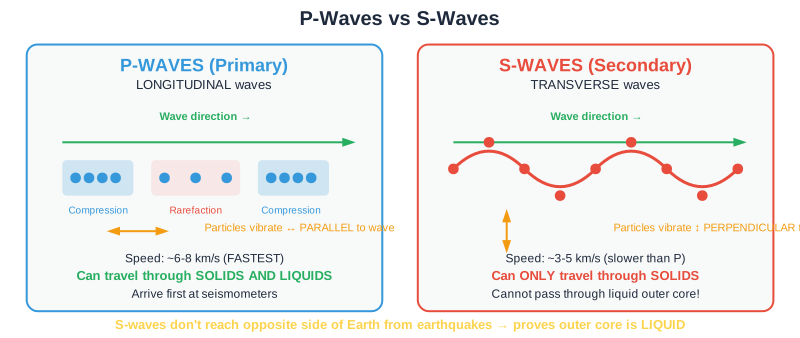
Comparison of P-waves (longitudinal, travel through solids and liquids) and S-waves (transverse, only travel through solids)

Figure 1: P-waves are longitudinal and pass through all media; S-waves are transverse and cannot pass through liquids

KEY EVIDENCE: S-waves don't reach the opposite side of Earth from an earthquake. This proves the outer core is liquid — S-waves cannot travel through liquids!

Keep building this topic

Read this section alongside the surrounding pages in Seismic Waves. That gives you the full topic sequence instead of a single isolated revision point.

Practice Questions for Seismic Waves

What type of wave is a P-wave (primary seismic wave)?

  • A. Longitudinal wave
  • B. Transverse wave
  • C. Electromagnetic wave
  • D. Surface wave only
1 markfoundation

State two differences between P-waves and S-waves in terms of how the particles move and what materials they can travel through.

2 marksstandard

Quick Recall Flashcards

What are P-waves?
Primary (longitudinal) seismic waves - fastest
What are S-waves?
Secondary (transverse) seismic waves - slower

Want to test your knowledge?

PrepWise has 13 exam-style questions and 15 flashcards for Seismic Waves — with adaptive difficulty and instant feedback.

Join Alpha