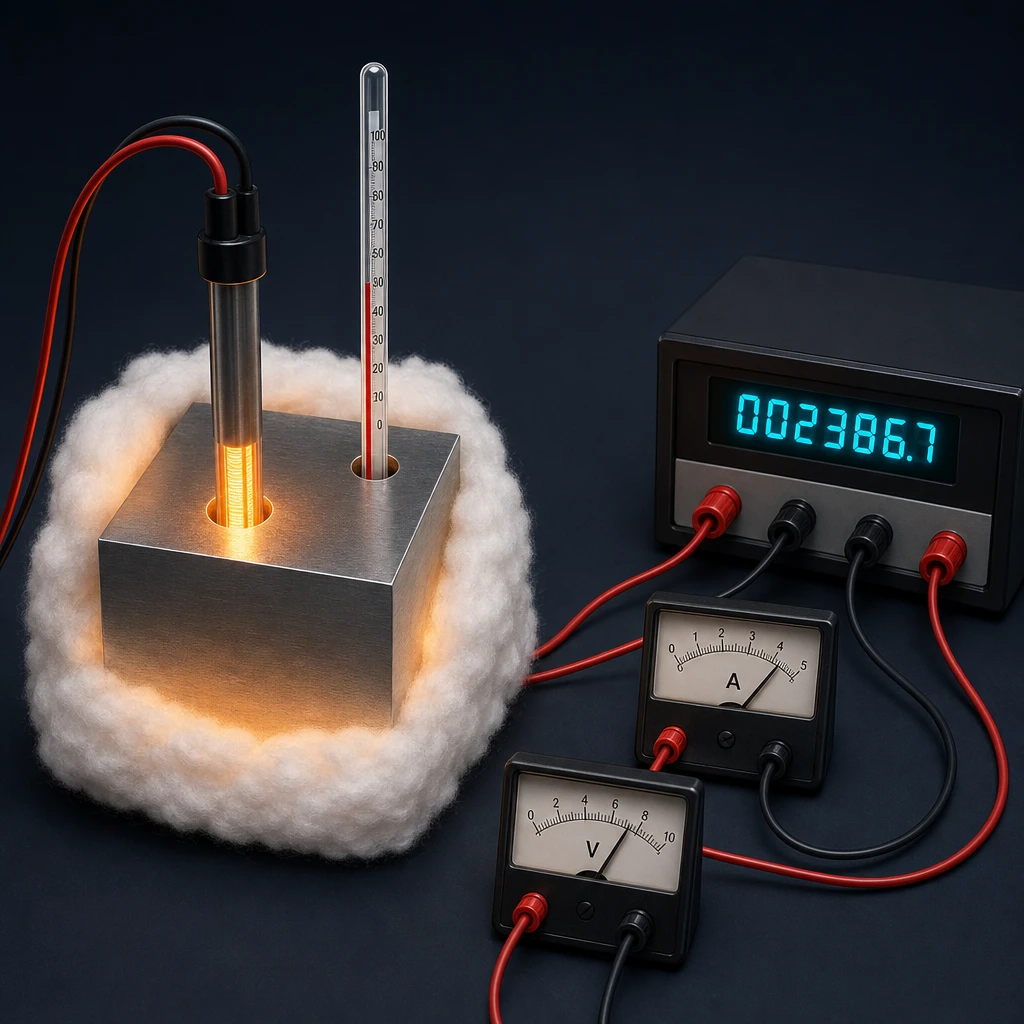
Figure 1: Required practical setup — metal block with immersion heater and thermometer, insulated with cotton wool to reduce heat loss. Joulemeter records energy; ammeter and voltmeter allow P = IV calculation.
Equipment needed:
- Metal block with two holes (one for heater, one for thermometer)
- Immersion heater connected to power supply
- Thermometer (or temperature probe)
- Joulemeter OR ammeter + voltmeter + stopwatch
- Balance to measure mass
- Insulation (cotton wool/bubble wrap)
Method:
- Measure and record the mass of the metal block (m)
- Insert immersion heater and thermometer into holes
- Add a drop of oil to thermometer hole for better thermal contact
- Record starting temperature (θ₁)
- Switch on heater and start recording energy (or start timer)
- Heat for a set time (e.g., 10 minutes)
- Record final temperature (θ₂) and total energy transferred (ΔE)
- Calculate: c = ΔE ÷ (m × Δθ)
If using P = IV instead of joulemeter:
- Measure current (I) and voltage (V)
- Calculate power: P = I × V
- Calculate energy: ΔE = P × t (where t is time in seconds)
This required practical covers REQUIRED PRACTICAL: Measuring Specific Heat Capacity within Specific Heat Capacity for GCSE Physics. Revise Specific Heat Capacity in Energy for GCSE Physics with 15 exam-style questions and 13 flashcards. This topic shows up very often in GCSE exams, so students should be able to explain it clearly, not just recognise the term. It is section 7 of 15 in this topic. Revise both the method and the reason for each step, because practical questions often test understanding rather than pure recall.
Practice questions for Specific Heat Capacity
What does the specific heat capacity of a substance measure?
Water has a specific heat capacity of 4200 J/kg°C, much higher than most other common substances. Explain why this makes water useful in central heating systems.