536 questions with model answers · Chemistry Paper 2 · GCSE Chemistry revision
A student is investigating the rate of the reaction between marble chips (calcium carbonate) and dilute hydrochloric acid. She records the volume of carbon dioxide produced over time. Using your knowledge of collision theory, evaluate the effect of each of the following changes on the rate of this reaction, explaining the mechanism in each case: 1. Crushing the marble chips into powder 2. Increasing the concentration of the acid 3. Raising the temperature by 20 degrees C 4. Adding a catalyst In your answer, refer to collision frequency, activation energy, and the Maxwell-Boltzmann distribution where appropriate.
1. Crushing the marble chips increases the surface area of the solid reactant. More calcium carbonate particles are exposed at the surface and available for collision with hydrogen ions in the acid. Collision frequency increases, so more successful collisions occur per second and the rate increases. 2. Increasing the acid concentration means more hydrogen ions are present in the same volume. The particles are more densely packed, increasing collision frequency between acid particles and marble surface particles. More successful collisions occur per second and the rate increases. Concentration does not affect the activation energy. 3. Raising the temperature increases the kinetic energy of all particles, so they move faster. This increases collision frequency. More importantly, on the Maxwell-Boltzmann distribution, the curve shifts to the right and flattens. The area under the curve to the right of the activation energy line increases significantly, meaning a much greater proportion of particles now have energy equal to or greater than the activation energy. This leads to a large increase in successful collisions per second and a disproportionately large increase in rate. 4. A catalyst provides an alternative reaction pathway with a lower activation energy. On the Maxwell-Boltzmann distribution, this is equivalent to moving the activation energy line to the left. A greater proportion of the existing particles now have sufficient energy for successful collisions. The rate increases without the catalyst being consumed.
This 6-mark question tests the ability to apply collision theory systematically across four different rate factors. The highest marks go to answers that: (1) correctly distinguish between factors that change collision frequency versus those that change collision energy, (2) correctly describe the Maxwell-Boltzmann explanation for temperature, and (3) correctly explain that a catalyst does not increase collision frequency but lowers the activation energy threshold.
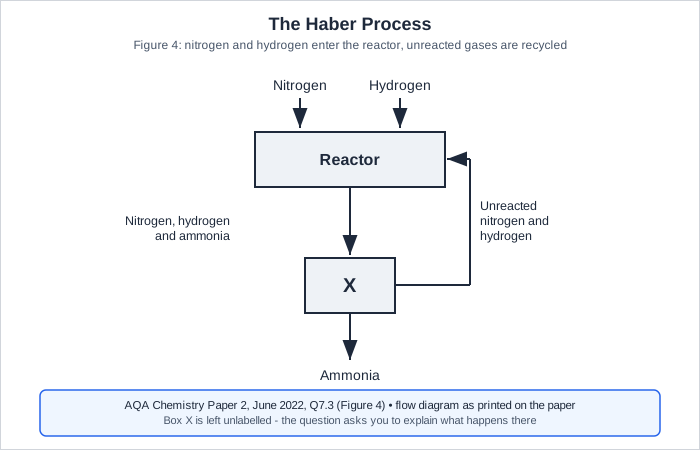
The Haber process makes ammonia using the reversible reaction: N₂(g) + 3H₂(g) ⇌ 2NH₃(g) (ΔH = −92 kJ/mol) The industrial conditions used are: temperature 450°C, pressure 200 atmospheres, iron catalyst. Using your knowledge of collision theory and Le Chatelier’s principle, explain why these conditions are chosen as a compromise and not the theoretically ideal values.
The forward reaction is exothermic, so according to Le Chatelier’s principle, a lower temperature would increase the yield of ammonia by shifting equilibrium to the right. However, a lower temperature means particles have less kinetic energy, so fewer collisions exceed the activation energy, making the rate very slow. 450°C is a compromise: the rate is acceptably fast and the yield is still economically viable. There are four moles of gas on the left and two on the right, so high pressure shifts equilibrium to the right, increasing yield. However, very high pressures are expensive to maintain and create safety hazards. 200 atm is a compromise between yield and cost. The iron catalyst lowers the activation energy by providing an alternative reaction pathway. This increases the rate without altering the equilibrium position or yield. The catalyst allows a lower temperature to be used than would otherwise be feasible, improving both rate and yield together.
The Haber process is the classic GCSE example of compromise conditions because Le Chatelier’s principle and collision theory pull in opposite directions for temperature. The reaction is exothermic, so cooling it would shift the equilibrium right and increase yield — but cooling also means fewer particles have enough energy to exceed the activation energy, making the rate unacceptably slow. 450°C is the industrial sweet spot. Pressure at 200 atm exploits the fact there are more moles of gas on the reactant side (N₂ + 3H₂ = 4 moles) than the product side (2NH₃ = 2 moles), so higher pressure pushes equilibrium toward the products; but extreme pressure is dangerous and costly. The iron catalyst is crucial: by providing an alternative lower-energy pathway, it raises the rate without disturbing the equilibrium position, allowing a lower operating temperature to be viable. A common error is claiming the catalyst increases yield — it does not; it only increases the speed at which equilibrium is reached.
For the equilibrium reaction: N₂O₄(g) ⇌ 2NO₂(g) Increasing the pressure shifts the equilibrium position to the left, producing more N₂O₄. Using ideas about collision theory and Le Chatelier’s principle, explain: (a) Why increasing pressure increases the rate of both forward and reverse reactions. (b) Why, despite both rates increasing, the equilibrium shifts to the left.
(a) Increasing pressure compresses the gas mixture into a smaller volume. All gas particles are now more densely packed. Collision frequency increases for both forward and reverse reactions because particles encounter each other more often in the smaller space. More successful collisions occur per second for both directions, so both rates increase. (b) There is 1 mole of gas on the left (N₂O₄) and 2 moles of gas on the right (2NO₂). According to Le Chatelier’s principle, the system responds to oppose the change in pressure. The side with fewer moles of gas (the left) exerts less pressure. Shifting the equilibrium to the left reduces the total number of moles of gas, which partially counteracts the increase in pressure. Therefore the reverse reaction rate increases more than the forward reaction rate, and the equilibrium shifts leftward until a new equilibrium is reached.
This question exposes a common confusion: students often think increasing pressure simply ‘shifts the equilibrium’ without understanding that pressure first increases BOTH rates because all gas particles are packed into a smaller volume and collide more frequently. The equilibrium shift happens because the two rates do not increase by the same amount. Since there are more gas molecules on the NO₂ side (2 moles) than the N₂O₄ side (1 mole), the reverse reaction is more sensitive to the pressure increase and its rate increases more, driving the equilibrium leftward until a new balance is established. Le Chatelier’s principle provides the prediction; collision theory provides the mechanism.
An industrial chemist is trying to maximise the production of a product P in the exothermic reversible reaction: A(g) + B(g) ⇌ P(g) (ΔH = −56 kJ/mol) The chemist must choose between two strategies to increase the rate of production of P: Strategy 1: Increase the temperature by 100°C. Strategy 2: Add a suitable catalyst. Evaluate both strategies, considering their effect on the rate of reaction and the equilibrium yield of P. Explain which strategy you would recommend for maximising the overall production of P.
Strategy 1 — Increasing temperature: Raising the temperature gives particles more kinetic energy, so they move faster, collision frequency increases, and a greater proportion of particles have energy equal to or above the activation energy. The rate of reaction increases. However, the forward reaction is exothermic, so by Le Chatelier’s principle, increasing temperature shifts the equilibrium to the left (towards reactants), decreasing the yield of P. Higher rate but lower yield. Strategy 2 — Catalyst: A catalyst provides an alternative reaction pathway with a lower activation energy. A greater proportion of particles now have sufficient energy for successful collisions, so the rate increases. Crucially, a catalyst affects the forward and reverse reactions equally. It does not change the equilibrium position, so the yield of P is unchanged. Higher rate and maintained yield. Recommendation: Strategy 2 (catalyst) is better. It increases the rate without reducing the yield of P, whereas Strategy 1 increases the rate but reduces the equilibrium yield. For maximum overall production, a high rate with an unchanged yield is preferable to a high rate with a reduced yield.
This evaluation question tests the difference between rate and yield, a distinction many students miss. Increasing temperature increases rate (more kinetic energy → more particles exceed the activation energy) but, for an exothermic reaction, it shifts equilibrium left by Le Chatelier’s principle, reducing yield. A catalyst increases rate by lowering the activation energy via an alternative pathway. Because a catalyst lowers the activation energy equally for BOTH the forward and reverse reactions, the ratio of forward to reverse rate is unchanged and so the equilibrium position — and therefore the yield — is unaffected. For any exothermic reversible industrial reaction, a catalyst is therefore better than raising temperature because you gain rate without sacrificing yield.
A student investigates the rate of reaction between magnesium ribbon and dilute hydrochloric acid at 20°C. She repeats the experiment at 40°C and also with double the concentration of acid. Using collision theory, explain how each change — increasing temperature and increasing concentration — increases the rate of reaction. In your answer, refer to collision frequency, activation energy, and kinetic energy.
Increasing temperature gives particles more kinetic energy so they move faster. This increases collision frequency as particles cover more distance per second and encounter each other more often. Crucially, a greater proportion of particles now have energy equal to or greater than the activation energy, so a larger fraction of collisions are successful. Both effects increase the rate. Doubling the concentration of acid means more hydrogen ions are present in the same volume. The particles are more densely packed, so they collide more frequently. This increase in collision frequency means more successful collisions per second, increasing the rate. Unlike temperature, increasing concentration does not affect the energy of particles or the activation energy; it acts only by increasing how often collisions occur.
This question requires distinguishing between two rate factors that both increase collision frequency but work differently at the particle level. Temperature increases kinetic energy, making particles faster and increasing collision frequency. Critically, it also raises the proportion of collisions that exceed the activation energy threshold, because more particles sit in the high-energy tail of the Maxwell-Boltzmann distribution. Concentration does not change particle energies at all — it only packs more particles into the same space, so encounters happen more frequently. The key examiner mark is recognising this difference: temperature affects BOTH frequency and success rate; concentration affects frequency only. Students who say concentration gives particles more energy will lose marks.
A reversible reaction reaches a state of dynamic equilibrium in a closed system. (a) Explain, in terms of the rates of forward and reverse reactions, what is meant by dynamic equilibrium. (b) More reactant is then added to the system. Using collision theory and Le Chatelier’s principle, predict and explain what happens to the concentrations of reactants and products, and to the rates of forward and reverse reactions, until a new equilibrium is reached.
(a) Dynamic equilibrium is reached when the forward reaction and reverse reaction are occurring at the same rate. The concentrations of reactants and products remain constant over time, but the reactions have not stopped — both directions continue to proceed simultaneously. It is ‘dynamic’ because reactions are still occurring; it is ‘equilibrium’ because the rates are equal and concentrations are constant. (b) Adding more reactant increases the concentration of reactants. By collision theory, there are now more reactant particles in the same volume, so the frequency of collisions between reactant particles increases. The rate of the forward reaction increases, producing more products. As product concentration rises, the reverse reaction rate also begins to increase. By Le Chatelier’s principle, the system opposes the increase in reactant concentration by shifting the equilibrium to the right (towards products). Eventually a new equilibrium is reached where the forward and reverse rates are once again equal, but at higher concentrations of both reactants and products than the original equilibrium, with the proportion of products being greater.
Dynamic equilibrium is one of the most commonly misunderstood concepts at GCSE. The word ‘dynamic’ is crucial: reactions have NOT stopped; both forward and reverse reactions continue at equal rates. A static equilibrium (where nothing moves) does not occur in chemistry. When reactant is added, collision theory predicts the immediate effect: more particles in the same volume means more frequent collisions, so the forward rate rises immediately. Le Chatelier’s principle then describes the system’s overall response: it shifts right to consume the added reactant and partially restore the original concentrations. New equilibrium is reached when the two rates equalize again. Two key misconceptions to avoid: (1) equilibrium means reactions stop — they do not; (2) equal concentrations at equilibrium — concentrations are constant, not necessarily equal to each other.
Use the Maxwell-Boltzmann distribution to explain why a small increase in temperature causes a large increase in the rate of reaction.
The Maxwell-Boltzmann distribution shows the spread of energies among particles. At higher temperature, the curve shifts to the right and flattens — the most likely energy increases. The area under the curve to the right of the activation energy line represents the proportion of particles with sufficient energy to react. Even a small temperature rise causes a large increase in this area, so a much greater proportion of particles have energy equal to or above the activation energy. This leads to a large increase in the number of successful collisions per second and a disproportionately large increase in reaction rate.
The key insight is that because the Maxwell-Boltzmann distribution is not linear near the activation energy, a small shift in the curve causes a disproportionately large increase in the area beyond the activation energy threshold, explaining why even a 10-degree rise can double the rate.
Compare how increasing temperature and using a catalyst both increase the rate of reaction. In your answer, refer to activation energy and collision frequency.
Increasing temperature raises the kinetic energy of particles, increasing both collision frequency and the proportion of particles with energy equal to or greater than the activation energy. Both effects increase the number of successful collisions per second. A catalyst provides an alternative reaction pathway with a lower activation energy, so a greater proportion of particles have sufficient energy for successful collisions, increasing the rate. Unlike temperature increase, a catalyst does not significantly increase collision frequency — it acts only by lowering the activation energy threshold.
The critical distinction for higher marks: temperature increases BOTH collision frequency AND the proportion of successful collisions. A catalyst increases only the proportion of successful collisions (by lowering the activation energy threshold) without meaningfully increasing how often particles collide.
Explain, using collision theory, why powdering a solid reactant increases the rate of reaction compared to using the same mass as large pieces.
Powdering the solid increases its surface area. More reactant particles are exposed at the surface and available for collisions with other reactant particles. This increases the frequency of collisions between reactant particles. More successful collisions occur per second, so the rate of reaction increases.
The key chain is: powder → larger surface area → more exposed particles → more frequent collisions → more successful collisions per second → faster rate. The total number of particles does not change, only how many are accessible for collision.
For a reaction between gases, explain why increasing the pressure increases the rate of reaction.
Increasing pressure forces the gas particles into a smaller volume. The same number of particles are now more concentrated. This means particles collide more frequently with each other. More successful collisions occur per second, so the rate of reaction increases.
Pressure compresses gas into a smaller volume. Particle density (effective concentration) rises. Particles collide more frequently so more successful collisions occur per unit time, raising the rate.
Using the Maxwell-Boltzmann distribution diagram, explain how a catalyst increases the rate of reaction.
A catalyst lowers the activation energy for the reaction. On the Maxwell-Boltzmann distribution, this moves the activation energy line to the left. The area under the curve to the right of the new lower activation energy is greater than before. This means a larger proportion of particles now have sufficient energy for successful collisions, so the rate of reaction increases.
On the Maxwell-Boltzmann diagram, the curve (distribution) stays the same. Only the activation energy line moves — the catalyst shifts it left to a lower energy value, revealing a larger area of particles that can now react.
Explain what happens at a molecular level when two reactant particles collide but do not react.
If the colliding particles do not have sufficient energy — that is, their combined kinetic energy is less than the activation energy — the collision is unsuccessful. The particles do not have enough energy to break the existing bonds. The particles simply bounce off each other and no new products are formed.
At GCSE, an unsuccessful collision is one where collision energy is below the activation energy. Without sufficient energy, existing bonds cannot break, so no new bonds form and no products are made.
State the two conditions required for a chemical reaction to occur according to collision theory.
Particles must collide with each other. The collision must have energy equal to or greater than the activation energy.
Collision theory has two core conditions: (1) particles must physically collide, and (2) that collision must have at least the activation energy for bonds to break and a reaction to proceed.
Explain, using collision theory, why increasing the concentration of a reactant solution increases the rate of reaction.
Increasing concentration means there are more particles in the same volume. This increases the frequency of collisions between reactant particles, so more successful collisions occur per second, increasing the rate of reaction.
More reactant particles in the same volume means they are closer together and encounter each other more frequently. The rate depends on how many successful collisions occur per second, so more frequent collisions means a higher rate.
Explain, using collision theory, why increasing temperature increases the rate of reaction.
Increasing temperature gives particles more kinetic energy, so they move faster. More particles now have energy equal to or greater than the activation energy, so the proportion of successful collisions increases and the rate of reaction increases.
Temperature increases give particles more kinetic energy. They move faster (more frequent collisions) and with more force (higher collision energy). Both effects mean more collisions exceed the activation energy threshold.
Explain how a catalyst increases the rate of a reaction without being used up.
A catalyst provides an alternative reaction pathway with a lower activation energy. A greater proportion of particles now have sufficient energy to react, increasing the frequency of successful collisions. The catalyst is not consumed because it is regenerated at the end of the reaction.
Catalysts work by providing a new lower-energy route for the reaction. More collisions are successful because fewer particles need to reach the (now lower) threshold. The catalyst is not destroyed because it is reformed after each catalytic cycle.
According to collision theory, which of the following must happen for a chemical reaction to take place?
Collision theory states that particles must collide AND have enough energy (at least equal to the activation energy) for a reaction to occur. Dissolving, a fixed temperature, or a specific physical state are not requirements.
What is activation energy?
Activation energy is the minimum energy that colliding particles must possess for a reaction to occur. It represents the energy barrier that must be overcome for bonds to break and new bonds to form.
A student increases the concentration of a reactant solution. Using collision theory, what happens to the rate of reaction?
Increasing concentration means more particles are present in the same volume. This increases the frequency of collisions between reactant particles, so more successful collisions occur per second and the rate increases.
State what is meant by a successful collision in collision theory.
A successful collision is one where the colliding particles have energy equal to or greater than the activation energy, causing a reaction to occur.
A successful collision requires both collision (particles meeting) and sufficient energy (at or above activation energy). Without enough energy, particles simply bounce off each other.
A reaction is carried out at 30 degrees C and then repeated at 50 degrees C. Which statement best explains why the rate is faster at 50 degrees C?
Raising temperature increases the average kinetic energy of particles. A greater proportion of particles now have energy at or above the activation energy threshold, so more collisions are successful per second, increasing the rate.
Marble chips (calcium carbonate) react faster when powdered than when in large lumps. Which collision theory statement explains this?
Smaller particles have a larger total surface area exposed to the acid. More reactant surface is available for acid particles to collide with, so collisions happen more frequently and the rate increases.
How does a catalyst increase the rate of a reaction?
A catalyst works by providing an alternative reaction pathway with a lower activation energy. This means a greater proportion of collisions are successful, increasing the reaction rate. The catalyst is not consumed in the process.
On a Maxwell-Boltzmann energy distribution graph, what happens to the area under the curve to the right of the activation energy line when temperature increases?
When temperature increases, the Maxwell-Boltzmann curve shifts to the right and flattens. The area under the curve to the right of the activation energy line increases significantly, representing a greater proportion of particles with sufficient energy for successful collisions.
A reaction between two gases is carried out at twice the original pressure. Which statement correctly explains why the rate increases?
Increasing pressure on a gas compresses the particles into a smaller volume. The same number of particles are now closer together, so they collide more frequently. This increases the number of successful collisions per second and raises the rate.
A factory manufactures a dye using a reaction between two dissolved chemicals. The factory manager wants to increase the rate of production to meet increased demand. Suggest THREE different ways the factory could increase the rate of the dye-making reaction and explain, using collision theory, why each method would work. [6 marks]
The factory could increase the temperature of the reaction. At higher temperatures, particles have more kinetic energy and move faster. This means collisions are more frequent and more collisions have energy equal to or greater than the activation energy, so the rate increases. The factory could increase the concentration of the dissolved reactants. A higher concentration means more particles are present in the same volume of solution, so collisions between reactant particles happen more frequently, increasing the rate. The factory could use a catalyst. A catalyst provides an alternative reaction pathway with a lower activation energy. This means a greater proportion of collisions have sufficient energy to react, so the rate increases without changing the temperature or concentration.
Collision theory explains that reactions only occur when particles collide with enough energy (equal to or above the activation energy). Temperature increases particle kinetic energy so collisions are both more frequent and more energetic — both effects raise the rate. Concentration increases the number of particles per unit volume, raising collision frequency. Catalysts lower the activation energy required, so a larger fraction of collisions result in a reaction. Surface area increases the number of exposed reactant particles available to collide. For a 6-mark Level of Response question, you need three factors, each with a full collision theory explanation — not just a list.
Explain how four different factors affect the rate of a chemical reaction. In your answer, use collision theory to explain why each factor changes the rate. [6 marks]
Temperature: Increasing temperature gives particles more kinetic energy so they move faster. Collision frequency increases and, crucially, a greater proportion of particles have energy equal to or above the activation energy, leading to more successful collisions and a faster rate. Concentration: Increasing concentration puts more reactant particles in the same volume, so particles are closer together and collide more frequently, increasing the rate. Surface area: Breaking a solid into smaller pieces increases the surface area. More particles of the solid are exposed to the other reactant, so collisions occur more frequently and the rate increases. Catalyst: A catalyst provides an alternative reaction pathway with a lower activation energy. More particles have sufficient energy to overcome this lower barrier, so there are more successful collisions per second and the rate increases. The catalyst itself is not used up.
A 6-mark extended writing question tests whether students can apply collision theory consistently to multiple factors. The mark scheme awards 1 mark per valid collision-theory-based point. A grade 9 answer clearly distinguishes between effects on collision frequency (concentration, surface area, pressure) and effects on the proportion of successful collisions (temperature, catalyst).
A student plans to investigate how the concentration of hydrochloric acid affects the rate of reaction with magnesium ribbon. Describe how the student should carry out a fair test, including which variables to change, measure and control.
The independent variable is the concentration of HCl, which should be varied across at least five values. The dependent variable is the rate of reaction, measured by timing how long it takes for the magnesium to fully dissolve, or by recording the volume of hydrogen gas collected per unit time. Control variables include the length and surface area of the magnesium ribbon, the volume of acid, the temperature, and the same magnesium ribbon from the same batch. These must be kept constant to ensure any change in rate is due to concentration alone.
A fair test requires exactly one variable to be changed (independent), one to be measured (dependent), and all others held constant (control variables). This is fundamental to experimental design at GCSE and beyond.
Explain, in terms of particles, why increasing temperature increases the rate of reaction.
Increasing temperature gives particles more kinetic energy so they move faster. This means particles collide more frequently. It also means more particles have energy greater than or equal to the activation energy, so more collisions are successful and the rate increases.
Temperature affects rate in two linked ways: first, faster-moving particles collide more often; second, a larger fraction of those collisions have energy equal to or above the activation energy, making them productive. Both effects combine to significantly increase rate.
Nitrogen and hydrogen react together to form ammonia. Explain, in terms of particles, why increasing the pressure increases the rate of this reaction.
Increasing pressure decreases the volume that the gas particles occupy. This means the gas particles are closer together and collide more frequently. More frequent collisions mean the rate of reaction increases.
Pressure is the equivalent of concentration for gas-phase reactions. Higher pressure compresses the gas, increasing the number of particles per unit volume. Particles are closer together, meet more frequently, and the rate rises.
A student investigates the reaction between calcium carbonate chips and hydrochloric acid as part of a water-quality study. She measures the mass of the flask every 30 seconds as carbon dioxide gas escapes. The graph of mass lost against time shows a steep slope at the start that gradually becomes less steep and then flat. Explain what the shape of the graph shows about the rate of reaction at the start and at the end. [3 marks]
At the start of the reaction the gradient is steep, which shows the rate of reaction is fastest. This is because the concentration of hydrochloric acid is highest at the start, so collisions between reactant particles are most frequent. As the reaction proceeds the gradient becomes less steep because the reactants are being used up, so the concentration decreases and collisions happen less often. The graph becomes flat when the reaction has stopped because one or both reactants have been completely used up.
The gradient (steepness) of a mass-lost-vs-time graph directly represents the rate of reaction — steeper = faster. At the start, reactant concentrations are highest, so particles collide most frequently and the rate is greatest. As reactants are consumed, concentration falls and collision frequency drops, so the rate slows (gradient decreases). When the graph is completely flat, the rate is zero because all reactants have been used up. OCR B often presents this graph in a civic or environmental context — the chemistry of interpreting the gradient is the same regardless of the scenario.
A student investigates the effect of surface area on rate by reacting equal masses of large marble chips and powdered marble with excess hydrochloric acid. Describe and explain the difference in results expected for the two experiments.
The powdered marble reacts faster than the large chips. This is because powder has a much larger surface area, exposing more CaCO3 particles to the acid. Collisions between acid particles and marble particles are more frequent, so the rate is faster. Both experiments produce the same total volume of CO2 because the same mass of marble is used.
Surface area controls rate but NOT the total amount of product. Powder reacts faster (steeper rate-time curve, completes sooner) but both experiments reach the same final volume of CO2 because the total moles of CaCO3 are equal.
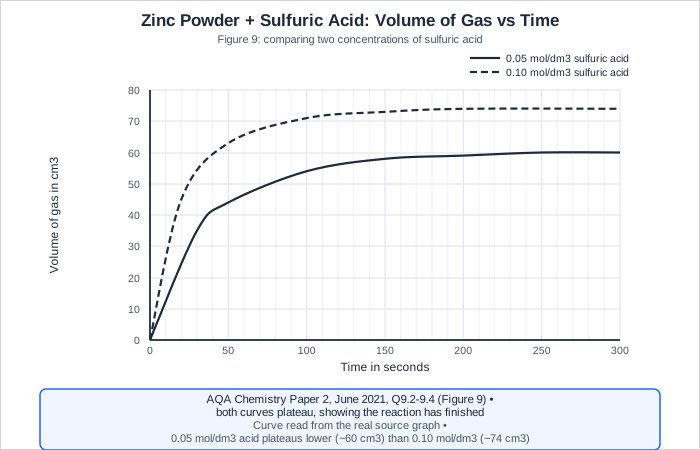
A student measures the volume of gas produced over time for a reaction at two different temperatures: 20°C and 40°C. Describe what the two curves on the rate-time graph would look like and explain the difference.
The curve at 40°C has a steeper initial gradient and levels off more quickly than the 20°C curve. Both curves level off at the same final volume because the same amounts of reactant were used. The steeper gradient at 40°C shows a faster rate because at higher temperature particles have more kinetic energy, collide more frequently, and more collisions exceed the activation energy.
A rate-time (volume vs time) graph is steeper when the reaction is faster. The initial gradient equals the initial rate. Temperature changes the gradient and the time taken, but NOT the final volume, because the same moles of reactant are present in both.
Explain two advantages of using a catalyst in an industrial chemical process.
A catalyst lowers the activation energy of the reaction, so the process can be run at a lower temperature, saving fuel costs. The catalyst is not used up during the reaction, so it can be recovered and reused many times, reducing raw material costs.
Industrial catalysts (like iron in the Haber process) are used precisely for these two reasons: they enable lower operating temperatures (saving energy costs) and they are not consumed (reducing raw material costs). These are standard exam mark points.
Explain why breaking a solid reactant into smaller pieces increases the rate of reaction.
Breaking a solid into smaller pieces increases the surface area. This means more particles of the solid are exposed and available to collide with the other reactant, so collisions happen more frequently and the rate increases.
When a solid is broken into smaller pieces, the total surface area increases because the interior of the solid becomes accessible. More solid particles are in direct contact with the other reactant, leading to more frequent collisions and a faster reaction rate.
A food manufacturer monitors the rate of fermentation when bread dough rises. Yeast in the dough converts sugars into carbon dioxide gas, which makes the dough rise. Name ONE factor the manufacturer could change to increase the rate of the fermentation reaction and explain, using collision theory, why this would work. [2 marks]
The manufacturer could increase the temperature of the dough. At higher temperatures, the yeast and sugar particles have more kinetic energy and move faster, so collisions between them are more frequent and more collisions have enough energy to react, increasing the rate of fermentation.
Any factor that increases collision frequency or the proportion of successful collisions will increase the reaction rate. For fermentation, increasing temperature gives particles more kinetic energy so they move and collide more often — and more collisions have enough energy to react. Increasing the concentration of sugar increases the number of sugar particles available, so collisions happen more frequently. In OCR B questions, you always need to name the factor AND explain it using collision theory — just naming the factor gives you only 1 out of 2 marks.
Explain why increasing the concentration of a reactant in solution increases the rate of reaction.
Increasing concentration means there are more particles of the reactant per unit volume. The particles are closer together, so they collide more frequently, increasing the rate of reaction.
Concentration is a measure of how many particles are dissolved per unit volume. A higher concentration packs more reactant particles into the same space, so the chance of any two particles meeting and colliding is greater, increasing the rate.
Explain how a catalyst increases the rate of reaction.
A catalyst provides an alternative reaction pathway with a lower activation energy. This means more particles have sufficient energy to react when they collide, so there are more successful collisions and the rate increases.
A catalyst works by providing an alternative, lower-energy route through which the reaction can proceed. Because the activation energy is lower, more of the colliding particles have enough energy to react, so there are more productive collisions per second.
In an experiment, 48 cm³ of gas is collected in 60 seconds. Calculate the mean rate of reaction. Give your answer with units.
Rate = volume / time = 48 / 60 = 0.8 cm³/s
Mean rate of reaction = volume of gas produced / time taken = 48 cm3 / 60 s = 0.8 cm3/s. Always include units in a rate calculation answer.
Which of the following factors does NOT affect the rate of a chemical reaction?
The colour of reactants has no effect on how quickly particles collide or on activation energy. The four main factors that affect rate are temperature, concentration (or pressure for gases), surface area, and catalysts.
A catalyst speeds up a reaction by:
A catalyst provides an alternative reaction pathway with a lower activation energy. This means more particles have sufficient energy to react when they collide, so the rate increases. The catalyst itself is not used up.
Marble chips are added to hydrochloric acid. The reaction is faster when the marble is in small chips rather than one large lump. What is the main reason for this?
Crushing marble into small chips dramatically increases the total surface area exposed to the acid. More surface area means more reactant particles are available to collide with acid particles, so the reaction is faster.
State what a catalyst is.
A catalyst is a substance that speeds up a chemical reaction without being used up or chemically changed at the end of the reaction.
A catalyst is a substance that speeds up a chemical reaction. The key distinguishing feature is that the catalyst is not permanently changed or consumed - it can be recovered unchanged at the end.
A chemist increases the temperature of a reaction mixture. According to collision theory, which statement best explains why the rate of reaction increases?
Higher temperature gives particles more kinetic energy, making them move faster. This has two effects: collisions happen more frequently (particles are moving faster and encounter each other more often), and more of those collisions have energy at or above the activation energy. Both effects increase the rate. Activation energy does NOT increase with temperature — it is fixed for a given reaction. Particle size and concentration do not change with temperature.
Magnesium ribbon is placed into two separate beakers of hydrochloric acid. Beaker A contains 2 mol/dm³ HCl and Beaker B contains 0.5 mol/dm³ HCl. Which statement correctly explains why the reaction in Beaker A is faster?
Higher concentration means more acid particles are dissolved in the same volume. This increases the chance of acid particles colliding with the magnesium surface per unit time, so the reaction rate is faster.
The rate of a reaction increases significantly when temperature is raised from 20°C to 30°C. Which of the following best explains this?
Increasing temperature shifts the Maxwell-Boltzmann distribution so that a larger proportion of particles have energy at or above the activation energy. This means more collisions are successful, dramatically increasing the rate.
Two gases are reacting together. The pressure of the system is doubled. What effect does this have on the reaction rate, and why?
Increasing pressure reduces the volume the gas occupies, pushing particles closer together. This increases the number of collisions per second, so the rate of reaction increases. Pressure has the same effect on gas reactions as concentration has on reactions in solution.
A student claims that adding a catalyst to a reaction increases the yield of product. Which response correctly evaluates this claim?
A catalyst speeds up the rate of reaction but does not change the equilibrium position or the total amount of product that can form. The yield (amount of product) depends on the stoichiometry and the equilibrium, not the presence of a catalyst.
A student is investigating the rate of the reaction between calcium carbonate and hydrochloric acid, which produces carbon dioxide gas. Which pair of methods could both be used to measure the rate of this reaction?
Both methods track how much CO2 is produced over time. A gas syringe measures the volume of CO2 collected. A balance measures the decrease in mass as CO2 escapes from the flask. Either method gives rate = change in measurement / time.
Evaluate the continued use of crude oil as an energy source, considering both advantages and disadvantages.
Crude oil has significant advantages: it is a high-energy fuel, it is relatively cheap due to existing infrastructure, and it can produce a wide range of products beyond fuels such as plastics, pharmaceuticals and lubricants. However, crude oil has major disadvantages: it is a finite (non-renewable) resource and will eventually run out. Its combustion produces carbon dioxide, a greenhouse gas that contributes to climate change. Incomplete combustion also produces carbon monoxide, a toxic gas, and particulates that cause respiratory problems. On balance, the long-term sustainability and environmental concerns mean investment in renewable alternatives is necessary, though crude oil will remain important in the medium term due to its versatility and existing infrastructure.
This 4-mark evaluate question requires at least one advantage, at least two distinct disadvantages, and a balanced conclusion. Advantages of crude oil: (1) It is an energy-dense fuel — a small volume stores large amounts of chemical energy, making it practical for transport. (2) It has an existing global infrastructure: refineries, pipelines, petrol stations, engines. (3) Beyond fuel, crude oil is the raw material for an enormous range of products: plastics, pharmaceuticals, lubricants, dyes, fertilisers. Disadvantages: (1) Crude oil is finite/non-renewable — it took hundreds of millions of years to form and is being consumed millions of times faster than it forms. Proven reserves will eventually be exhausted. (2) Combustion produces CO₂, a greenhouse gas that contributes to global warming and climate change. (3) Incomplete combustion produces carbon monoxide (toxic, binds to haemoglobin) and particulates (cause respiratory disease). (4) Extraction and transport risks environmental damage (oil spills). Conclusion: while crude oil has high energy density and is economically embedded, the environmental and finite-resource concerns mean investment in renewable energy sources is essential for long-term sustainability. The key feature of an 'evaluate' question is the balanced judgement — you must weigh up both sides, not just list points.
Explain how fractional distillation separates crude oil into different fractions.
Crude oil is heated until most of it vaporises. The vapour enters a fractionating column which has a temperature gradient — it is hot at the bottom and cooler at the top. As vapours rise they cool. Each hydrocarbon condenses when the temperature falls to its boiling point and is collected at that height in the column. Hydrocarbons with the highest boiling points condense near the bottom and those with the lowest boiling points condense near the top or exit as gases.
The key to this 3-mark question is linking three features: vaporisation, the temperature gradient, and different boiling points. Crude oil is heated in a furnace until most of it vaporises, then the mixed vapours are fed into the base of a tall fractionating column. The column has a temperature gradient — it is very hot at the bottom (over 300°C) and progressively cooler at the top (around 25°C). As the vapour mixture rises, each fraction reaches a height where the temperature has dropped to its specific boiling point. At that point, the molecules condense from vapour back into liquid and run off through a pipe into a storage vessel. Molecules with high boiling points (long chains, e.g. bitumen) condense low down near the hot base; molecules with low boiling points (short chains, e.g. refinery gases) condense near the cool top or escape as gas. Common mistake: saying crude oil is 'filtered' or that a 'chemical reaction' separates the fractions. Fractional distillation is entirely physical — no bonds are broken.
Describe how three properties of hydrocarbons change as the length of the carbon chain increases.
As carbon chain length increases: (1) boiling point increases because there are stronger intermolecular forces between larger molecules requiring more energy to overcome; (2) viscosity increases because longer molecules have greater intermolecular attractions making them harder to flow; (3) flammability decreases because longer chains vaporise less readily, making them harder to ignite.
Three properties change predictably with increasing chain length, each earning 1 mark. All three changes are caused by the same underlying reason: longer chains have greater surface area, which increases the strength of van der Waals (intermolecular) forces between neighbouring molecules. (1) Boiling point increases: stronger intermolecular forces require more energy (higher temperature) to overcome and separate the molecules. (2) Viscosity increases: stronger attractions make the molecules harder to slide past each other, so the liquid flows more slowly (is more viscous). (3) Flammability decreases: longer-chain molecules are less volatile (they don't vaporise easily at room temperature), so less flammable vapour forms in the air, making them harder to ignite. Common mistake: reversing any of these trends. A very common error is saying flammability increases with chain length — it is the opposite. Short-chain fractions (e.g. petrol) are very flammable because they are volatile gases or low-boiling liquids.
Explain what is meant by complete and incomplete combustion of hydrocarbons, including the products formed in each case.
Complete combustion occurs when there is a plentiful supply of oxygen. The hydrocarbon burns fully to produce only carbon dioxide and water. Incomplete combustion occurs when there is a limited supply of oxygen. The carbon is not fully oxidised and produces carbon monoxide or carbon (soot) as well as water. Carbon monoxide is a toxic gas.
This 3-mark question requires distinct coverage of both combustion types and their products. Complete combustion occurs when a hydrocarbon burns in an excess (plentiful) supply of oxygen. The carbon is fully oxidised to carbon dioxide (CO₂) and the hydrogen is fully oxidised to water (H₂O). The flame burns blue. Incomplete combustion occurs when the oxygen supply is limited. There is not enough O₂ to fully oxidise all the carbon, so carbon monoxide (CO) is produced instead of (or as well as) CO₂. Carbon (soot/black particles) may also form. Water is still produced. The flame burns yellow/orange. Carbon monoxide is toxic because it binds irreversibly to haemoglobin, preventing oxygen transport in blood. The distinction matters for GCSE exams: CO is the toxic product of incomplete combustion; CO₂ is the greenhouse gas from both types but mainly complete combustion. A very common error is stating that incomplete combustion produces only CO₂ — it must produce CO and/or carbon to be incomplete combustion.
Crude oil produces fractions in different proportions to what is demanded. Explain why cracking is an important industrial process in this context.
Fractional distillation produces a surplus of longer-chain fractions such as fuel oil but not enough of the more useful shorter-chain fractions such as petrol. Cracking breaks down long-chain hydrocarbons into shorter, more useful hydrocarbons. This helps match supply to demand and also produces alkenes, which are important raw materials for making plastics and other chemicals.
This 3-mark question tests understanding of why cracking is economically necessary and what it produces. Mark 1: fractional distillation of crude oil produces too much of the long-chain fractions (such as fuel oil and bitumen) but not enough of the shorter-chain fractions (like petrol) that are in higher demand. There is a mismatch between supply and demand. Mark 2: cracking is a thermal decomposition reaction that breaks down the C-C bonds in long-chain hydrocarbon molecules, producing shorter, more useful and more valuable hydrocarbon molecules. It can be done by thermal cracking (high temperature, ~700°C+) or catalytic cracking (lower temperature with a zeolite catalyst). Mark 3: cracking also produces alkenes (molecules with C=C double bonds) such as ethene. These alkenes are essential raw materials (feedstock) for the chemical industry, used to make polymers (addition polymerisation) and other chemicals. Common mistake: describing cracking as a physical process. It is chemical — covalent bonds are broken and new molecules are formed.
Explain why crude oil is described as a non-renewable resource.
Crude oil takes millions of years to form and is being used up faster than it can be replaced, so it is a finite resource that will eventually run out.
Non-renewable means it cannot be replenished on a human timescale. Crude oil took around 300-400 million years to form from marine organisms, but global consumption is measured in billions of barrels per year.
What is meant by a 'fraction' in the context of crude oil distillation?
A fraction is a group of hydrocarbon molecules with similar boiling points that are collected together from the fractionating column.
A fraction is NOT a pure substance — it is a mixture of hydrocarbons with similar (but not identical) chain lengths. Their similar chain lengths mean similar boiling points, so they condense at the same region of the column.
What are two features that define an alkane?
Alkanes are saturated hydrocarbons that contain only single carbon-carbon bonds. They have the general formula CₙH₂ₙ₊₂.
Alkanes are defined by two linked features, each worth 1 mark. First, they are saturated hydrocarbons: all carbon-carbon bonds are single bonds (C-C), meaning no double bonds are present. The word 'saturated' specifically means the carbon skeleton holds the maximum possible number of hydrogen atoms — it is 'saturated' with hydrogen. Second, they follow the general formula CnH2n+2, where n is the number of carbon atoms. For example: methane (n=1) is CH4; ethane (n=2) is C2H6; propane (n=3) is C3H8. This formula always gives 2 more hydrogen atoms than twice the carbon count. Common mistake: confusing alkanes (CnH2n+2, single bonds) with alkenes (CnH2n, double bond). Another error is saying alkanes are 'unsaturated' — they are saturated because they only have single bonds.
Explain, in terms of intermolecular forces, why larger hydrocarbons have higher boiling points.
Larger hydrocarbon molecules have more electrons and greater surface area, so they have stronger intermolecular (van der Waals) forces between them. More energy is needed to overcome these stronger forces and separate the molecules, so the boiling point is higher.
The question specifically asks for an explanation 'in terms of intermolecular forces', so both marks require reference to these forces. Mark 1: larger molecules have more electrons and greater surface area, resulting in stronger van der Waals (London dispersion) forces between neighbouring molecules. These are the weak intermolecular forces that act between all covalent molecules. Mark 2: to boil a liquid, enough thermal energy must be supplied to overcome these intermolecular forces and separate the molecules into the gas phase. Because the forces are stronger in larger molecules, more energy is needed, and therefore a higher temperature (higher boiling point) is required. Critical distinction: van der Waals forces are intermolecular (between molecules), not intramolecular (within molecules). The C-H and C-C covalent bonds within each molecule are NOT broken during boiling — only the intermolecular forces are overcome. Students often lose marks by confusing these two types of bonding.
State one use for each of the following fractions from crude oil: (a) petrol, (b) kerosene.
(a) Petrol is used as a fuel for cars / motor vehicles. (b) Kerosene is used as aviation fuel / jet fuel for aircraft.
Each fraction earns 1 mark for a correctly named use. Petrol (also called gasoline) is used as a fuel for cars and other road vehicles with petrol engines. It is a medium-chain fraction (roughly C4-C12 carbons) with a relatively low boiling point, making it volatile enough to combust in internal combustion engines. Kerosene (also written as kerosine) is the fraction used as aviation fuel (jet fuel) for aircraft. It burns cleanly at altitude where conditions are cold and the fuel must flow reliably at low temperatures. It can also be used as a fuel for domestic heating (paraffin heaters) or lamp oil. Memory tip for the fractional distillation order from bottom to top: Bitumen, Fuel oil, Diesel, Kerosene, Petrol, Refinery gases. Common mistake: confusing kerosene with diesel — diesel powers lorries, buses and many cars; kerosene is used in jet engines.
Explain the difference between fractional distillation and cracking in terms of whether they are physical or chemical processes.
Fractional distillation is a physical process because no chemical bonds are broken within the hydrocarbon molecules — the molecules are simply separated by their different boiling points. Cracking is a chemical process because covalent bonds within long-chain molecules are broken to form new, shorter molecules.
This 2-mark question requires a comparison using the physical/chemical process distinction. Fractional distillation is a physical process: the hydrocarbon molecules are not chemically altered in any way. No bonds within the molecules are broken or formed. The molecules are simply separated from one another by exploiting their different boiling points using the temperature gradient in the column. The identity of every molecule leaving the column is the same as when it entered. Cracking is a chemical process: it involves the thermal (or catalytic) breaking of covalent C-C bonds within long-chain hydrocarbon molecules. New, smaller molecules are formed — this is a genuine chemical change because new substances (shorter alkanes and alkenes) are created that were not present before. The key test for physical vs chemical: does the chemical identity of the substances change? In distillation, no. In cracking, yes. Common mistake: calling cracking a physical change because it involves heating. Heating alone does not make a process chemical — it is the breaking of covalent bonds and formation of new molecules that makes cracking chemical.
A hydrocarbon is a compound that contains only:
Hydrocarbons contain ONLY hydrogen and carbon. The prefix 'hydro' refers to hydrogen; 'carbon' is the second element. Any molecule containing oxygen, nitrogen or other elements is not a hydrocarbon.
Crude oil is formed from:
Crude oil formed from dead marine microorganisms (mainly plankton) that sank to the sea bed, were buried under sediment and subjected to heat and pressure over millions of years. Coal forms from land plants; crude oil from sea organisms.
Fractional distillation of crude oil is described as a physical process. This means that:
A physical process does not change the chemical identity of substances — no bonds within molecules are broken or formed. Fractional distillation simply separates the existing hydrocarbon molecules by exploiting their different boiling points. The hydrocarbons leave the column unchanged.
State what crude oil is.
Crude oil is a mixture of many different hydrocarbons.
Crude oil is not a pure substance — it is a complex mixture of hydrocarbon molecules with different chain lengths. Because it is a mixture, it can be separated physically by fractional distillation.
During fractional distillation of crude oil, which fraction is collected at the TOP of the fractionating column?
The top of the fractionating column is the coolest region. Only substances with the lowest boiling points (the shortest-chain refinery gases) remain as vapour long enough to reach the top before condensing. Flammability and density do not determine position in the column.
As the carbon chain length of a hydrocarbon fraction increases, what happens to its viscosity?
Longer carbon chains have greater surface area, so they form stronger van der Waals intermolecular forces. These forces make molecules harder to slide past one another, increasing viscosity. Note: it is intermolecular forces that change, NOT covalent bonds within the molecule.
An alkane has the molecular formula CₙH₂ₙ₊₂. What is the correct molecular formula for an alkane with 5 carbon atoms?
Using the general formula CₙH₂ₙ₊₂ with n = 5: H = (2 × 5) + 2 = 12. So the formula is C₅H₁₂ (pentane). C₅H₁₀ is the alkene formula CₙH₂ₙ; C₅H₈ is an alkyne or diene; C₅H₁₀O introduces oxygen which is not present in alkanes.
Why are short-chain hydrocarbon fractions MORE flammable than long-chain fractions?
Flammability depends on how readily a substance vaporises — gases and volatile liquids ignite far more easily than viscous liquids or solids. Short-chain hydrocarbons have low boiling points (many are gases at room temperature), so they vaporise readily and form flammable vapour-air mixtures easily.
Bitumen is collected from the bottom of the fractionating column and is used for road surfacing. Which property of bitumen makes it suitable for this use?
Bitumen consists of very long-chain hydrocarbons with very high boiling points. At room temperature it is a thick, black solid (or very viscous semi-solid). Its high viscosity makes it stick and stay on road surfaces, and its low flammability means it does not ignite from vehicle heat or friction.
Describe and explain the trends in boiling point, viscosity, and flammability as the chain length of alkanes increases from methane to decane.
As the chain length increases from methane to decane, boiling point and viscosity both increase while flammability decreases. Longer molecules have greater surface area, so there are stronger and more numerous van der Waals intermolecular forces between them. More energy is needed to separate the molecules, which raises the boiling point and makes the molecules harder to separate (more viscous). Longer chains are less volatile (higher boiling points mean less vapour is formed at room temperature), so they are harder to ignite and less flammable.
All three trends stem from the same root cause — intermolecular force strength (related to surface area). Boiling point and viscosity increase together; flammability decreases because longer chains are less volatile (stay liquid or solid at room temperature).
Write a balanced symbol equation for the complete combustion of propane (C₃H₈). Include state symbols. Then state what type of reaction this is and give one environmental consequence.
C₃H₈(g) + 5O₂(g) → 3CO₂(g) + 4H₂O(g). This is an exothermic oxidation reaction. An environmental consequence is that carbon dioxide produced contributes to the greenhouse effect and global warming.
Complete combustion of propane: C₃H₈ + 5O₂ → 3CO₂ + 4H₂O. Check balance: left = 3C, 8H, 10O; right = 3C, 8H (in 4H₂O), 6O (in 3CO₂) + 4O (in 4H₂O) = 10O. Balanced. All species are gases at combustion temperatures. Combustion is always exothermic. CO₂ is a greenhouse gas — its increasing atmospheric concentration enhances the greenhouse effect.
Explain why the boiling point of alkanes increases as the chain length increases.
As the chain length increases, the molecules have a larger surface area. This means there are stronger and more numerous van der Waals intermolecular forces between the molecules. More energy is needed to overcome these forces and separate the molecules, so the boiling point is higher.
The key chain: larger molecule → more surface area → stronger van der Waals forces → more energy needed → higher boiling point.
Explain what is meant by incomplete combustion of an alkane and state two products that can form, other than water.
Incomplete combustion occurs when an alkane burns in a limited supply of oxygen. Because there is insufficient oxygen to fully oxidise all the carbon to carbon dioxide, carbon monoxide gas and/or carbon (soot) are formed instead.
Complete combustion (excess O₂): CₙH₂ₙ₊₂ + O₂ → CO₂ + H₂O. Incomplete combustion (limited O₂): also produces CO and/or C. CO is dangerous because it binds irreversibly to haemoglobin.
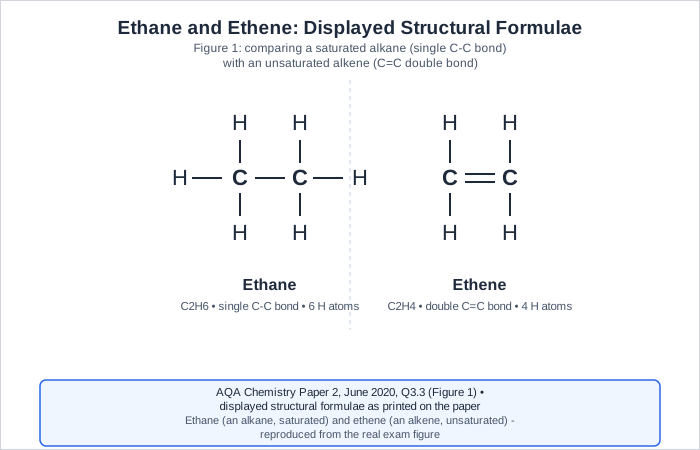
Describe the displayed formula of ethane (C₂H₆) and state how many bonds are shown.
The displayed formula of ethane shows two carbon atoms joined by a single covalent C-C bond. Each carbon has three hydrogen atoms attached by single C-H covalent bonds. The displayed formula shows all seven covalent bonds: one C-C bond and six C-H bonds.
A displayed formula shows every bond as a line. Ethane: H₃C-CH₃. Count: 1 C-C bond + 6 C-H bonds = 7 bonds total. All bonds are single covalent bonds (one shared pair of electrons each).
Explain why short-chain alkanes are more flammable than long-chain alkanes.
Short-chain alkanes have lower boiling points because they have weaker intermolecular forces. This makes them more volatile — they evaporate easily at room temperature to form flammable vapour. A substance needs to be in the vapour phase to ignite, so more volatile alkanes are more easily ignited and are therefore more flammable.
Flammability depends on volatility (how easily a substance forms vapour). Short-chain alkanes are volatile because of their low boiling points. More vapour at room temperature = more easily ignited = more flammable. Long-chain alkanes are less volatile and harder to ignite.
Explain why carbon monoxide produced by incomplete combustion of alkanes is dangerous to humans.
Carbon monoxide is a toxic gas because it binds to haemoglobin in red blood cells more strongly than oxygen does. This prevents haemoglobin from carrying oxygen around the body. Tissues and organs are deprived of oxygen, which can lead to loss of consciousness and death.
CO is colourless and odourless — it cannot be detected without a monitor. It binds to haemoglobin ~200 times more strongly than O₂, forming carboxyhaemoglobin. The result is oxygen deprivation (hypoxia) which can be fatal, especially in poorly ventilated spaces.
Define the term 'saturated hydrocarbon'.
A saturated hydrocarbon is a compound containing only carbon and hydrogen atoms, with only single covalent bonds between carbon atoms.
A hydrocarbon contains C and H only. Saturated means only single C-C bonds — no double bonds. Alkenes are unsaturated (they contain C=C).
State two features of a homologous series.
Members of a homologous series all have the same general formula and the same functional group. They also show a gradual change in physical properties as the chain length increases.
A homologous series is a family of compounds: same general formula, same functional group, similar chemical properties, and a gradual trend in physical properties (e.g. boiling point) going up the series.
State the products of the complete combustion of an alkane.
Complete combustion of an alkane produces carbon dioxide and water.
Complete combustion requires excess oxygen. The carbon is fully oxidised to CO₂ and the hydrogen is fully oxidised to H₂O. No CO or soot is produced.
A student adds bromine water to a sample of hexane. Explain what the student observes and why.
The bromine water remains orange/brown and does not decolourise. This is because hexane is a saturated hydrocarbon with only single covalent bonds, so it does not react with bromine under these conditions.
Alkenes (unsaturated) decolourise bromine water because the C=C double bond reacts with Br₂ in an addition reaction. Alkanes (saturated) do not react with bromine water at room temperature — the colour stays orange-brown. This is the standard test to distinguish alkanes from alkenes.
What is the general formula for the alkane homologous series?
Alkanes have the general formula CₙH₂ₙ₊₂. For each carbon you get two hydrogens plus two extra. CₙH₂ₙ is the formula for alkenes (which contain a C=C double bond).
Which alkane has the molecular formula C₃H₈?
Prop- means 3 carbons. Using CₙH₂ₙ₊₂ with n=3: C₃H₂(3)+₂ = C₃H₈. Propane is used in camping gas cylinders.
State the molecular formula of butane.
C₄H₁₀
But- means 4 carbons. Using CₙH₂ₙ₊₂: 2(4)+2 = 10 hydrogens. So butane is C₄H₁₀.
Why are alkanes called 'saturated' hydrocarbons?
Saturated means all bonds between carbon atoms are single covalent bonds. There are no C=C double bonds. Each carbon is bonded to the maximum number of hydrogen atoms possible.
Methane (CH₄) is a gas at room temperature, while octane (C₈H₁₈) is a liquid. Which statement best explains this difference?
Longer chain alkanes have greater surface area, so they have stronger and more numerous van der Waals intermolecular forces. More energy is needed to separate octane molecules, giving it a higher boiling point — liquid at room temperature.
Butane (C₄H₁₀) contains only single covalent bonds. How many C-C bonds does a butane molecule contain?
Butane is a straight chain of 4 carbons: C-C-C-C. There are 3 bonds joining 4 carbon atoms together (think of a chain of 4 links — 3 connections between them).
A student compares hexane (C₆H₁₄) and decane (C₁₀H₂₂). Which property would decane have compared to hexane?
Longer chain alkanes are more viscous because their longer molecules get tangled together and are harder to slide past each other. Decane (10 carbons) is more viscous than hexane (6 carbons). Longer chains also have higher boiling points.
When methane burns in a limited supply of oxygen, which pair of products can be formed?
Incomplete combustion (limited oxygen supply) produces carbon monoxide (CO) and/or solid carbon (soot) alongside water. Carbon monoxide is a colourless, odourless, highly toxic gas. Complete combustion (excess oxygen) produces only CO₂ and H₂O.
Each successive member of the alkane homologous series differs from the previous one by which group?
Methane CH₄ → Ethane C₂H₆ → Propane C₃H₈. Each step adds one carbon and two hydrogens, which is the CH₂ unit. This is the defining feature of any homologous series — each member differs by one CH₂ group.
Describe and compare thermal cracking and catalytic cracking. Include: conditions used, products formed, and one use of the alkene products. (4 marks)
Thermal cracking uses very high temperature (~700 °C) and very high pressure with no catalyst, producing mainly alkenes. Catalytic cracking uses a zeolite catalyst at moderate temperature (~500 °C) and low pressure, producing a mixture of shorter alkanes and aromatic compounds suitable for petrol. Both processes produce alkenes which can be used as monomers to make addition polymers such as poly(ethene).
This extended response requires comparing conditions (different temperatures, pressures, catalyst use), product comparison (thermal cracking favours alkenes; catalytic cracking favours branched alkanes), and the downstream use of alkenes in polymer manufacture.
Evaluate the importance of cracking in the petrochemical industry. Include economic benefits, the role of alkene products, and one potential concern. (4 marks)
Cracking is economically important because it converts the excess long-chain heavy fractions from crude oil distillation into shorter-chain fractions like petrol that are in high demand, increasing the commercial value of crude oil. The alkene products are valuable monomers used in addition polymerisation to manufacture polymers such as poly(ethene) and poly(propene). Catalytic cracking reduces energy costs by operating at lower temperature using a zeolite catalyst. However, burning the shorter-chain hydrocarbon fuels produced releases carbon dioxide, contributing to climate change and the greenhouse effect.
An evaluation question requires both positive and negative aspects. The economic benefits (supply-demand balance, polymer production, lower energy costs) must be weighed against environmental concerns (CO2 emissions from burning the fuel products). A complete 4-mark response addresses all dimensions.
Describe the conditions used in thermal cracking and state the types of product formed.
Thermal cracking uses very high temperatures (approximately 700 °C) and very high pressure with no catalyst. The products are shorter-chain alkanes and alkenes.
Thermal cracking requires no catalyst — all bond-breaking energy comes from extremely high temperature and pressure. This produces a higher proportion of alkenes compared to catalytic cracking.
Describe the conditions used in catalytic cracking.
Catalytic cracking uses a zeolite catalyst at a moderately high temperature of approximately 500 °C and low pressure.
Catalytic cracking is the industrial method that uses a zeolite (aluminosilicate) catalyst. The catalyst lowers the activation energy so lower temperatures and pressures can be used compared to thermal cracking, reducing energy costs.
A cracking product decolourises bromine water. Explain why this happens.
The product is an alkene. Alkenes contain a C=C double bond which reacts with bromine in an addition reaction, breaking the orange bromine molecules. The solution turns colourless as the bromine is used up.
Alkenes are unsaturated hydrocarbons with a C=C double bond. This pi bond reacts with Br2 molecules in an electrophilic addition reaction, converting the orange Br2 into a colourless dibromoalkane and explaining the colour change observed.
Compare the conditions used in thermal cracking and catalytic cracking, and suggest why catalytic cracking is more economical.
Thermal cracking uses very high temperature (~700 °C) and very high pressure with no catalyst. Catalytic cracking uses a zeolite catalyst at a lower temperature (~500 °C) and low pressure. Catalytic cracking is more economical because the catalyst lowers the activation energy, so less energy is needed, reducing costs.
The comparison shows that catalytic cracking is operated at significantly milder conditions thanks to the zeolite catalyst. This reduces energy costs substantially, making it the preferred industrial method for producing petrol fractions.
Explain how cracking addresses the mismatch between the supply of crude oil fractions and demand from consumers.
Fractional distillation of crude oil produces large quantities of long-chain heavy fractions that are in low demand. There is a higher demand for shorter-chain fractions such as petrol and kerosene. Cracking converts the excess long-chain fractions into the shorter-chain fractions that are in high demand, balancing supply with consumer needs.
This is fundamentally an economic argument. The composition of crude oil does not match market demand. Cracking is the industrial solution that converts the surplus heavy fractions into the high-demand lighter fractions, improving the commercial value of the crude oil.
Dodecane (C₁₂H₂₆) is cracked. Write a balanced equation for one possible cracking reaction and state which product is an alkene.
C₁₂H₂₆ → C₆H₁₄ + C₆H₁₂. C₆H₁₂ is the alkene (hexene) because it has the formula CnH2n which is unsaturated. The equation is balanced as 12 carbons and 26 hydrogens appear on both sides.
Any balanced cracking equation is acceptable provided carbons and hydrogens are conserved. An alkene product must fit CnH2n (e.g., ethene C2H4, propene C3H6, butene C4H8) and the student should justify why it is an alkene — either citing the CnH2n formula, the C=C double bond, or the term unsaturated.
Explain why cracking is an important industrial process using the diagram. [3 marks]
As shown in the diagram, long-chain hydrocarbons from fractional distillation are broken down into shorter-chain molecules. Long-chain fractions are in low demand and less commercially useful, whereas short-chain hydrocarbons such as petrol and diesel are in very high demand. Cracking converts excess long-chain fractions into more useful short-chain fuels, which matches supply to demand better. The diagram also shows that alkenes are produced during cracking — alkenes are important as monomers for making polymers such as poly(ethene), making cracking valuable to the plastics industry as well.
Cracking is industrially important for three main reasons: (1) Fractional distillation of crude oil produces too many long-chain fractions (e.g., heavy fuel oil, bitumen) which are in low commercial demand. (2) Short-chain fractions like petrol and naphtha are in very high demand. Cracking converts the excess long-chain molecules into high-demand short-chain products. (3) Cracking produces alkenes (e.g., ethene, propene) which serve as monomers for manufacturing polymers such as poly(ethene) — essential for the plastics industry.
Name the two types of cracking used in industry.
The two types of cracking are thermal cracking and catalytic cracking.
There are two main industrial methods of cracking: thermal cracking (uses very high temperature and pressure, no catalyst) and catalytic cracking (uses a zeolite catalyst at lower temperature).
Describe the test for an alkene and state what a positive result looks like.
Add bromine water to the sample. If an alkene is present the bromine water decolourises, turning from orange to colourless.
Alkenes decolourise bromine water because the C=C double bond undergoes an addition reaction with bromine (Br2), breaking the orange Br2 molecules and forming a colourless dibromoalkane product.
Explain why cracking is carried out in the oil industry.
Long-chain hydrocarbons from crude oil are less useful and in low demand. Cracking converts them into shorter-chain hydrocarbons that are more useful and in higher demand as fuels.
Fractional distillation of crude oil produces too many long-chain hydrocarbons relative to demand. Shorter fractions (petrol, kerosene) are in far greater demand. Cracking breaks the unwanted long chains into the useful short chains.
Ethene is produced by cracking. Explain how ethene can be used to make a polymer.
Ethene is a monomer. Many ethene molecules join together in an addition polymerisation reaction to form poly(ethene), a polymer.
Ethene (C2H4) is an alkene monomer. Under high pressure and with a catalyst, many ethene molecules undergo addition polymerisation: the C=C double bonds break and the molecules link together forming poly(ethene), a thermoplastic polymer used in plastic bags and bottles.
Using the diagram, describe the conditions needed for cracking. [2 marks]
As shown in the diagram, cracking requires a high temperature to vaporise the hydrocarbon and break the C-C bonds. A catalyst (such as aluminium oxide or silica-alumina) is also used in catalytic cracking to speed up the reaction and allow it to occur at a lower temperature than pure thermal cracking. The hydrocarbon must be vaporised before the catalyst can work effectively.
Cracking can be performed in two main ways: (1) Thermal cracking — very high temperatures (400-900°C) and high pressures, no catalyst; produces shorter alkanes and alkenes. (2) Catalytic cracking — moderate temperature (~500°C), uses an aluminium oxide (or zeolite) catalyst, lower energy cost. Both methods require the long-chain hydrocarbon to be vaporised first. The diagram shows catalytic cracking where a catalyst is present in the reaction vessel.
Name the products of cracking shown in the diagram. [2 marks]
The two types of product shown in the cracking diagram are a shorter-chain alkane and an alkene. The alkane is a saturated hydrocarbon with only carbon-carbon single bonds, while the alkene (such as ethene) is an unsaturated hydrocarbon containing at least one carbon-carbon double bond.
The two main product types from cracking are: (1) Shorter-chain alkanes — saturated hydrocarbons with only C-C single bonds, useful as fuels (e.g., petrol, kerosene). (2) Alkenes — unsaturated hydrocarbons with at least one C=C double bond (e.g., ethene CH2=CH2). The alkene's double bond makes it reactive and useful as a monomer for polymerisation. The exact products depend on which long-chain alkane is cracked and the conditions used.
What is cracking in chemistry?
Cracking breaks C-C bonds in long-chain alkanes to produce shorter alkanes and alkenes that are more useful and in higher demand.
A student adds bromine water to a product of cracking. The solution turns from orange to colourless. What does this show?
Bromine water decolourises (turns from orange to colourless) in the presence of alkenes because alkenes react with bromine across the C=C double bond in an addition reaction.
What type of reaction is shown in the cracking diagram?
Cracking is a type of thermal decomposition reaction. Large hydrocarbon molecules are broken down (decomposed) into smaller, more useful molecules using high temperature and/or a catalyst. It is the reverse of polymerisation (which joins small molecules into large ones). Combustion involves burning hydrocarbons with oxygen, and neutralisation involves acids and bases.
Which conditions are used in thermal cracking?
Thermal cracking uses very high temperatures (approximately 700 °C or higher) and very high pressure (up to 70 atm) with no catalyst. It tends to produce a higher proportion of alkenes.
The alkenes produced by cracking are valuable raw materials. What is one major use of these alkenes?
Alkenes such as ethene (C2H4) are the monomers used to make polymers (plastics) such as poly(ethene) through addition polymerisation. This is one of the key reasons cracking is economically important.
Why is catalytic cracking preferred over thermal cracking for producing petrol fractions?
Catalytic cracking (zeolite catalyst, ~500 °C, low pressure) produces more branched-chain alkanes and aromatic hydrocarbons that have higher octane ratings suitable for petrol. The lower operating temperature also significantly reduces energy costs compared to thermal cracking.
A refinery produces mostly heavy fuel oil from crude oil distillation, but demand for petrol is much higher. Which statement best explains why cracking is the solution?
Fractional distillation produces fractions in proportions that do not match market demand — there is excess supply of long-chain heavy fractions and insufficient supply of short-chain fractions like petrol. Cracking breaks the excess long-chain molecules into the shorter-chain molecules that are in high demand.
Decane (C₁₀H₂₂) is cracked to give octane (C₈H₁₈) and one other product. What is the formula of the other product?
Conservation of atoms: C₁₀H₂₂ gives C₈H₁₈ + ?. Carbon: 10 - 8 = 2C remaining. Hydrogen: 22 - 18 = 4H remaining. Formula = C₂H₄ (ethene). Ethene is an alkene (2n+2 = 6 ≠ 4 so not an alkane; C₂H₄ fits the alkene formula CnH2n for n=2).
A zeolite catalyst is used in catalytic cracking. What is the role of the zeolite catalyst?
A catalyst lowers the activation energy for the reaction without being consumed itself. The zeolite provides a surface with acid sites that facilitate the breaking of C-C bonds at a lower temperature (~500 °C) than would be needed without a catalyst.
A student has two unlabelled colourless liquid samples. One is pentane (C₅H₁₂) and one is pentene (C₅H₁₀). Describe an experiment the student could carry out to identify which sample is which. Include the reagent used, what you would observe with each sample, the conclusion, and a relevant safety precaution.
Add a few drops of bromine water to each sample in separate test tubes. The pentene (alkene) turns the bromine water colourless because bromine undergoes addition across the C=C double bond. The pentane (alkane) does not react and the bromine water stays orange because it is saturated and has no C=C bonds. Conclusion: the sample that decolourises bromine water is pentene; the other is pentane. Safety: wear eye protection and carry out the test in a fume cupboard because bromine is toxic and an irritant.
Bromine water (orange) is added to each sample. Pentene (alkene) decolourises it to colourless via addition across the C=C double bond. Pentane (alkane, saturated) leaves it orange. Safety: eye protection + fume cupboard; bromine is toxic.
Bromine water is added separately to cyclohexane and cyclohexene. Predict what is observed in each case and explain your predictions.
Cyclohexane: bromine water stays orange. No reaction occurs because cyclohexane is saturated and has no C=C double bonds. Cyclohexene: bromine water turns colourless. Cyclohexene is unsaturated and contains a C=C double bond which undergoes addition with bromine.
Cyclohexane (saturated, no C=C bonds) does not react with bromine water, which stays orange. Cyclohexene (unsaturated, has C=C) reacts by addition with bromine, decolourising the solution to colourless.
Suggest why alkenes are not found naturally in crude oil, and explain why they are important industrial chemicals.
Alkenes are not found naturally in crude oil because they are too reactive - their C=C double bonds would react away over the millions of years it takes for crude oil to form. Industrially, alkenes are produced by cracking long-chain alkanes from crude oil. They are important because they can be used to make polymers (plastics) and to make ethanol by hydration.
Alkenes are absent from crude oil because their C=C double bonds are reactive and would have reacted away over geological timescales. Industrially they are produced by cracking alkanes and are vital for making polymers (plastics) and ethanol.
Compare alkanes and alkenes in terms of (a) their bonding and structure, and (b) their reactivity. Explain why they differ in reactivity.
Alkanes are saturated hydrocarbons with only C-C single bonds and follow the general formula CnH2n+2. Alkenes are unsaturated hydrocarbons containing at least one C=C double bond and follow CnH2n. Alkenes are more reactive than alkanes because the C=C double bond can break to allow addition reactions. Alkanes are relatively unreactive as they only have stable C-C single bonds and mainly undergo combustion or substitution reactions.
Alkanes (saturated, CnH2n+2, single C-C bonds) vs alkenes (unsaturated, CnH2n, contain C=C). Alkenes are more reactive because the C=C double bond can break to allow addition reactions. Alkanes are less reactive as single bonds are stable.
Name the first three members of the alkene homologous series and give the molecular formula for each.
The first three alkenes are ethene (C₂H₄), propene (C₃H₆), and butene (C₄H₈). They all follow the general formula CnH2n.
The first three alkenes: ethene (C₂H₄, n=2), propene (C₃H₆, n=3), butene (C₄H₈, n=4). Each follows CnH2n.
State the conditions required for the industrial hydration of ethene to make ethanol, and write a balanced equation for the reaction.
Conditions: high temperature (~300°C), high pressure (~70 atm), phosphoric acid (H₃PO₄) catalyst. Equation: C₂H₄ + H₂O → C₂H₅OH.
Industrial hydration: C₂H₄ + H₂O → C₂H₅OH. Conditions: ~300°C, ~70 atm, phosphoric acid (H₃PO₄) catalyst. The water (steam) adds across the C=C double bond.
Describe how you would use bromine water to distinguish between ethane and ethene, and explain the results you would observe.
Add a few drops of bromine water to each compound. Ethene (alkene) turns the bromine water colourless because the C=C double bond undergoes addition with bromine. Ethane (alkane) has no double bonds so bromine water stays orange and no reaction occurs.
Bromine water (orange) is added to each compound. Ethene is an alkene with a C=C double bond. The double bond undergoes an addition reaction with bromine — the bromine adds across the double bond, decolourising the bromine water from orange to colourless. Ethane is a saturated alkane with no double bonds, so it cannot undergo addition reactions and the bromine water remains orange. This test distinguishes saturated from unsaturated hydrocarbons.
Explain how ethene can be converted into poly(ethene). Include a word equation in your answer.
Many ethene monomers join together in addition polymerisation. The C=C double bonds break and the molecules link up to form a long polymer chain. Word equation: ethene → poly(ethene).
Ethene undergoes addition polymerisation. Many ethene monomers join as their C=C double bonds break and each carbon bonds to the next monomer, forming a long-chain polymer: poly(ethene).
Explain what is meant by the term 'unsaturated' when applied to alkenes.
Alkenes are described as unsaturated because they contain one or more carbon-carbon double bonds (C=C). This means they can undergo addition reactions and more atoms can be added across the double bond.
Alkenes are unsaturated because they contain C=C double bonds. Unlike saturated alkanes (which only have single bonds), alkenes have a double bond that can break to allow other atoms to add across it.
Explain why alkenes are more reactive than alkanes.
Alkenes are more reactive than alkanes because they contain a C=C double bond. This double bond can break to allow other atoms or molecules to add across it in addition reactions, which alkanes cannot do as they only have C-C single bonds.
Alkenes are more reactive because their C=C double bond can break open to allow addition reactions. Alkanes have only C-C single bonds which are stable and harder to break, making alkanes much less reactive.
Write a balanced symbol equation for the reaction of ethene with hydrogen. State the type of reaction and name the product.
C₂H₄ + H₂ → C₂H₆. This is an addition reaction (hydrogenation) and the product is ethane.
C₂H₄ + H₂ → C₂H₆. Hydrogen adds across the C=C double bond of ethene in an addition reaction (specifically called hydrogenation). The product is ethane.
A hydrocarbon has the molecular formula C₄H₈. Explain whether this compound is an alkane or an alkene.
C₄H₈ is an alkene. It fits the alkene general formula CnH2n: with n=4, 2×4=8 hydrogen atoms. If it were an alkane (CnH2n+2, n=4), it would be C₄H₁₀.
C₄H₈ is an alkene. Using CnH2n with n=4: 2×4=8, which matches. The corresponding alkane (CnH2n+2, n=4) would be C₄H₁₀.
What is the general formula for alkenes?
Alkenes have the general formula CnH2n because they contain one C=C double bond, which means 2 fewer hydrogen atoms than the corresponding alkane (CnH2n+2).
What is observed when bromine water is added to an alkene?
Alkenes decolourise bromine water because the C=C double bond reacts with bromine in an addition reaction, breaking the double bond and forming a colourless dibromoalkane product.
What is the molecular formula of ethene?
Ethene is the first alkene with 2 carbon atoms. Applying the general formula CnH2n with n=2 gives 2×2=4 hydrogen atoms, so the formula is C₂H₄.
Which type of reaction is characteristic of alkenes?
The C=C double bond in alkenes makes them undergo addition reactions. During addition, the double bond breaks and atoms from another molecule bond to both carbon atoms.
Which molecule is formed when hydrogen (H₂) is added to ethene (C₂H₄)?
When hydrogen adds to ethene (hydrogenation), H₂ adds across the C=C double bond: C₂H₄ + H₂ → C₂H₆. The double bond breaks and ethene becomes ethane.
A student has two colourless liquids. One is hexane (C₆H₁₄) and one is hexene (C₆H₁₂). What would be observed when bromine water is added to hexene?
Hexene is an alkene with a C=C double bond. When bromine water is added, it reacts by addition across the double bond, producing a colourless dibromoalkane product and decolourising the bromine water.
What product is formed when steam (H₂O) is added to ethene in the presence of a phosphoric acid catalyst?
Hydration of ethene: C₂H₄ + H₂O → C₂H₅OH. Steam adds across the C=C double bond in the presence of a phosphoric acid catalyst at high temperature (~300°C) and high pressure (~70 atm).
Which set of conditions is used for the industrial hydration of ethene to produce ethanol?
Industrial hydration of ethene to make ethanol requires approximately 300°C, 70 atmospheres of pressure, and a phosphoric acid (H₃PO₄) catalyst. The high temperature and pressure overcome activation energy and increase reaction rate.
An unknown gas is suspected to be one of the following: hydrogen, oxygen, carbon dioxide, chlorine, or ammonia. Write a detailed plan to identify the gas. Your plan should include: the order of tests and why that order is chosen, the test method and reagent for each gas, the expected positive result, and the safety precautions needed.
Safety: wear goggles throughout, work in a fume cupboard or well-ventilated area (especially for chlorine), use only small quantities of gas. Test 1: place a glowing splint in the gas. If it relights, the gas is oxygen. This test is done first as it is safe and does not alter the gas sample. Test 2: hold a burning splint near the gas. If a squeaky pop is heard, the gas is hydrogen. The burning splint test is done before the limewater test to avoid a flame interfering with later tests. Test 3: bubble the gas through limewater. If the limewater turns milky or cloudy, the gas is carbon dioxide. Test 4: hold damp blue litmus paper near the gas in a fume cupboard. If the litmus bleaches white, the gas is chlorine. Test 5: hold damp red litmus paper near the gas. If the paper turns blue, the gas is ammonia. Each test eliminates one possibility, leading to a definitive identification.
A systematic approach is critical in gas testing: (1) Test for oxygen first (safe, non-destructive, uses glowing splint). (2) Test for hydrogen before limewater (burning splint — if CO2 is also present, the flame could drive off the gas or cause safety issues). (3) Limewater for CO2. (4) Damp litmus for chlorine (fume cupboard essential — toxic). (5) Damp red litmus for ammonia (elimination of previous gases confirms this). The order matters and students must justify it for full marks on 6-mark questions.
Compare the tests for hydrogen and oxygen using splints. Explain why different types of splint are used for each gas and what each result shows about the gas.
Hydrogen is tested with a burning splint. The burning splint ignites the hydrogen, which burns rapidly in the oxygen of the air, producing a squeaky pop sound. A burning splint is used because hydrogen is itself a fuel that needs igniting. Oxygen is tested with a glowing splint. Oxygen supports combustion so it causes the glowing splint to relight and burst into flame. A glowing splint is used because oxygen does not burn itself — it only supports combustion of other materials.
The key distinction is that hydrogen IS a fuel (it combusts), while oxygen only SUPPORTS combustion (it is an oxidiser). Therefore a burning splint (with energy) is needed to ignite hydrogen, and the rapid combustion causes the pop. A glowing splint (which has potential to burn) is sufficient for oxygen because oxygen provides the molecules to sustain combustion of the splint wood.
Describe the safety precautions a student should take when testing for (a) chlorine gas and (b) hydrogen gas in a school laboratory. Explain the reason for each precaution.
For chlorine: work in a fume cupboard or well-ventilated area because chlorine is a toxic gas that irritates and damages the lungs if inhaled. Wear safety goggles because chlorine is corrosive and can damage eyes. For hydrogen: keep all naked flames away from the hydrogen (except the test splint) because hydrogen is highly flammable and can explode when mixed with air. In both cases, use small amounts only and point the test tube away from people.
Chlorine (Cl2) is a toxic, yellow-green gas used as a chemical weapon in WW1 — even small concentrations damage the respiratory system. It is also corrosive. Hydrogen (H2) is highly flammable — it has a wide explosive range (4-75% in air) and burns with an almost invisible flame. These very different hazard profiles require different safety precautions.
State the best collection method for each gas and explain your reasoning: (a) Hydrogen (b) Carbon dioxide (c) Oxygen
Hydrogen: collect by downward displacement of air because hydrogen is less dense than air and rises. Carbon dioxide: collect by upward displacement of air because carbon dioxide is denser than air. Oxygen: collect over water because oxygen is insoluble in water.
Collection method depends on density relative to air and solubility in water. Hydrogen (density ~0.09 g/dm3) is far less dense than air (~1.29 g/dm3), so it floats upward and is collected by downward displacement of air. Carbon dioxide (density ~1.96 g/dm3) is denser than air, so it sinks and is collected by upward displacement of air. Oxygen is insoluble in water, so can be collected over water using a gas syringe or trough.
A student carries out gas tests and obtains these results: - Test A: glowing splint bursts into flame - Test B: burning splint produces a squeaky pop - Test C: limewater turns milky Identify the gas in each test tube and give the name of the gas for each result.
Test A: The gas is oxygen. Oxygen supports combustion so a glowing splint relights. Test B: The gas is hydrogen. Hydrogen burns rapidly causing a squeaky pop. Test C: The gas is carbon dioxide. Carbon dioxide reacts with limewater to form calcium carbonate, turning it milky.
Each gas has a unique positive test result. A glowing (smouldering) splint relights only in oxygen because oxygen supports combustion. A burning splint produces a squeaky pop only with hydrogen because hydrogen burns explosively in air. Limewater turns milky only with carbon dioxide because CO2 reacts with Ca(OH)2 to form insoluble CaCO3.
Explain why damp red litmus paper turns blue when exposed to ammonia gas.
Ammonia dissolves in the water on the surface of the damp litmus paper. This produces an alkaline solution because ammonia releases hydroxide ions when dissolved in water. The alkaline solution causes the red litmus paper to turn blue.
The equation for ammonia dissolving in water is: NH3(g) + H2O(l) -> NH4+(aq) + OH-(aq). The hydroxide ions (OH-) make the solution alkaline (pH > 7). Alkaline solutions turn red litmus blue. This is why the litmus must be damp — dry litmus provides no water for the ammonia to dissolve in, and no colour change would be observed.
Describe the test for chlorine gas, including the positive result.
Hold a piece of damp blue litmus paper near the gas. The litmus paper first turns red then bleaches white if chlorine is present. The paper bleaches because chlorine forms hypochlorous acid with the water on the paper.
Chlorine is a powerful bleaching agent when dissolved in water. The damp litmus paper provides the water needed. Chlorine dissolves to form hydrochloric acid and hypochlorous acid (HClO). The HClO destroys the dye in the litmus paper, bleaching it to white. The paper first turns red (due to the acid) then white (due to bleaching).
Describe how you would test for ammonia gas. State the positive result.
Hold a piece of damp red litmus paper near the gas. If ammonia is present, the damp red litmus paper turns blue because ammonia is an alkaline gas.
Ammonia is the only common gas in GCSE chemistry that is alkaline. When ammonia dissolves in the water on the damp red litmus paper, it forms an alkaline solution. This causes the pH to rise above 7 and the red litmus turns blue. Using damp RED litmus (not blue) gives the clearest colour change.
Explain why hydrogen gas produces a squeaky pop when tested with a burning splint.
Hydrogen burns rapidly in the oxygen present in air. The rapid combustion causes a small explosion due to the sudden rapid expansion of hot gases, which produces the characteristic squeaky pop sound.
When hydrogen is ignited by the burning splint, it reacts with oxygen in the air. Hydrogen is very reactive and burns rapidly. The rapid combustion produces a sudden release of energy and a rapid expansion of hot gases, which causes the small explosion heard as a squeaky pop.
Explain why limewater turns milky when carbon dioxide is bubbled through it.
Carbon dioxide reacts with calcium hydroxide in the limewater. This reaction produces calcium carbonate, which is an insoluble white precipitate. The calcium carbonate precipitate makes the limewater appear milky or cloudy.
The equation for this reaction is: CO2(g) + Ca(OH)2(aq) -> CaCO3(s) + H2O(l). Calcium carbonate is insoluble in water, so it appears as a white solid suspended in the liquid, making the solution look milky or cloudy. This is a reliable and specific test for carbon dioxide.
Which observation confirms a gas is hydrogen when tested with a burning splint?
Hydrogen burns rapidly in oxygen from the air when a burning splint is applied, producing a characteristic squeaky pop sound. The splint relighting is the test for oxygen. Limewater turning milky tests for carbon dioxide. Bleaching litmus tests for chlorine.
What happens when a glowing splint is placed in a test tube containing oxygen gas?
Oxygen supports combustion. A glowing (not burning) splint relights when placed into oxygen because oxygen provides the molecules needed to sustain combustion, causing the smouldering splint to burst back into flame.
Which reagent is used to test for carbon dioxide gas?
Limewater (calcium hydroxide solution) is the reagent used to test for carbon dioxide. When CO2 is bubbled through limewater it reacts with calcium hydroxide to form calcium carbonate, an insoluble white solid that makes the solution turn milky or cloudy.
A student holds a piece of damp blue litmus paper near a gas and it bleaches white. Which gas is present?
Chlorine is a powerful oxidising and bleaching agent. When damp litmus paper is exposed to chlorine, the chlorine first dissolves in the water to form hydrochloric acid and hypochlorous acid. The hypochlorous acid bleaches the dye in the litmus paper, turning it white. The paper first turns red (acid) then white (bleached).
Damp red litmus paper turns blue when held in a gas. Which gas causes this?
Ammonia is the only common gas in GCSE chemistry that is alkaline. It dissolves in the water on the damp litmus paper to form ammonium hydroxide solution, which is alkaline and turns red litmus paper blue. All other common test gases are either neutral or acidic.
Describe the test for hydrogen gas.
Hold a burning splint near the gas. A squeaky pop sound is heard if hydrogen is present. The hydrogen burns rapidly in air, causing the pop.
Hydrogen is a flammable gas. When a burning splint is applied, the hydrogen rapidly combusts in the oxygen of the air. The rapid burning causes a small explosion, heard as a characteristic squeaky pop sound. This is the standard AQA test for hydrogen gas.
Describe the test for oxygen gas.
Place a glowing splint into the gas. The glowing splint relights and bursts into flame if oxygen is present. Oxygen supports combustion.
Oxygen supports combustion. A glowing splint that is placed into oxygen relights because the high concentration of oxygen provides the molecules needed to sustain burning. This distinguishes oxygen from air, which contains only 21% oxygen and cannot relight a glowing splint.
A student bubbles a gas through limewater. The limewater remains clear. The student then holds a burning splint near the gas and hears a squeaky pop. Which conclusion is correct?
The limewater remaining clear eliminates carbon dioxide (which would make it milky). The squeaky pop with a burning splint is the definitive positive test for hydrogen. Oxygen would relight a glowing splint, not produce a squeaky pop. Chlorine would bleach damp litmus paper white.
Why must litmus paper be damp (not dry) when testing for chlorine gas?
Chlorine gas on its own is not a bleaching agent. Chlorine must dissolve in water to react: Cl2 + H2O → HCl + HClO. It is the hypochlorous acid (HClO) that bleaches the dye in the litmus paper. Without moisture, no hypochlorous acid forms and no bleaching occurs.
Which method is most suitable for collecting hydrogen gas in the laboratory?
Hydrogen is much less dense than air (density about 0.09 g/dm3 compared to air at ~1.29 g/dm3). When collecting by downward displacement of air, the hydrogen rises to fill a downward-pointing container from the bottom upwards, displacing the denser air. It can also be collected over water (it is insoluble), but downward displacement of air is the most reliable method for pure hydrogen.
Evaluate the conditions used in the Haber process (N₂(g) + 3H₂(g) ⇌ 2NH₃(g), forward reaction exothermic) to explain how chemists balance the competing demands of reaction rate and equilibrium yield. In your answer, discuss the effects of temperature, pressure, and catalysts.
The Haber process requires balancing reaction rate against equilibrium yield. Temperature: the forward reaction is exothermic, so by Le Chatelier's principle a lower temperature shifts equilibrium to the right, favouring ammonia production and giving a higher yield. However, lower temperatures reduce the rate of reaction, making the process too slow to be commercially viable. The compromise temperature of 450°C gives an acceptable yield at an acceptable rate. Pressure: the left side has 4 moles of gas (1 mol N₂ + 3 mol H₂) and the right has 2 moles (2 mol NH₃). Higher pressure shifts equilibrium to the right (fewer gas moles), increasing yield. However, very high pressures require stronger, more expensive equipment and create greater safety hazards. The compromise of 200 atm gives a significantly improved yield without excessive cost or risk. Catalyst: an iron catalyst is used. It increases the rate of both forward and reverse reactions equally, allowing equilibrium to be reached much more quickly. Importantly, it does not change the position of equilibrium or increase yield. Its value is economic: it allows the reaction to proceed at a useful rate at the moderate temperature of 450°C.
The Haber process involves three key compromises. Temperature: the forward reaction is exothermic, so lower temperature shifts equilibrium right (more ammonia), but rate becomes too slow — 450°C balances rate and yield. Pressure: more gas moles on the left (4 mol) than right (2 mol), so higher pressure shifts equilibrium right, increasing ammonia yield, but very high pressures are expensive and hazardous — 200 atm is the economic compromise. Catalyst: the iron catalyst speeds up both forward and reverse reactions equally, reaching equilibrium faster without changing the equilibrium position or yield. A strong answer addresses the trade-off for each variable rather than just stating the direction of shift.
The Haber process uses the reaction N₂(g) + 3H₂(g) ⇌ 2NH₃(g), where the forward reaction is exothermic. The industrial conditions are 450°C and 200 atmospheres pressure. Explain why these conditions are described as a 'compromise'.
The forward reaction is exothermic, so a lower temperature would shift equilibrium to the right, giving a higher yield of ammonia. However, at low temperatures the rate of reaction is too slow to be economical. A temperature of 450°C is a compromise: it gives a reasonable yield in a reasonable time. Higher pressure shifts equilibrium to the right (fewer moles of gas on the right), increasing yield. However, very high pressures are expensive to maintain and create safety risks. 200 atmospheres is a compromise between yield and cost. A catalyst (iron) is also used to increase the rate of reaction without affecting the equilibrium position.
The conditions are a compromise because: (1) Temperature — a lower temperature would give a higher yield of ammonia (forward reaction is exothermic, Le Chatelier shifts equilibrium right at lower temperature), but the rate would be too slow. 450°C balances acceptable yield with acceptable rate. (2) Pressure — higher pressure favours the side with fewer gas moles (right: 2 moles vs left: 4 moles), increasing yield, but very high pressure requires expensive equipment and creates safety risks. 200 atm is the economic compromise. An iron catalyst is also used to reach equilibrium faster without changing the equilibrium position.
Explain what is meant by a dynamic equilibrium in a reversible reaction.
Dynamic equilibrium occurs in a closed system when both the forward and reverse reactions are taking place at the same rate. Because the rates are equal, the concentrations of reactants and products remain constant over time. The word 'dynamic' means both reactions are still occurring - the system has not stopped, it is balanced.
Dynamic equilibrium occurs in a closed system when both the forward and reverse reactions are taking place simultaneously at the same rate. Because both reactions proceed at equal rates, the concentrations of reactants and products remain constant — they are being produced and used up at the same rate. The word 'dynamic' means the reactions have not stopped; 'equilibrium' means they are balanced. A common mistake is saying the concentrations are equal — they are constant, not necessarily equal.
For the reaction N₂(g) + 3H₂(g) ⇌ 2NH₃(g), the forward reaction is exothermic. Explain using Le Chatelier's principle what happens to the equilibrium position and the yield of ammonia when the temperature is increased.
Increasing the temperature adds more heat energy to the system. According to Le Chatelier's principle, the system responds to oppose this by favouring the reaction that absorbs heat - the endothermic reaction. Since the forward reaction is exothermic, the reverse reaction is endothermic. Therefore, the equilibrium shifts to the left, and less ammonia is produced. The yield of ammonia decreases.
Increasing the temperature provides more heat energy to the system. Le Chatelier's principle states the system opposes this by favouring the reaction that absorbs heat — the endothermic direction. Since the forward reaction is exothermic, the reverse reaction is endothermic. Therefore, increasing temperature shifts the equilibrium to the left, decomposing ammonia back into nitrogen and hydrogen. The yield of ammonia decreases. Students often confuse this with reaction rate — higher temperature does increase the rate, but it lowers the equilibrium yield for exothermic reactions.
For the equilibrium N₂(g) + 3H₂(g) ⇌ 2NH₃(g), explain using Le Chatelier's principle what happens when the pressure is increased.
Increasing the pressure means the system has more gas molecules per unit volume. Le Chatelier's principle states that the system opposes this change by shifting equilibrium towards the side with fewer moles of gas. The left side has 4 moles of gas (1 mole N₂ + 3 moles H₂) and the right side has 2 moles of gas (2 moles NH₃). Therefore the equilibrium shifts to the right, increasing the yield of ammonia.
Increasing pressure means more gas molecules are present per unit volume. Le Chatelier's principle states the system opposes this by shifting equilibrium to the side with fewer moles of gas. Counting the gas moles: left side = 1 mol N₂ + 3 mol H₂ = 4 moles; right side = 2 moles NH₃. The right side has fewer gas moles, so equilibrium shifts to the right, increasing the yield of ammonia. A common mistake is forgetting to count total gas moles on each side.
Explain the effect of adding a catalyst to a reversible reaction that is at equilibrium.
A catalyst increases the rate of both the forward and reverse reactions by the same amount. This means that equilibrium is reached more quickly. However, the position of equilibrium does not change - the same proportions of reactants and products are present. The catalyst does not increase the yield of products.
A catalyst speeds up both the forward and reverse reactions by the same factor, so equilibrium is reached more quickly. However, because both rates increase equally, the position of equilibrium does not change — the same proportions of reactants and products are present at equilibrium. A catalyst increases the rate of reaching equilibrium but does not increase the yield. A common misconception is that a catalyst shifts the equilibrium position — it does not.
Describe the reversible reaction involving copper sulfate crystals, including the colours of the two forms.
Blue hydrated copper sulfate crystals can be heated to produce white anhydrous copper sulfate and water. This is reversible: adding water to the white anhydrous copper sulfate reforms the blue hydrated crystals.
Heating blue hydrated copper sulfate (CuSO₄·5H₂O) removes water of crystallisation, producing white anhydrous copper sulfate (CuSO₄). This is the forward reaction. Adding water reverses the process: the white anhydrous copper sulfate absorbs the water and turns blue again, reforming the hydrated crystals. This colour change (blue ↔ white) is a classic example of a reversible reaction.
Explain how anhydrous copper sulfate can be used to test for the presence of water.
White anhydrous copper sulfate is added to the substance being tested. If water is present, it reacts with the anhydrous copper sulfate and the white powder turns blue, indicating that water is present.
White anhydrous copper sulfate is added to the substance being tested. If water is present, the anhydrous copper sulfate absorbs the water and turns blue (forming hydrated copper sulfate). A colour change from white to blue is a positive result for water. Note: this test shows whether water is present but does not confirm it is pure water — use cobalt chloride paper as an alternative test.
Explain the relationship between the energy changes in the forward and reverse reactions of a reversible reaction.
If the forward reaction is exothermic, the reverse reaction is endothermic. The amount of energy released by the forward reaction is exactly equal to the amount of energy absorbed by the reverse reaction. Energy is conserved in reversible reactions.
In a reversible reaction, if the forward reaction is exothermic (releases energy), the reverse reaction is endothermic (absorbs energy). The amount of energy involved is exactly the same in both directions — only the direction of energy transfer is reversed. This follows the law of conservation of energy. A common mistake is thinking both reactions release or absorb the same energy in the same direction.
Describe what happens when ammonium chloride is heated and then cooled, explaining why this is evidence of a reversible reaction.
When ammonium chloride is heated, it decomposes to form ammonia gas and hydrogen chloride gas. When these gases cool, they recombine to reform the solid white ammonium chloride. This is evidence of a reversible reaction because the products can react together to regenerate the original reactant.
When ammonium chloride (NH₄Cl) is heated, it decomposes into two gases: ammonia (NH₃) and hydrogen chloride (HCl). When cooled, these gases recombine and reform solid white ammonium chloride. This proves the reaction is reversible — the products (NH₃ and HCl) can react together to regenerate the original reactant. Students often confuse HCl gas with chlorine gas (Cl₂); it is hydrogen chloride, not chlorine.
A reaction reaches equilibrium: N₂(g) + 3H₂(g) ⇌ 2NH₃(g). More nitrogen gas is then added. Using Le Chatelier's principle, predict and explain what happens to the position of equilibrium.
Adding more nitrogen increases the concentration of a reactant. According to Le Chatelier's principle, the system responds to oppose this change. The position of equilibrium shifts to the right (forward direction), using up the extra nitrogen and producing more ammonia.
Adding more nitrogen increases the concentration of a reactant, disturbing the equilibrium. Le Chatelier's principle states that the system responds to oppose this change. To reduce the excess nitrogen, the forward reaction is favoured — nitrogen and hydrogen react to produce more ammonia. The equilibrium position shifts to the right. A common mistake is saying the equilibrium shifts left; it must shift in the direction that consumes the added substance.
What does the symbol ⇌ mean when used in a chemical equation?
The ⇌ symbol indicates a reversible reaction. It shows that the reaction can proceed from left to right (forward reaction) AND from right to left (backward/reverse reaction). This is different from a one-way arrow (→) which indicates a reaction that goes to completion.
What colour is anhydrous copper sulfate?
Anhydrous copper sulfate (CuSO₄) is white. When water is added it becomes hydrated copper sulfate (CuSO₄·5H₂O) which is blue. This reversible colour change makes anhydrous copper sulfate useful as a test for water.
When ammonium chloride is heated, what two gases are produced?
Ammonium chloride (NH₄Cl) decomposes on heating to form ammonia (NH₃) and hydrogen chloride (HCl): NH₄Cl(s) ⇌ NH₃(g) + HCl(g). On cooling, the two gases recombine to reform the white solid ammonium chloride. This is a classic example of a reversible reaction.
State what is meant by a reversible reaction.
A reversible reaction is one that can proceed in both the forward direction (reactants to products) and the backward direction (products back to reactants).
A reversible reaction is one that can go in both the forward direction (reactants forming products) and the backward direction (products reforming the original reactants). This is shown by the ⇌ symbol in equations. A common mistake is thinking all reactions can reverse — most reactions go to completion in one direction only.
In a reversible reaction, the forward reaction releases 150 kJ of energy. What can be said about the reverse reaction?
In a reversible reaction, if the forward reaction is exothermic (releases energy), the reverse reaction is endothermic and absorbs exactly the same amount of energy. If the forward reaction releases 150 kJ, the reverse reaction must absorb 150 kJ. The energy change is equal in magnitude but opposite in direction.
At dynamic equilibrium in a closed system, which of the following statements is correct?
At dynamic equilibrium, both the forward and reverse reactions are still occurring but at the same rate. This means the concentrations of reactants and products remain constant (not changing). The word 'dynamic' means both reactions are still happening; 'equilibrium' means they are balanced.
A reversible reaction has an endothermic forward reaction. According to Le Chatelier's principle, what happens when the temperature is increased?
Le Chatelier's principle states that if a change is made to a system at equilibrium, the system responds to oppose that change. Increasing temperature adds heat energy. The system opposes this by absorbing the extra heat — so the endothermic (heat-absorbing) forward reaction is favoured. The equilibrium shifts right, producing more products.
Why must a reversible reaction be carried out in a closed system for equilibrium to be established?
Equilibrium can only be established in a closed system because no substances can enter or leave. In an open system, gaseous or volatile products would escape into the surroundings. If the products escape, the reverse reaction cannot occur, so equilibrium is never reached — the reaction simply goes to completion in the forward direction.
For the equilibrium A + B ⇌ C + D, the concentration of reactant A is suddenly increased. What happens to the position of equilibrium?
When the concentration of reactant A is increased, the system is no longer at equilibrium. According to Le Chatelier's principle, the system responds to oppose this change by reducing the concentration of A. This is achieved by the forward reaction being favoured — A and B react to form more C and D. The equilibrium shifts to the right.
The Haber process is one of the most important industrial chemical processes. N₂(g) + 3H₂(g) ⇌ 2NH₃(g) ΔH = −92 kJ/mol Describe and explain the industrial conditions used in the Haber process and discuss the scientific reasoning behind each choice of conditions. In your answer, refer to Le Chatelier's principle and economic considerations.
The Haber process uses a temperature of approximately 450 °C, a pressure of approximately 200 atm, and an iron catalyst. Temperature choice: The forward reaction is exothermic (ΔH = −92 kJ/mol). By Le Chatelier's principle, a lower temperature would shift the equilibrium to the right, increasing the yield of ammonia. However, at very low temperatures the rate of reaction is too slow to be economically viable. At 450 °C the rate is fast enough whilst accepting a lower yield. This is a compromise between yield and rate. Pressure choice: On the left there are 4 moles of gas (1 N₂ + 3 H₂) and on the right there are 2 moles (2 NH₃). By Le Chatelier's principle, increasing pressure shifts the equilibrium to the right (fewer moles of gas), increasing the yield. However, very high pressures are expensive to achieve and maintain and create significant safety risks. 200 atm is chosen as a compromise between good yield and practical economics. Catalyst: The iron catalyst lowers the activation energy of both the forward and reverse reactions by the same amount. Both rates increase equally, so the equilibrium position is unchanged. The catalyst allows equilibrium to be reached more quickly, improving the economics without affecting the yield. In summary, the industrial conditions represent compromises between thermodynamics (maximum yield favours low temperature and high pressure) and kinetics/economics (viable rate and manageable cost favour higher temperature and moderate pressure).
The Haber process demonstrates the tension between thermodynamics (equilibrium yield) and kinetics (rate). Temperature: the forward reaction is exothermic (ΔH = −92 kJ/mol), so lower temperature gives higher ammonia yield by Le Chatelier's principle, but the rate is too slow — 450°C is the compromise. Pressure: 4 gas moles on the left vs 2 on the right, so higher pressure shifts equilibrium right and increases yield, but extreme pressures are costly and hazardous — 200 atm is the compromise. Catalyst (iron): speeds up both reactions equally, reaching equilibrium faster without changing the yield. A high-level answer discusses both thermodynamic and kinetic reasoning for each variable.
For the equilibrium: 2SO₂(g) + O₂(g) ⇌ 2SO₃(g) ΔH = −197 kJ/mol Predict and explain the effect of each of the following changes on the yield of SO₃: (a) increasing temperature (b) increasing pressure (c) removing SO₃ as it is formed
(a) Increasing temperature decreases the yield of SO₃. The forward reaction is exothermic so the equilibrium shifts left (towards the endothermic reverse reaction) to absorb the extra heat. (b) Increasing pressure increases the yield of SO₃. The left side has 3 moles of gas (2 SO₂ + 1 O₂) and the right has 2 moles (2 SO₃). The equilibrium shifts right towards fewer gas moles to reduce pressure. (c) Removing SO₃ decreases its concentration, so the equilibrium shifts right to replace the removed product, increasing the yield of SO₃.
(a) Increasing temperature decreases SO₃ yield. The forward reaction is exothermic (ΔH = −197 kJ/mol), so by Le Chatelier's principle, higher temperature favours the endothermic reverse reaction, shifting equilibrium left. (b) Increasing pressure increases SO₃ yield. Left side has 3 moles of gas (2SO₂ + 1O₂); right side has 2 moles (2SO₃). Equilibrium shifts right to reduce gas moles and pressure. (c) Removing SO₃ lowers product concentration; the system shifts right to replace it, increasing SO₃ yield — this technique is used industrially to drive reactions to completion.
The Contact process is used industrially to manufacture sulfuric acid. A key step is: 2SO₂(g) + O₂(g) ⇌ 2SO₃(g) ΔH = −197 kJ/mol The industrial plant uses a temperature of around 450 °C rather than a very high or very low temperature. Explain why a compromise temperature is used, referring to both yield and rate of reaction. [3 marks]
The forward reaction is exothermic. At higher temperatures, the equilibrium shifts to the left (towards reactants) according to Le Chatelier's principle, because the system tries to oppose the increase in temperature by favouring the endothermic reverse reaction. This would reduce the yield of sulfur trioxide. However, at very low temperatures the rate of reaction would be too slow to be economically viable, even though the equilibrium position favours more product. A compromise temperature of around 450 °C is used because it gives a sufficiently fast rate of reaction while still maintaining an acceptable yield of sulfur trioxide.
Le Chatelier's principle states that if you change a condition of a system at equilibrium, the equilibrium shifts to oppose that change. Since the forward reaction (making SO₃) is exothermic, increasing temperature supplies 'extra heat' — the system responds by favouring the reverse endothermic reaction, shifting equilibrium left and reducing yield. Conversely, lower temperatures shift equilibrium right (higher yield) but make the reaction very slow. Industry needs both a reasonable yield AND a fast enough rate to be profitable, so a compromise temperature around 450 °C is chosen. OCR B Higher Depth papers regularly ask for this equilibrium-versus-rate trade-off in industrial contexts.
The Haber process: N₂(g) + 3H₂(g) ⇌ 2NH₃(g) ΔH = −92 kJ/mol Predict and explain the effect of increasing temperature on the yield of ammonia.
Increasing temperature decreases the yield of ammonia. By Le Chatelier's principle, the system shifts in the endothermic direction to absorb the extra heat. Because the forward reaction is exothermic (ΔH = −92 kJ/mol), the reverse reaction is endothermic. The equilibrium shifts to the left, decomposing ammonia back into nitrogen and hydrogen, reducing the yield of NH₃.
The negative ΔH (−92 kJ/mol) tells us the forward reaction is exothermic. Increasing temperature adds heat energy. By Le Chatelier's principle, the system absorbs the extra heat by favouring the endothermic direction — which is the reverse reaction. The equilibrium shifts left, decomposing ammonia back into N₂ and H₂, so the yield of ammonia decreases. Remember: for exothermic forward reactions, higher temperature = lower yield.
N₂(g) + 3H₂(g) ⇌ 2NH₃(g) Predict and explain the effect of increasing pressure on the position of equilibrium in the Haber process.
Increasing pressure shifts the equilibrium to the right, towards the products. On the left side there are 4 moles of gas (1 N₂ + 3 H₂) and on the right there are only 2 moles of gas (2 NH₃). The system opposes the pressure increase by shifting towards the side with fewer moles of gas, which is the right side, increasing the yield of ammonia.
Increasing pressure shifts equilibrium towards the side with fewer moles of gas. Left side: 1 mol N₂ + 3 mol H₂ = 4 moles of gas. Right side: 2 mol NH₃ = 2 moles of gas. The right side has fewer gas moles, so the equilibrium shifts right to reduce the total number of gas molecules, which reduces the pressure. This increases the yield of ammonia. Always count total gas moles on each side — only gaseous species count.
The Haber process uses conditions of 450 °C, 200 atm, and an iron catalyst. Explain why these are described as 'compromise conditions'.
These are compromise conditions because each one balances the competing demands of yield and rate. At 450 °C the yield of ammonia is lower than at lower temperatures, but the reaction is fast enough to be economically viable. At lower temperatures the yield would be higher but the rate would be too slow. At 200 atm the yield is favoured (more moles of gas on the left), but higher pressures would be too expensive and dangerous to maintain. The iron catalyst speeds up the reaction without changing the equilibrium position, allowing a lower temperature to be used.
The conditions are a compromise because: Temperature (450°C) — lower temperature gives a higher equilibrium yield of ammonia (exothermic forward reaction, Le Chatelier), but the rate is too slow for commercial production. 450°C balances acceptable yield with acceptable rate. Pressure (200 atm) — higher pressure increases yield (4 gas moles on left vs 2 on right), but very high pressures require expensive, dangerous equipment. 200 atm is the economic compromise. Catalyst (iron) — speeds up equilibrium being reached without changing the equilibrium position, enabling the lower temperature to be viable.
Define the term 'dynamic equilibrium'.
Dynamic equilibrium is the state reached in a closed system when the rate of the forward reaction equals the rate of the reverse reaction. The concentrations of reactants and products remain constant because the two reactions proceed at the same rate.
Dynamic equilibrium has two key features: (1) the rate of the forward reaction equals the rate of the reverse reaction, and (2) the concentrations of all species remain constant. It only occurs in a closed system. The word 'dynamic' indicates that both reactions are still occurring — the system is not static. Students often think equilibrium means equal concentrations — in fact, concentrations are constant but not necessarily equal.
A student heats blue copper sulfate crystals. They turn white and lose mass. When the student adds water to the white solid, it turns blue again and becomes warm. Using this example, explain what is meant by a reversible reaction and state ONE condition that determines which direction the reaction goes. [2 marks]
A reversible reaction is one that can go in both the forward and reverse directions — the products of the reaction can react together to re-form the original reactants. In this example, heating drives the forward reaction (blue copper sulfate losing water to form white anhydrous copper sulfate), while adding water drives the reverse reaction. The condition that determines which direction the reaction goes is whether heat or water is added.
A reversible reaction is shown by the symbol ⇌ and means the reaction can proceed in BOTH directions — forward (reactants → products) and reverse (products → reactants). The direction depends on the conditions. For copper sulfate, heat drives the forward reaction (water is driven off, blue → white). Adding water drives the reverse reaction (white → blue, and the reaction is exothermic, releasing heat). This is a common OCR B example for reversible reactions and frequently appears in Foundation Depth papers.
Explain the effect of increasing temperature on the position of an equilibrium where the forward reaction is exothermic.
Increasing temperature shifts the equilibrium to the left, towards the reactants. This is because the system opposes the temperature increase by favouring the endothermic direction (the reverse reaction), which absorbs heat. As a result, the yield of products decreases.
When temperature is increased, the system opposes the change by favouring the endothermic direction (the one that absorbs heat). If the forward reaction is exothermic, the reverse reaction is endothermic. Therefore, increasing temperature shifts equilibrium to the left — towards the reactants. This reduces the yield of products. A common mistake is thinking higher temperature always increases yield — it only does so if the forward reaction is endothermic.
Explain what happens to the position of equilibrium when the concentration of a reactant is increased.
When the concentration of a reactant is increased, the equilibrium shifts to the right towards the products. This is because the system opposes the change by removing the excess reactant, converting it into more product. The concentration of the reactant falls back but to a higher level than before the change.
Increasing the concentration of a reactant disturbs the equilibrium. Le Chatelier's principle predicts the system will shift to reduce the excess reactant — this means the forward reaction is favoured, shifting equilibrium to the right and producing more product. The concentration of the reactant will decrease again (though not back to its original value) as it is converted into products.
Explain why adding a catalyst to a system at equilibrium does not change the equilibrium position.
A catalyst lowers the activation energy of both the forward and the reverse reactions by the same amount. Both reactions therefore speed up by the same factor, so the ratio of their rates is unchanged. Because the forward and reverse rates remain equal, the equilibrium position does not change - only the time taken to reach equilibrium is reduced.
A catalyst lowers the activation energy of both the forward and reverse reactions by the same amount. Because both rates increase equally, the ratio of forward to reverse rate is unchanged and the equilibrium position does not shift. The catalyst's only effect is to allow equilibrium to be reached more quickly. It does not increase the yield of products. Confusing rate with equilibrium position is the most common mistake in this topic.
Consider the equilibrium: H₂(g) + I₂(g) ⇌ 2HI(g). Explain what happens to the equilibrium position when pressure is increased.
Increasing pressure has no effect on the equilibrium position. There are equal numbers of moles of gas on both sides of the equation: 2 moles on the left (1 H₂ + 1 I₂) and 2 moles on the right (2 HI). Because there is no difference in the number of gas moles, there is no advantage to shifting in either direction, so the equilibrium position remains unchanged.
The equation H₂(g) + I₂(g) ⇌ 2HI(g) has 2 moles of gas on both sides (1 H₂ + 1 I₂ on the left = 2; 2 HI on the right = 2). When pressure is increased, the system responds by shifting towards fewer gas moles — but both sides are equal. There is no direction that would reduce the number of gas molecules, so the equilibrium position is unchanged. This is a common exam trap.
At dynamic equilibrium, which of the following is true?
At dynamic equilibrium the forward and reverse reactions continue simultaneously at equal rates. Concentrations remain constant but are not necessarily equal. Neither reaction stops.
Dynamic equilibrium can only be established in which type of system?
Equilibrium requires a closed system because if products or reactants escape, the system cannot reach a constant composition. In an open system, gases would escape and the reverse reaction could not maintain its rate.
Le Chatelier's principle states that when a system at equilibrium is disturbed, the system will:
Le Chatelier's principle: when a system at equilibrium is disturbed, it shifts in whichever direction opposes or counteracts that disturbance. This is how the system reaches a new equilibrium position.
State Le Chatelier's principle.
When a system at equilibrium is subjected to a change, the equilibrium will shift in the direction that opposes or counteracts that change.
Le Chatelier's principle states that when a change is applied to a system at equilibrium, the equilibrium shifts in the direction that opposes or counteracts that change. The system does not go back exactly to the original position — it reaches a new equilibrium. This principle predicts the direction of shift for changes in temperature, pressure, and concentration.
What does the symbol ⇌ mean in a chemical equation?
The symbol ⇌ indicates that the reaction is reversible - it can proceed in both the forward and the reverse direction. Reactants can form products and products can reform the reactants.
The ⇌ symbol means the reaction is reversible — it can proceed in both the forward direction (reactants forming products) and the reverse direction (products reforming reactants). It is used whenever a reaction can reach a dynamic equilibrium. This contrasts with the → symbol, which indicates a reaction that goes to completion in one direction only.
A reversible reaction has an exothermic forward reaction. What happens to the equilibrium position when temperature is increased?
Increasing temperature adds heat energy to the system. By Le Chatelier's principle, the equilibrium shifts to oppose this change by absorbing heat, which means favouring the endothermic direction. If the forward reaction is exothermic, the reverse reaction is endothermic, so equilibrium shifts left (towards reactants).
For the equilibrium N₂(g) + 3H₂(g) ⇌ 2NH₃(g), what is the effect of increasing pressure on the equilibrium position?
The left side has 4 moles of gas (1 N₂ + 3 H₂) and the right side has 2 moles (2 NH₃). Increasing pressure shifts equilibrium towards the side with fewer moles of gas (the right), to reduce pressure. This is predicted by Le Chatelier's principle.
A catalyst is added to a reaction at equilibrium. Which statement correctly describes its effect?
A catalyst lowers the activation energy of both the forward and reverse reactions by the same amount. Both rates increase equally, so the equilibrium position is unchanged. The catalyst only helps equilibrium be reached more quickly.
In the Haber process (N₂ + 3H₂ ⇌ 2NH₃, forward reaction exothermic), the industrial temperature used is 450 °C. This is a compromise because:
The Haber process forward reaction is exothermic. Lower temperatures favour the forward reaction and give a higher equilibrium yield of NH₃. However, low temperatures mean the rate is unacceptably slow. At 450 °C the yield is lower than at, say, 200 °C, but the rate is fast enough to be economically viable. This is the industrial compromise.
A(aq) + B(aq) ⇌ C(aq) + D(aq). Some solid A is added to the equilibrium mixture. What happens to the concentration of C at the new equilibrium position, compared to the original equilibrium?
Adding reactant A increases its concentration. By Le Chatelier's principle the equilibrium shifts right (towards products) to reduce the excess A. This produces more C and D, so the concentration of C at the new equilibrium is higher than at the original equilibrium.
Consider an exothermic equilibrium reaction: A(g) + B(g) ⇌ C(g) What is the effect of increasing the temperature on the equilibrium position?
For an exothermic reaction, increasing temperature shifts the equilibrium position to the LEFT (towards reactants), reducing the yield of C. This is Le Chatelier's principle: the system opposes the change by favouring the endothermic direction (reverse reaction), which absorbs the extra heat. Increasing temperature does increase both forward and reverse rates, but NOT equally — the endothermic (reverse) reaction is increased more, shifting equilibrium left and reducing yield. Temperature always affects equilibrium position for reactions with an enthalpy change.
Explain why a temperature of approximately 450°C and a pressure of approximately 200 atmospheres are used in the Haber process, rather than lower temperature and lower pressure.
A lower temperature would increase the yield of ammonia because the forward reaction is exothermic — by Le Chatelier's principle, decreasing temperature shifts the equilibrium to the right. However, at very low temperatures the rate of reaction is too slow to be economically viable. 450°C is a compromise that gives an acceptable rate while still producing a reasonable yield. A higher pressure would also increase the yield because there are fewer moles of gas on the product side (4 moles → 2 moles). However, very high pressures are extremely expensive to maintain and pose safety risks. 200 atm is the economic and safety compromise.
This is the classic 'compromise conditions' question. You must address BOTH temperature AND pressure, and for each you must say (a) what the thermodynamic effect would be AND (b) why the extreme value cannot be used. Temperature: low T shifts equilibrium right (exothermic forward reaction) giving more NH₃, but rate becomes unacceptably slow. Pressure: high P shifts equilibrium right (fewer moles of gas produced) giving more NH₃, but very high P is expensive and dangerous. 450°C and 200 atm are chosen as the best compromise between yield, rate, and cost.
Describe how the Haber process operates to produce ammonia on an industrial scale, and explain why the unreacted gases are recycled.
In the Haber process, nitrogen from the air and hydrogen from natural gas are passed over an iron catalyst at approximately 450°C and 200 atmospheres pressure. The reaction is reversible so the equilibrium mixture contains unreacted nitrogen and hydrogen as well as ammonia. The gases are cooled and the ammonia liquefies and is removed. The unreacted nitrogen and hydrogen are recycled back into the reactor so they are not wasted, which increases the overall yield of ammonia and reduces costs.
This question tests the full industrial process, not just isolated facts. The key ideas are: (1) sources of reactants — N₂ from air, H₂ from natural gas; (2) catalyst and conditions — iron, 450°C, 200 atm; (3) the reaction is reversible so only a fraction converts to NH₃ at equilibrium; (4) ammonia is condensed and removed, and critically the unreacted gases are recycled — this is what makes the process economically viable despite the low single-pass yield of only ~15–25%.
State the equation for the Haber process and give the conditions used. Include the catalyst.
The equation is N₂ + 3H₂ ⇌ 2NH₃. The reaction is carried out at a temperature of approximately 450°C and a pressure of approximately 200 atmospheres. An iron catalyst is used.
The Haber process equation is N₂ + 3H₂ ⇌ 2NH₃ — the ⇌ symbol shows the reaction is reversible. The three mark points are the equation, the temperature (~450°C), and the conditions of ~200 atm pressure with an iron catalyst. Memorise these as a set: equation, temperature, pressure + catalyst. The iron catalyst and the pressure are often awarded together in a single mark, so make sure to state both.
In the Haber process, where is the nitrogen obtained from?
The atmosphere is approximately 78% nitrogen gas (N₂). In the Haber process, nitrogen is obtained by fractional distillation of liquid air. Hydrogen — not nitrogen — is obtained from natural gas (methane reacted with steam). This is a common exam trap: students sometimes confuse which gas comes from air and which comes from methane.
Which row correctly states the conditions used in the Haber process?
The Haber process uses approximately 450°C and 200 atmospheres pressure with an iron catalyst (sometimes with promoters such as potassium oxide). Platinum is used as a catalyst in other industrial processes (e.g. the Contact process for making sulfuric acid). A temperature of 200°C would give a better yield of ammonia but the rate would be far too slow. 450 atm would improve yield further but is prohibitively expensive and dangerous.
Crude oil contains many long-chain hydrocarbons. Explain why cracking is needed, describe the cracking process, and explain why the products are more useful than the original long-chain alkanes. [6 marks]
Crude oil is separated into fractions by fractional distillation. Long-chain alkanes in the heavy fractions have low demand because they are viscous, do not flow easily, and are difficult to ignite as fuels. Cracking is needed to convert these surplus long-chain molecules into shorter, more useful products. In catalytic cracking, the long-chain alkane is heated with a catalyst; in thermal cracking, very high temperatures and pressures are used. Cracking breaks carbon-carbon bonds in the long chains, producing a mixture of shorter alkane molecules (useful as fuels such as petrol) and alkene molecules (containing a C=C double bond). Alkenes are more chemically reactive than alkanes and can be used as monomers to make addition polymers such as poly(ethene) and poly(propene), which are widely used plastics. Overall, cracking converts low-demand fractions into high-demand fuels and reactive feedstocks for the chemical industry.
This 6-mark question links crude oil separation (fractional distillation), cracking, and the chemistry of alkenes. Long-chain alkanes have low demand and high boiling points — they are viscous and less flammable, making them poor fuels. Cracking thermally or catalytically breaks C-C bonds to produce shorter alkanes (for petrol and other fuels) and alkenes (for making polymers). Alkenes are much more reactive than alkanes because they contain a C=C double bond, making them useful as monomers for addition polymerisation. The key insight is that cracking converts low-demand heavy fractions into high-demand lighter fractions and chemically reactive alkene feedstocks, matching supply to demand from crude oil.
Evaluate the environmental impact of using crude oil fractions as fuels compared with using plant-based alternatives. In your answer, consider combustion products, carbon neutrality, and sustainability. [6 marks]
Crude oil fractions such as petrol and diesel release carbon dioxide, carbon monoxide, sulfur dioxide, nitrogen oxides, and soot when burned. Carbon dioxide contributes to the enhanced greenhouse effect and global warming. Sulfur dioxide and nitrogen oxides cause acid rain. Carbon monoxide is toxic. In contrast, plant-based biofuels such as bioethanol produce mainly carbon dioxide and water on combustion and contain very little sulfur, so fewer acidic pollutants are released. Biofuels are considered approximately carbon neutral because the plants absorbed carbon dioxide from the atmosphere during photosynthesis as they grew; burning releases roughly the same amount back, so there is little net change in atmospheric CO₂. Fossil fuels, however, release carbon that was locked underground for millions of years, causing a net increase in atmospheric CO₂. Biofuels are also renewable — crops can be regrown — whereas crude oil is a finite, non-renewable resource that will eventually run out. However, growing biofuel crops requires large areas of land and may compete with food production, and energy is needed to grow and process the crops, reducing the environmental benefit.
This question demands evaluation across three criteria: combustion products (fossil fuels produce CO₂, CO, SO₂, NOx, soot; biofuels mainly CO₂ and H₂O with fewer sulfur/nitrogen pollutants), carbon neutrality (fossil fuels add ancient carbon to the atmosphere — net increase; biofuels in theory recycle recent atmospheric CO₂ because the plant absorbed CO₂ as it grew, so burning releases the same CO₂ back), and sustainability (fossil fuels are non-renewable and will run out; biofuels are renewable as crops can be regrown). A strong answer distinguishes between 'releasing CO₂' and 'net increase in atmospheric CO₂' — the key concept of carbon neutrality. Criticisms of biofuels include land use competition with food crops and the energy cost of growing and processing them.
A student says: 'We should stop using all products made from crude oil because they damage the environment.' Evaluate this statement using your knowledge of organic chemistry. [6 marks]
The student's statement has some merit because burning crude oil fractions as fuels does cause environmental damage. Combustion releases carbon dioxide, a greenhouse gas contributing to global warming and climate change. Incomplete combustion produces toxic carbon monoxide and soot (particulates), causing health problems. Sulfur impurities produce sulfur dioxide causing acid rain that damages ecosystems. Crude oil is also non-renewable, so continued use is not sustainable long-term. However, the statement is too extreme. Crude oil is not only burned as fuel — it is also used to make polymers such as plastics, which are essential for medicine, food packaging, construction, and electronics. Alkenes from cracking are monomers for addition polymers like poly(ethene). It also provides feedstocks for medicines, solvents, and dyes. These uses do not involve combustion and are not directly harmful in the same way. Stopping all crude oil products immediately would not be practical or safe. A more balanced conclusion is that we should reduce combustion of crude oil fractions (replacing fuels with renewables) while developing alternatives for polymer production, rather than stopping all uses immediately.
This 6-mark evaluation question rewards breadth and a balanced argument — students must consider evidence for AND against the statement. Evidence supporting the statement: combustion of crude oil fractions releases CO₂ (greenhouse effect/global warming), SO₂ and NOx (acid rain), CO (toxic), soot (health and global dimming); crude oil is non-renewable; plastic pollution (crude oil-derived polymers) persist in environment for hundreds of years. Evidence against (or qualifications): crude oil is not JUST burned — it is the source of virtually all plastics (polymers), medicines, solvents, dyes, and many other essential materials; life without these products would be extremely difficult; alternatives (e.g., bio-based polymers) are not yet available at scale; the student's statement is too absolute — some uses could be replaced but others cannot. A full mark answer makes an overall judgement: the environmental harms of combustion are real and serious, but complete elimination of all crude oil products is not currently feasible and ignores the many non-fuel uses. The best approach is to reduce combustion uses (switch to renewables) while continuing to use crude oil for polymer and pharmaceutical manufacture, and develop alternatives over time.
Evaluate the environmental and health impacts of burning fossil fuels, referring to specific pollutants formed and the conditions under which they are produced. [5 marks]
Burning fossil fuels produces several pollutants. Complete combustion of carbon in the fuel produces carbon dioxide (CO₂), a greenhouse gas. CO₂ absorbs infrared radiation from Earth’s surface and re-emits it, trapping heat and causing global warming and climate change. Incomplete combustion, occurring when oxygen is limited, produces carbon monoxide (CO) and soot. CO is colourless and odourless and is highly toxic because it binds to haemoglobin in red blood cells more strongly than oxygen, preventing oxygen transport to tissues. Soot (carbon particulates) causes global dimming by absorbing sunlight and causes respiratory disease when inhaled. Sulfur impurities in fossil fuels burn to form sulfur dioxide (SO₂), which dissolves in rain water to produce acid rain that damages ecosystems and corrodes buildings. At the high temperatures inside combustion engines, atmospheric nitrogen and oxygen react to form nitrogen oxides, which also contribute to acid rain and photochemical smog.
This 5-mark question rewards breadth and accuracy — aim to cover at least five distinct pollutant-impact pairs. Structure: (1) CO₂ from complete combustion → greenhouse gas → global warming/climate change; (2) CO from incomplete combustion (limited O₂) → binds haemoglobin → prevents O₂ transport → toxic/fatal; (3) Soot/particulates from very limited O₂ → global dimming (reflects sunlight) and respiratory disease; (4) SO₂ from sulfur impurities burning → dissolves in rainwater → acid rain → kills aquatic organisms, damages trees, corrodes buildings; (5) Nitrogen oxides (NOₓ) from N₂ + O₂ reacting at high engine temperatures → acid rain and photochemical smog. Common mistakes: confusing which gas causes which effect (CO₂ is greenhouse, SO₂ is acid rain), or saying nitrogen comes from the fuel rather than the atmosphere.
Alkenes produced by cracking can be used to make polymers. Compare addition polymerisation and condensation polymerisation in terms of monomers used, the polymerisation process, and the products formed. [5 marks]
In addition polymerisation, the monomers are unsaturated alkene molecules that contain a carbon-carbon double bond (C=C). The double bond opens and many thousands of monomer molecules join together to form a long polymer chain. The only product formed is the polymer itself — no other molecules are produced. In condensation polymerisation, two different types of monomer are used, each containing two functional groups (for example a dicarboxylic acid and a diol, or an amino acid). As the monomers join, a small molecule — usually water — is eliminated with each bond formed. The polymer formed contains ester linkages (polyester) or amide linkages (polyamide/nylon) within the chain. Both processes produce long-chain polymers, but addition polymerisation only produces the polymer whereas condensation polymerisation also produces a small molecule by-product.
This 5-mark question tests the ability to compare two polymerisation types across three criteria. Addition polymerisation uses unsaturated monomers (alkenes with C=C double bonds); the double bond opens and thousands of monomers join in a chain to form a long-chain polymer — the only product. No other molecules are released. By contrast, condensation polymerisation uses two different types of monomer that each have two functional groups (e.g. a dicarboxylic acid and a diol, or an amino acid). As the monomers join, a small molecule — usually water (or HCl) — is expelled with each bond formed. Both produce long-chain polymers, but condensation polymers contain functional groups (ester or amide linkages) within the chain while addition polymers are purely carbon-chain backbones. Examples: poly(ethene) is an addition polymer; nylon and polyester are condensation polymers.
Explain why incomplete combustion is dangerous and how it differs from complete combustion. Include the products formed under each condition and explain the health effects of the toxic product. [5 marks]
Complete combustion of a hydrocarbon occurs when excess oxygen is available. All carbon atoms are fully oxidised to carbon dioxide (CO₂) and all hydrogen atoms form water (H₂O). No toxic gases are produced. Incomplete combustion occurs when the supply of oxygen is limited. Carbon atoms cannot be fully oxidised and instead form carbon monoxide (CO) and/or solid carbon (soot). Carbon monoxide is the most dangerous product because it is colourless and odourless — it cannot be detected by smell or sight — so it builds up in enclosed spaces without warning. CO is toxic because it binds to haemoglobin in red blood cells far more strongly than oxygen does, forming carboxyhaemoglobin. This prevents haemoglobin from carrying oxygen around the body, starving cells of oxygen, which can rapidly cause unconsciousness and death.
This 5-mark cross-topic question links combustion conditions, product identification, and biological toxicity — three distinct areas tested at Higher. Complete combustion occurs when excess oxygen is available: all carbon is fully oxidised to CO₂ and all hydrogen to H₂O. Incomplete combustion occurs when oxygen is limited: carbon is only partially oxidised, producing CO and/or solid carbon (soot) instead of CO₂. The danger comes specifically from CO: it is colourless and odourless (unlike soot which is visible), so it builds up undetected. At the molecular level, CO binds to haemoglobin approximately 200 times more strongly than oxygen, forming carboxyhaemoglobin that is stable and does not release oxygen. This permanently reduces the blood's oxygen-carrying capacity, starving cells of oxygen and potentially causing fatal hypoxia. A key distinction is that CO₂ is NOT toxic at normal concentrations — CO is the dangerous product, and students frequently confuse the two.
A gas boiler in a poorly ventilated room is producing a yellow flame. Explain why this situation is potentially life-threatening. [4 marks]
A yellow flame indicates incomplete combustion is occurring due to insufficient oxygen supply. Incomplete combustion produces carbon monoxide (CO) gas. Carbon monoxide is colourless and odourless so cannot be detected without an alarm. It binds to haemoglobin more strongly than oxygen, preventing the blood from carrying oxygen to the body’s cells and tissues, which can rapidly cause death.
Four mark points: (1) yellow flame = incomplete combustion (limited oxygen); (2) incomplete combustion produces CO; (3) CO is colourless and odourless, so undetectable without a CO alarm; (4) CO binds to haemoglobin more strongly than oxygen, preventing blood from transporting oxygen, which is potentially fatal. This question links flame colour, combustion type, pollutant formed, and biological toxicity all together.
Burning fossil fuels releases several pollutants. Describe the formation of three different pollutants and explain a different environmental or health problem caused by each one. [4 marks]
Sulfur dioxide (SO₂) is formed when sulfur impurities in the fuel burn in oxygen; it dissolves in rain water to form acid rain which damages ecosystems. Carbon monoxide (CO) is formed during incomplete combustion when oxygen supply is limited; it is toxic as it binds to haemoglobin and prevents oxygen transport. Carbon dioxide (CO₂) is formed during complete combustion of carbon-containing fuels; as a greenhouse gas it absorbs infrared radiation and contributes to global warming. (Award up to 4 marks: 1 mark per pollutant correctly linked to its source and one mark for a correctly linked effect, maximum 2 marks for 2 pollutants, 4 marks for 3 pollutants each with formation and effect.)
Three pollutants to know: (1) SO₂ — from sulfur impurities in fuel burning; causes acid rain. (2) CO — from incomplete combustion (limited O₂); toxic as it binds haemoglobin preventing O₂ transport. (3) CO₂ — from complete combustion; greenhouse gas causing global warming. Also acceptable: NOx (from N₂ + O₂ at high engine temperature, causes acid rain/smog) and soot/particulates (from very incomplete combustion, causes global dimming and respiratory disease). Score 1 mark per pollutant with correct formation route; +1 mark for a correctly linked effect.
Explain why carbon monoxide (CO) is toxic to humans. [3 marks]
Carbon monoxide binds to haemoglobin in red blood cells. It binds more strongly than oxygen, forming carboxyhaemoglobin. This prevents the blood from carrying oxygen to cells and tissues, which can cause loss of consciousness and death.
CO is a colourless, odourless gas produced by incomplete combustion, which makes it especially dangerous. It binds to haemoglobin in red blood cells more strongly than oxygen, forming carboxyhaemoglobin. This permanently blocks oxygen transport — cells are starved of oxygen and cannot carry out aerobic respiration, causing unconsciousness and potentially death. CO is dangerous because you cannot smell or see it, so people can be poisoned without realising.
Explain how burning fossil fuels leads to acid rain and describe one harmful effect of acid rain. [3 marks]
Fossil fuels contain sulfur impurities. When burned, the sulfur reacts with oxygen to form sulfur dioxide (SO₂). Sulfur dioxide dissolves in water in clouds to form sulfurous and sulfuric acid. This acid rain lowers the pH of lakes and rivers, killing aquatic organisms.
Three mark points: (1) sulfur impurities in fossil fuels → SO₂ when burned; (2) SO₂ dissolves in rainwater/cloud water to form acidic solution (sulfurous/sulfuric acid); (3) one harmful effect — accept any of: kills aquatic life (lowers pH of lakes/rivers), damages trees/plants, corrodes limestone buildings/metal structures. All three mark points are clearly distinct and must each be addressed.
Explain how nitrogen oxides are formed when petrol burns in a car engine, and describe one environmental problem they cause. [3 marks]
Inside a car engine, very high temperatures are reached during combustion. At these high temperatures, nitrogen and oxygen from the atmosphere react together to form nitrogen oxides (NOx). Nitrogen oxides dissolve in rain water to form acid rain, which damages ecosystems and corrodes buildings.
Unlike sulfur dioxide (from sulfur in fuel), nitrogen oxides form because of the high temperatures in the engine. Nitrogen (N₂) and oxygen (O₂) from the air normally don't react at room temperature, but at the very high temperatures inside an engine they have enough energy to react: N₂ + O₂ → 2NO. These nitrogen oxides dissolve in rain to form acid rain. The three mark points: high temperature, N₂ + O₂ react to form NOx, one environmental effect (acid rain/harm to aquatic life/building corrosion).
Explain how the combustion of fossil fuels contributes to the enhanced greenhouse effect and climate change. [3 marks]
Burning fossil fuels releases carbon dioxide into the atmosphere. Carbon dioxide is a greenhouse gas that absorbs infrared radiation emitted by Earth’s warm surface. The CO₂ molecules re-emit this radiation in all directions, including back towards Earth. This enhanced greenhouse effect traps more heat in the atmosphere, causing global temperatures to rise (global warming) and leading to climate change.
Three mark points: (1) burning fossil fuels increases CO₂ in atmosphere; (2) CO₂ is a greenhouse gas that absorbs infrared radiation from Earth’s surface; (3) heat is trapped/re-emitted back to Earth, raising global temperatures (enhanced greenhouse effect / climate change). A common misconception is that greenhouse gases ‘block’ the sun — they actually absorb infrared radiation emitted BY the Earth, not sunlight coming in.
A gas engineer is checking a boiler and notices it is burning with a yellow flame. Explain why this is both inefficient and potentially dangerous, and suggest how the problem can be solved. [3 marks]
A yellow flame indicates incomplete combustion is occurring because oxygen supply to the boiler is insufficient. Incomplete combustion is inefficient because not all the fuel is fully oxidised, so less energy is released per gram of fuel compared to complete combustion. It is dangerous because incomplete combustion produces carbon monoxide, a colourless odourless toxic gas that binds to haemoglobin and prevents oxygen transport. The problem can be solved by improving the air supply to the boiler, for example by cleaning the air inlet or improving ventilation.
A yellow or orange flame is the key indicator of incomplete combustion — it means the air supply is too restricted for full oxidation. Incomplete combustion is inefficient because the fuel releases less energy per gram than complete combustion; unburned carbon ends up as soot rather than CO₂. The danger lies in carbon monoxide (CO) production: CO is colourless and odourless so cannot be detected by the senses, yet it binds to haemoglobin far more strongly than oxygen, blocking oxygen transport to cells and potentially causing fatal poisoning. The fix is always about increasing the oxygen supply — opening the air inlet, improving ventilation, or cleaning a blocked flue.
State two differences between complete combustion and incomplete combustion of hydrocarbons.
Complete combustion occurs when there is excess oxygen, producing carbon dioxide and water only. Incomplete combustion occurs when oxygen is limited, producing carbon monoxide and/or soot (carbon) as well as water.
Two key differences: (1) oxygen supply — complete requires excess/plentiful oxygen; incomplete has limited oxygen; (2) products — complete makes only CO₂ and H₂O; incomplete also makes CO and/or soot (carbon). Incomplete combustion is recognisable by a yellow/orange flame and black smoky deposits. Complete combustion gives a blue flame.
Write the balanced symbol equation, including state symbols, for the complete combustion of methane (CH₄).
CH₄(g) + 2O₂(g) → CO₂(g) + 2H₂O(l)
Complete combustion of any hydrocarbon produces only CO₂ and H₂O. For methane: CH₄(g) + 2O₂(g) → CO₂(g) + 2H₂O(l). Balance by counting: 1 C on each side (balanced); 4 H on left → 2H₂O needed (2 × 2 = 4 H); 4 O needed (1 in CO₂ + 2 in 2H₂O = 4 O) so 2O₂. State symbols: all gases except water which is a liquid at room temperature.
State two harmful effects of fine carbon particles (soot/particulates) released from burning fossil fuels.
Soot particles absorb sunlight, reducing the amount reaching Earth’s surface and causing global dimming. When breathed in, soot particles lodge in the lungs and airways causing respiratory problems and lung disease.
Fine carbon particles (particulates/soot) have two key harmful effects: (1) environmental — they absorb and reflect sunlight, reducing light reaching Earth’s surface (global dimming); (2) health — when inhaled they lodge deep in the lungs causing respiratory disease, asthma, and lung cancer. Students often miss the ‘global dimming’ environmental effect and focus only on health.
Write the balanced symbol equation for the complete combustion of propane (C₃H₈).
C₃H₈ + 5O₂ → 3CO₂ + 4H₂O
Complete combustion: hydrocarbon + oxygen → CO₂ + H₂O only. For C₃H₈: 3 C atoms → 3CO₂; 8 H atoms → 4H₂O (4 × 2H). Count O needed on right: 3×2 + 4×1 = 6 + 4 = 10 O atoms = 5O₂. Final equation: C₃H₈ + 5O₂ → 3CO₂ + 4H₂O. Check: 3C, 8H, 10O each side. Always check balance after writing the equation.
What are the only products formed during the complete combustion of a hydrocarbon?
Complete combustion of a hydrocarbon in excess oxygen produces only carbon dioxide (CO₂) and water (H₂O). Carbon monoxide and soot are products of incomplete combustion when oxygen is limited.
Incomplete combustion of a hydrocarbon occurs when there is:
Incomplete combustion occurs when there is a limited (insufficient) supply of oxygen. This means the carbon in the hydrocarbon cannot be fully oxidised to CO₂ and instead forms carbon monoxide (CO) or solid carbon (soot).
Why is carbon monoxide dangerous to humans?
Carbon monoxide (CO) binds to haemoglobin in red blood cells much more strongly than oxygen does. This forms carboxyhaemoglobin and prevents the blood from transporting oxygen to cells and organs, which can be fatal.
Burning fossil fuels can release sulfur dioxide (SO₂). Which statement correctly describes how SO₂ causes environmental damage?
Sulfur dioxide dissolves in water in clouds to form sulfurous and sulfuric acid. This acid rain lowers the pH of lakes and soils, harming aquatic life, killing trees, and corroding buildings and statues.
Nitrogen oxides are produced when fossil fuels are burned in car engines. What is the reason nitrogen oxides form in these conditions?
At the very high temperatures reached inside combustion engines, nitrogen (N₂) and oxygen (O₂) from the atmosphere have enough energy to react together, forming nitrogen oxides (NOx). These contribute to acid rain and photochemical smog.
Fine carbon particles (soot) released from incomplete combustion have two main harmful effects. Which option correctly identifies both?
Solid carbon particulates (soot) from incomplete combustion have two key effects: they absorb and reflect sunlight, reducing the amount reaching Earth’s surface (global dimming); and when breathed in, they lodge in the lungs causing serious respiratory health problems.
A student claims that incomplete combustion is better than complete combustion because it produces more products. Why is this reasoning incorrect?
Complete combustion is more efficient because it fully oxidises all the carbon and hydrogen in the fuel, releasing the maximum amount of energy. Incomplete combustion releases less energy per gram of fuel and produces toxic CO and harmful soot, making it less desirable for both energy yield and safety.
The burning of fossil fuels is the main cause of increasing CO₂ levels in the atmosphere. Which statement best explains how this contributes to climate change?
Carbon dioxide is a greenhouse gas. It absorbs infrared (heat) radiation emitted by Earth’s warm surface and re-emits it in all directions, including back towards Earth. This trapping of heat in the atmosphere is called the enhanced greenhouse effect and leads to global warming and climate change.
A student is designing a new biodegradable packaging material using condensation polymerisation. The student wants to use a diol and a dicarboxylic acid as monomers. Explain: (i) why these two monomers are needed, (ii) what bond forms between them, and (iii) what small molecule is released. Name the type of polymer produced.
Two different monomers are needed because each must have two functional groups, allowing the chain to grow in both directions: the diol provides two -OH groups and the dicarboxylic acid provides two -COOH groups. When a -COOH group reacts with an -OH group, an ester bond (-COO-) is formed and a water molecule is released. The polymer produced is a polyester.
This question integrates condensation polymerisation, functional group chemistry, and polymer naming — key skills for AQA higher tier Section 4.7.3.
Explain how condensation polymerisation differs from addition polymerisation. Give two differences.
In addition polymerisation, monomers with a C=C double bond are used and only one product (the polymer) is formed with no atoms lost. In condensation polymerisation, two different monomers with functional groups (such as -OH and -COOH) react together and a small molecule such as water is released at each bond-forming step.
Understanding the two polymerisation types is essential for AQA higher tier. The key contrasts are: monomers needed, functional groups required, and whether a small molecule is produced.
Evaluate the use of biodegradable polymers as a replacement for conventional synthetic polymers. Consider both advantages and disadvantages in your answer.
Advantages of biodegradable polymers include: they can be broken down by microorganisms, so they do not persist in landfill sites for hundreds of years, reducing long-term pollution; and some are made from renewable plant-based feedstocks, reducing dependence on finite crude oil. Disadvantages include: they are often weaker and less durable than conventional synthetic polymers, making them unsuitable for demanding uses; and they are currently more expensive to manufacture, limiting widespread adoption.
This evaluate question is common at higher tier. A balanced answer must address both sides with scientific reasoning, not just list generic environmental buzzwords.
Explain how addition polymerisation works. Include the role of the double bond.
Addition polymerisation uses alkene monomers that contain a carbon-carbon double bond. The double bond opens up, allowing the monomers to join together and form a long polymer chain. Only one product is formed because no atoms are lost from the monomers.
Addition polymerisation is distinct from condensation polymerisation because no atoms leave the chain. Every atom in every monomer ends up in the polymer.
Explain why most synthetic polymers cause environmental problems when they are disposed of in landfill sites.
Most synthetic polymers are non-biodegradable, which means microorganisms cannot break them down. They persist in landfill sites for hundreds of years, taking up valuable space. Over time they can break into tiny microplastics that enter food chains and harm wildlife.
Non-biodegradability is the core problem with synthetic polymer disposal. This contrasts with natural polymers like starch and proteins that microorganisms can break down.
Give three examples of naturally occurring polymers and state the monomer each is made from.
Starch is a naturally occurring polymer made from glucose monomers. Proteins are natural polymers made from amino acid monomers. DNA is a natural polymer made from nucleotide monomers.
These three natural polymers — starch, proteins, and DNA — are all formed by condensation polymerisation inside living organisms.
Identify the monomer used to make poly(propene) and draw the repeating unit. Describe the structural change that occurs to the monomer during addition polymerisation.
The monomer is propene (CH₂=CH-CH₃). During addition polymerisation, the C=C double bond in propene opens, allowing the monomers to join together. The repeating unit is -CH₂-CH(CH₃)- with continuation bonds shown at each end.
Poly(propene) naming follows the convention: poly(monomer name). The systematic naming and structural drawing of addition polymers are common exam tasks.
Describe how amino acids join together to form proteins. Include the type of polymerisation involved.
Amino acids join together by condensation polymerisation. The amine group (-NH₂) of one amino acid reacts with the carboxyl group (-COOH) of the next, forming a peptide bond and releasing a water molecule at each step. A long chain of amino acids joined this way is called a polypeptide, which folds into a protein.
Protein formation is a classic example of condensation polymerisation in biological systems, forming peptide bonds with water as a by-product.
Explain what biodegradable polymers are and why they are considered better for the environment than conventional synthetic polymers.
Biodegradable polymers are polymers that can be broken down by microorganisms into simpler, harmless products. They are better for the environment because they do not persist in landfill sites for hundreds of years as conventional non-biodegradable plastics do, reducing long-term waste accumulation. In addition, some biodegradable polymers are made from renewable plant-based sources, reducing dependence on crude oil.
Biodegradable polymers represent a developing solution to plastic waste. However, they are often weaker and more expensive, so they are not yet a complete replacement for conventional polymers.
State what is meant by the terms 'monomer' and 'polymer'.
A monomer is a small molecule that can join together in large numbers to form a polymer. A polymer is a long chain molecule made from many repeating monomer units.
These definitions are fundamental to understanding polymerisation. Monomers are the small reactive building blocks; polymers are the large product molecules.
Burning polymer waste (incineration) is one method of disposal. Give one advantage and one disadvantage of this method.
Advantage: incineration recovers energy from the polymer, which can be used to generate electricity or heat. Disadvantage: it releases carbon dioxide, a greenhouse gas, and burning some polymers produces toxic gases such as hydrogen chloride.
Incineration is a trade-off: it solves the volume problem and recovers energy, but produces greenhouse gases and potentially toxic gases from certain polymers.
A student is given an unknown polymer sample. Describe one test and its result that would confirm the polymer contains a C=C double bond in its monomer (i.e. it was formed by addition polymerisation).
Add bromine water to the monomer of the polymer. If the monomer contains a C=C double bond (is unsaturated), the orange bromine water will decolourise to colourless, confirming the polymer was formed by addition polymerisation.
Bromine water tests for unsaturation (C=C bonds). In addition to testing monomers, this test can distinguish alkenes from alkanes in organic chemistry.
What type of monomers are needed for addition polymerisation?
Addition polymerisation requires monomers containing a C=C double bond (alkenes). The double bond opens up to form new single bonds, linking monomer units into a long polymer chain without any atoms being lost.
Which small molecule is released as a by-product during condensation polymerisation?
During condensation polymerisation, monomers with two functional groups react together and a small molecule — most commonly water — is eliminated at each bond-forming step. This distinguishes condensation from addition polymerisation, which produces no by-product.
Which of the following is an example of a naturally occurring polymer?
Starch is a naturally occurring polymer made from glucose monomers joined by condensation polymerisation inside plant cells. Poly(ethene), PVC, and nylon are all synthetic (man-made) polymers.
Why do most synthetic polymers cause environmental problems when disposed of?
Most synthetic polymers are non-biodegradable, meaning microorganisms cannot break them down. This leads to long-term accumulation in landfill sites, oceans, and other environments, causing pollution and harm to wildlife.
Poly(ethene) is made from ethene monomers (CH₂=CH₂). What is the repeating unit of poly(ethene)?
When ethene (CH₂=CH₂) undergoes addition polymerisation, the double bond opens. Each monomer contributes a -CH₂-CH₂- unit to the chain, forming poly(ethene). The double bond is not present in the polymer.
A student burns a polymer in a lab and notices the gas produced turns limewater milky. The polymer must contain which element?
Limewater turns milky in the presence of carbon dioxide (CO₂). CO₂ is only produced when a carbon-containing substance burns. Therefore the polymer must contain carbon.
In condensation polymerisation forming a polyester, which two functional groups react together?
A polyester is formed when a diol (molecule with two -OH groups) reacts with a dicarboxylic acid (molecule with two -COOH groups). At each bond, -COOH and -OH react to form an ester linkage, releasing water.
A student compares burning polymer waste in a bin (incineration) with sending it to landfill. Which statement correctly evaluates these two disposal methods?
Neither method is ideal. Incineration recovers energy from polymers but releases greenhouse gases (CO₂) and toxic gases (e.g. HCl from PVC). Landfill prevents gas emissions but wastes land space and the buried non-biodegradable polymer persists indefinitely.
A pharmaceutical company needs to produce a batch of ibuprofen tablets. The active ingredient (ibuprofen) has a known melting point of 75–77°C when pure. The company also needs to decide what other ingredients to add. Evaluate how the company could use both the concept of purity and the concept of formulation to ensure a high-quality medicine is produced.
The company should first test the purity of the ibuprofen by measuring its melting point. Pure ibuprofen has a sharp melting point at 75–77°C. If the sample melts over a wider range or at a very different temperature, it contains impurities and should not be used, as impurities could make the medicine unsafe or reduce its effectiveness. Once pure ibuprofen is confirmed, the company designs a formulation — a mixture containing ibuprofen as the active ingredient along with excipients such as binders (to hold the tablet together), fillers (to give the tablet bulk and a handleable size), and a coating (to make it easier to swallow). The proportions of each component are carefully controlled so that each tablet contains exactly the right dose of ibuprofen and has consistent physical properties such as hardness and dissolution rate. Without precise formulation, tablets in the same batch could vary in dose or disintegrate incorrectly.
This extended question requires students to draw together both concepts: purity (testing the raw ingredient with a melting point test) and formulation (designing the final tablet with specific proportions of each component for a purpose). High-quality marks require linking purity testing to safety/effectiveness, and linking formulation design to consistent dosing and physical properties.
Evaluate the advantages and disadvantages of using formulations compared to pure substances in everyday products such as medicines, paints, and cleaning products. [5 marks]
A formulation is a mixture of substances in specific proportions designed to have useful properties for a particular purpose. Unlike a pure substance, a formulation can be designed to have exactly the combination of properties needed for its intended use. Advantages of formulations: the properties can be tailored precisely — for example, a tablet contains the correct dose of active ingredient plus binders, fillers, and coatings that make it safe and effective to swallow. A paint formulation contains pigments for colour, solvents for viscosity, binders to make it stick, and preservatives to prevent deterioration. A cleaning product may include surfactants, disinfectants, and fragrance in carefully optimised proportions. Formulations can also make active ingredients more stable, easier to use, and more effective than the pure compound alone. Disadvantages: formulations are more complex and expensive to manufacture than simple pure substances. They must be carefully quality controlled to ensure each batch has the correct proportions, which adds cost. Some consumers may prefer 'pure' products without additives. Different components in a formulation may interact in unexpected ways, requiring extensive testing to ensure safety.
This evaluate question requires students to move beyond simple definitions and weigh up both advantages and disadvantages of formulations in context. A formulation is a carefully designed mixture in which each component has a specific role and the proportions are precisely controlled. In a medicine tablet: active drug (therapeutic effect) + binder (holds tablet together) + filler (gives tablet bulk) + coating (controls drug release, aids swallowing). In paint: pigment (colour) + solvent (viscosity control) + binder (adhesion) + preservative (shelf life). The advantages lie in the ability to combine multiple properties that no single pure substance could provide, and to ensure a consistent, safe, effective product every time. The disadvantages are the complexity and cost of manufacturing and quality-controlling multi-component mixtures, the need for extensive testing to check component interactions and stability, and the fact that some active ingredients may degrade when combined with other components. Students should distinguish between 'pure substance' (single element or compound) and 'formulation' (designed mixture) — a formulation is NEVER a pure substance by the GCSE chemistry definition.
Describe how melting point analysis and paper chromatography can each be used to determine the purity of a substance. Explain why both methods might be needed when analysing a sample. [5 marks]
Melting point analysis: a pure substance has a sharp, precise melting point at a specific temperature. If a sample is impure, the melting point is lower than expected and occurs over a range of temperatures rather than at a single value. The sample is heated and the temperature at which it starts and finishes melting is recorded; a narrow range (1-2°C) indicates purity, while a wide range or depressed melting point indicates impurities. Paper chromatography: the sample is dissolved in a solvent and spotted at the baseline of chromatography paper. The paper is placed in a solvent (mobile phase) which travels up by capillary action. Components in the mixture separate as they travel at different rates depending on their solubility in the mobile phase and attraction to the paper. A pure substance produces a single spot; an impure sample produces multiple spots. Rf values can be calculated and compared to known standards. Both methods may be needed because melting point tells you whether a substance is pure (one melting point) but not what the impurities are. Chromatography can identify impurities and separate them for further analysis, but cannot determine purity for solid substances that do not dissolve easily. Together they give more complete information.
This question requires students to describe two distinct analytical techniques and then justify why both are needed — a common AQA higher/challenge question structure. Melting point: a pure crystalline solid has a sharp, clearly defined melting point (the temperature at which the ordered lattice breaks down uniformly). Impurities disrupt the lattice, requiring less energy to melt (melting point depression) and causing melting to occur over a range rather than sharply. You heat the sample slowly and record the temperature at which it starts to melt and when melting is complete — a spread of more than 2°C indicates impurity. Paper chromatography: works on the principle that different substances have different affinities for the mobile phase (solvent) and stationary phase (paper). Substances with higher solubility in the mobile phase travel further; those with stronger attraction to the paper travel less far. Rf = distance travelled by substance / distance travelled by solvent front. A pure substance gives one spot; a mixture gives multiple spots. Each spot's Rf value can be compared to reference standards to identify the substance. The key point for the final mark: melting point gives YES/NO purity information but cannot tell you WHAT the impurity is; chromatography can identify specific impurities but cannot be applied to all solids (some do not dissolve well or decompose before melting). Together they provide both the confirmation of purity and the identification of any contaminants.
Paint is described as a formulation. Describe what this means and explain how the formulation approach is important in the paint industry.
Paint is a formulation because it is a mixture where each component is present in a specific proportion to achieve desired properties. A typical paint formulation contains a pigment for colour, a solvent to give the right viscosity for application, a binder to make the paint stick to surfaces, and additives to improve properties such as drying time and durability. The proportions of each component are carefully controlled because changing them would alter the colour, texture, coverage, or drying behaviour of the paint. Without the formulation approach, paint manufacturers could not guarantee consistent, reliable products with the same performance every time.
Formulations are everywhere in the chemical industry because controlling the precise proportions of each component is essential to getting a reliable, consistent product. In paint, the pigment determines colour, the solvent controls how the paint flows and spreads, the binder makes it adhere to surfaces, and additives control drying time, durability, and other performance characteristics. Even small changes to these proportions would noticeably affect the final product.
Explain why the presence of impurities in a substance lowers its melting point and causes it to melt over a range of temperatures.
Impurities disrupt the regular arrangement of particles in the crystal structure, so less energy is needed to break it down. This means the impure substance melts at a lower temperature than the pure substance. Because different parts of the sample contain different amounts of impurity, melting begins at different temperatures across the sample, so it melts over a range rather than at one sharp point.
Impurities disrupt the regular crystal structure of a solid, so less energy (lower temperature) is needed to break the intermolecular forces and cause melting. The uneven distribution of impurities throughout the sample means that melting begins at slightly different temperatures in different regions, producing a broad melting range rather than a sharp point.
A painkiller tablet contains aspirin, starch, and a binding agent. Explain why this tablet is described as a formulation rather than simply a mixture.
The tablet is a formulation because it is a mixture where each component is present in a specific proportion to achieve a desired purpose. The aspirin is the active ingredient that relieves pain, the starch acts as a filler, and the binding agent holds the tablet together. The proportions are carefully controlled so the tablet delivers the correct dose and has the right physical properties.
A formulation is specifically a mixture where components are in deliberate, precise proportions to achieve a desired function. A random mixture of aspirin and starch would not be a formulation; the formulation aspect comes from the careful design of those proportions to deliver the correct dose and give the tablet its physical properties.
A student is given two samples of copper sulfate crystals. Sample A melts at exactly 110°C. Sample B begins to melt at 103°C and finishes melting at 112°C. Use your knowledge of purity to explain what the melting point data tells us about each sample.
Sample A is likely pure because it melts at a single sharp temperature (110°C) with no range. Sample B is impure because its melting point is spread over a range (103–112°C) and it begins to melt at a temperature lower than expected, which is consistent with the presence of impurities that disrupt the regular crystal structure and lower the melting point.
The melting point test is a reliable indicator of purity. A sharp, single melting point (Sample A at 110°C) indicates purity. A broad melting range starting below the expected temperature (Sample B, 103–112°C) indicates impurities — these disrupt the crystal structure, lower the energy needed to melt the solid, and produce a range because impurities are unevenly distributed throughout the sample.
A milk carton is labelled 'pure whole milk'. Explain why a chemist would say this milk is NOT pure, and describe how a chemist could test whether a substance is pure.
A chemist would say the milk is not pure because in chemistry, a pure substance contains only one type of element or compound. Milk is a mixture of water, fats, proteins, sugars, vitamins, and minerals, so it contains many different types of compound. The label uses 'pure' in its everyday meaning of natural or unadulterated, not the chemical definition. A chemist could test purity by measuring the melting or boiling point of the substance and comparing it to the known value. A pure substance will melt at a precise, sharp temperature with no range, while an impure substance will show a lower melting point and melt over a range of temperatures.
This question tests whether students understand that 'pure' has different meanings in everyday life versus chemistry. In everyday language, 'pure' often means natural or uncontaminated. In chemistry, pure means a single element or compound with no other substances present. Measuring melting or boiling points is the standard practical test for purity, with a sharp point indicating purity and a range indicating the presence of impurities.
Describe how the melting and boiling points of a pure substance differ from those of an impure substance.
A pure substance has a sharp, fixed melting point and a sharp, fixed boiling point. An impure substance has a lower melting point than expected and melts over a range of temperatures.
Pure substances have sharp, fixed melting and boiling points — the temperature does not change during the change of state. Impurities disrupt the crystal structure, meaning less energy is needed to melt the solid. This lowers the melting point below the expected value and causes melting to occur over a range rather than at one precise temperature.
Define the term 'formulation' as used in chemistry.
A formulation is a mixture that has been designed so that each component is present in a specific proportion to give the product a desired property or function.
A formulation is a mixture where the components are deliberately added in specific, controlled proportions to achieve particular properties. This distinguishes a formulation from a random mixture — the design and purpose are central. Medicines, fuels, paints, fertilisers, and alloys are all formulations.
Give two examples of formulations from everyday life, other than paint, and state why each is a formulation.
Medicines (e.g. painkiller tablets) are formulations because they contain active ingredients and excipients in specific proportions to deliver the correct dose. Fuels (e.g. petrol) are formulations because they contain different hydrocarbons in specific proportions to give reliable performance and the correct energy output.
Formulations are common in daily life wherever a product needs to consistently deliver specific properties. Medicines must deliver the right dose of active ingredient. Fuels must provide consistent energy and burn characteristics. Fertilisers must provide the right nutrient ratios for plant growth. Cleaning products must have the right balance of surfactants and solvents. All of these are mixtures with carefully controlled, deliberate proportions.
In chemistry, what does it mean for a substance to be described as 'pure'?
In chemistry, a pure substance contains only one type of element or compound. This is different from the everyday meaning of 'pure', which often implies clean or safe. A chemically pure substance has a fixed, definite composition throughout.
Which observation confirms that a substance is chemically pure?
A pure substance melts (and boils) at a precise, sharp temperature — there is no broad range. If a substance is impure, the melting point is lower than expected and occurs over a range of temperatures rather than at one sharp point.
Which of the following best describes a formulation?
A formulation is a mixture that has been designed so that the components are present in precise, specific proportions to give the product a desired set of properties or function. Examples include medicines, paints, fuels, and fertilisers.
Which of the following is an example of a formulation?
A painkiller tablet is a formulation — a mixture where each component (aspirin as active ingredient, starch as filler, binding agent) is present in deliberately chosen, specific proportions to achieve a desired function (pain relief, correct tablet size and structure). Pure water is a pure substance, not a formulation. Crude oil and seawater are naturally occurring mixtures with no deliberate design.
Pure water boils at exactly 100°C at standard pressure. What does this tell a chemist about the sample?
A sharp, fixed boiling point (100°C for water at standard pressure) is characteristic of a pure substance. If the sample contained impurities (like dissolved salts), the boiling point would be elevated above 100°C. The sharp, invariable nature of the boiling point confirms purity.
State the chemistry meaning of a 'pure substance'.
A pure substance contains only one type of element or compound.
In chemistry, 'pure' has a specific meaning: the substance contains only one type of element or compound. This is different from the everyday sense of 'pure' (which might mean clean or fresh). A glass of milk labelled 'pure' in everyday life is actually a complex mixture in chemistry.
A student tests a sample of aspirin and finds it melts between 133°C and 141°C. The pure melting point of aspirin is 135°C. What does this tell the student?
A pure substance melts at exactly one sharp temperature with no range. The fact that this sample melts over a range of 8°C (133–141°C) tells the student it contains impurities. The range is the key indicator, not just where it starts or whether 135°C is included.
Which statement correctly describes the effect of impurities on the melting point of a substance?
Impurities disrupt the regular arrangement of particles in the solid, meaning less energy is needed to break down the structure. This lowers the melting point below the expected value and also causes it to occur over a range (rather than a sharp point), because different parts of the sample have slightly different compositions.
Steel is an alloy containing iron and carbon in specific proportions to give it particular properties. Why is steel best described as a formulation rather than simply a mixture?
Both B and D are similar, but D is most precise. Steel is a formulation because the components (iron and carbon) are present in carefully controlled, deliberate proportions specifically to achieve desired properties (strength, hardness, corrosion resistance). This intentional, purpose-driven design distinguishes a formulation from a random mixture.
The melting point of pure ice is 0°C. A student measures the melting point of a sample of ice and records a value of exactly 0°C with no range. Is the sample pure or impure? Give a one-word answer.
A sharp melting point at exactly the expected value (0°C for water/ice) with no range confirms the sample is pure. An impure sample would begin melting below 0°C and the melting would occur over a temperature range.
A student is testing two samples of a substance. Pure sample X melts at 78°C. Sample Y starts to melt at 71°C and finishes at 79°C. What is the melting range of Sample Y in degrees Celsius? Give your answer as a number.
The melting range = upper temperature - lower temperature = 79 - 71 = 8°C. The fact that Sample Y has an 8°C range (compared to Sample X melting at a single sharp point of 78°C) confirms that Sample Y contains impurities.
A forensic scientist has a sample of an unknown powder. She needs to determine whether it is a pure substance or a mixture, and then identify the substance(s) present. She has access to a set of known reference compounds with published Rf values. Describe the full procedure she should follow, explain how she would interpret her results, and evaluate the limitations of her conclusions. [6 marks]
Dissolve the unknown powder in a suitable solvent to produce a solution. Draw a pencil baseline on chromatography paper (pencil is insoluble in the solvent). Spot the unknown solution and all known reference compounds on the baseline. Lower the paper into the solvent, ensuring the baseline is above the solvent level. Allow the solvent to rise up the paper, then mark the solvent front. Calculate Rf = distance moved by spot / distance moved by solvent front for every spot, including the unknown. If the unknown produces a single spot, it is likely a pure substance. If it produces two or more spots, it is a mixture. Compare the Rf values of the unknown spots to those of the reference compounds (run under the same conditions). A matching Rf value suggests the unknown contains that reference compound. Limitation: two different substances can have the same Rf value, so a matching Rf does not provide conclusive proof of identity. The scientist should use an additional technique such as mass spectrometry to confirm her findings.
This 6-mark question requires a full procedure, interpretation, and evaluation. Full marks require: (1) dissolving the sample and setting up the chromatogram correctly with reference compounds alongside; (2) running the experiment and calculating Rf values; (3) using number of spots to determine purity; (4) comparing Rf values to references for identification; (5) recognising that the same Rf does not guarantee identity; (6) suggesting a confirmatory technique such as mass spectrometry.
A food manufacturer suspects that a batch of orange food colouring contains an unauthorised dye. Plan a method using paper chromatography to identify the dyes present in the sample. Include how you would compare the results with known reference dyes. [6 marks]
Draw a pencil baseline near the bottom of a piece of chromatography paper — pencil is used because ink would dissolve in the solvent and interfere with the results. Spot the orange food colouring sample on the baseline, and also spot each known reference dye alongside it on the same baseline. Place the chromatography paper in a beaker of suitable solvent, making sure the solvent level is below the baseline so the spots do not dissolve directly into it. Allow the solvent to travel up the paper, then remove the paper and immediately mark the solvent front in pencil before it evaporates. For each spot, calculate Rf = distance moved by spot / distance moved by solvent front. Compare the Rf values of the spots from the food colouring sample with the Rf values of the known reference dyes. Any spot in the food colouring that shares an Rf value with a reference dye is likely that dye. Any spot with an Rf value that does not match any authorised reference dye may indicate the presence of an unauthorised substance.
This is a 6-mark Level of Response question modelled on AQA November 2021 Paper 2 Higher Q3.1. Full marks require a logical, stepwise method covering: (1) pencil baseline — pencil is used because ink is soluble in the solvent and would run up the paper; (2) spotting both the sample and reference dyes on the same baseline so they experience identical conditions; (3) solvent level below the baseline to prevent spots dissolving directly; (4) marking the solvent front once the run is complete; (5) calculating Rf = distance spot moved / distance solvent front moved for every spot; (6) comparing sample Rf values to reference Rf values and concluding that any unmatched spot may be an unauthorised dye. A common error is forgetting to spot reference dyes or omitting the Rf formula entirely.
A student carries out paper chromatography on ink sample X. Spot A travels 4.8 cm and the solvent front travels 10.0 cm. When the experiment is repeated using a different solvent, spot A travels 7.2 cm and the solvent front travels 12.0 cm. Calculate both Rf values. Explain why the Rf values are different when a different solvent is used. [5 marks]
Rf in solvent 1 = 4.8 / 10.0 = 0.48. Rf in solvent 2 = 7.2 / 12.0 = 0.60. The Rf value depends on the relative attraction of the dye molecules to the mobile phase (solvent) compared to the stationary phase (paper). When a different solvent is used, the attraction between the dye and that solvent changes. In solvent 2, the dye has a stronger attraction to the mobile phase than in solvent 1, so it spends more time in the mobile phase and travels a greater fraction of the solvent front distance — giving a higher Rf value.
This question combines a two-step Rf calculation with a mechanistic explanation — a common AQA Higher pattern worth 5 marks (JUN23 P2H Q6 style). Rf₁ = 4.8/10.0 = 0.48 and Rf₂ = 7.2/12.0 = 0.60. The key concept is that Rf reflects how a substance distributes itself between the mobile phase (solvent) and the stationary phase (paper). Because different solvents have different polarities and intermolecular forces, they interact differently with the dye molecules. In the second solvent the dye has a greater attraction to the mobile phase, so it spends proportionally more time being carried along and therefore travels a greater fraction of the solvent front distance — a higher Rf. A common error is stating that Rf changes because the solvent moves faster or farther without explaining the underlying attraction between dye and solvent.
Evaluate the advantages and disadvantages of using gas chromatography-mass spectrometry (GC-MS) compared to paper chromatography for identifying substances in a mixture. Consider sensitivity, speed, the type of information provided, and cost. [5 marks]
GC-MS is far more sensitive than paper chromatography — it can detect and identify substances present in very small quantities that would not produce a visible spot on paper. Unlike paper chromatography, which can only identify a substance by comparing its Rf value to known reference standards, GC-MS provides molecular mass information from the mass spectrometer and produces a fragmentation pattern that is compared to a database. This means GC-MS can identify completely unknown substances without needing a reference sample. GC-MS is also faster and more accurate for complex mixtures containing many components. However, the main disadvantage of GC-MS is that the equipment is very expensive and requires trained scientists to operate, whereas paper chromatography uses simple, cheap materials and requires no specialist training. For routine screening where reference dyes are known, paper chromatography is often sufficient.
This evaluation question is modelled on AQA June 2024 Paper 2 Higher Q4.6, which asked students to evaluate the advantages of GC-MS for identifying substances in a yellow dye mixture. The key advantage of GC-MS is its sensitivity — it detects trace quantities invisible to paper chromatography. Crucially, GC-MS can identify completely unknown substances because the mass spectrometer produces a molecular mass and fragmentation pattern that is matched against a spectral database, removing the need for reference standards. Paper chromatography, by contrast, can only identify substances when reference samples are run alongside under identical conditions. GC-MS is also faster and more precise for complex mixtures. The key trade-off is cost and expertise: GC-MS instruments are very expensive and require trained scientists, making paper chromatography the practical choice for routine, low-cost screening.
Explain why two different substances produce spots at different positions on a chromatogram, and how Rf values are used to identify substances.
Different substances have different solubilities in the mobile phase (solvent) and different attractions to the stationary phase (paper). A substance with greater solubility in the solvent is carried further up the paper, giving a larger Rf value. A substance more strongly attracted to the paper moves less far, giving a smaller Rf value. The Rf value is calculated as: Rf = distance moved by substance / distance moved by solvent front. Each substance has a unique Rf value under the same conditions. To identify an unknown substance, its Rf value is compared to the Rf values of known reference substances run on the same chromatogram. A matching Rf value indicates the unknown is likely to be that substance.
Separation in chromatography depends on each substance's unique balance of attractions: how soluble it is in the mobile phase (solvent) versus how strongly it bonds to the stationary phase (paper). Greater solubility in the solvent means travelling further (higher Rf). The Rf value formula quantifies this and allows identification by comparison to known standards.
Explain how paper chromatography can be used to detect illegal food colourings in a food sample. Include how you would obtain results and how you would interpret them.
Dissolve a sample of the food in a suitable solvent to extract the dye. Place a spot of the food extract and spots of known legal food colourings on a pencil baseline on chromatography paper. Lower the paper into a solvent with the baseline above the solvent level. Allow the solvent to travel up the paper and mark the solvent front. Calculate the Rf value for each spot (Rf = distance moved by spot / distance moved by solvent front). Compare the Rf values of the unknown food sample spots to those of the known legal colourings. If a spot in the food sample has an Rf value that does not match any legal colouring, it may be an illegal additive.
Chromatography is a key analytical tool for detecting illegal food additives. By running the unknown food sample alongside known legal reference dyes under the same conditions, and comparing Rf values, any dye producing a spot with a non-matching Rf value is identified as a potential illegal additive. This technique is used widely in food safety testing.
A reference compound has an Rf value of 0.60. The solvent front in this experiment travels 12.5 cm. Calculate the distance this compound would travel from the baseline. Give your answer in cm.
Rearranging the Rf formula: distance moved by substance = Rf x distance moved by solvent front = 0.60 x 12.5 = 7.5 cm. This tests whether students can apply the formula in reverse, which is a common exam question style.
Explain how a chromatogram can be used to determine whether a substance is pure or a mixture.
A pure substance produces only one spot on the chromatogram, because it contains only one component. A mixture produces two or more spots, because its different components separate as they travel different distances through the stationary phase due to having different Rf values. If only one spot is present, the substance is pure.
The number of spots on a chromatogram directly indicates the number of components in a sample. A pure substance has exactly one component and so produces one spot. A mixture contains multiple components; as they travel through the stationary phase with the mobile phase, they separate because each component has a unique Rf value (unique affinity for the mobile and stationary phases). This produces multiple spots at different positions.
Describe how you would use Rf values to identify an unknown substance using paper chromatography.
Run the unknown substance and a series of known reference substances on the same chromatogram using the same solvent. Measure the distance each spot travels from the baseline and the distance the solvent front travels. Calculate the Rf value for the unknown (Rf = distance moved by substance / distance moved by solvent front). Compare the Rf value of the unknown to the Rf values of the known reference substances. If the Rf values match, the unknown is likely to be that reference substance.
Rf values allow substances to be identified because each substance has a unique Rf value under the same conditions. By running an unknown alongside known reference substances, calculating their Rf values, and comparing, you can identify the unknown.
Describe the steps to set up a paper chromatography experiment correctly, including safety and accuracy points.
Draw a pencil baseline near the bottom of the chromatography paper, not touching the solvent. Place small spots of the substances to be tested on the baseline. Lower the paper into the solvent, ensuring the baseline is above the solvent level. Allow the solvent to travel up the paper until it reaches near the top. Mark the solvent front in pencil immediately when the experiment is stopped. Pencil is used for the baseline and solvent front because it is insoluble in the solvent and will not travel or interfere with the results.
Correct setup of paper chromatography requires: (1) pencil baseline (insoluble in solvent); (2) baseline above solvent level (so substances travel up rather than dissolving directly into the solvent); (3) spots placed on the baseline and allowed to dry before the paper enters the solvent.
Evaluate the limitations of using Rf values to identify unknown substances.
Rf values are only reliable for identification if the same solvent and conditions (temperature, paper type) are used. Different solvents will produce different Rf values for the same substance, so Rf values from different experiments cannot be directly compared. Additionally, two different substances may have the same Rf value under the same conditions, meaning a matching Rf does not conclusively identify a substance. For confident identification, other analytical methods such as mass spectrometry should be used alongside chromatography.
Two key limitations of Rf identification: (1) Rf values change with solvent/conditions, so cross-experiment comparison is invalid; (2) two substances can share an Rf value, so a match is not definitive proof. Confident identification requires additional techniques such as mass spectrometry.
State what is meant by the terms 'mobile phase' and 'stationary phase' in paper chromatography.
The mobile phase is the solvent that moves up the paper, carrying dissolved substances with it. The stationary phase is the chromatography paper, which stays fixed and does not move.
In paper chromatography, the mobile phase (the solvent) moves up through the paper by capillary action, carrying dissolved substances with it. The stationary phase (the paper) remains fixed and does not move. Separation occurs because different substances have different affinities for these two phases.
State the formula for calculating an Rf value and give the units.
Rf = distance moved by the substance / distance moved by the solvent front. Rf values have no units because it is a ratio of two distances.
The Rf formula is: Rf = distance moved by substance / distance moved by solvent front. Because both measurements are distances (usually in cm), dividing them gives a pure ratio with no units. Rf values are always between 0 and 1.
In a chromatography experiment, a spot travels 6.0 cm from the baseline. The solvent front travels 8.0 cm. Calculate the Rf value of the substance. Give your answer to 2 decimal places.
Rf = distance moved by substance / distance moved by solvent front = 6.0 / 8.0 = 0.75. Rf values have no units because they are a ratio of two distances. The value 0.75 means the substance travelled 75% of the distance the solvent travelled.
Two compounds A and B are run alongside an unknown substance X. Compound A travels 3.2 cm and the solvent front travels 8.0 cm. Compound B travels 6.4 cm. The unknown X travels 6.4 cm. Which compound is X most likely to be, and what is its Rf value?
Rf of X = 6.4 / 8.0 = 0.80. Compound B also travels 6.4 cm, so its Rf = 6.4 / 8.0 = 0.80. Since X and B travel the same distance under the same conditions, they have the same Rf value and X is most likely compound B. Compound A has Rf = 3.2 / 8.0 = 0.40, which is different.
What is the purpose of chromatography?
Chromatography is a separation technique used to separate and identify the components of a mixture. It works because different components travel different distances through the stationary phase depending on how strongly they interact with it.
Why is the baseline drawn in pencil rather than pen when setting up a paper chromatography experiment?
The baseline must be drawn in pencil because pencil (graphite) is insoluble in the solvent used. Ink from a pen is soluble and would dissolve and travel up the paper with the solvent, creating additional spots that would interfere with the results and make identification of substances impossible.
In paper chromatography, which of the following correctly describes the stationary phase?
In paper chromatography, the stationary phase is the chromatography paper, which does not move. The mobile phase is the solvent, which moves up through the paper by capillary action, carrying the dissolved substances with it at different rates.
How can you tell from a chromatogram that a substance is pure?
A pure substance contains only one component, so it produces exactly one spot on a chromatogram. A mixture would produce two or more spots because its different components separate as they travel different distances through the stationary phase. The position of the spot is irrelevant to purity — only the number of spots matters.
A chromatogram shows three separate spots for a sample. What does this tell you about the sample?
Each spot on a chromatogram represents a different substance. Three spots indicate the sample contains at least three different substances. We say 'at least' because two substances with very similar Rf values might travel to the same position and appear as one spot — meaning there could be more substances present than spots visible.
A substance travels 4.5 cm from the baseline. The solvent front travels 9.0 cm. What is the Rf value of the substance?
Rf = distance moved by substance / distance moved by solvent front = 4.5 / 9.0 = 0.50. Rf values are always between 0 and 1 because a substance can never travel further than the solvent front. An Rf of 0.50 means the substance moved exactly halfway up the paper relative to the solvent.
Why do different substances travel different distances in paper chromatography?
Different substances travel different distances because they have different solubilities in the mobile phase (solvent) and different attractions to the stationary phase (paper). A substance that is more soluble in the solvent (stronger attraction to the mobile phase) will travel further. A substance with stronger attraction to the paper (stationary phase) will travel less far. This difference in affinity is the principle behind all forms of chromatography.
A student is trying to identify food colourings in a sweet. She runs chromatography and finds a spot with Rf = 0.62. She compares this to reference standards: Red 40 has Rf = 0.45, Yellow 5 has Rf = 0.62, Blue 1 has Rf = 0.78. Which dye is present?
The unknown substance has Rf = 0.62, which matches exactly with Yellow 5 (Rf = 0.62). To identify an unknown substance using chromatography, you compare its Rf value to the Rf values of known reference standards run under identical conditions. A match in Rf value strongly suggests the substances are the same. Red 40 (0.45) and Blue 1 (0.78) have different Rf values.
A student tests a mixture of two metal compounds using a flame test and observes a yellow colour. The student concludes the mixture contains only sodium ions. Explain why the flame test result alone is insufficient to identify all the metal ions present. Describe the additional tests you would carry out to identify any other metal ions that might be in the mixture, and state the expected results. [5 marks]
The flame test shows a yellow colour, which confirms sodium ions (Na⁺) are present. However, yellow is a very dominant flame colour and would mask the colours of other metal ions present. For example, potassium gives a lilac/violet flame, but this would not be visible if sodium is also present because the yellow overpowers it. To identify other metal ions in the mixture, the following additional tests should be carried out: 1. Add sodium hydroxide solution (NaOH). Different metal hydroxide precipitates form with different colours: Ca²⁺ gives a white precipitate; Cu²⁺ gives a blue precipitate; Fe²⁺ gives a green precipitate; Fe³⁺ gives a red-brown precipitate; Al³⁺ gives a white precipitate that dissolves in excess NaOH; NH₄⁺ produces ammonia gas on warming (recognised by damp red litmus turning blue). 2. Add dilute HCl then silver nitrate solution to test for halide ions: white precipitate = Cl⁻; cream precipitate = Br⁻; yellow precipitate = I⁻. These additional tests are more reliable for identifying specific ions that might be masked by the dominant sodium flame.
This question tests whether students understand the LIMITATION of flame tests for mixtures and can design a multi-test analytical approach. The key problem is that sodium’s yellow flame is exceptionally bright and completely dominates the spectrum, hiding any other flame colours — a 0.01% sodium contamination can overpower even a bright potassium lilac. This makes flame tests unreliable for identifying ions in a mixture. The NaOH precipitation test is the primary additional test: sodium hydroxide forms insoluble metal hydroxide precipitates with specific colours — Cu²⁺ blue, Fe²⁺ green (pale), Fe³⁺ red-brown (rust), Ca²⁺ white, Al³⁺ white (but dissolves in excess NaOH — an important distinguisher between Ca and Al). For halide ions, the test is acidify with dilute HCl (to remove carbonate interference), then add AgNO₃ solution: AgCl white, AgBr cream, AgI yellow. Students need to show they understand WHY flame tests fail for mixtures and that a systematic panel of tests, each targeting specific ions, is required for complete identification. A Level 3 answer names at least two NaOH precipitate colours, describes a second test, and explains why multiple tests are necessary.
Evaluate the use of flame tests as a method for identifying metal ions in a sample. Include limitations in your answer. [4 marks]
Flame tests are a quick and simple method for identifying metal ions. Each ion produces a characteristic colour: lithium gives crimson, sodium gives yellow, potassium gives lilac, calcium gives orange-red, and copper gives blue-green. However, flame tests cannot reliably identify ions in a mixture because colours from different ions can overlap and one colour may mask another. Sodium is particularly problematic because its intense yellow colour overwhelms other colours, even when only trace amounts are present. Flame tests can only identify certain ions covered by the colour reference, so ions without a distinctive flame colour cannot be identified this way. Instrumental methods such as atomic emission spectroscopy can identify more ions with greater precision.
Flame tests are useful for quickly identifying certain metal ions by their characteristic colours. However, they have key limitations: unreliable for mixtures (colours overlap), sodium’s intense yellow is problematic, and not all ions can be identified. Modern instrumental methods such as atomic emission spectroscopy are more precise and can identify a wider range of ions quantitatively.
Evaluate the use of flame tests compared to instrumental methods (such as atomic emission spectroscopy) for identifying metal ions. In your answer, consider accuracy, cost, and sensitivity. [4 marks]
Flame tests are simple and cheap: no expensive equipment is required and the test can be done quickly in a school laboratory. The result is immediate and easy to interpret for common ions (Na⁺ = yellow, K⁺ = lilac, Cu²⁺ = green-blue, Ca²⁺ = orange-red, Li⁺ = crimson). However, flame tests are qualitative only — they give a colour, not a quantitative measurement of concentration. They have poor sensitivity: only the dominant colour is seen, making it difficult to identify mixtures. Human error in colour perception can also lead to incorrect identification (e.g. confusing lithium crimson with calcium orange-red). Instrumental methods such as atomic emission spectroscopy are far more accurate and sensitive. They can detect trace amounts of ions at very low concentrations, and provide a quantitative measurement. They can identify multiple ions in a mixture simultaneously because they analyse the spectrum at many wavelengths, not just a visible colour. They are also more objective (no human colour perception required) and give a permanent, replicable record. However, instrumental methods require expensive equipment and trained operators, and are not portable. Overall, flame tests are suitable for routine qualitative identification of single, common ions; instrumental methods are essential for complex mixtures, trace analysis, and research.
This evaluate question tests students’ ability to assess the relative merits of two analytical techniques using scientific criteria. Flame tests: the advantage is simplicity and low cost — you need only a nichrome wire loop, a Bunsen burner, and the ability to recognise a small number of colours. This makes flame tests ideal for quick school-lab identification of sodium, potassium, lithium, calcium, copper, and barium. The disadvantages are significant: (1) qualitative only — cannot tell you HOW MUCH of an ion is present; (2) poor sensitivity for mixtures — sodium’s dominant yellow masks all other colours; (3) limited to metal ions with visible flame colours — many ions give no distinctive colour; (4) subjective — different observers may disagree about colours, especially the similar reds of lithium and calcium. Instrumental methods (atomic emission spectroscopy, AES; inductively coupled plasma, ICP; flame emission spectrometry, FES): these analyse the precise wavelengths of light emitted when atoms are excited. Because every element has a unique spectral ‘fingerprint’ at precise wavelengths (not just a broad colour), instruments can detect multiple ions simultaneously even in complex mixtures. They can detect concentrations in parts per billion (ppb) — far beyond the sensitivity of a human eye. They also provide quantitative data (concentration). The disadvantages are high cost and the need for trained operators. A Level 3 answer must make a balanced conclusion acknowledging the appropriate use of each method rather than simply declaring one ‘better’.
Explain why different metal ions produce different colours in flame tests.
When metal ions are heated in a flame, electrons absorb energy and move to higher energy levels. When the electrons fall back down to lower energy levels, they emit light. Each element has a unique set of energy levels, so the light emitted has a characteristic colour specific to that element.
In flame tests, metal ions are heated and the electrons absorb energy, moving to higher energy levels. When electrons return to their ground state, they release this energy as visible light. Each element has a unique set of allowed energy levels, so the energy gaps (and thus the colours) are characteristic of each element.
Describe the full method for carrying out a flame test on a solid metal salt. Include why each step is carried out.
Dip a nichrome wire in dilute hydrochloric acid to remove any contamination. Heat the wire in a Bunsen flame until it produces no colour, to confirm the wire is clean. Dip the cleaned wire into the metal salt sample. Hold the wire in the hot blue part of the Bunsen flame and observe the colour produced. Compare the colour to known results to identify the metal ion.
The flame test method: (1) Dip nichrome wire in dilute HCl to clean it. (2) Heat in flame until no colour = wire is clean. (3) Dip wire in sample. (4) Hold in flame and observe colour. (5) Compare colour to reference results to identify the ion. Nichrome is used because it does not produce its own flame colour.
A student is testing two unknown salt solutions using a flame test. Salt A gives a deep red/crimson colour and Salt B gives an orange-red colour. The student concludes both contain calcium ions. Explain why the student’s conclusion is incorrect, and state the identity of each ion.
The student is incorrect. Salt A gives a crimson colour which indicates lithium ions are present. Salt B gives an orange-red colour which indicates calcium ions. Crimson and orange-red are different colours: lithium gives a deeper, cooler red (crimson) while calcium gives a warmer orange-red. The student has confused the two similar shades of red.
This question targets a common misconception: students confuse lithium’s crimson with calcium’s orange-red because both are reddish. Lithium gives a deep, cool crimson. Calcium gives a warmer, more orange-toned red. Examiners test this distinction frequently.
Describe two steps in the method for carrying out a flame test before the sample is placed in the flame.
Dip the nichrome wire in dilute hydrochloric acid to clean it, then heat the wire in the flame until no colour is produced to confirm it is clean.
The standard flame test method requires: (1) dipping the nichrome wire in dilute HCl to dissolve and remove any contaminants, and (2) heating the clean wire in the Bunsen flame until it produces no colour, confirming no contaminating ions remain.
State the flame colours produced by (a) sodium ions and (b) copper ions.
(a) Sodium ions produce a yellow flame. (b) Copper ions produce a blue-green flame.
Sodium ions produce a yellow flame. This is one of the most well-known flame colours and is particularly easy to remember. Copper ions produce a blue-green flame, which is distinct from all other common ions and makes copper straightforward to identify.
Give one limitation of using flame tests to identify metal ions in a sample.
Flame tests cannot reliably identify mixtures of metal ions because one colour may mask another. Sodium in particular gives such a strong yellow colour that it can overwhelm the colour produced by other ions present.
The main limitation of flame tests is that they cannot reliably identify ions in a mixture. The colours can overlap or one colour can dominate. Sodium’s intense yellow is particularly problematic because it will mask the colours of other ions present in the same sample.
What colour flame is produced by lithium ions (Li⁺)?
Lithium ions produce a crimson (deep red) flame. When lithium atoms are heated, electrons absorb energy and jump to higher energy levels. When they fall back down, they release energy as visible light of a specific colour.
What colour flame is produced by sodium ions (Na⁺)?
Yellow
Sodium ions produce a very intense yellow flame. Sodium's flame colour is so distinctive and bright that even trace amounts of sodium contamination on a wire can overwhelm the colour of another metal being tested.
What colour flame is produced by potassium ions (K⁺)?
Lilac
Potassium ions produce a lilac (pale purple) flame. This colour is sometimes harder to see in bright laboratory conditions and is best observed in a darkened room or through a blue glass filter.
What colour flame is produced by calcium ions (Ca²⁺)?
Calcium ions produce an orange-red (brick red) flame. This is distinct from lithium’s deeper crimson red, though students sometimes confuse the two. Calcium’s colour is closer to orange.
What colour flame is produced by copper ions (Cu²⁺)?
Blue-green (green)
Copper ions produce a distinctive blue-green flame. This colour is unique among the common ions tested at GCSE and makes copper relatively easy to identify by flame test.
Which type of wire is used to carry out a flame test?
A nichrome wire is used because it does not produce its own flame colour when heated, so it does not interfere with the result. Copper wire would give a blue-green colour regardless of the sample, which would invalidate the test. Platinum is also acceptable in professional labs but nichrome is the standard choice at GCSE.
Before carrying out a flame test, the wire is dipped in dilute hydrochloric acid. What is the purpose of this step?
The wire is dipped in dilute hydrochloric acid (HCl) before each test to remove any contamination from previous tests. If the wire is not cleaned, traces of earlier samples could produce a different or mixed colour, giving a misleading result.
A student places a metal salt on a nichrome wire and holds it in a Bunsen flame. The flame turns lilac. Which ion is present?
A lilac flame indicates the presence of potassium ions (K⁺). Lithium gives crimson, calcium gives orange-red, and copper gives blue-green. The lilac colour is distinctive and characteristic of potassium.
Which ion produces a blue-green colour in a flame test?
Copper ions (Cu²⁺) produce a distinctive blue-green flame. This is one of the easiest colours to identify because no other common GCSE ion produces a green flame. Lithium is crimson, potassium is lilac, and calcium is orange-red.
A student is attempting a flame test for potassium but observes a strong yellow colour instead of lilac. What is the most likely reason?
Sodium gives such an intense yellow flame that even trace contamination on the wire will completely mask the lilac colour of potassium. This is why the wire must be thoroughly cleaned with dilute HCl and reheated until no colour is produced before each test. This makes sodium contamination the most common source of error in flame testing.
A student carries out flame tests on two unknown metal salts. Salt X gives a crimson flame and Salt Y gives an orange-red flame. Which pair of ions is correct?
Crimson flame indicates lithium (Li⁺) and orange-red flame indicates calcium (Ca²⁺). This question tests the ability to distinguish between similar red shades: lithium’s crimson is a deeper, cooler red, while calcium’s orange-red has a more orange tone.
A sample contains both lithium and sodium ions. A student carries out a flame test. What is the most likely result?
Sodium’s yellow flame is so intensely bright that it will dominate and mask the crimson from lithium. This is a key limitation of flame tests: mixtures of ions cannot always be reliably identified because dominant colours (particularly sodium’s yellow) overwhelm other colours.
After dipping a nichrome wire in dilute hydrochloric acid, what should be done before dipping it into the test sample?
After dipping in HCl, the wire must be heated in the Bunsen flame until it produces no colour. This confirms that the wire is clean and free from contamination. Only then should it be dipped in the sample to be tested. Skipping this step could lead to residual HCl or other contamination affecting the result.
A student is given an unknown green crystalline solid. They carry out the following tests. Test 1: Dissolves in water to give a green solution. Test 2: Adding dilute HCl causes fizzing; the gas turns limewater milky. Test 3: Adding sodium hydroxide solution to the original green solution gives a green precipitate. Identify the compound, stating which ion each test identifies. Then write the ionic equations for the reactions in Test 2 and Test 3.
The compound is iron(II) carbonate (FeCO3). Test 2 identifies carbonate ions: the fizzing and the gas turning limewater milky confirms CO2 is produced, which is characteristic of carbonate ions reacting with acid. Ionic equation: CO32-(aq) + 2H+(aq) → CO2(g) + H2O(l). Test 3 identifies iron(II) ions: the green precipitate formed with sodium hydroxide is iron(II) hydroxide, Fe(OH)2, characteristic of Fe2+ ions. Ionic equation: Fe2+(aq) + 2OH-(aq) → Fe(OH)2(s). Together, Fe2+ and CO32- identify the compound as iron(II) carbonate.
This 6-mark question requires linking observations to specific ions AND writing ionic equations. Key ionic equations to know: carbonate + acid: CO32-(aq) + 2H+(aq) → CO2(g) + H2O(l); iron(II) + NaOH: Fe2+(aq) + 2OH-(aq) → Fe(OH)2(s); iron(III) + NaOH: Fe3+(aq) + 3OH-(aq) → Fe(OH)3(s). State symbols are essential in ionic equations. The green colour at every stage (solution, precipitate) is the giveaway for Fe2+. FeCO3 is a valid but uncommon salt — this tests whether students can apply their ion test knowledge to an unfamiliar compound.
A student tests an unknown white solid and records these results: (1) Yellow/orange flame in a flame test. (2) A white precipitate forms when dilute HCl is added, then barium chloride solution. Identify the compound and justify your answer using the test results.
The compound is sodium sulfate (Na2SO4). The yellow/orange flame in the flame test indicates the presence of sodium ions (Na+), as sodium always gives a distinctive yellow flame. The white precipitate that forms when dilute HCl and then barium chloride solution are added indicates the presence of sulfate ions (SO42-), as barium sulfate (BaSO4) is an insoluble white solid. Together, the presence of Na+ and SO42- identifies the compound as sodium sulfate.
This is a classic two-ion identification question. Yellow/orange flame → always sodium (Na+). White precipitate with dilute HCl then BaCl2 → always sulfate (SO42-). Combining Na+ and SO42- gives Na2SO4 (sodium sulfate). In exam answers, always link each test result to the specific ion it identifies. Simply naming the compound without justification loses marks.
A student has an unknown ionic compound dissolved in solution. Plan a systematic series of tests to identify both the cation (positive ion) and the anion (negative ion) present.
To identify the cation, add sodium hydroxide solution and observe the colour of the precipitate: blue = Cu2+, green = Fe2+, brown = Fe3+, white = Al3+, Ca2+, or Mg2+. If a white precipitate forms, add excess NaOH — if it dissolves, the ion is Al3+; if it remains, use a flame test to distinguish Ca2+ (orange-red flame) from Mg2+ (no colour). To identify the anion, first add dilute acid — fizzing with CO2 that turns limewater milky indicates carbonate. Then add dilute HCl followed by barium chloride — a white precipitate indicates sulfate. Finally, add dilute HNO3 followed by silver nitrate — white = chloride, cream = bromide, yellow = iodide.
A systematic approach to ion identification always tests the cation first (NaOH test), then the anion (carbonate, sulfate, halide in that order). The key decision point is what to do with a white precipitate from NaOH — only aluminium hydroxide dissolves in excess NaOH. Calcium and magnesium require flame tests to distinguish. For anions, the order HCl + BaCl2 (sulfate) then HNO3 + AgNO3 (halides) prevents the acids from interfering with each other's tests.
Describe the test for sulfate ions and the expected positive result.
To test for sulfate ions, first add dilute hydrochloric acid to the sample solution to remove any carbonate ions that could give a false positive result. Then add barium chloride solution. If sulfate ions are present, a white precipitate of barium sulfate (BaSO4) will form.
The sulfate ion test uses barium chloride because Ba2+ and SO42- react to form barium sulfate (BaSO4), which is an insoluble white solid. Dilute HCl must be added first because carbonate ions (CO32-) would also react with barium ions to give a white precipitate of BaCO3, which would be a false positive. HCl reacts with carbonates producing CO2 gas, removing them before BaCl2 is added.
Describe how you would test for carbonate ions and explain what you would observe as a positive result.
To test for carbonate ions, add dilute acid (such as hydrochloric acid) to the sample. A positive result is fizzing or effervescence due to carbon dioxide gas being produced. To confirm the gas is carbon dioxide, bubble it through limewater — the limewater turns milky or cloudy if carbonate ions are present.
The carbonate ion test is a two-step process: first observe fizzing when acid is added (the acid-carbonate reaction: CO32- + 2H+ → CO2 + H2O), then confirm the gas is CO2 by bubbling through limewater. Limewater (calcium hydroxide solution) reacts with CO2 to form calcium carbonate, an insoluble white solid: CO2 + Ca(OH)2 → CaCO3 + H2O. The white CaCO3 makes the limewater appear milky.
Describe how sodium hydroxide solution can be used to distinguish between iron(II) ions and iron(III) ions in solution, including the expected observations.
Add sodium hydroxide solution to each sample. If iron(II) ions (Fe2+) are present, a green precipitate of iron(II) hydroxide forms. If iron(III) ions (Fe3+) are present, a brown or orange precipitate of iron(III) hydroxide forms. The different colours of the precipitates allow the two ions to be distinguished.
Sodium hydroxide is the key reagent for testing transition metal ions. Fe2+ (iron in +2 oxidation state) forms iron(II) hydroxide, Fe(OH)2, which is green. Fe3+ (iron in +3 oxidation state) forms iron(III) hydroxide, Fe(OH)3, which is brown/orange. This colour difference is very distinctive and easy to observe, making it a reliable test for distinguishing between the two iron ions.
A student adds sodium hydroxide to a solution and a white precipitate forms. When more sodium hydroxide is added, the precipitate disappears. Which metal ion is present? Explain the observations.
Aluminium ions (Al3+) are present. When sodium hydroxide is first added, a white precipitate of aluminium hydroxide Al(OH)3 forms. When excess sodium hydroxide is added, this precipitate redissolves because aluminium hydroxide is amphoteric — it can react with both acids and bases. No other common metal ion in this test shows this behaviour, making it a diagnostic feature for aluminium.
Aluminium hydroxide is the only metal hydroxide in the AQA GCSE specification that redissolves in excess sodium hydroxide. Calcium hydroxide and magnesium hydroxide both give white precipitates but these remain even with excess NaOH. This dissolving behaviour is the key distinguishing feature for Al3+ ions. Aluminium is described as amphoteric — it reacts with both acids (to form Al3+ salts) and with excess strong alkali.
Describe the test for ammonium ions (NH4+) in a solution, including the reagents used and the expected observations.
To test for ammonium ions, add sodium hydroxide solution to the sample and warm it gently. If ammonium ions are present, ammonia gas (NH3) is produced. The gas can be identified by holding damp red litmus paper above the solution — the litmus turns from red to blue because ammonia is an alkaline gas.
The ammonium ion test relies on the fact that NH4+ ions react with OH- ions (from NaOH) to produce ammonia gas: NH4+(aq) + OH-(aq) → NH3(g) + H2O(l). Warming the mixture is essential to drive off the ammonia gas. The gas is alkaline and turns damp red litmus paper blue. This test distinguishes ammonium ions from other cations, as no other common cation produces ammonia gas with NaOH.
Explain why dilute nitric acid (HNO3) is added before silver nitrate solution when testing for halide ions.
Dilute nitric acid is added first to remove any carbonate or sulfate ions from the solution, as these ions would also react with silver nitrate to produce a precipitate. This prevents false positive results — without the acid step, you cannot be sure the precipitate is due to halide ions alone.
Carbonate ions (CO32-) react with silver nitrate to form silver carbonate, a pale yellow precipitate, while sulfate ions can also give precipitates. These would make it impossible to tell whether the precipitate is from a halide ion or another anion. Adding dilute HNO3 reacts with carbonates: CO32- + 2H+ → CO2 + H2O, and prevents sulfates from precipitating. This ensures any precipitate that forms is definitely due to halide ions.
Both calcium ions and magnesium ions produce a white precipitate when sodium hydroxide is added. Explain how you could distinguish between them.
Since both calcium and magnesium produce white precipitates with sodium hydroxide, carry out a flame test to distinguish them. Calcium gives an orange-red flame, whereas magnesium gives no characteristic colour in the flame. The presence or absence of the orange-red colour confirms which ion is present.
Both Ca2+ and Mg2+ give white precipitates with NaOH, so the NaOH test alone cannot distinguish them. Flame tests solve this: calcium gives a distinctive orange-red flame (similar to but darker than the copper green-blue), while magnesium gives no characteristic colour (its flame is colourless or very faintly white). This difference makes the flame test the standard way to confirm which of these two ions is present after obtaining a white precipitate.
Which reagents are used to test for carbonate ions in a solution?
To test for carbonate ions (CO32-), add dilute acid (such as HCl) to the sample. Carbonate ions react with acid to produce carbon dioxide gas, which causes fizzing. The CO2 gas is then bubbled through limewater, which turns milky/cloudy if CO2 is present. This confirms the presence of carbonate ions.
A student adds sodium hydroxide solution to an unknown solution and observes a blue precipitate. Which metal ion is present?
Copper(II) ions (Cu2+) react with sodium hydroxide to form a characteristic blue precipitate of copper(II) hydroxide, Cu(OH)2. This is one of the most distinctive results in the ion tests, as the blue colour is highly recognisable. Each metal ion produces a different coloured precipitate, allowing them to be distinguished.
When silver nitrate solution is added to a solution after acidifying with dilute HNO3, a white precipitate forms. Which halide ion is present?
The three halide ions produce different coloured precipitates with silver nitrate solution: chloride (Cl-) gives a white precipitate of silver chloride (AgCl), bromide (Br-) gives a cream precipitate of silver bromide (AgBr), and iodide (I-) gives a yellow precipitate of silver iodide (AgI). Dilute HNO3 is added first to remove any carbonate or sulfate ions that might interfere.
Which colour precipitate does silver nitrate produce with bromide ions?
Silver nitrate produces characteristic coloured precipitates with each halide ion: chloride gives white (AgCl), bromide gives cream (AgBr), and iodide gives yellow (AgI). The cream colour of silver bromide sits between white and yellow, which can help distinguish it from the other two halides. Remember the order: white, cream, yellow going down Group 7.
What colour precipitate is produced when sodium hydroxide is added to a solution containing iron(II) ions (Fe2+)?
Iron(II) ions (Fe2+) react with sodium hydroxide to produce a green precipitate of iron(II) hydroxide, Fe(OH)2. Iron(III) ions (Fe3+) produce a brown/orange precipitate of iron(III) hydroxide, Fe(OH)3. The colour difference allows you to distinguish between the two oxidation states of iron.
Which ion produces a yellow precipitate when silver nitrate solution is added after acidifying with dilute HNO3?
Iodide ions (I-) react with silver nitrate to form silver iodide (AgI), which is a bright yellow precipitate. This is one of three halide precipitate tests: Cl- gives white AgCl, Br- gives cream AgBr, and I- gives yellow AgI. A useful memory aid is that the precipitates get darker in colour going down Group 7: white → cream → yellow.
When testing for sulfate ions, dilute HCl is added before barium chloride solution. Why is this step necessary?
Carbonate ions (CO32-) would also react with barium ions to form a white precipitate of barium carbonate (BaCO3), which looks identical to barium sulfate (BaSO4). Adding dilute HCl first reacts with and removes any carbonate ions: CO32- + 2H+ → CO2 + H2O. This ensures the only white precipitate that forms when BaCl2 is then added is barium sulfate, confirming the presence of sulfate ions.
A student adds sodium hydroxide solution to a solution of metal ions. A white precipitate forms, but then dissolves when excess NaOH is added. Which ion is present?
Aluminium hydroxide (Al(OH)3) is unique because it dissolves in excess sodium hydroxide solution. A white precipitate forms initially, but when more NaOH is added, the aluminium hydroxide reacts with the excess hydroxide ions to form the soluble aluminate ion. This behaviour is not shown by calcium or magnesium hydroxides, which makes it a diagnostic test for aluminium ions.
Write the ionic equation, including state symbols, for the reaction between iron(III) ions and sodium hydroxide solution.
Iron(III) ions carry a 3+ charge. To balance with hydroxide ions (OH-, each with a 1- charge), three hydroxide ions are needed. The product, iron(III) hydroxide Fe(OH)3, is an insoluble brown solid, so it has the state symbol (s). Reactants are in aqueous solution (aq). The ionic equation removes spectator ions (Na+ ions are not included). Compare with iron(II): Fe2+(aq) + 2OH-(aq) → Fe(OH)2(s) — only 2 hydroxide ions needed.
Write the ionic equation, including state symbols, for the precipitation of barium sulfate when barium chloride is added to a sulfate solution.
Barium ions (Ba2+, 2+ charge) react with sulfate ions (SO42-, 2- charge) in a 1:1 ratio, forming barium sulfate BaSO4. This compound is insoluble in water, so it precipitates as a white solid — state symbol (s). Both reactants are dissolved in aqueous solution — state symbol (aq). Chloride ions (Cl- from BaCl2) are spectator ions and are not included in the ionic equation. This is why we write a net ionic equation: it shows only the ions that actually change.
A forensic scientist has a small sample from a crime scene. She believes it contains a sodium compound and an unknown organic dye. Explain how she could use chromatography to identify the organic dye and flame emission spectroscopy to confirm the presence of sodium. In your answer, describe how each technique provides evidence and compare their advantages over traditional chemical tests.
For the organic dye, paper chromatography is used. The unknown sample is placed on the plate alongside known reference dyes, and the plate is developed in a suitable solvent. The Rf value of the unknown dye is calculated (Rf = distance moved by substance ÷ distance moved by solvent front). If the Rf of the unknown matches a reference dye run under the same conditions, they are likely the same compound. For the sodium ion, flame emission spectroscopy is used. The sample is heated in a flame; energy excites electrons in sodium ions to higher energy levels. When they return to the ground state, light is emitted at specific wavelengths producing a line spectrum. The characteristic yellow-orange line at 589 nm confirms sodium. Both techniques are more accurate and sensitive than traditional tests — instruments detect trace amounts that precipitation or colour tests would miss.
This cross-topic question links chromatography, flame emission spectroscopy, and the advantages of instrumental analysis. For the dye: run chromatography, calculate Rf = distance substance / distance solvent front, compare to reference Rf values for identification. For sodium: flame emission spectroscopy excites electrons → they emit light at characteristic wavelengths → produce a unique line spectrum → the sodium lines (yellow-orange ~589 nm) confirm sodium's presence. Both techniques beat traditional tests on accuracy (precise quantitative results, no human colour judgement) and sensitivity (traces detectable that wet chemistry would miss). This is exactly the type of question OCR A HT exams have asked as 4-mark questions combining two analytical techniques.
Explain how paper chromatography can be used to determine whether a sample is pure and to identify an unknown substance present in the sample.
If the chromatogram shows a single spot, the sample is a pure substance. If multiple spots appear, the sample is a mixture. To identify an unknown, calculate the Rf value of each spot (Rf = distance moved by substance ÷ distance moved by solvent front). Compare the Rf value of the unknown spot to the Rf values of known reference substances run under identical conditions. If the Rf values match, the substances are likely identical.
This question covers three linked mark points. (1) Purity: a pure substance gives one spot because it contains only one component; a mixture gives multiple spots because different components travel different distances. (2) Rf calculation: Rf = distance substance moved ÷ distance solvent front moved — always a value between 0 and 1 with no units. (3) Identification: you compare the Rf value of the unknown to the Rf values of known reference substances run on the same plate under identical conditions. A matching Rf value is strong evidence (though not absolute proof) of the same identity.
Describe how flame emission spectroscopy is used to identify metal ions in a solution. Include what happens to electrons in the process.
The sample is heated in a hot flame, which gives energy to the electrons in the metal ions, exciting them to higher energy levels. When these electrons fall back to their ground state, they release energy as light at specific wavelengths. This produces a line spectrum. Each metal ion produces a unique line spectrum, so comparing the pattern of lines to known spectra identifies which metal ion is present.
Flame emission spectroscopy works in three stages: (1) the flame provides energy to excite electrons in the metal ion's atoms to higher energy levels; (2) when these electrons drop back to the ground (lowest) energy state, they release that energy as light at specific wavelengths — this light, separated by a spectrometer, forms a line spectrum with lines at characteristic positions; (3) because the arrangement of electron energy levels is unique to each element, the pattern of lines in the spectrum is a fingerprint for that element, allowing identification by comparison to known reference spectra. At GCSE you need to know: electrons excite, then emit light, producing a unique spectrum.
State two advantages of using instrumental methods of analysis compared with traditional chemical tests.
Instrumental methods are more accurate than traditional chemical tests, giving precise, reproducible measurements. They are also more sensitive, allowing very small quantities of a substance to be detected.
Examiners expect two distinct advantages. The two most reliably credited are: (1) accuracy — instruments give precise, quantitative measurements free from human error in reading colour changes; and (2) sensitivity — instruments can detect substances present in very small quantities (parts per million or less), far beyond what a colour change or precipitation test could reveal. Speed is a third valid advantage but the question only asks for two.
Which formula correctly calculates the Rf value in chromatography?
The Rf value (retention factor) is always calculated as the distance moved by the substance divided by the distance moved by the solvent front. This gives a value between 0 and 1 with no units. Option A is the most common mistake — students sometimes divide the wrong way round, giving a value greater than 1, which is impossible.
A student runs a paper chromatography experiment on sample X and obtains three spots at different heights. What can the student conclude about sample X?
Each spot on a chromatogram corresponds to one component of the mixture. Three spots at different heights means at least three different substances are present, each with a different Rf value. A pure substance would produce only a single spot. Options A and D are wrong because multiple spots indicate a mixture (impure sample), not a pure substance.
Describe the reactions of ethanol with (i) sodium metal, (ii) oxygen (complete combustion), and (iii) an oxidising agent. For each reaction, state the products and write a balanced equation. [5 marks]
(i) Sodium: ethanol reacts with sodium to produce sodium ethoxide and hydrogen gas. 2C2H5OH + 2Na → 2C2H5ONa + H2. (ii) Complete combustion: ethanol burns in excess oxygen to produce carbon dioxide and water. C2H5OH + 3O2 → 2CO2 + 3H2O. (iii) Oxidising agent (e.g., acidified KMnO4 or bacteria): ethanol is oxidised to ethanoic acid (carboxylic acid). C2H5OH + [O] → CH3COOH + H2O (or: ethanol → ethanoic acid).
Five mark points cover three reactions. For reaction (i) with sodium: state the two products — hydrogen gas (H₂) AND sodium ethoxide (C₂H₅ONa) — then give the balanced equation 2C₂H₅OH + 2Na → 2C₂H₅ONa + H₂. The sodium attacks the –OH group; the reaction is similar to sodium reacting with water. For reaction (ii) complete combustion: products are carbon dioxide AND water, equation C₂H₅OH + 3O₂ → 2CO₂ + 3H₂O. A common mistake is writing CO instead of CO₂ — that only occurs in incomplete combustion. For reaction (iii) with an oxidising agent (e.g., acidified KMnO₄ or bacterial action): state that the product is ethanoic acid (CH₃COOH), then write a valid equation such as C₂H₅OH + [O] → CH₃COOH + H₂O. Do not confuse oxidation (gives ethanoic acid) with dehydration (gives ethene).
Compare the properties and reactions of methanol, ethanol, propanol, and butanol. Explain the trend in boiling points across this homologous series. [5 marks]
Methanol, ethanol, propanol, and butanol are all members of the alcohol homologous series. They all have the hydroxyl (-OH) functional group, which gives them similar chemical properties: they all combust to produce carbon dioxide and water, react with sodium to produce hydrogen gas, and can be oxidised to produce carboxylic acids. The boiling points increase along the series: methanol 65°C, ethanol 78°C, propanol 97°C, butanol 118°C. This trend occurs because as the carbon chain length increases, the molecules become larger and heavier, and the induced dipole (London dispersion / van der Waals) forces between molecules become stronger. More energy is required to overcome these forces and separate the molecules, so the boiling point rises. All four alcohols also form hydrogen bonds between molecules due to the -OH group, contributing to their relatively high boiling points compared to alkanes of similar molecular mass. However, the increasing chain length trend is due to the increasing strength of London dispersion forces.
This question tests two things: (1) the shared properties of a homologous series, and (2) the explanation of a physical property trend. All four alcohols (methanol CH₃OH, ethanol C₂H₅OH, propanol C₃H₇OH, butanol C₄H₉OH) contain the hydroxyl (-OH) functional group — this is the defining feature of alcohols and gives them their common reactions. Shared reactions to know: combustion (produces CO₂ and H₂O); reaction with sodium metal (produces hydrogen gas and a sodium alkoxide); oxidation with acidified KMnO₄ (produces a carboxylic acid). For the boiling point trend: the homologous series shows a regular increase (each additional CH₂ group adds approximately 20°C). The explanation is intermolecular forces — specifically London dispersion forces (also called van der Waals forces), which arise from temporary induced dipoles. Larger molecules with more electrons develop stronger temporary dipoles, so the attraction between molecules increases. More energy (higher temperature) is needed to overcome these forces and allow molecules to escape into the vapour phase. Students must link: longer chain → more electrons → stronger London dispersion forces → more energy to separate → higher boiling point. A common error is to say 'bigger molecules are heavier so harder to move' — this is imprecise; the marking scheme requires the intermolecular force explanation.
Evaluate the use of ethanol as an alternative fuel to petrol, considering the methods of production, combustion, and environmental impact. [5 marks]
Ethanol can be produced by fermentation of sugars (from sugar cane or crops) using yeast in anaerobic conditions: C6H12O6 → 2C2H5OH + 2CO2. This is a renewable process because the crops that produce the sugar absorb CO2 as they grow, partially offsetting the CO2 released when the ethanol burns. The overall carbon impact is reduced compared to fossil fuels. Ethanol can also be produced from ethene by hydration: C2H4 + H2O → C2H5OH, using a phosphoric acid catalyst. This uses a non-renewable resource (ethene from crude oil), so it does not offer the same environmental advantage. On combustion, ethanol burns cleanly: C2H5OH + 3O2 → 2CO2 + 3H2O, producing only carbon dioxide and water (no sulfur dioxide, fewer particulates than petrol). However, ethanol has drawbacks as a fuel: it has a lower energy density than petrol so more fuel is needed to travel the same distance; growing crops for fuel uses agricultural land that could be used for food production; and if the fermentation process uses fossil fuels for energy, the environmental benefit is reduced. Overall, ethanol produced by fermentation is a more sustainable fuel than petrol, but it is not entirely carbon neutral.
This 5-mark evaluate question covers production, combustion chemistry, and environmental impact — three distinct areas requiring balanced treatment. Production: fermentation is the renewable route — glucose (from sugar cane, sugar beet, or starch crops) is converted by yeast under anaerobic conditions: C₆H₁₂O₆ → 2C₂H₅OH + 2CO₂. The key environmental claim is that the crops that supply the glucose absorb CO₂ as they photosynthesise, partially offsetting the CO₂ released when the ethanol burns. The alternative production route (hydration of ethene: C₂H₄ + H₂O → C₂H₅OH, catalyst H₃PO₄) uses a non-renewable ethene feedstock from crude oil. Combustion: ethanol burns to produce only CO₂ and water (C₂H₅OH + 3O₂ → 2CO₂ + 3H₂O) — unlike petrol, it contains no sulfur so produces no SO₂, and fewer particulates. Environmental limitations: ethanol is not truly carbon neutral because energy is used in farming, fermenting, distilling, and transporting; growing fuel crops diverts land from food production; and the lower energy density (~30% less energy per litre than petrol) means more fuel and more journeys. A Level 3 answer presents a conclusion that weighs these arguments rather than just listing them.
Compare the fermentation and hydration methods for producing ethanol. Include advantages and disadvantages of each method. [4 marks]
Fermentation uses a renewable feedstock (sugar crops) and runs at low temperature (~35 °C) without high pressure, making it cheaper to set up. However, the rate is slow, it is a batch process, and the product is a dilute ethanol-water mixture needing distillation. Hydration of ethene uses a non-renewable feedstock (crude oil) and requires high temperature (~300 °C) and pressure (~60 atm), with a phosphoric acid catalyst. However, the rate is fast, it is a continuous process, and the product is of higher purity.
Fermentation uses renewable sugar crops, operates at low temperature (~35°C), and requires no high pressure — but it is a slow batch process and produces a dilute ethanol-water mixture needing distillation. Hydration of ethene uses a non-renewable feedstock (crude oil), requires high temperature (~300°C) and pressure (~60 atm) with a phosphoric acid catalyst — but it is fast, continuous, and gives a purer product. A common exam mistake is saying fermentation is 'better' without qualifying that context (economic, environmental, or product purity) matters.
A student claims that ethanol used as a biofuel is carbon neutral. Evaluate this claim. [4 marks]
The claim has some validity: when sugar crops grow, they absorb CO2 from the atmosphere by photosynthesis. When the bioethanol is burned as fuel, CO2 is released. In theory the CO2 released equals the CO2 absorbed, making the overall cycle carbon neutral. However, the claim is not fully accurate because energy is needed for cultivation, harvesting, fermentation and distillation — processes that often use fossil fuels and release additional CO2. Therefore bioethanol reduces but does not eliminate net CO2 emissions.
To earn all four marks you must argue both sides then conclude. Mark point 1: during growth, sugar crops absorb CO₂ from the atmosphere by photosynthesis. Mark point 2: when the bioethanol is burned as fuel, CO₂ is released in roughly equal quantity, suggesting a closed carbon cycle. Mark point 3: however, the process is NOT perfectly carbon neutral because energy is required for cultivation, harvesting, fermentation, and distillation — these industrial steps typically use fossil fuels and release extra CO₂ not captured by the crops. Mark point 4: a balanced conclusion is essential — bioethanol is approximately or partially carbon neutral, reducing net CO₂ emissions compared with fossil fuels but not eliminating them entirely. A common mistake is stating that burning ethanol produces no CO₂ at all; it does, but the CO₂ was previously absorbed by the crop.
Describe the process of fermentation used to produce ethanol. Include the word equation in your answer.
Fermentation uses glucose (from sugar crops) as the raw material. Yeast provides enzymes that break down glucose under anaerobic conditions. The products are ethanol and carbon dioxide. Word equation: glucose → ethanol + carbon dioxide.
Fermentation is an anaerobic process (no oxygen) in which yeast enzymes break down glucose to produce ethanol and carbon dioxide. The word equation is: glucose → ethanol + carbon dioxide. Sugar crops such as sugar cane or sugar beet provide the glucose. The temperature must be kept warm (~35°C) — too cold and the enzymes are inactive; too hot and they denature. Students often mistakenly include water as a product of fermentation.
Explain what happens when ethanol reacts with sodium metal. Include a balanced equation in your answer.
Sodium reacts with the hydroxyl group (-OH) in ethanol. Hydrogen gas is produced and sodium ethoxide (C2H5ONa) is formed. The balanced equation is: 2C2H5OH + 2Na → 2C2H5ONa + H2.
Sodium reacts with the -OH (hydroxyl) group in ethanol. The products are hydrogen gas (H₂) and sodium ethoxide (C₂H₅ONa). The balanced equation is: 2C₂H₅OH + 2Na → 2C₂H₅ONa + H₂. This is similar to sodium reacting with water (producing NaOH + H₂), but the reaction with ethanol is less vigorous. The sodium reacts with the acidic H from the -OH group, releasing H₂ gas.
Explain why ethanol is used as a fuel and write the balanced equation for its complete combustion.
Ethanol is used as a fuel because it burns in air, releasing energy. Complete combustion of ethanol produces carbon dioxide and water. The balanced equation is: C2H5OH + 3O2 → 2CO2 + 3H2O.
Ethanol burns in excess oxygen (complete combustion) releasing heat energy, which makes it useful as a fuel. The products of complete combustion are carbon dioxide and water. Balanced equation: C₂H₅OH + 3O₂ → 2CO₂ + 3H₂O. Complete combustion requires sufficient oxygen — incomplete combustion (limited oxygen) produces carbon monoxide (toxic) and soot. Ethanol is used as biofuel blended with petrol because it is derived from renewable plant sources.
After fermentation, ethanol must be separated from the dilute mixture. Explain how distillation is used to obtain a more concentrated solution of ethanol.
Distillation exploits the difference in boiling points between ethanol (78 °C) and water (100 °C). The mixture is heated; ethanol vapour boils off first and is collected. The vapour passes through a condenser and is cooled back to liquid. The resulting liquid is more concentrated in ethanol than the original fermented mixture.
Distillation separates ethanol from water using the difference in their boiling points. Ethanol boils at 78°C and water boils at 100°C. When the fermented mixture is heated, ethanol vapour boils off first. This vapour passes through a condenser (cooled by cold water running around it), condenses back into liquid, and is collected. The result is a more concentrated ethanol solution. Students often confuse evaporation with distillation — distillation includes the condensation step to collect the vapour as a liquid.
Describe the conditions required for the industrial production of ethanol by the hydration of ethene. Include the balanced equation.
Ethene reacts with steam in the presence of a phosphoric acid catalyst at approximately 300 °C and 60–70 atm pressure. The balanced equation is: C2H4(g) + H2O(g) → C2H5OH(g). These conditions are used to achieve an acceptable rate and yield.
Three mark points are required. (1) The catalyst is phosphoric acid (H₃PO₄) — a common error is writing iron (which is used in the Haber process, not here). (2) The conditions are high temperature (approximately 300 °C) and high pressure (approximately 60–70 atm) — both are needed to achieve an acceptable reaction rate and yield; writing ‘low temperature’ or ‘low pressure’ loses this mark. (3) The balanced equation is C₂H₄ + H₂O → C₂H₅OH. Ethene (C₂H₄) reacts with steam (H₂O) in the presence of the catalyst; the reaction is an addition reaction across the C=C double bond. State symbols are not required but may be included as (g) for all species.
Name the first four alcohols in the homologous series in order of increasing carbon chain length.
Methanol (1 carbon), ethanol (2 carbons), propanol (3 carbons), butanol (4 carbons). All contain the hydroxyl (-OH) functional group.
The first four alcohols follow the naming pattern: meth- (1C) = methanol, eth- (2C) = ethanol, prop- (3C) = propanol, but- (4C) = butanol. Each ends in -ol to show the presence of the -OH group.
State two uses of ethanol.
Ethanol is used as a fuel (for example in bioethanol for vehicles) and as a solvent (for example in perfumes and cleaning products). It is also used in alcoholic drinks.
Ethanol has several important uses: as a fuel (biofuel, can be mixed with petrol), as a solvent (in perfumes, cleaning products, medicines), and in alcoholic beverages. It is also used as an antiseptic.
Explain why short-chain alcohols such as ethanol are miscible with (dissolve in) water.
Short-chain alcohols contain a hydroxyl (-OH) group that can form hydrogen bonds with water molecules. This allows them to mix completely with water in all proportions.
The hydroxyl (-OH) group in alcohols is polar and can form hydrogen bonds with water molecules (which also contain -OH/-H bonds). This intermolecular attraction makes short-chain alcohols fully miscible with water.
Describe what happens when ethanol is oxidised. Name the product and state one use of this product.
When ethanol is oxidised (for example by bacteria in air or by acidified potassium dichromate), ethanoic acid is produced. Ethanoic acid is the main component of vinegar and is used as a food preservative and condiment.
Oxidation of ethanol produces ethanoic acid (CH3COOH). This is the reaction that makes wine turn to vinegar when exposed to air (bacteria oxidise the ethanol). Ethanoic acid is used in vinegar, as a food preservative, and as a solvent.
What is the functional group present in all alcohols?
The hydroxyl group (-OH) is the functional group that defines the alcohol homologous series. It gives alcohols their characteristic properties including solubility in water and reactivity with sodium.
Which of the following is the general formula for the alcohol homologous series?
The general formula for alcohols is CnH2n+1OH where n is the number of carbon atoms. The +1 in the hydrogen count and the OH come from the saturated carbon chain with one hydroxyl group attached.
In the fermentation of glucose to produce ethanol, which organism provides the enzymes needed?
Yeast contains enzymes (collectively called zymase) that catalyse the conversion of glucose into ethanol and carbon dioxide. This anaerobic process is called fermentation.
Ethanol reacts with sodium metal. Which gas is produced in this reaction?
When sodium reacts with the hydroxyl group (-OH) in ethanol, hydrogen gas is produced and sodium ethoxide is formed: 2C2H5OH + 2Na → 2C2H5ONa + H2. This is similar to sodium reacting with water.
When ethanol is oxidised, which organic compound is produced?
Oxidation of ethanol (for example by bacteria in air, or using acidified potassium dichromate) produces ethanoic acid (CH3COOH). This is why wine turns to vinegar when left open to the air.
Why does fermentation stop if the temperature is raised too high (above about 45 °C)?
Yeast enzymes are proteins. Above their optimum temperature (around 37–45 °C), the enzymes become denatured — their tertiary structure is disrupted, the active site changes shape, and glucose can no longer fit. Fermentation ceases.
In the industrial production of ethanol by hydration of ethene, which catalyst is used?
In industrial ethanol production by hydration of ethene, phosphoric acid (H3PO4) acts as the catalyst. The reaction is: C2H4 + H2O → C2H5OH, carried out at about 300 °C and 60–70 atm.
Which statement correctly compares the fermentation and hydration methods for producing ethanol?
Fermentation uses sugar crops (renewable, as new crops can be grown) while hydration of ethene uses a petrochemical feedstock (non-renewable, from crude oil). However, hydration gives faster rates, continuous production, and a purer product.
A student prepares two solutions, each with concentration 0.1 mol/dm³: solution A is ethanoic acid (CH₃COOH) and solution B is hydrochloric acid (HCl). The student measures a pH of 3.5 for solution A and a pH of 1 for solution B. Compare the reactions of ethanoic acid with those of hydrochloric acid. Use the pH data to explain the difference between strong and weak acids at the particle level. [5 marks]
Both ethanoic acid and hydrochloric acid react with metals, metal carbonates, and metal oxides/hydroxides, and both produce salts in these reactions. For example, both react with zinc to produce hydrogen gas, and both react with sodium carbonate to produce carbon dioxide. The reactions of ethanoic acid are typically slower because the concentration of hydrogen ions (H⁺) in the solution is much lower. The pH data explains the difference: both solutions have the same concentration (0.1 mol/dm³), but hydrochloric acid has pH 1 while ethanoic acid has pH 3.5. This is because HCl is a strong acid and dissociates completely in water: HCl → H⁺ + Cl⁻. All HCl molecules produce H⁺ ions, so [H⁺] = 0.1 mol/dm³, giving pH ≈ 1. Ethanoic acid is a weak acid and only partially dissociates: CH₃COOH ⇌ CH₃COO⁻ + H⁺. Only a small proportion of ethanoic acid molecules donate their proton, so [H⁺] is much less than 0.1 mol/dm³, giving a higher pH of 3.5. The equilibrium sign (⇌) shows the dissociation is reversible and incomplete.
This question requires students to connect the particle-level definition of strong and weak acids to observable data (pH values at the same concentration). Both acids have the same concentration (0.1 mol/dm³), so any difference in pH must be due to the degree of dissociation. HCl is a strong acid — it dissociates completely and irreversibly: HCl(aq) → H⁺(aq) + Cl⁻(aq). Every HCl molecule produces one H⁺ ion, so [H⁺] = 0.1 mol/dm³, giving pH ≈ 1. Ethanoic acid is a weak acid — it partially dissociates in a reversible equilibrium: CH₃COOH(aq) ⇌ CH₃COO⁻(aq) + H⁺(aq). The equilibrium lies far to the left, meaning only a small fraction (typically 1–4%) of molecules donate H⁺. The [H⁺] is therefore much less than 0.1 mol/dm³, producing pH 3.5 — notably higher than HCl at the same concentration. Both acids undergo the same reaction types (with metals → H₂, with carbonates → CO₂, with bases → salt and water), but ethanoic acid's reactions are slower and less vigorous at the same concentration because the H⁺ concentration is lower. Students often confuse strength (degree of dissociation) with concentration — a common misconception the negative keyword targets.
Name the four carboxylic acids with one to four carbon atoms and give the molecular formula of each.
Methanoic acid HCOOH; Ethanoic acid CH₃COOH; Propanoic acid C₂H₅COOH; Butanoic acid C₃H₇COOH.
The first four carboxylic acids: methanoic acid (HCOOH, 1 C), ethanoic acid (CH₃COOH, 2 C), propanoic acid (C₂H₅COOH, 3 C), butanoic acid (C₃H₇COOH, 4 C).
Compare the reactions of ethanoic acid and hydrochloric acid (both at 0.1 mol/dm³) with excess magnesium ribbon. Explain any differences in the rate of fizzing observed.
Hydrochloric acid is a strong acid that completely dissociates, giving a high concentration of H⁺ ions. Ethanoic acid is a weak acid that only partially dissociates, giving a lower H⁺ ion concentration at the same molar concentration. The rate of reaction with magnesium depends on H⁺ concentration: HCl produces faster (more vigorous) fizzing. Ethanoic acid produces slower fizzing. However, as ethanoic acid is consumed, the equilibrium shifts to produce more H⁺ ions, so eventually the same total volume of hydrogen is produced from the same moles of acid.
HCl (strong acid) fully dissociates giving many H⁺ ions; ethanoic acid (weak acid) partially dissociates giving fewer H⁺ ions at the same concentration. Rate of reaction with Mg depends on [H⁺], so HCl gives faster/more vigorous fizzing. However, the total moles of H⁺ available are the same (from the same moles of either acid), so the same total volume of hydrogen gas is produced.
A student dissolves 0.01 mol of propanoic acid in 100 cm³ of water and measures the pH as 3.5. A separate student dissolves 0.01 mol of hydrochloric acid in 100 cm³ of water and measures the pH as 2.0. Explain the difference in pH values and use this data to justify the classification of propanoic acid as a weak acid.
Both solutions have the same number of moles of acid at the same volume, so the same initial concentration (0.1 mol/dm³). HCl has pH 2.0 because it completely dissociates, releasing H⁺ from every molecule and giving [H⁺] = 0.1 mol/dm³. Propanoic acid has pH 3.5 (higher than HCl), which means its H⁺ concentration is lower despite having the same molar concentration. This is because propanoic acid only partially dissociates in water, releasing H⁺ from only a small fraction of molecules. The higher pH at the same concentration confirms propanoic acid is a weak acid.
Both solutions have concentration 0.01 mol ÷ 0.1 dm³ = 0.1 mol/dm³. HCl (strong acid) fully dissociates so [H⁺] = 0.1 mol/dm³, giving pH = 1 (approximately 2.0 as given). Propanoic acid (weak acid) only partially dissociates so [H⁺] < 0.1 mol/dm³, giving pH = 3.5. The higher pH at the same concentration is direct evidence of partial dissociation and justifies classifying propanoic acid as a weak acid.
Evaluate the use of carboxylic acids in the food industry, considering their chemical properties and the reactions they undergo.
Carboxylic acids are useful in the food industry because they are weak acids with low pH, which inhibits bacterial growth making them effective preservatives. Ethanoic acid (vinegar) is widely used to preserve pickles and condiments. Their acidic taste contributes to flavour. Carboxylic acids also react with alcohols to form esters, which are sweet-smelling compounds used as artificial food flavourings. Citric acid from citrus fruits is another example. The weak acid nature means they are safe to consume unlike strong mineral acids.
Carboxylic acids in the food industry: (1) Ethanoic acid (vinegar) is a preservative - its low pH inhibits bacterial growth. Citric acid is used in drinks. (2) Esterification with alcohols produces esters used as artificial flavourings and fragrances. (3) As weak acids they are safe to consume, unlike strong mineral acids. (4) Evaluative consideration: natural esters can be synthesised artificially, making food flavouring cost-effective at industrial scale.
Describe and explain the reaction between ethanoic acid and ethanol to form ethyl ethanoate. Include the role of the catalyst, the equation for the reaction, and how you could increase the yield of ester. [4 marks]
Ethanoic acid reacts with ethanol in an esterification reaction to form ethyl ethanoate (an ester) and water. The equation is: CH₃COOH + C₂H₅OH ⇌ CH₃COOC₂H₅ + H₂O. The reaction is reversible, shown by the equilibrium sign (⇌), so the yield of ester is never 100%. The catalyst used is a concentrated acid, typically concentrated sulfuric acid (H₂SO₄). The catalyst speeds up the rate at which equilibrium is reached but does not change the position of equilibrium. To increase the yield of ethyl ethanoate: (1) remove one of the products as it forms — either distil off the ester (it has a low boiling point) or remove the water using a drying agent, which shifts the equilibrium to the right (Le Chatelier's principle); (2) use an excess of one of the reactants (ethanol or ethanoic acid) to shift the equilibrium towards the product side.
This question covers the esterification reaction in depth — equation, catalyst, reversibility, and yield manipulation. The equation: CH₃COOH + C₂H₅OH ⇌ CH₃COOC₂H₅ + H₂O. The equilibrium sign (⇌) is essential — it shows the reaction is reversible, meaning the ester and water can react back to reform the acid and alcohol. This is why the yield is always less than 100%. The catalyst is concentrated sulfuric acid (H₂SO₄) — students often confuse this with iron (Haber process) or phosphoric acid (industrial ethanol production). The catalyst's role is only to increase the rate at which equilibrium is reached — it does NOT shift the equilibrium position or increase yield. To increase yield, you must disturb the equilibrium in favour of the product side (Le Chatelier's principle): (1) Remove the ester by distillation — it has a low boiling point and can be removed as it forms; (2) Remove water using a drying agent; (3) Use an excess of ethanol or ethanoic acid — if one reactant is in excess, more product forms before equilibrium is reached. These are the standard AQA mark-scheme answers for yield questions.
Write a balanced symbol equation, including state symbols, for the reaction between ethanoic acid and sodium carbonate.
2CH₃COOH(aq) + Na₂CO₃(s) → 2CH₃COONa(aq) + H₂O(l) + CO₂(g)
2CH₃COOH(aq) + Na₂CO₃(s) → 2CH₃COONa(aq) + H₂O(l) + CO₂(g). Two moles of ethanoic acid are needed to react with one mole of sodium carbonate. The products are the salt sodium ethanoate, water, and carbon dioxide gas.
Describe the reaction between carboxylic acids and alcohols. Include the type of reaction, the products formed, and the conditions required.
Carboxylic acids react with alcohols in a condensation reaction called esterification. The products are an ester and water. The reaction requires a concentrated sulfuric acid catalyst and heating. The reaction is reversible.
Esterification is a condensation reaction between a carboxylic acid and an alcohol. Products are an ester and water. The reaction requires a concentrated sulfuric acid catalyst and heating. The reaction is reversible (⇌).
Explain how the souring of wine is related to the chemistry of carboxylic acids.
Wine contains ethanol. When exposed to air, bacteria oxidise the ethanol to ethanoic acid. Ethanoic acid is acidic and has a sour, vinegar-like taste, causing the wine to taste sour.
Wine contains ethanol. When exposed to air, bacteria oxidise the ethanol to ethanoic acid: C₂H₅OH + 2[O] → CH₃COOH + H₂O. Ethanoic acid (the acid in vinegar) gives a sour taste, causing the wine to sour.
Explain why a solution of ethanoic acid at concentration 0.1 mol/dm³ has a higher pH than a solution of hydrochloric acid at the same concentration.
Ethanoic acid is a weak acid that only partially dissociates in water, so only a small fraction of molecules release H⁺ ions. Hydrochloric acid is a strong acid that completely dissociates, releasing H⁺ from every molecule. At the same concentration, ethanoic acid has a lower H⁺ ion concentration, so its pH is higher.
At the same concentration, ethanoic acid (weak acid, partial dissociation) has fewer H⁺ ions than HCl (strong acid, complete dissociation). pH increases as H⁺ concentration decreases. Therefore ethanoic acid has a higher pH.
Write a balanced equation for the reaction between ethanoic acid and ethanol to form ethyl ethanoate. Include state symbols and name the type of reaction.
CH₃COOH(l) + C₂H₅OH(l) ⇌ CH₃COOC₂H₅(l) + H₂O(l). This is a condensation reaction (esterification).
CH₃COOH(l) + C₂H₅OH(l) ⇌ CH₃COOC₂H₅(l) + H₂O(l). The reaction is esterification (condensation). The reversible arrow (⇌) is used because the reaction does not go to completion; the ester and water can react back to form the acid and alcohol.
State two uses of carboxylic acids in everyday life.
Ethanoic acid is used as vinegar (food flavouring/preservative). Carboxylic acids are used to make esters, which are used in perfumes and food flavourings.
Two everyday uses: (1) Ethanoic acid is used as vinegar, a common food preservative and flavouring. (2) Carboxylic acids react with alcohols to form esters, which are widely used in perfumes and artificial food flavourings.
Explain why carboxylic acids are described as weak acids.
Carboxylic acids are weak acids because they only partially dissociate (ionise) in water. Only a small proportion of the molecules release H⁺ ions, so the H⁺ ion concentration is lower than a strong acid of the same concentration.
Carboxylic acids are weak acids because only a small proportion of their molecules dissociate (ionise) in water to release H⁺ ions. Strong acids like HCl fully dissociate. At the same concentration, carboxylic acids have a lower H⁺ concentration and a higher pH.
A student adds a small amount of sodium carbonate powder to a test tube of propanoic acid solution. Describe two observations the student would make.
Fizzing (effervescence) would be observed as carbon dioxide gas is produced. The sodium carbonate powder would dissolve as it reacts.
Propanoic acid reacts with sodium carbonate: 2C₂H₅COOH + Na₂CO₃ → 2C₂H₅COONa + H₂O + CO₂. Two observations: (1) fizzing as CO₂ gas is produced, (2) the solid carbonate dissolves as it reacts.
What is the functional group present in all carboxylic acids?
The functional group in carboxylic acids is -COOH (carboxyl group). It consists of a carbonyl group (C=O) bonded to a hydroxyl group (-OH) on the same carbon.
Which of the following is the correct name for CH₃COOH?
CH₃COOH is ethanoic acid. The 'ethan-' prefix tells us there are 2 carbon atoms. It is commonly known as acetic acid and is the acid in vinegar.
What is the general formula for the homologous series of carboxylic acids?
The general formula for carboxylic acids is CₙH₂ₙ₊₁COOH. The -COOH group is attached to a saturated carbon chain. For example, n=1 gives CH₃COOH (ethanoic acid), n=2 gives C₂H₅COOH (propanoic acid).
Which observation confirms that a carboxylic acid is present when sodium carbonate is added to an unknown solution?
Carboxylic acid + sodium carbonate → salt + water + CO₂. The CO₂ causes fizzing (effervescence). Passing the gas through limewater turns it milky, confirming CO₂ and therefore the presence of a carboxylic acid.
Which of the following is a real-world source of ethanoic acid?
Vinegar is a dilute solution of ethanoic acid (CH₃COOH). This is why ethanoic acid is also known as acetic acid. Ant stings contain methanoic acid; lemon juice contains citric acid.
A student compares 0.1 mol/dm³ ethanoic acid with 0.1 mol/dm³ hydrochloric acid. Which statement correctly describes the difference in their pH values?
At equal concentrations, ethanoic acid (weak acid, partial dissociation) produces fewer H⁺ ions than HCl (strong acid, complete dissociation). Fewer H⁺ ions means a higher pH. Ethanoic acid therefore has a higher pH than HCl at the same concentration.
What type of reaction occurs when ethanoic acid reacts with ethanol to form ethyl ethanoate?
When a carboxylic acid reacts with an alcohol, a condensation reaction (esterification) occurs. Two molecules join together and a small molecule (water) is eliminated. The product is an ester: ethanoic acid + ethanol ⇌ ethyl ethanoate + water.
Methanoic acid is the simplest carboxylic acid. What is its molecular formula?
Methanoic acid (HCOOH) is the simplest carboxylic acid. It has just one carbon atom, which forms the -COOH group. There is no additional carbon chain, so the formula is H-COOH.
Evaluate the evidence scientists use to understand the composition of Earth's early atmosphere, and explain why there is still uncertainty about its exact composition.
Scientists have evidence that the early atmosphere was mainly carbon dioxide and water vapour based on the composition of volcanic gases today, comparison with the atmospheres of Mars and Venus, and the presence of ancient carbonate rocks and fossil records. However, there is uncertainty because no direct samples of the early atmosphere exist as it was billions of years ago. Scientists cannot be certain about the exact proportions of gases because the evidence is indirect — it comes from rocks and comparisons with other planets. Different scientists may interpret this evidence differently, leading to different models of the early atmosphere. The lack of direct sampling means that scientific understanding is based on models and theories, which may be revised as new evidence is found.
Understanding the early atmosphere relies entirely on indirect evidence because no samples exist from 4 billion years ago. Volcanic activity provides analogy for gas release; Venus/Mars provide planetary comparisons; ancient sedimentary rocks record past conditions. However, these are all indirect proxies subject to interpretation, hence uncertainty remains.
Explain four ways in which carbon dioxide was removed from the early atmosphere.
Carbon dioxide dissolved in the oceans as they formed. Plants and algae removed carbon dioxide through photosynthesis. When marine organisms with carbonate shells died, their remains formed sedimentary rocks such as limestone, locking carbon dioxide away. Organisms also became buried and over millions of years formed fossil fuels such as coal and oil, which stored carbon.
Four key mechanisms removed CO2 from the early atmosphere: (1) dissolution in the oceans; (2) photosynthesis by plants and algae; (3) formation of carbonate rocks such as limestone from marine organisms; (4) formation of fossil fuels as organisms were buried under sediment over millions of years.
A student says: 'The early atmosphere of Earth was similar to the current atmosphere of Venus.' Evaluate this statement using your knowledge of atmospheric composition.
The statement is mostly correct. Earth's early atmosphere was mainly carbon dioxide and water vapour with very little or no oxygen, similar to Venus and Mars today which are also mainly carbon dioxide. However, Earth's atmosphere then changed significantly as water vapour condensed to form oceans and photosynthesis by plants and algae removed carbon dioxide and released oxygen. Today Earth's atmosphere is mostly nitrogen with about 21% oxygen, which is very different from Venus.
Earth's early atmosphere resembled Venus/Mars (mainly CO2). However, Earth is at the right distance from the Sun for liquid water to exist, allowing oceans to form (CO2 dissolved). Photosynthesis then removed CO2 and added O2. Venus did not develop life or liquid water, so its atmosphere remained mainly CO2.
Describe how Earth's early atmosphere was formed.
Intense volcanic activity released large amounts of carbon dioxide and water vapour into the early atmosphere. There was little or no oxygen present. The early atmosphere was mainly carbon dioxide, similar to the atmospheres of Venus and Mars today.
The early atmosphere formed through volcanic outgassing. Volcanoes released large amounts of carbon dioxide, water vapour, and other gases. The early atmosphere was therefore mainly carbon dioxide with very little oxygen — similar to the atmospheres of Venus and Mars today.
Explain how photosynthesis by early plants and algae changed the composition of the atmosphere.
Plants and algae carried out photosynthesis, which used carbon dioxide from the atmosphere. Oxygen was released as a waste product of photosynthesis. Over time, carbon dioxide levels decreased and oxygen levels increased.
Early plants and algae (including cyanobacteria) carried out photosynthesis. Photosynthesis uses carbon dioxide and water, producing glucose and oxygen. As photosynthesis increased, carbon dioxide was removed from the atmosphere and oxygen was added. Over millions of years, CO2 levels fell dramatically and oxygen rose to approximately 21%.
What were cyanobacteria, and why were they important to the development of the atmosphere?
Cyanobacteria were among the first simple organisms capable of photosynthesis. They used carbon dioxide from the atmosphere and released oxygen as a waste product. Over millions of years this caused oxygen levels to rise and carbon dioxide levels to fall, fundamentally changing the composition of the atmosphere.
Cyanobacteria were among the earliest photosynthetic organisms. By photosynthesising, they consumed atmospheric CO2 and produced O2, gradually building up the oxygen content of the atmosphere over hundreds of millions of years.
Describe how fossil fuels link to the early atmosphere's carbon dioxide.
Plants and marine organisms removed carbon dioxide from the early atmosphere through photosynthesis. When these organisms died, they were buried under layers of sediment. Over millions of years, heat and pressure transformed the buried organisms into fossil fuels such as coal, oil, and natural gas. The carbon from CO2 was locked inside the fossil fuels.
Carbon dioxide from the early atmosphere was absorbed by plants and marine organisms. When these organisms died, they were buried under sediment. Over hundreds of millions of years, heat and pressure transformed their remains into fossil fuels — coal (from land plants), oil and gas (from marine organisms). The carbon dioxide is therefore locked inside these fuels.
State the approximate percentages of nitrogen and oxygen in the current atmosphere.
Nitrogen is approximately 78% of the atmosphere. Oxygen is approximately 21% of the atmosphere.
The two main gases in air are nitrogen (~78%) and oxygen (~21%). Together they account for about 99% of the atmosphere.
Name the two main gases present in Earth's early atmosphere.
Carbon dioxide and water vapour were the two main gases in Earth's early atmosphere.
Earth's early atmosphere was mainly carbon dioxide (like the present atmospheres of Venus and Mars) and water vapour released by volcanic activity. There was very little or no oxygen.
Why did the percentage of nitrogen in the atmosphere increase as the atmosphere evolved?
As carbon dioxide was removed from the atmosphere, the percentage of nitrogen increased. Although the actual amount of nitrogen stayed roughly the same, its proportion of the total atmosphere increased as CO2 levels fell.
Nitrogen itself was not produced in large new quantities. As carbon dioxide was removed by photosynthesis, dissolving in oceans, and forming rocks, the overall composition of the atmosphere changed. Nitrogen then became a larger fraction of what remained.
State ONE similarity and ONE difference between Earth's early atmosphere and the current atmosphere.
A similarity is that both atmospheres contain nitrogen. A difference is that the early atmosphere had much more carbon dioxide and little or no oxygen, whereas the current atmosphere has very little carbon dioxide and about 21% oxygen.
Both atmospheres contain nitrogen. However, the early atmosphere was dominated by carbon dioxide and had very little oxygen, whereas today's atmosphere has only 0.04% CO2 and about 21% oxygen.
Explain why the early atmosphere of Earth contained very little oxygen.
Oxygen is produced by photosynthesis. In the early atmosphere there were no plants or algae carrying out photosynthesis to produce oxygen. Volcanoes only released carbon dioxide and water vapour, not oxygen.
Oxygen in the atmosphere comes from photosynthesis by plants and algae. In the very early Earth, life had not yet evolved, so no photosynthesis was occurring. Volcanoes produced CO2 and water vapour but not oxygen. Only after cyanobacteria and eventually plants evolved did oxygen begin to accumulate.
What is the approximate percentage of nitrogen in the current atmosphere?
Nitrogen makes up approximately 78% of the current atmosphere. Oxygen makes up about 21%, argon about 0.9%, and carbon dioxide only about 0.04%.
Which gas in the current atmosphere is present at approximately 0.04%?
Carbon dioxide (CO2) makes up approximately 0.04% of the current atmosphere. This is a very small proportion but plays a significant role in the greenhouse effect and climate change.
How did the oceans form on early Earth?
As Earth cooled, the water vapour in the early atmosphere condensed to form liquid water, which collected in low-lying areas to form the oceans. This removed a large amount of water vapour from the atmosphere.
What is the approximate percentage of argon in the current atmosphere?
Argon is a noble gas and makes up approximately 0.9% (close to 1%) of the current atmosphere. It is chemically inert and does not react with other atmospheric gases.
Which gas in the atmosphere is produced by photosynthesis?
Photosynthesis produces oxygen as a waste product. The equation for photosynthesis is: carbon dioxide + water → glucose + oxygen. This is the process that built up oxygen in the atmosphere over millions of years.
Which of the following correctly describes how carbon dioxide was removed from the early atmosphere? Select the BEST answer.
Carbon dioxide was removed from the early atmosphere by three main processes: dissolving in the oceans, being used in photosynthesis by plants and algae, and being locked up in sedimentary rocks (like limestone) and fossil fuels when organisms died and were buried.
In a 250 cm³ sample of air, calculate the volume of oxygen present. (Assume oxygen is 21% of air.)
Volume of oxygen = 21% × 250 cm³ = (21/100) × 250 = 52.5 cm³.
Which statement correctly describes how limestone forms and its link to atmospheric carbon dioxide?
Limestone is a sedimentary rock made of calcium carbonate (CaCO3). It formed from the shells and skeletons of marine organisms. Carbon dioxide dissolved in the oceans, forming carbonate ions which marine organisms used to build their shells. When these organisms died, their remains were compressed to form limestone, locking carbon away.
Explain how the composition of the Earth's atmosphere has changed over approximately 4.6 billion years. Include the roles of volcanic activity, photosynthesis, and the formation of fossil fuels in shaping the atmosphere we have today.
The early atmosphere, produced by volcanic outgassing, was rich in carbon dioxide and water vapour with little or no oxygen. As the Earth cooled, water vapour condensed forming the oceans, and much CO2 dissolved into them, greatly reducing atmospheric CO2. Early photosynthesising organisms such as cyanobacteria and algae began producing oxygen and removing CO2 over billions of years. Nitrogen accumulated because it is unreactive and not removed by biological or chemical processes. Dead organisms were buried and fossilised over millions of years, locking their carbon into coal, oil, and gas — removing more carbon from the atmosphere. Today the atmosphere contains approximately 78% nitrogen, 21% oxygen, and only 0.04% CO2.
Earth's atmosphere has changed dramatically over 4.6 billion years through several linked processes. Initially, volcanic outgassing produced a dense atmosphere of CO2, water vapour, and other gases with almost no oxygen. As Earth cooled, water vapour condensed to form the oceans, and CO2 dissolved into them, reducing atmospheric CO2 significantly. The evolution of photosynthesising organisms (cyanobacteria, then algae and plants) both removed CO2 and released oxygen — over billions of years, oxygen built up in the atmosphere. Nitrogen accumulated because it is chemically unreactive and not removed by life processes. Carbon was gradually locked away as dead organisms were buried and converted to fossil fuels over millions of years. The result is today's atmosphere: roughly 78% nitrogen, 21% oxygen, and just 0.04% CO2 — a dramatic transformation from the original CO2-rich mix. Understanding this history is key to appreciating why burning fossil fuels — releasing that locked-away carbon — raises atmospheric CO2 back towards ancient levels.
Evaluate strategies for reducing the environmental impact of human activities on the atmosphere. In your answer, consider: reducing fossil fuel use, developing renewable energy, carbon capture and storage, and reforestation. Which approaches do you think will be most effective, and why?
Reducing fossil fuel use and switching to renewable energy sources such as solar, wind, and hydroelectric power directly reduces CO2 emissions at source, since combustion no longer occurs. Carbon capture and storage (CCS) removes CO2 from power station flue gases or directly from the air and stores it underground, preventing it from entering the atmosphere. Reforestation uses photosynthesis to absorb CO2 and store carbon in trees and soil. Renewable energy is sustainable long-term as the energy source will not run out, unlike finite fossil fuels. No single strategy is sufficient alone: the most effective approach combines reducing emissions (switching to renewables) with active removal strategies (CCS and reforestation). However, limitations exist — CCS remains expensive and is not widely deployed; reforestation takes decades to have significant impact; and renewable infrastructure requires large investment.
This question requires you to do more than list strategies — you must evaluate them against each other, considering advantages, limitations, and which combination would be most effective. Reducing fossil fuel use and switching to renewables directly cuts CO2 emissions at source. Carbon capture and storage (CCS) tackles the problem at industrial facilities, capturing CO2 before it enters the atmosphere and pumping it underground. Reforestation uses the natural process of photosynthesis to draw down atmospheric CO2, storing carbon in biomass and soil. Renewables have a crucial advantage over fossil fuels: they are sustainable and will not run out, while fossil fuels are finite. However, every strategy has drawbacks — CCS is currently expensive and not widely deployed at scale; reforestation takes decades to make a significant dent in CO2 levels; renewable infrastructure requires large upfront investment. The scientific consensus is that no single strategy is sufficient: deep cuts in emissions through renewables must be combined with active removal strategies (CCS, reforestation) to stabilise atmospheric CO2.
Evaluate the claim that human activities are the primary cause of the increase in greenhouse gases since the Industrial Revolution. In your answer, refer to specific human activities and the greenhouse gases they produce.
Since the Industrial Revolution, burning fossil fuels has released large amounts of CO2 through combustion of carbon compounds in coal, oil, and gas. Deforestation reduces photosynthesis so less CO2 is absorbed, and burning cleared forests releases additional CO2. Agriculture involving cattle farming produces methane, and decomposing waste in landfill sites also releases methane. As a result, atmospheric CO2 and methane concentrations have risen significantly above natural pre-industrial levels. Natural sources such as volcanoes have not increased over this period, strongly supporting the claim that human activities are the primary cause.
Since the Industrial Revolution, human activities have increased greenhouse gas concentrations dramatically. Burning fossil fuels (coal, oil, gas) releases CO₂ through combustion. Deforestation reduces photosynthesis (so less CO₂ is absorbed) and releases stored carbon. Agriculture and landfill produce methane. CO₂ concentrations have risen from ~280 ppm pre-industrial to over 420 ppm today. Natural sources like volcanoes produce far less CO₂ than human activities and have not changed significantly — strongly supporting the claim that humans are the primary cause.
A student says: 'The greenhouse effect is entirely harmful and should be eliminated.' Evaluate this statement using your knowledge of atmospheric chemistry.
The student is incorrect. The natural greenhouse effect is essential for life — without it, Earth's average temperature would be approximately -18°C, far too cold for most life. Greenhouse gases like CO2, water vapour, and methane absorb infrared radiation from Earth's surface and re-emit it, keeping the planet warm. However, the enhanced greenhouse effect, caused by human activities increasing greenhouse gas concentrations through burning fossil fuels and deforestation, does cause harmful additional warming and climate change. The claim is therefore incorrect — the natural greenhouse effect is beneficial and necessary; it is the enhanced greenhouse effect that is problematic.
The student's statement is an oversimplification that confuses two separate things: the natural greenhouse effect and the enhanced greenhouse effect. The natural greenhouse effect is not harmful — it is essential for life. Without it, Earth would average about -18°C, far too cold to sustain the ecosystems we have. Greenhouse gases (CO2, water vapour, methane) absorb infrared radiation from Earth's warmed surface and re-emit it in all directions, including back towards Earth, maintaining a habitable temperature of around +15°C. The problem is the enhanced greenhouse effect, where human activities (burning fossil fuels, deforestation, agriculture) have raised greenhouse gas concentrations significantly above natural levels. This extra absorption of infrared radiation causes temperatures to rise beyond the natural range, driving climate change with consequences including sea level rise, extreme weather, and ecosystem disruption. A complete evaluation must distinguish between these two: natural = beneficial and necessary; enhanced = harmful.
Compare the environmental impact of extracting and using finite resources with that of developing and using renewable alternatives. Use specific examples in your answer and consider both the extraction and use stages.
Finite resources such as fossil fuels and metal ores require destructive extraction — mining and drilling cause habitat destruction, soil erosion, and water pollution. During use, burning fossil fuels releases CO2 and other pollutants, driving the enhanced greenhouse effect and climate change. Renewable alternatives such as solar panels and wind turbines have very low emissions during use as no combustion occurs. However, their manufacture requires energy and raw materials such as rare earth metals, so they still have environmental costs. Finite resources will eventually be depleted, whereas renewable energy sources are sustainable long-term. A full lifecycle assessment, considering extraction, manufacture, use, and disposal, is needed to accurately compare the total environmental impact — but renewables generally have a significantly lower impact over their lifetime.
When comparing finite and renewable resources, you need to consider two stages: extraction and use. Finite resources like fossil fuels and metal ores require mining and drilling — these processes cause significant environmental damage including habitat destruction, soil contamination, and water pollution. When fossil fuels are burned (used), they release CO2 and other pollutants that drive the enhanced greenhouse effect and climate change. Renewable resources like solar panels and wind turbines have a very different profile: they produce electricity without combustion during their use phase, meaning very low operational emissions. However, they are not impact-free — manufacturing requires energy and materials such as rare earth metals, which themselves require mining. The key advantage of renewables is sustainability: they rely on inexhaustible natural energy flows (sunlight, wind, rainfall), whereas finite resources will eventually run out. A lifecycle assessment considers all stages from raw material extraction through manufacture, use, and end-of-life disposal, giving a fairer comparison of total environmental impact. Renewables generally come out better overall, but the comparison is not as simple as 'renewables have zero impact'.
Explain why the increase in atmospheric carbon dioxide concentration since 1800 has led to concerns about climate change. In your answer, explain how the greenhouse effect works and describe at least two pieces of evidence that support concerns about climate change.
Carbon dioxide is a greenhouse gas that absorbs long-wave infrared radiation emitted by Earth's surface and re-emits it in all directions, including back towards Earth, warming the surface. Since 1800, burning fossil fuels and deforestation have significantly increased atmospheric CO2 concentrations, enhancing the greenhouse effect beyond natural levels. Evidence supporting climate change concerns includes: (1) global average temperatures have risen by approximately 1.2°C since the pre-industrial era, closely correlated with rising CO2; (2) sea levels have risen globally due to thermal expansion of seawater and melting of glaciers and polar ice caps. These observed changes raise serious concerns about more extreme weather events, habitat loss, disruption to food production, and threats to ecosystems and human communities.
This question links three key ideas: how the greenhouse effect works, what has increased atmospheric CO2 since 1800, and what evidence we have for the resulting climate change. The greenhouse effect: Earth's surface absorbs short-wave solar radiation, warms up, and re-emits energy as long-wave infrared. CO2 and other greenhouse gases absorb this infrared and re-radiate it in all directions, including back towards Earth — trapping heat. Since 1800, industrialisation has driven up CO2 from ~280 ppm to over 420 ppm today through fossil fuel combustion and deforestation. Two key lines of evidence support concerns: (1) Temperature records show global average temperatures have risen by around 1.2°C since pre-industrial times, closely tracking CO2 increase. (2) Sea level data shows a measurable global rise due to thermal expansion (warmer water takes up more space) and ice melt from glaciers and polar ice caps. These changes raise serious concerns about more intense storms, coastal flooding, agricultural disruption, and biodiversity loss that could affect billions of people. Strong evaluation answers also note that the correlation between CO2 rise and temperature rise is very strong, supporting a causal link.
Explain, in detail, how the greenhouse effect keeps the Earth warm. Include reference to the types of radiation involved.
The Sun emits short-wave radiation which passes through the atmosphere and is absorbed by Earth's surface, warming it. The surface re-emits this energy as long-wave infrared radiation. Greenhouse gases such as CO2 and methane absorb this infrared radiation and re-emit it in all directions, including back towards Earth, keeping the surface warm.
The greenhouse effect involves four steps: (1) The Sun emits short-wave radiation (visible light and UV) which passes through the atmosphere and reaches Earth's surface. (2) Earth's surface absorbs this radiation and warms up. (3) The warmed surface re-emits energy as long-wave infrared radiation. (4) Greenhouse gases such as CO₂ and methane absorb this infrared and re-emit it in all directions, including back towards Earth, keeping the surface warm. The key distinction is short-wave in, long-wave trapped.
A student claims: 'Since greenhouse gases are natural, increasing their concentration cannot be harmful.' Evaluate this claim.
The student is partly correct that greenhouse gases such as CO2, methane, and water vapour are naturally present. However, human activities like burning fossil fuels and deforestation have significantly increased concentrations beyond natural levels. Higher concentrations absorb more infrared radiation, enhancing the greenhouse effect and causing climate change. The claim is therefore incorrect because the natural origin of a substance does not mean increased concentrations are harmless.
The student is partly right that greenhouse gases (CO₂, methane, water vapour) occur naturally. However, human activities (burning fossil fuels, deforestation) have raised concentrations far above natural levels. Higher concentrations absorb MORE infrared radiation, enhancing the greenhouse effect and causing additional warming and climate change. Being natural does not mean a substance is harmless at any concentration — the claim is therefore incorrect. A good analogy: water is natural but flooding is still harmful.
Evaluate whether individual action or government policy is more effective at reducing carbon footprints. In your answer, consider both types of action and come to a reasoned conclusion.
Individual actions such as using public transport and reducing energy use in the home can reduce personal carbon footprints. Government policies such as carbon taxes, subsidies for renewables, and regulations on vehicle emissions act at a much larger scale. Government action can decarbonise the national grid and enforce efficiency standards across all industries, which individual choices alone cannot achieve. Government policy is therefore more effective overall, though individual behaviour shifts also create political pressure for change.
Individual actions (using public transport, reducing meat, switching to renewable home energy) reduce personal carbon footprints but are limited in scale. Government policies (carbon taxes, subsidies for renewables, banning fossil-fuel vehicles, building efficiency standards) can mandate change across entire economies. Governments can decarbonise the national electricity grid — something no individual can do alone. Government action is generally more effective because it creates systemic change at scale, though individual choices also matter by creating social pressure for policy change.
A government is considering switching all public transport to electric buses powered by the national grid. A critic argues this will not reduce carbon footprints because electricity generation still uses fossil fuels. Evaluate this argument.
The critic has a valid point that if the grid is powered by fossil fuels, electric buses still produce CO2 indirectly. However, electric buses can be charged using renewable electricity such as solar and wind, producing very low emissions. Electric motors are also more efficient than combustion engines, so even with mixed-source electricity, total emissions per kilometre may be lower. As renewable energy in the grid increases, the carbon footprint of electric buses will continue to fall, making the switch worthwhile long-term.
The critic's point is partially valid — if the electricity grid is powered by fossil fuels, charging electric buses does produce CO₂ indirectly at the power station. However, renewable electricity (solar, wind) produces near-zero emissions. Electric motors are significantly more efficient than diesel combustion engines, so even with a mixed-source grid, total emissions per journey may still be lower. Crucially, as the proportion of renewables in the grid increases over time, the carbon footprint of electric buses will continue to decrease — making the policy beneficial long-term even if imperfect now.
Name three greenhouse gases found in the Earth's atmosphere.
Carbon dioxide, methane, and water vapour are all greenhouse gases found in the atmosphere.
The three main greenhouse gases found naturally in Earth's atmosphere are carbon dioxide (CO₂), methane (CH₄), and water vapour (H₂O). These gases absorb infrared radiation emitted by Earth's surface and re-emit it in all directions, keeping the planet warm. Nitrogen and oxygen, which make up most of the atmosphere, are NOT greenhouse gases.
Explain the difference between the natural greenhouse effect and the enhanced greenhouse effect.
The natural greenhouse effect occurs when naturally present greenhouse gases trap infrared radiation, keeping Earth warm. The enhanced greenhouse effect is caused by human activities such as burning fossil fuels increasing greenhouse gas concentrations, leading to additional warming and climate change.
The natural greenhouse effect is caused by naturally occurring greenhouse gases (CO₂, methane, water vapour) that trap infrared radiation, keeping Earth's average temperature around 15°C and making it habitable. The enhanced greenhouse effect is caused by human activities (burning fossil fuels, deforestation) that have increased greenhouse gas concentrations beyond natural levels. The result is additional warming beyond the natural level, leading to climate change. The natural effect is essential for life; it is the enhancement that is harmful.
Suggest three ways an individual or government could reduce carbon dioxide emissions.
Use renewable energy sources such as solar and wind power to replace fossil fuels. Improve energy efficiency through better insulation and more efficient vehicles. Plant more trees through reforestation to absorb CO2 from the atmosphere.
To reduce CO₂ emissions, three main strategies are: (1) Switching to renewable energy sources (solar, wind, hydroelectric) to replace fossil fuels in electricity generation. (2) Improving energy efficiency — better home insulation, efficient vehicles, and LED lighting mean less fuel is burned for the same output. (3) Reforestation — planting trees that absorb CO₂ through photosynthesis, and stopping further deforestation. Governments can also apply carbon taxes and set emission targets to drive these changes.
State two human activities that increase the amount of methane in the atmosphere.
Keeping cattle produces methane from digestion. Decomposing waste in landfill sites also releases methane.
Methane is produced by two major human activities. Cattle and other livestock produce methane during digestion (a process called enteric fermentation). Organic waste in landfill sites is broken down by bacteria in anaerobic (oxygen-free) conditions, releasing methane. Rice paddy farming also produces methane. Any two of these activities earn full marks.
Explain why the natural greenhouse effect is important for life on Earth.
Without the natural greenhouse effect, Earth's temperature would be around -18°C. The greenhouse effect keeps Earth warm enough for liquid water and life to exist.
Without the natural greenhouse effect, Earth's average temperature would be around -18°C instead of the current +15°C. Greenhouse gases such as CO₂, methane, and water vapour trap infrared radiation emitted by Earth's surface, preventing it from escaping to space. This trapping of heat keeps the planet warm enough for liquid water to exist and for life to survive. The natural greenhouse effect is essential for life; it is the human-enhanced version that causes problems.
Explain how burning fossil fuels increases the amount of carbon dioxide in the atmosphere.
Fossil fuels contain carbon. When burned, combustion occurs and the carbon reacts with oxygen to produce carbon dioxide, which is released into the atmosphere.
Fossil fuels contain carbon-based compounds. During combustion, the carbon in these fuels reacts with oxygen from the air: C + O₂ → CO₂. The carbon dioxide produced is released directly into the atmosphere, increasing its concentration. This is the main mechanism by which burning fossil fuels contributes to the enhanced greenhouse effect.
What is meant by the term 'carbon footprint'?
A carbon footprint is the total amount of carbon dioxide and other greenhouse gases emitted by an individual, organisation, or activity over a specified period of time.
A carbon footprint is defined as the total amount of carbon dioxide and other greenhouse gases (including methane) emitted over a specified period, expressed in CO₂ equivalent units. It can be calculated for an individual, an organisation, a product, or an event. A common misconception is that it only counts CO₂ — it actually includes all greenhouse gases, converted to an equivalent CO₂ value.
Which of these gases is NOT a greenhouse gas?
Nitrogen (N2) makes up about 78% of the atmosphere but does NOT absorb infrared radiation, so it is not a greenhouse gas. Carbon dioxide, water vapour, and methane are all greenhouse gases because they absorb and re-emit infrared radiation.
What type of radiation does the Earth's surface re-emit after absorbing energy from the Sun?
The Earth's surface absorbs short-wave radiation from the Sun and then re-emits this energy as long-wave infrared (heat) radiation. Greenhouse gases in the atmosphere absorb this infrared radiation, trapping heat and warming the planet.
Which human activity directly increases carbon dioxide levels in the atmosphere?
Burning fossil fuels (coal, oil, natural gas) releases carbon dioxide that was locked underground for millions of years, directly increasing atmospheric CO2 concentrations. Solar panels, planting trees, and recycling metals do not release CO2.
How does deforestation increase the amount of carbon dioxide in the atmosphere?
Deforestation increases atmospheric CO2 in two ways: (1) burning or decomposing the felled trees releases their stored carbon as CO2, and (2) with fewer trees, less CO2 is removed from the atmosphere by photosynthesis. Both effects act simultaneously to increase CO2 levels.
A student wants to reduce their personal carbon footprint. Which action would be MOST effective?
Transport — particularly private car use — is one of the largest contributors to an individual's carbon footprint. Switching from a petrol car to public transport or cycling can reduce CO2 emissions by hundreds of kilograms per year. Changing light bulbs or shortening showers makes a much smaller reduction.
Which statement correctly describes the sequence of events in the greenhouse effect?
The correct sequence is: (1) Sun emits short-wave radiation which passes through the atmosphere, (2) Earth's surface absorbs it and warms up, (3) Earth re-emits energy as long-wave infrared radiation, (4) Greenhouse gases absorb this infrared and re-emit it in all directions including back towards Earth.
Methane (CH4) is present in the atmosphere in much smaller concentrations than carbon dioxide (CO2), yet it is considered a significant greenhouse gas. What best explains this?
Methane is approximately 25-30 times more potent as a greenhouse gas than CO2 over a 100-year period. This means each methane molecule absorbs significantly more infrared radiation than a CO2 molecule, so even at lower concentrations, methane has a substantial warming effect.
A country replaces all its coal power stations with nuclear power stations. Which statement best explains why this reduces greenhouse gas emissions?
Coal combustion produces large amounts of CO2 (C + O2 -> CO2). Nuclear power uses fission reactions that do not produce CO2 during electricity generation. This replacement therefore directly reduces greenhouse gas emissions. Note that nuclear power is NOT renewable — it uses finite uranium.
Scientists are concerned about 'positive feedback loops' in the climate system. Explain what a positive feedback loop is, give two examples from climate science, and explain why these loops make predicting the future climate challenging. [5 marks]
A positive feedback loop is a process where an initial change triggers further changes that amplify the original change rather than reducing it. Example one: as the Arctic warms, sea ice and snow melt, exposing darker ocean and land surfaces. These absorb more solar radiation than the reflective ice did (reduced albedo), causing further warming, which melts more ice — a self-reinforcing cycle. Example two: as permafrost in Siberia and Canada thaws due to warming, trapped organic matter decomposes, releasing large amounts of methane and CO₂. These are potent greenhouse gases that cause further warming, which thaws more permafrost. These feedback loops make predictions challenging because climate models must estimate when these thresholds are reached, how much greenhouse gas is released, and how quickly — all of which involve significant uncertainty. If these loops accelerate, warming could exceed current model predictions significantly.
Five marks requiring definition + 2 examples + 2 prediction-difficulty points. (1) Definition: a positive feedback loop is where an initial change triggers further changes that AMPLIFY (increase) the original change rather than reducing it. (2) Ice-albedo feedback: warming melts ice → exposes dark ocean/land (lower albedo/reflectivity) → absorbs more solar radiation → causes more warming → melts more ice. (3) Permafrost feedback: warming thaws permafrost → frozen organic matter decomposes releasing CH₄ and CO₂ (potent greenhouse gases) → causes more warming → thaws more permafrost. (4) Predictions are challenging because the timing and scale of gas release from permafrost is highly uncertain — small changes in thaw rate could release vastly different amounts of CH₄. (5) If feedback loops accelerate, warming could significantly exceed current model predictions, potentially crossing irreversible 'tipping points'.
Evaluate the effectiveness of three different strategies for reducing greenhouse gas emissions. Consider both the advantages and limitations of each. [5 marks]
Switching to renewable energy (solar, wind, hydroelectric) greatly reduces CO₂ emissions from electricity generation. However, these sources are intermittent (not always available) and require expensive infrastructure investment and grid upgrades. Nuclear power provides reliable low-carbon electricity but produces radioactive waste and has high construction costs and public opposition. Carbon capture and storage (CCS) technology can remove CO₂ from industrial processes but is currently expensive, unproven at large scale, and requires geological storage sites. International agreements such as the Paris Agreement commit countries to emission reductions, but lack legal enforcement mechanisms meaning countries can miss targets without penalty. Each strategy has merit but no single solution is sufficient — a combination of approaches with strong political will and international cooperation is needed to achieve the necessary scale of emissions reduction.
An 'evaluate' question demands both advantages AND limitations for each strategy. Five marks require: three strategies (3 marks) + comparative evaluation (1 mark) + political will/context (1 mark). Strategy 1 — Renewables: advantage = no CO₂ from operation; limitation = intermittent supply (sun/wind not always available), expensive infrastructure. Strategy 2 — Nuclear: advantage = reliable, large-scale low-carbon electricity; limitation = expensive to build, radioactive waste disposal, public opposition. Strategy 3 — Carbon capture and storage (CCS): advantage = removes CO₂ from industrial processes at source; limitation = very expensive, not yet proven at industrial scale, needs geological storage sites. Comparative evaluation: no single strategy is sufficient; all must be combined. Political dimension: all strategies require sustained political will and international coordination — without which even technically viable solutions cannot be deployed at the required scale.
A scientist claims there are four independent lines of evidence that the Earth is warming. Describe four pieces of evidence for global warming and explain why having multiple independent sources of evidence is important. [4 marks]
First, global temperature records from weather stations and ocean buoys show a rising trend in average temperature since industrialisation. Second, satellite and tide gauge measurements show sea levels are rising, consistent with thermal expansion and land ice melting. Third, ice core data shows CO₂ concentrations have risen sharply above any natural level in the last 800,000 years. Fourth, glaciers and Arctic sea ice are retreating at measurable rates. Multiple independent lines of evidence are important because if several different types of measurement, collected by different teams worldwide, all point to the same conclusion, it is very unlikely that all of them are affected by the same error or bias. This convergence of evidence greatly strengthens the scientific case.
This 4-mark question has three parts: evidence types (3 marks) + explanation of independence (1 mark). Four evidence types: (1) Global temperature records (weather stations, satellites, ocean buoys) — rising average temperatures since industrialisation; (2) Sea level rise — measured by tide gauges and satellites, consistent with thermal expansion and ice melt; (3) Ice core data — CO₂ levels above any natural level seen in 800,000 years; (4) Retreating glaciers and Arctic sea ice loss — measurable reduction in ice coverage. Why multiple independent sources matter (1 mark): if several different types of measurements collected by different research teams all point to the same conclusion, it is very unlikely that all are affected by the same errors or biases — the convergence greatly increases confidence in the conclusion.
Discuss the challenges of taking international action to reduce greenhouse gas emissions. [4 marks]
International agreements such as the Paris Agreement commit countries to reducing their emissions, but enforcement is a major challenge because there is no global authority that can legally compel nations to meet targets. Economic barriers are significant — developing countries argue that they should be allowed to industrialise using fossil fuels as developed countries did, making it difficult to agree on fair emissions reductions. The costs of switching to renewable energy and developing carbon capture technology are high, which can discourage governments from acting. Additionally, the timescales of climate change are very long, making it politically difficult to justify costly short-term actions when the most severe consequences will only be felt by future generations.
This 4-mark 'discuss' question requires exploration of multiple challenges. Four mark-winning points: (1) No enforcement — international agreements (e.g., Paris Agreement) cannot legally compel nations to meet targets; countries can miss commitments without penalty; (2) Economic inequality — developing nations argue they should be allowed to industrialise as developed countries did; this makes fair emissions sharing difficult to negotiate; (3) High financial cost — switching to renewables, developing CCS technology, and upgrading infrastructure requires large investment, deterring action especially for poorer nations; (4) Political short-termism — climate change timescales (decades to centuries) vastly exceed electoral cycles; governments prioritise short-term economic concerns over long-term climate benefits. 'Discuss' means consider multiple perspectives — acknowledge that action is both urgent and genuinely difficult.
Explain three consequences of climate change for the environment or human populations. [3 marks]
Rising sea levels caused by thermal expansion of ocean water and melting land ice lead to coastal flooding and loss of low-lying habitats and communities. More frequent and intense extreme weather events such as hurricanes and droughts cause damage to infrastructure and food insecurity. Species are forced to migrate to new ranges or face extinction as their habitats change, disrupting ecosystems.
Three consequences needed, each for 1 mark. Key ones: (1) Sea level rise → coastal flooding and displacement of communities; sea level rises because ocean water thermally expands AND land ice (glaciers, ice sheets) melts. Important: melting SEA ice does NOT raise sea levels — it's already floating. (2) More frequent/intense extreme weather events (storms, droughts, heatwaves) → food insecurity, infrastructure damage, human casualties. (3) Biodiversity loss — species unable to adapt to changed habitats face extinction; others must migrate; disruption to ecosystems. Also acceptable: threats to food security (changed rainfall patterns affecting crops), spread of tropical diseases to new regions.
Ice core data shows that over the last 800,000 years, periods of higher CO₂ concentration correlate with higher temperatures. Explain how scientists obtain this data and what it tells us. [3 marks]
Ice cores are drilled from glaciers in Antarctica or Greenland. As ice forms each year, air bubbles become trapped inside, preserving the ancient atmosphere. Scientists analyse these bubbles to measure past CO₂ and methane concentrations. The oxygen isotope ratios in the ice reveal past temperatures. The data show a strong correlation between CO₂ levels and global temperature over hundreds of thousands of years, supporting the link between greenhouse gases and warming.
Ice cores are cylinders of ice drilled from glaciers in Antarctica or Greenland. Three mark points: (1) Air bubbles trapped in the ice as it formed preserve ancient atmospheric gas composition — analysing these gives past CO₂ and CH₄ concentrations; (2) Oxygen isotope ratios (¹⁸O/¹⁶O) in the ice reveal past temperatures — this is the temperature proxy; (3) The data show a strong correlation between high CO₂ and high global temperatures over 800,000 years, supporting the link between greenhouse gases and climate. Note: correlation ≠ causation, but combined with physical models it strongly supports anthropogenic climate change. Do not say ice cores 'prove' causation.
Explain why peer review is used in climate science and how it helps build confidence in the evidence for climate change. [3 marks]
Peer review means that before a scientific paper is published, it is evaluated by other independent scientists who are experts in the same field. They check the methods, data analysis, and conclusions for errors, bias, or flaws. If many independent research groups carry out studies on climate change and reach the same conclusions after peer review, this reproducibility greatly increases confidence that the findings are reliable and not due to error or bias.
Peer review is fundamental to scientific credibility. Three mark points: (1) Independent scientists (experts in the same field) examine the methods, data and conclusions of a study BEFORE it is published — they look for errors, flawed methodology, or bias; (2) This process identifies and removes errors and bias, meaning only reliable work gets published; (3) When many independent research groups (across different countries and institutions) all reach the same conclusion through peer-reviewed research, the reproducibility builds a very strong scientific consensus. Climate change conclusions are supported by thousands of independently peer-reviewed studies — this convergence makes it extremely unlikely that the findings are all wrong.
Some people argue that the current period of global warming is caused by natural factors rather than human activity. Evaluate this claim using scientific evidence. [3 marks]
Natural factors such as volcanic eruptions, variations in solar output, and natural cycles do affect climate. However, the current rate and extent of warming far exceeds what natural factors alone can explain. Ice core and temperature records show previous natural warming events happened far more slowly. The sharp rise in CO₂ and temperature since industrialisation (around 1850) closely matches the increase in fossil fuel burning. The scientific consensus, based on thousands of peer-reviewed studies, is that human activities are the dominant cause of current climate change.
This 'evaluate' question requires you to consider both sides before reaching a conclusion. Mark points: (1) Acknowledge natural factors DO affect climate — solar variation, volcanic eruptions, and Milankovitch orbital cycles have driven climate changes throughout Earth's history; (2) However, the current RATE of warming far exceeds what natural factors can explain — the sharp rise in CO₂ since 1850 correlates precisely with industrialisation/fossil fuel burning, not with natural cycles; (3) The scientific consensus, based on thousands of peer-reviewed studies using multiple independent lines of evidence, overwhelmingly attributes current warming to human activity. An 'evaluate' response must NOT ignore one side — state the natural factors, then explain why the evidence points to human causes.
Describe three actions that humans can take to reduce the effects of climate change. For each action, explain how it reduces greenhouse gas levels. [3 marks]
Switching to renewable energy sources (solar, wind, hydroelectric) or nuclear power reduces CO₂ emissions from electricity generation. Reforestation increases the number of trees, which absorb CO₂ from the atmosphere through photosynthesis, acting as a carbon sink. Carbon capture and storage technology captures CO₂ from power stations and industrial processes before it enters the atmosphere and stores it underground in geological formations.
Each mark requires an action PLUS how it reduces greenhouse gases (action alone is not enough). Three well-scored pairs: (1) Renewable energy (solar, wind, hydro) or nuclear power replaces fossil fuels in electricity generation → less CO₂ emitted; (2) Reforestation/tree planting → trees absorb CO₂ through photosynthesis, acting as carbon sinks; (3) Carbon capture and storage (CCS) → CO₂ captured from power stations or industrial flue gases before it enters the atmosphere, stored underground in geological formations. Other valid actions: reduce deforestation, improve energy efficiency, international emissions agreements. Each action must be linked to a mechanism — do not just list actions.
Explain how climate change could threaten food security for human populations. [3 marks]
Climate change increases the frequency and severity of droughts, which reduce soil moisture and cause crop failures in agricultural regions. Flooding caused by sea level rise and extreme rainfall events can destroy crops and render farmland unusable by depositing salt. Rising temperatures shift the ranges of agricultural pests and diseases, which can damage crops in regions where they were previously not present, further reducing food production.
Food security threats from climate change come from multiple routes — three mark points: (1) More frequent/severe droughts reduce soil moisture and water availability, causing crop failures and lower yields in agricultural regions; (2) Flooding from sea level rise or extreme rainfall destroys crops and can make farmland unusable (salt intrusion from coastal flooding permanently damages soil); (3) Warmer temperatures expand the ranges of agricultural pests and diseases into new regions where crops have no resistance, reducing harvests. Also valid: changing rainfall patterns disrupting growing seasons, coral reef bleaching threatening fish stocks as a food source. Each consequence must be clearly linked to a specific impact on food production.
Describe how the greenhouse effect causes the Earth to warm. [2 marks]
The Sun's radiation passes through the atmosphere and warms the Earth's surface. The Earth then emits infrared radiation, which is absorbed by greenhouse gases in the atmosphere and re-emitted in all directions, including back towards Earth, causing warming.
The greenhouse effect is a natural process. Solar radiation (mainly visible light) passes through the atmosphere and is absorbed by the Earth's surface. The warm surface then emits infrared (IR) radiation upwards. Greenhouse gases (CO₂, CH₄, H₂O vapour) absorb this IR radiation and re-emit it in all directions — including back towards Earth — trapping heat. The two mark points are: (1) Earth emits infrared radiation; (2) greenhouse gases absorb and re-emit it back to Earth. Common error: saying the Sun heats greenhouse gases directly — it is the EARTH'S emitted infrared that is trapped.
State two types of evidence that scientists use to show that the Earth's climate is changing. [2 marks]
Scientists use ice core data, which shows past CO2 concentrations and temperatures going back hundreds of thousands of years. They also use temperature records from weather stations worldwide, which show a rising trend in global average temperature over the past 150 years.
A range of evidence types is accepted for 1 mark each. Two marks for two distinct types, briefly described. Valid options: (1) Ice core data — trapped air bubbles show past CO₂ concentrations; oxygen isotope ratios show past temperatures going back 800,000 years; (2) Temperature records from weather stations — global average temperature has risen ~1.1°C since pre-industrial times; (3) Retreating glaciers worldwide — glaciers and ice sheets are shrinking; (4) Rising sea levels — from satellite measurements, sea levels have risen ~20cm since 1900 due to thermal expansion and ice melt; (5) Arctic sea ice coverage decreasing. State each piece of evidence clearly and describe what it shows.
Which statement correctly describes the difference between weather and climate?
Weather describes the day-to-day atmospheric conditions (temperature, rainfall, wind) in a specific place. Climate is the long-term average of these conditions measured over at least 30 years. Confusing these two is a common error — a single cold day does not disprove global warming because that is weather, not climate.
Which two gases are the main greenhouse gases responsible for enhanced global warming?
The two most significant greenhouse gases driving enhanced global warming are carbon dioxide (CO₂), released by burning fossil fuels and deforestation, and methane (CH₄), released from livestock, rice paddies, and landfill. Although water vapour is also a greenhouse gas, it is not primarily driven by human activity in the same direct way.
Ice core data is used as evidence for climate change. What does ice core data provide information about?
Ice cores drilled from Antarctica and Greenland contain trapped air bubbles from ancient atmospheres. Scientists analyse these bubbles to determine CO₂ and methane concentrations going back up to 800,000 years. The oxygen isotope ratios in the ice also give information about past temperatures. This makes ice cores one of the most valuable pieces of evidence for understanding past climate.
Why is peer review important in establishing the scientific consensus on climate change?
Peer review is the process where independent experts in the same field critically evaluate a study's methodology, data analysis, and conclusions before it is published. This filters out errors, bias, and fraudulent work. The overwhelming consensus on climate change has been established because thousands of peer-reviewed studies from independent research groups worldwide have reached the same conclusions.
A student states: 'Sea levels rise because the ocean water heats up and expands, and because land ice melts.' Which statement about this claim is correct?
Sea level rise has two main causes: (1) thermal expansion — as ocean water warms, it expands and takes up more volume; (2) melting of land ice (glaciers and ice sheets in Antarctica and Greenland) adds water to the oceans. Notably, melting SEA ice does not raise sea levels because it is already floating in the ocean. Both contributions are significant and measurable.
Some scientists disagree on the predicted extent of global warming over the next century. Which of the following best explains why scientists can disagree even when they accept the same basic evidence?
Scientists broadly agree that human activity is causing climate change but disagree on the precise extent because climate models are complex and must make assumptions about feedback loops (such as how melting permafrost releases methane), future human behaviour (will emissions increase or decrease?), and the sensitivity of the climate system. Different models using different assumptions produce different predictions — this is normal scientific uncertainty, not evidence that climate change is not happening.
Which of the following is a method of reducing carbon dioxide levels in the atmosphere?
Switching from fossil fuels to nuclear power and renewable energy sources (wind, solar, hydroelectric) reduces the amount of CO₂ released into the atmosphere from electricity generation. These low-carbon energy sources still generate electricity without burning carbon-containing fuels. Other methods include carbon capture and storage, reforestation, and international agreements to limit emissions.
A scientist presents three pieces of evidence for climate change: retreating glaciers, rising global average temperatures from instrument records, and rising sea levels from satellite measurements. A critic argues that each piece of evidence on its own could have an alternative explanation. What does the combined weight of all three pieces of evidence suggest?
In science, when multiple independent lines of evidence all point to the same conclusion, this greatly strengthens the case — even if individual pieces could theoretically have alternative explanations. Retreating glaciers, rising temperatures from weather station records, rising sea levels from tide gauges and satellites, decreasing Arctic sea ice extent, and biological evidence (species migration, earlier flowering) all point consistently to global warming. The convergence of independent evidence is what gives the scientific consensus its strength.
Evaluate the advantages and disadvantages of switching from finite to renewable resources for energy production. Use scientific knowledge to justify your conclusion.
Advantages of switching to renewable resources: they will not run out unlike fossil fuels, which are finite and will eventually be depleted. Renewable sources such as solar and wind produce very little CO2 during operation, which reduces the greenhouse effect and slows climate change. They also improve energy security by reducing dependence on imported fossil fuels. Disadvantages: the initial cost of building renewable infrastructure such as wind farms and solar panels is very high. Renewable sources are intermittent — solar panels only work in daylight and wind turbines only generate power when the wind blows — so backup power or large-scale energy storage is needed. Conclusion: Overall, switching to renewable resources is scientifically justified because fossil fuels are finite and their combustion drives climate change. However, energy storage technology must improve to make renewables fully reliable. A phased transition using a mix of renewable sources alongside improved storage would be the most practical approach.
This is a 6-mark extended response. The best answers: (1) give at least 2 advantages (sustainability, reduced CO2/greenhouse effect, energy security); (2) give at least 2 disadvantages (high capital cost, intermittency/reliability); (3) write a justified conclusion that weighs the evidence. Purely listing points without explanation or a conclusion will not reach the top band.
Explain why scientists develop synthetic alternatives to natural products. In your answer, refer to natural rubber and synthetic rubber as an example.
Scientists develop synthetic alternatives to natural products because natural products are often obtained from finite or limited sources. Natural rubber is obtained from the sap (latex) of rubber trees, which grow in tropical regions and have limited supply. Synthetic rubber is made from petrochemicals (derived from crude oil), meaning it can be manufactured at large scale and at a more consistent quality. However, synthetic rubber also uses finite resources (crude oil), so developing bio-based synthetic alternatives is an ongoing area of research.
Natural rubber (polyisoprene) is harvested from the latex of the Hevea brasiliensis tree, predominantly grown in tropical regions. Supply can be disrupted by disease, weather or political factors. Synthetic rubber (e.g. styrene-butadiene rubber, SBR) is manufactured from petrochemicals, allowing consistent large-scale production. However, it relies on crude oil — a finite resource. This illustrates the trade-off: replacing a limited natural product with a synthetic one that uses a different finite resource.
Explain how copper is extracted from copper-rich ores by smelting. Include a word equation in your answer.
In smelting, copper-rich ore (such as copper sulfide) is heated to high temperatures in a furnace. Carbon or carbon monoxide acts as a reducing agent, removing oxygen from the copper compound. The copper ore is reduced to copper metal: copper oxide + carbon -> copper + carbon dioxide. The impure copper produced can then be purified by electrolysis.
Smelting extracts copper from copper-rich ores. The ore is heated in a furnace to high temperatures with carbon (a reducing agent). Carbon removes oxygen from copper compounds: copper oxide + carbon -> copper + carbon dioxide. This reduction produces impure copper which is then purified by electrolysis (the anode dissolves and pure copper deposits at the cathode).
Explain the benefits of recycling copper compared with extracting copper from its ore. Refer to both economic and environmental reasons.
Recycling copper uses less energy than smelting copper from ore, which reduces both the cost and the carbon dioxide emissions associated with energy production. It also conserves finite copper ore reserves, meaning they will last longer for future generations. Recycling copper reduces the need for open-cast mining, which causes less habitat destruction and land damage. Economically, recycled copper can be cheaper to process than mining and smelting new ore, especially as high-grade ore deposits become scarcer.
Recycling copper has multiple benefits: (1) Energy: melting scrap copper uses far less energy than smelting ore — reducing costs and CO2 from energy generation. (2) Resource conservation: finite copper ores are preserved for future use. (3) Environmental: open-cast copper mining destroys large areas of habitat — recycling reduces this. (4) Economic: as easily-accessible high-grade ores are depleted, mining costs rise, making recycled copper increasingly competitive.
Compare phytomining and bioleaching as methods of extracting copper from low-grade ores. Include both advantages and disadvantages of each method.
Phytomining uses plants to absorb copper from low-grade ore-bearing soil. The plants are then burned and copper is extracted from the ash. Bioleaching uses bacteria to break down low-grade copper ores, producing a leachate from which copper is extracted. Both methods are useful for low-grade ores that cannot be smelted economically. Advantages: both cause less habitat damage than traditional open-cast mining and require less energy than smelting. Disadvantages: both are slow processes compared to smelting. Phytomining requires suitable land for growing plants; bioleaching requires careful management of acidic leachate which can pollute water sources.
Phytomining vs Bioleaching comparison: Phytomining — plants absorb copper, burned, copper extracted from ash. Bioleaching — bacteria break down sulfide ores, copper ions in leachate collected and copper displaced by scrap iron. Shared advantages: both work on low-grade ores unsuitable for smelting; both less energy-intensive. Disadvantages: both slow; bioleaching produces acidic waste leachate (environmental risk); phytomining needs large land areas and specific climate conditions.
State what is meant by sustainable development and give two examples of how chemistry can contribute to it.
Sustainable development means meeting the needs of people today without compromising the ability of future generations to meet their own needs. Chemistry contributes by developing alternative materials to replace finite resources, such as synthetic materials to replace natural ones. Chemistry also contributes by improving recycling processes so that finite metals and materials can be reused rather than discarded.
Sustainable development requires balancing present use of resources with future availability. Chemistry contributes through: (1) alternative extraction methods like phytomining and bioleaching that reduce land damage; (2) recycling of metals which reduces the need to mine finite ores; (3) development of synthetic alternatives to natural products and biofuels as renewable fuel sources.
Explain how agriculture provides both food and useful materials for industry. Give two examples of materials obtained from agriculture.
Agriculture provides food such as cereals, fruit and vegetables to meet human nutritional needs. It also provides raw materials for industry, such as cotton (a plant-based fibre used in textiles) and wool (an animal-based fibre used in clothing). These materials are renewable because crops and animals can be grown and raised repeatedly within human timescales.
Agriculture is a source of renewable resources: it provides food (cereals, fruit, vegetables, meat, dairy) and industrial materials. Natural fibres include cotton (from the cotton plant) and wool (from sheep). Other agricultural products include timber (from managed forests) and biofuels (ethanol from sugar cane or maize).
Give one advantage and one disadvantage of using phytomining to extract copper compared to traditional smelting.
One advantage of phytomining is that it can extract copper from low-grade ores that are not economical to smelt, meaning more copper can be obtained from the Earth's crust. It also causes less environmental damage than open-cast mining. One disadvantage is that it is a slow process because the plants need time to grow and accumulate copper.
Phytomining advantages: works on low-grade ores too poor for smelting; less energy-intensive; less surface damage than open-cast mining. Disadvantages: slow (plants must grow); requires large land areas; produces less copper per year than conventional methods. Traditional smelting is faster and produces more copper but requires higher-grade ore and consumes large amounts of energy at very high temperatures.
In bioleaching, a copper sulfate solution (leachate) is produced. Explain how scrap iron can be used to obtain copper metal from this solution. Write a word equation for the reaction.
Scrap iron is added to the copper sulfate leachate solution. Iron is more reactive than copper, so iron displaces copper from the solution. The iron dissolves into solution and copper metal forms as a solid deposit. The word equation is: iron + copper sulfate -> iron sulfate + copper.
Displacement reactions occur when a more reactive metal displaces a less reactive one from a salt solution. Iron (Fe) is above copper (Cu) in the reactivity series. When scrap iron is added to copper sulfate (CuSO4) leachate: Fe(s) + CuSO4(aq) -> FeSO4(aq) + Cu(s). The iron dissolves into solution as iron(II) ions and copper metal deposits as a solid that can be collected.
State one difference between a finite resource and a renewable resource.
A finite resource cannot be replaced within human timescales (e.g. coal takes millions of years to form), whereas a renewable resource can be replenished naturally within human timescales (e.g. timber from trees that are replanted).
Finite resources such as coal and oil take millions of years to form and cannot be replaced within human timescales. Renewable resources such as timber and biofuels can be replenished by natural processes (growing trees, growing crops) within human timescales.
Describe how phytomining is used to extract copper from low-grade ores.
Plants called hyperaccumulators absorb copper compounds through their roots. The plants are harvested and then burned. The ash contains a high concentration of copper compounds, which are processed to extract the copper.
Phytomining uses plants that naturally accumulate high concentrations of metals (hyperaccumulators). When grown in copper-rich soil, they absorb copper compounds. After harvesting and burning, the copper-rich ash is processed (using smelting or leaching) to obtain copper metal.
Describe how bioleaching is used to obtain copper from low-grade ores.
Bacteria are used to break down low-grade copper ores. The bacteria produce a leachate solution that contains copper ions. The copper is then extracted from this solution, for example by displacement using scrap iron.
Bioleaching uses naturally occurring bacteria to break down low-grade copper ores (such as copper sulfide). The bacteria oxidise the sulfide, releasing copper ions into a leachate solution. Copper is then extracted from this solution by adding scrap iron — the more reactive iron displaces the less reactive copper.
Which of the following best describes a finite resource?
Finite resources exist in limited amounts and cannot be replaced within human timescales. Examples include fossil fuels and metal ores.
Which of the following is an example of a renewable resource?
Timber is a renewable resource because trees can be replanted and regrown within human timescales. Coal, crude oil and uranium are all finite resources.
In phytomining, how do plants help in the extraction of copper?
In phytomining, hyperaccumulator plants absorb copper compounds through their roots. The plants are then harvested and burned; the ash contains a high concentration of copper compounds which can be processed to extract copper.
In bioleaching, which organisms are used to extract copper from low-grade ores?
In bioleaching, bacteria are used to break down low-grade copper ores. The bacteria produce a leachate solution containing copper ions, which is then processed (e.g. using scrap iron) to obtain copper metal.
Which of the following is the best definition of sustainable development?
Sustainable development is defined as meeting the needs of present generations without compromising future generations' ability to meet their own needs. It involves balancing economic growth, environmental protection and social wellbeing.
A manufacturer switches from using copper ore mined from the ground to using recycled copper from old appliances. Which principle of sustainable development does this BEST demonstrate?
Recycling copper from old appliances reduces the need to mine new copper ore (a finite resource), demonstrating the principle of conserving finite resources for future generations.
Cotton and wool are natural fibres obtained from agriculture. Which statement explains why synthetic fibres such as nylon are increasingly used as alternatives?
Synthetic fibres like nylon are made from petrochemicals (finite resources). They can be produced in factories independent of agricultural land, but this does come with the disadvantage of depleting finite fossil fuel resources.
Which of the following is an advantage of recycling metals compared to extracting them from ores?
Recycling metals means fewer finite ore resources need to be extracted from the ground. It also generally requires less energy than extracting metal from its ore, reducing both cost and environmental impact.
A region suffers from water scarcity and is considering two options: (1) building a desalination plant to treat seawater, or (2) improving the infrastructure to collect and treat rainwater using standard methods. Evaluate the advantages and disadvantages of desalination compared to standard freshwater treatment. Use your knowledge of chemistry to support your answer.
Standard freshwater treatment (sedimentation, filtration, chlorination) requires much less energy than desalination and is cheaper to operate. However, it requires a reliable freshwater source such as a river or reservoir, which may not be available in water-scarce regions with little rainfall. Desalination can produce potable water from seawater, providing a solution where no freshwater exists. Distillation evaporates seawater and condenses the vapour to collect fresh water. Reverse osmosis forces seawater through a partially permeable membrane under high pressure. Both methods require significantly more energy than standard treatment, making desalination expensive and increasing carbon emissions if fossil fuels are used. Desalination also produces concentrated brine as a by-product, which must be disposed of carefully to avoid environmental harm. In conclusion, desalination is justified in truly water-scarce regions where no freshwater is available, despite the high energy and financial cost. Where freshwater supplies exist, standard treatment is far more sustainable and cost-effective.
Standard freshwater treatment (sedimentation, filtration, chlorination) is low-energy and cheap but requires a freshwater source. Desalination (distillation or reverse osmosis) works from seawater but requires large amounts of energy — heating water for distillation or maintaining high pressure for reverse osmosis. For a water-scarce region with access to the sea, desalination is the only viable option despite its high cost. Where rainfall and freshwater exist, standard treatment is far more sustainable and cost-effective.
Describe the complete process of waste water (sewage) treatment, from the point the sewage arrives at the treatment plant to the point the treated water is returned to the environment. Include in your answer what happens to the sewage sludge.
Sewage arrives at the treatment plant and first passes through screens to remove large solid objects such as plastics and rags (screening). The liquid then enters large settlement tanks where heavier particles sink to the bottom, forming sewage sludge, while the liquid effluent moves on (sedimentation). The liquid effluent enters biological treatment tanks where aerobic bacteria break down dissolved organic matter. Air is pumped in to supply oxygen so the bacteria can respire aerobically. After biological treatment, the mixture undergoes final settlement to remove remaining bacteria and solids. The treated water is then safe to discharge into rivers. The sewage sludge from sedimentation is treated separately by anaerobic digestion. Bacteria break down the sludge in the absence of oxygen. This produces biogas, mainly methane, which can be burned as a fuel to generate electricity for the plant. The remaining digested sludge can be used as a fertiliser on farmland.
Wastewater from homes, industry, and agriculture must be treated before it can be safely released into rivers or the sea. Untreated sewage contains harmful bacteria, viruses, and high concentrations of organic matter that would remove dissolved oxygen from rivers (causing death of aquatic life), cause algal blooms, and spread disease. Treatment removes these hazards, protecting ecosystems and public health.
Explain how potable water is produced from fresh water and how sewage is treated before being released into rivers. Include the scientific reasons for each step.
To produce potable water from fresh water, the water first undergoes sedimentation where large suspended particles settle to the bottom of tanks under gravity. The cleaner water above then passes through filtration beds of sand and gravel, which remove fine particles and some microorganisms. Finally, chlorine is added (chlorination) to kill any remaining bacteria and pathogens, making the water safe to drink. For sewage treatment, large solid objects such as plastics and rags are first removed by passing the sewage through metal screens (screening). The sewage then undergoes sedimentation where heavier solids settle to form sludge. The liquid effluent passes into biological treatment tanks where aerobic bacteria break down dissolved organic matter. Air is pumped in to supply oxygen for the bacteria to respire aerobically. After biological treatment, final settlement removes remaining bacteria and solids, and the water may also receive chemical treatment to remove phosphates and nitrates before being released into rivers, preventing eutrophication.
This question links two processes studied in AQA Chemistry: drinking water production and sewage treatment. For potable water, sedimentation and filtration are physical removal stages — they exploit particle size and gravity. Chlorination is the chemical step, adding a disinfectant to eliminate biological hazards. For sewage, screening is also physical removal, but biological treatment is fundamentally different: it uses living bacteria to chemically break down dissolved organic pollutants through aerobic respiration. The final treatment stage is often overlooked by students but is scientifically important — dissolved nutrients such as phosphates and nitrates must be removed to prevent eutrophication (algal blooms that deoxygenate rivers). Understanding WHY each step is needed, not just naming it, is what separates Level 3 from Level 4 answers at AQA Higher.
Evaluate the advantages and disadvantages of using desalination to provide potable water in drought-affected regions. In your answer, consider energy use, environmental impact, and alternative approaches.
Desalination is the process of removing dissolved salts from seawater to produce potable water. Methods include distillation, where seawater is heated to produce steam which is then condensed as pure water leaving salts behind, or reverse osmosis, where water is forced through a semi-permeable membrane under high pressure. The main advantage of desalination is that seawater is available in virtually unlimited supply, making it a reliable source of potable water for drought-affected coastal regions that have no adequate fresh water resources. This makes desalination particularly valuable in arid countries. However, desalination has significant disadvantages. Both distillation and reverse osmosis are very energy-intensive processes, requiring large amounts of energy to operate at scale. If this energy is supplied by burning fossil fuels such as oil or natural gas, large quantities of carbon dioxide are released, contributing to the enhanced greenhouse effect and climate change. This means solving a water shortage could worsen a different environmental crisis. Alternative approaches include water recycling (treating and reusing waste water), reducing water consumption, and rainwater harvesting. These approaches are less energy-intensive and have lower environmental impact, but supply is less reliable — they depend on rainfall or sufficient water use to recycle, making them less effective in severe drought conditions. Overall, desalination is best justified where no viable alternative exists and where the energy used can come from renewable sources.
Desalination questions are a prime AQA evaluation pattern — students must weigh benefits against drawbacks using scientific knowledge across multiple topics. The key advantage is the essentially unlimited supply of seawater compared to scarce fresh water in arid regions. The methods (distillation and reverse osmosis) differ in mechanism but share the same critical disadvantage: both require substantial energy input. This is where the cross-topic link to climate change becomes essential: if that energy is generated by burning fossil fuels, desalination indirectly contributes to CO2 emissions and global warming. This creates a tension — solving a water crisis may worsen a climate crisis. Alternative approaches (recycling, harvesting, reducing usage) avoid this energy cost but cannot match the scale or reliability of desalination in severely drought-affected areas. A Level 4 AQA answer would make a reasoned judgement about when desalination is justified, weighing scale of need against environmental cost.
A student analyses water samples from two sources. Sample A has dissolved solids of 450 mg/L. Sample B has 120 mg/L. The legal limit for dissolved solids in potable water is 500 mg/L. Evaluate which sample is more suitable for drinking water, and explain why distillation might be needed for seawater (35,000 mg/L dissolved solids) but not for fresh water sources.
Both Sample A (450 mg/L) and Sample B (120 mg/L) are below the legal limit of 500 mg/L, so both are potentially suitable as potable water. However, Sample B is more suitable because it contains significantly fewer dissolved solids, meaning it requires less treatment and is of higher quality. Seawater contains approximately 35,000 mg/L of dissolved solids — 70 times the legal limit. Filtration and chlorination cannot remove dissolved salts because these processes only deal with suspended particles and microorganisms, not dissolved ionic compounds. Distillation is therefore required: the seawater is heated until the water evaporates as steam, which is then cooled and condensed back into pure liquid water. The dissolved salts remain behind in the boiling vessel. However, distillation requires a large amount of energy to boil the water, making it expensive and energy-intensive. For fresh water sources that are already below the legal limit, standard treatment (sedimentation, filtration, chlorination) is far cheaper and sufficient.
This question tests students' ability to interpret data and apply chemistry knowledge to evaluate water suitability. Both samples pass the legal limit — a key point students may miss if they assume only Sample B is 'safe'. Sample B is preferred because lower dissolved mineral content generally means fewer treatment steps and less risk of taste or health issues. The key concept for seawater is that dissolved salts cannot be removed by filtration or chlorination — these are physical/chemical steps that deal with particles and microorganisms, not dissolved ions. Distillation separates a mixture based on boiling point differences: water evaporates and re-condenses as pure liquid, leaving non-volatile salts behind. The disadvantage of distillation is its very high energy requirement, which makes it economically viable only where no alternative fresh water source exists (e.g., arid coastal regions). This is a cross-topic skill bridging water chemistry with practical analysis.
Describe and explain how water from a reservoir is treated to produce potable water. Include the name and purpose of each stage.
Water from the reservoir passes through sedimentation tanks where particles settle to the bottom, forming a sediment layer. The water then passes through filtration beds of sand and gravel, which remove fine particles that did not settle. Finally, chlorine is added in the chlorination stage to sterilise the water by killing any remaining harmful microorganisms such as bacteria and viruses. This makes the water potable and safe to drink.
Water treatment from a reservoir involves sedimentation (particles settle out), filtration through sand and gravel (removes fine particles), and chlorination (kills microorganisms). Each stage serves a specific purpose: sedimentation removes visible particles, filtration removes finer ones, and chlorination sterilises. Without chlorination, harmful bacteria and viruses could survive in the treated water and cause disease.
Describe two methods that can be used to produce potable water from seawater, and compare their energy requirements.
Distillation heats seawater so water evaporates, then the vapour is condensed to collect fresh water, leaving salts behind. Reverse osmosis forces seawater through a partially permeable membrane under high pressure, allowing only water molecules through. Both methods require more energy than treating freshwater from rivers or reservoirs. Distillation requires large amounts of energy to heat and evaporate the water. Reverse osmosis requires energy to generate the high pressure but is generally more energy-efficient than distillation.
The two methods of desalination are: (1) Distillation — seawater is heated so water evaporates and the steam is condensed, leaving salts behind. (2) Reverse osmosis — seawater is forced through a partially permeable membrane under high pressure, allowing only water molecules to pass. Both methods require significantly more energy than treating freshwater from rivers or reservoirs. Reverse osmosis is generally more energy-efficient than distillation.
Describe the three main stages used to treat water collected from a reservoir to make it suitable for drinking.
First, sedimentation allows particles and sediment to settle to the bottom of a tank. Then, filtration through sand and gravel removes remaining fine particles. Finally, chlorination kills harmful microorganisms and sterilises the water.
Water treatment from a reservoir involves three main stages: (1) Sedimentation — water sits in large tanks so particles and sediment sink to the bottom. (2) Filtration — water passes through beds of sand and gravel to remove smaller suspended particles. (3) Chlorination — chlorine is added to kill harmful microorganisms and sterilise the water. The order matters: you must remove solids before sterilising, otherwise chlorine is less effective.
Describe the stages involved in treating sewage (waste water) before it can be released into rivers.
First, screening removes large solid objects such as rags and plastics. Then sedimentation allows heavier solids to settle, forming sewage sludge. The liquid is then treated by aerobic biological treatment, where bacteria break down organic matter. After final settlement, the treated water is safe to release into rivers.
Sewage treatment occurs in three main stages: (1) Screening — large solids (plastics, rags) are removed by metal grids. (2) Sedimentation — heavier particles settle to form sewage sludge. (3) Biological treatment — aerobic bacteria break down dissolved organic matter in the liquid (effluent). The treated liquid is safe to release into rivers; the sludge is treated separately by anaerobic digestion.
Explain what happens to the sewage sludge produced during waste water treatment, and why this process is useful.
Sewage sludge is treated by anaerobic digestion, where bacteria break it down in the absence of oxygen. This produces biogas, which is mainly methane. The methane can be burned as a fuel to generate electricity or heat for the treatment plant, making the process more sustainable.
Sewage sludge is treated by anaerobic digestion: bacteria break down organic matter in the absence of oxygen. This produces biogas, which is mainly methane (CH₄) and can be burned as a fuel to generate electricity or heat for the treatment works itself. The process also produces a residue that can be used as a fertiliser. Anaerobic digestion is useful because it reduces waste volume and produces a renewable energy source.
Explain why desalination is not widely used in the UK to produce drinking water, even though it produces good-quality potable water.
Desalination requires a large amount of energy to operate, either to heat water for distillation or to generate the high pressure needed for reverse osmosis. This makes desalination much more expensive than treating freshwater from rivers and reservoirs. The UK has adequate rainfall and freshwater resources, so the high energy cost and environmental impact of desalination is not justified. Desalination is mainly used in regions where freshwater is scarce.
Desalination is not widely used in the UK because it requires much more energy (and therefore costs much more) than treating freshwater from rivers and reservoirs. The UK has sufficient rainfall and freshwater sources to meet demand without desalination. In water-scarce regions like the Middle East, where freshwater is severely limited, the high cost of desalination is justified. Energy cost is the key limiting factor.
Explain how biological treatment is used in sewage treatment, including why air is pumped into the treatment tank.
In biological treatment, aerobic bacteria are used to break down dissolved organic matter in the sewage liquid. Air is pumped into the tank to provide oxygen for the bacteria so they can carry out aerobic respiration. Without oxygen, the bacteria cannot break down the organic matter effectively. After biological treatment, the mixture undergoes final settlement to remove the bacteria and any remaining solids.
In the biological treatment stage of sewage treatment, aerobic bacteria are used to break down dissolved organic matter (from human waste and food) in the liquid sewage. Air is pumped into the tanks to supply oxygen for the bacteria to carry out aerobic respiration. This process converts harmful organic compounds into less harmful substances (CO₂ and water). Without oxygen, the bacteria cannot function effectively and organic matter would not be broken down.
Explain the difference between 'potable water' and 'pure water' as used in chemistry.
Potable water is water that is safe to drink. It may contain dissolved minerals, salts, and very low levels of microorganisms within safe limits. Pure water in chemistry means water that contains only H₂O molecules with no dissolved substances.
Potable water is water that is safe to drink; it can contain low levels of dissolved salts, minerals, and microorganisms within safe limits. Pure water (in the chemical sense) means only H₂O molecules — no dissolved substances at all. The key distinction is that potable does not mean chemically pure. Distilled water is chemically pure but not ideal for drinking because it lacks minerals the body needs.
Explain how distillation can be used to produce potable water from seawater.
Seawater is heated until the water evaporates, leaving behind the dissolved salts. The water vapour is then cooled and condensed to collect pure water. This process produces potable water from seawater by removing the dissolved salts.
Distillation is used to obtain fresh water from seawater. The seawater is heated until the water evaporates (boils), leaving the dissolved salts behind. The steam is then cooled and condensed to give pure, salt-free water. This method is effective but requires a large amount of energy to boil the water, making it expensive to run.
State two tests that can be used to assess the quality of a water sample, and what each test shows.
pH can be measured to check whether the water is acidic or alkaline. The level of dissolved solids can be measured to check how much salt or minerals are dissolved in the water. Alternatively, water can be tested for the presence of microorganisms such as bacteria.
Water quality can be tested by measuring pH (using a pH meter or indicator) to check whether the water is neutral, acidic, or alkaline. The level of dissolved solids can be measured to check for salts and minerals. Microbiological testing checks for harmful bacteria. For drinking water, specific limits exist for each parameter. A pH of 6.5–8.5 is typically acceptable; high dissolved solids may indicate contamination.
What does the term 'potable water' mean?
Potable water is water that is safe to drink. It does not have to be pure H₂O — it can contain low levels of dissolved salts, minerals, and microbes. Pure water means only H₂O molecules with nothing dissolved.
What is the correct order of stages in the treatment of water collected from a reservoir to make it potable?
After collection from a reservoir, water undergoes sedimentation (particles settle to bottom), then filtration through sand and gravel beds, then chlorination (sterilisation) to kill microorganisms. Screening of large debris happens at the collection stage before treatment begins.
Why is chlorine added to drinking water during treatment?
Chlorine is a sterilising agent. It kills harmful microorganisms such as bacteria, viruses, and parasites in the water, making it safe to drink. This final step of water treatment is called sterilisation or chlorination.
Which statement correctly distinguishes potable water from pure water?
Potable water is water that is safe to drink. It may contain dissolved salts, minerals, and very low levels of microorganisms within safe limits. Pure water (in the chemical sense) means only H₂O — no dissolved substances at all. Distilled water is an example of chemically pure water but it is not ideal for drinking.
In reverse osmosis desalination, how is fresh water obtained from seawater?
In reverse osmosis, seawater is forced through a partially permeable membrane under very high pressure. The membrane allows only water molecules to pass through, leaving the dissolved salt behind. This is different from distillation, where water is evaporated and re-condensed.
What is the purpose of screening in sewage treatment?
Screening is the first stage of sewage treatment. Metal grids or screens are used to filter out large solid objects such as plastics, rags, and other debris before the liquid sewage undergoes further treatment.
Sewage sludge from water treatment is treated by anaerobic digestion. Which gas does this process produce?
Anaerobic digestion of sewage sludge by bacteria in the absence of oxygen produces biogas, which is mainly methane (CH₄). This biogas can be used as a fuel to generate electricity or heat for the treatment plant itself.
Desalination is widely used in arid regions but is rarely used in the UK. What is the main reason for this?
Desalination (by distillation or reverse osmosis) requires large amounts of energy compared with standard water treatment from freshwater sources such as rivers and reservoirs. The UK has adequate rainfall and freshwater sources, so the high energy cost of desalination is not justified. Desalination is mainly used in water-scarce regions such as the Middle East.
Evaluate the usefulness of life cycle assessments for helping consumers and companies make environmentally responsible decisions.
Life cycle assessments are useful because they provide a systematic analysis of a product's environmental impact across all four stages: extracting raw materials, manufacturing, use, and disposal. This helps consumers and companies identify which stage contributes most to the impact so improvements can be targeted effectively. For example, the LCA for a petrol car reveals that the use stage produces the most CO₂, directing efforts towards fuel efficiency. However, LCAs have significant limitations. Some environmental impacts, such as habitat loss or biodiversity damage, are difficult to quantify numerically, making comparisons between products subjective. Additionally, LCAs can be biased when commissioned by companies with a financial interest in the result — they may exclude negative data or weight certain factors to favour their product. Different assessors can reach different conclusions from the same data. Overall, LCAs are a useful tool for identifying environmental hotspots, but their results should be treated critically, particularly when produced by interested parties. Independent LCAs and transparent methodology increase reliability.
This 6-mark evaluate question requires both strengths and limitations of LCAs with a balanced conclusion. Strengths: systematic coverage of all four stages, ability to identify environmental hotspots and target improvements. Limitations: subjectivity (difficult to quantify some impacts), potential company bias, different conclusions possible from same data. Conclusion should note that independent LCAs with transparent methodology are more reliable than company-commissioned ones.
Compare the life cycle assessments of a plastic bag and a paper bag. Evaluate which has a lower overall environmental impact, justifying your answer with reference to specific stages of the LCA. [5 marks]
A life cycle assessment considers four stages: raw material extraction, manufacturing, use, and disposal/end of life. Raw materials: plastic bags are made from crude oil (a non-renewable fossil fuel). Paper bags are made from wood (a renewable resource, especially if from sustainably managed forests). This stage favours paper. Manufacturing: producing a paper bag requires approximately 4 times more energy and significantly more water than producing a plastic bag. Paper production generates more greenhouse gas emissions per bag at this stage. This stage favours plastic. Use: plastic bags are strong, waterproof, lightweight, and reusable many times if not single-use. Paper bags are less durable and typically used only once. Disposal: plastic bags are non-biodegradable and can persist in the environment for hundreds of years, causing harm to wildlife. Paper bags are biodegradable. However, both can be recycled; plastic recycling rates are lower. If incinerated, paper releases CO₂ but paper carbon was recently absorbed from the atmosphere. Conclusion: the overall environmental impact depends on assumptions and usage. A reused plastic bag used many times may have a lower total impact than multiple single-use paper bags. However, if litter is considered, plastic causes far more persistent environmental damage. Independent LCA methodology and context (e.g. country's waste infrastructure) affect the conclusion.
This plastic-vs-paper LCA question is a classic AQA evaluate question where students must resist the temptation to give a simple answer. The key insight examiners want is that the answer is context-dependent. Stage analysis: Raw materials — plastic from crude oil (non-renewable, finite resource) vs paper from wood (renewable if sustainably managed). Manufacturing — counterintuitively, paper bags require roughly 4 times more energy and up to 10 times more water to produce than plastic bags. Paper production also generates more CO₂ and pollution per bag at this stage. Use — a single thin plastic bag holds more per unit weight; plastic is durable and waterproof (can be reused). Disposal — here paper clearly wins: paper is biodegradable (microorganisms break it down) while plastic persists for 200–1,000 years, fragmenting into microplastics that harm wildlife. The balanced conclusion is the key discriminator for Level 3: a plastic bag used just once and littered has terrible environmental impact; a plastic bag reused 5+ times and then properly recycled may have a lower total impact than five paper bags each used once. This is why the 'carrier bag charge' succeeded — it reduced usage and encouraged reuse. The answer depends on assumptions about behaviour, waste infrastructure, and the specific environmental metric prioritised (energy use vs biodegradability vs resource renewability).
State the four stages of a life cycle assessment, in the correct order.
The four stages of a life cycle assessment are: first, extracting raw materials; second, manufacturing the product; third, using the product; and fourth, disposal at end of life.
The four LCA stages follow the 'cradle to grave' path of a product: (1) Extracting raw materials — mining ores, drilling for oil, harvesting crops; (2) Manufacturing — turning raw materials into finished products; (3) Use — the consumer using the product, including any fuel or energy consumed; (4) Disposal — landfill, incineration, or recycling.
Describe the environmental impacts considered during the 'extracting raw materials' and 'manufacturing' stages of an LCA for a steel car body panel.
During the extracting raw materials stage, mining iron ore destroys habitats and damages ecosystems. Energy used in mining contributes to CO₂ emissions. During manufacturing, large amounts of energy are required to smelt iron ore into steel, producing CO₂ emissions. Chemicals and water are also used in processing, and waste is produced during manufacturing.
In the raw materials stage, mining iron ore destroys habitats and uses energy (producing CO₂). In manufacturing, smelting iron ore into steel requires enormous amounts of energy, generating significant CO₂ emissions. Chemicals and large amounts of water are also used in the steelmaking process, and substantial waste is produced.
Use the data below to evaluate which type of shopping bag has the lowest overall environmental impact. Bag type | Water used (L) | CO₂ emissions (kg) | Times needed to reuse to break even vs plastic Plastic | 1 | 1.6 | 1 Paper | 10 | 1.1 | 3 Cotton | 20,000 | 272 | 131
Plastic bags use the least water (1 litre) and produce moderate CO₂ emissions per bag. Cotton bags have very high water use (20,000 litres) and CO₂ emissions (272 kg), so must be reused 131 times to have a lower impact than a single plastic bag. Paper bags must be reused 3 times. However, if cotton bags are reused enough times, they can have a lower environmental impact per use. The conclusion depends on which factor is prioritised — water use, CO₂ emissions or reuse habits — making this comparison subjective.
This question tests data interpretation and understanding of LCA limitations. Per bag, plastic uses the least water (1 L) and cotton uses the most (20,000 L). However, cotton bags can 'break even' if reused 131 times. The key insight is that any conclusion depends on which factor (water, CO₂, reuse) you consider most important — making LCA comparisons inherently subjective.
Explain why two life cycle assessments of the same product can give different conclusions depending on the assumptions made. Discuss the limitations of LCAs as a decision-making tool. [4 marks]
A life cycle assessment examines the environmental impact of a product across all four stages: raw material extraction, manufacturing, use, and disposal. However, some environmental impacts are difficult to quantify precisely, such as the harm caused by releasing certain chemicals into rivers, or the social impact of mining. These must be estimated or assigned a numerical value subjectively, meaning different assessors can reach different conclusions from the same product. Assumptions also affect conclusions. For example, when comparing a plastic bag to a paper bag, the conclusion depends on: how many times the bag is assumed to be reused; whether the energy used in manufacturing is assumed to come from renewables or fossil fuels; and whether the analysis considers local conditions (recycling rates, waste management infrastructure). Changing any one assumption can reverse the conclusion. Additionally, LCAs can be biased if they are commissioned by companies with a financial interest in a specific outcome — a company may select assumptions that favour their own product. This means LCA results should be independently verified and the methodology made transparent for the conclusions to be trustworthy.
This 4-mark question targets a sophisticated understanding of LCA methodology rather than just its content. The core argument has four strands: (1) Subjectivity of quantification — some environmental impacts (e.g. biodiversity loss, harm from chemical pollution, social impacts of mining) cannot be measured on a standard scale. Assessors must assign numerical values to these impacts using their own or agreed frameworks, and different frameworks produce different numbers, so different conclusions. (2) Assumption sensitivity — a concrete example: comparing a plastic vs paper bag depends entirely on the assumed number of uses per bag lifetime. Change that assumption from 1 use to 10 uses, and the 'better' product may switch. Other assumptions include: the energy mix of the country (renewables vs coal-heavy grid), the recycling rate assumed, the transport distances assumed. (3) Bias — companies routinely commission LCAs to support marketing claims. A company manufacturing paper bags may assume single use for plastic while assuming 10 reuses for paper. Examiners reward students who note this as a structural limitation rather than an accusation. (4) Cross-category comparison — even if all values are objective, LCAs typically compare impacts across different dimensions: CO₂ emissions, water use, land use, biodiversity harm, energy use. There is no universally agreed method for converting these into a single score, so different methodologies weight them differently. Students should conclude that LCAs are useful tools but should be independent, transparent, and interpreted carefully.
A drinks company commissions an LCA and concludes that their aluminium cans are more environmentally friendly than glass bottles. Suggest three reasons why this conclusion might not be reliable.
The conclusion may not be reliable because the company biased the LCA in favour of their own product. They may have excluded certain impacts that make aluminium look worse, such as the large amount of energy needed to smelt aluminium from bauxite. Additionally, LCAs are subjective because some impacts are hard to quantify, so different assessors may reach different conclusions from the same data.
LCA results commissioned by companies are not always reliable because: (1) the company has a financial interest in a favourable outcome, making bias likely; (2) they may have excluded stages or impacts that make their product look worse; (3) even with complete data, LCAs involve subjective judgements about how to weigh different types of environmental impact.
Explain why the 'use' stage of an LCA is often the most significant stage for a petrol car.
The use stage is most significant for a petrol car because the car burns fuel continuously throughout its lifetime, which may be 10 to 15 years of driving. This produces large amounts of CO₂ emissions over many years. The total emissions from burning fuel during use are much greater than the emissions from manufacturing the car.
For a petrol car, the use stage dominates the LCA because the car burns petrol continuously over a lifetime of approximately 10-15 years. Each year of driving produces far more CO₂ than manufacturing the car. The total CO₂ from the use stage can be 5-10 times greater than from all other stages combined.
Explain how the method of disposal chosen at the end of a product's life affects the environmental impact recorded in an LCA.
The method of disposal greatly affects the LCA score. Recycling reduces the need to extract new raw materials, lowering the overall environmental impact. Landfill takes up land and can cause pollution through leaching chemicals into groundwater. Incineration releases CO₂ and pollutants into the atmosphere, though energy may be recovered from burning.
In an LCA, the disposal stage records different impacts depending on the method: recycling is best as it reduces extraction of new raw materials; landfill causes land use, leaching of chemicals and possible methane production from organic waste; incineration releases CO₂ and other pollutants but can recover energy from burning.
Suggest three ways in which the environmental impact of a product could be reduced at different stages of its life cycle.
One way to reduce environmental impact is to use renewable energy sources during manufacturing, which reduces CO₂ emissions. Another way is to design products to last longer or to be repaired, which reduces the need to extract new raw materials for replacement products. Finally, recycling materials at end of life reduces landfill and reduces the amount of new raw materials that need to be extracted.
Environmental impacts can be reduced at each LCA stage: at the raw materials stage, using fewer materials or recycled materials reduces extraction; at manufacturing, using renewable energy reduces CO₂ emissions; at the use stage, designing products to last longer reduces how often they need replacing; at end of life, recycling recovers materials and avoids landfill.
State two factors that are measured during a life cycle assessment.
Two factors measured in an LCA are energy consumption and water use. Other factors include CO₂ emissions, waste produced, and habitat destruction.
LCAs measure environmental impacts across all stages. These include: energy consumption (how much fuel or electricity is needed), water use, CO₂ and other greenhouse gas emissions, waste produced, use of finite resources, and impacts on habitats and ecosystems.
Explain one limitation of using life cycle assessments to compare the environmental impact of two products.
One limitation is that some environmental impacts are difficult to quantify accurately, such as habitat destruction or loss of biodiversity. This makes the LCA subjective, as different people may judge these impacts differently, and a company could bias the results to favour their own product.
A key limitation of LCAs is that some environmental impacts are difficult to assign a precise number to — for example, how do you quantify habitat destruction or a reduction in biodiversity? Because of this, LCAs involve subjective judgements about which impacts matter most. Companies may also bias their own LCAs to make their product look better.
Explain how a life cycle assessment relates to a product's carbon footprint.
An LCA measures the CO₂ and greenhouse gas emissions produced at each stage of a product's life, from extracting raw materials to disposal. Adding up the total CO₂ emissions across all stages gives the product's carbon footprint.
A carbon footprint measures the total greenhouse gas emissions produced by an activity or product. An LCA contributes to this by measuring CO₂ (and other greenhouse gas) emissions at every stage of the product's life — from mining raw materials through manufacturing, use, and disposal. Totalling these emissions across all stages gives the product's overall carbon footprint.
Explain why transportation is an important factor to consider during a life cycle assessment.
Transportation is important in an LCA because vehicles transporting materials or finished products burn fuel, producing CO₂ emissions. Transportation occurs between multiple stages of the product's life — from raw materials to factory, factory to shops, and from shops to disposal sites — so it contributes significantly to the total environmental impact.
Transportation is considered in LCAs because vehicles burn fuel (producing CO₂) to move raw materials, semi-finished goods, and finished products between stages. For many products, transportation occurs numerous times throughout the life cycle — raw materials to factory, factory to distribution centre, distribution centre to shops — making it a significant contributor to overall environmental impact.
What does LCA stand for in the context of environmental science?
LCA stands for Life Cycle Assessment. It is a method used to evaluate the total environmental impact of a product from cradle (raw material extraction) to grave (disposal).
How many main stages are included in a life cycle assessment?
An LCA has four main stages: (1) extracting raw materials, (2) manufacturing, (3) use, and (4) disposal/end of life.
Which of the following is NOT typically measured during a life cycle assessment?
LCAs measure environmental impacts such as CO₂ emissions, water use, and energy consumption. Selling price is an economic factor and is not part of an LCA.
Which of the following describes the final stage of a life cycle assessment?
The final stage of an LCA is disposal or end of life. This includes sending products to landfill, incineration, or recycling. Recycling reduces environmental impact by recovering materials.
Why are life cycle assessments sometimes considered to be subjective?
LCAs involve assessing impacts such as habitat destruction or biodiversity loss, which are difficult to assign a precise number to. Different people may weigh these differently, making LCAs partially subjective.
A plastic bag manufacturer publishes an LCA showing their bags are more environmentally friendly than paper bags. Why should this result be treated with caution?
When a company commissions its own LCA, they may select data or weigh impacts in a way that favours their product. This is a key limitation of LCAs — they can be biased by whoever funds them.
Which stage of the LCA for a petrol car is likely to produce the greatest CO₂ emissions?
For a petrol car, the use stage produces by far the most CO₂ emissions because the car burns petrol continuously over its lifetime (typically 10-15 years of driving). Manufacturing and raw material extraction are significant but much smaller in comparison.
An LCA shows that cotton bags require 20,000 litres of water to produce, plastic bags require 1 litre, and paper bags require 10 litres. Based on this water use data alone, which bag appears most environmentally friendly?
Based on water use data alone, plastic bags appear best as they use only 1 litre per bag versus 10 litres for paper and 20,000 litres for cotton. However, a full LCA considers many factors (CO₂ emissions, pollution, biodegradability, reuse) — this is why LCA comparisons are complex and sometimes lead to different conclusions depending on which factors are prioritised.
Evaluate the advantages and disadvantages of recycling as a strategy for managing Earth's finite resources. In your answer, refer to both environmental and economic factors.
Recycling offers significant environmental advantages. It conserves finite raw materials, reducing the rate at which non-renewable ore deposits are depleted. It uses less energy than extracting and processing virgin materials, which means fewer fossil fuels are burned and less CO2 and other greenhouse gases are emitted, helping to mitigate climate change. It also reduces the amount of waste sent to landfill, decreasing land use, pollution and methane emissions from decomposing waste. However, recycling has disadvantages. The collection, transport and sorting of recyclable materials is expensive and itself uses energy. For low-value materials, the economic cost of recycling may exceed the value of the recovered material. Not all materials can be recycled — thermosetting polymers cannot be remelted due to their permanent cross-links, and some materials like paper degrade in quality with each cycle. Economically, recycled materials must compete with virgin materials on price. Overall, recycling is a valuable strategy but must be considered alongside reduction and reuse — which are higher in the waste hierarchy — and both economic viability and net environmental benefit must be assessed for each material.
A full evaluation of recycling must cover: advantages (conserves finite resources, saves energy vs virgin extraction, reduces landfill and greenhouse gas emissions) and disadvantages (collection/sorting/processing costs, not all materials recyclable such as thermosetting polymers with permanent cross-links, degradation of some materials such as paper each cycle). The conclusion should recognise that recycling is valuable but sits third in the waste hierarchy below reduction and reuse, and that economic viability and net environmental benefit must both be positive for recycling to be justified.
The Haber process produces ammonia from nitrogen and hydrogen. The reaction is reversible and exothermic. Explain why the conditions of 450°C, 200 atmospheres, and an iron catalyst are used. Your answer should include ideas about rate of reaction, position of equilibrium, and economic factors.
A higher temperature increases the rate of reaction because particles have more energy and collide more frequently and successfully. However, since the Haber process is exothermic, increasing temperature shifts the equilibrium to the left, reducing ammonia yield. 450°C is a compromise temperature that gives an acceptable rate without too great a loss of yield. Higher pressure shifts the equilibrium to the right because the product side has fewer moles of gas (4 moles of reactants produce 2 moles of ammonia). 200 atm is a compromise because higher pressures would further increase yield, but the engineering costs and explosion risks become prohibitive. The iron catalyst increases the rate of reaction without shifting the equilibrium position, making the lower compromise temperature economically viable.
The Haber process conditions are a set of three linked compromises. Temperature: a higher temperature increases the rate (particles collide more often and with more energy), but because the reaction is exothermic, Le Chatelier's principle means higher temperature shifts the equilibrium left, reducing ammonia yield. 450°C is the compromise giving a useful rate without destroying the yield. Pressure: higher pressure favours the product side because there are fewer moles of gas on the right (N₂ + 3H₂ gives 2NH₃ — 4 moles becoming 2), so yield increases with pressure. But 200 atm is chosen because higher pressures demand very expensive, robust equipment and create serious explosion risks. Catalyst: the iron catalyst lowers the activation energy, increasing the rate of reaction — crucially it does not shift the equilibrium position, so yield is unaffected. It allows the lower compromise temperature to still produce ammonia at an acceptable rate.
Evaluate the advantages and disadvantages of recycling metals compared to extracting them from their ores. Use aluminium and iron as examples in your answer.
Recycling metals has several significant advantages over extracting them from ores. First, recycling uses far less energy — aluminium extraction by electrolysis consumes enormous quantities of electricity, whereas recycling aluminium simply requires melting it. Iron extraction in a blast furnace also demands high energy inputs. Second, recycling reduces mining activity, which limits habitat destruction, landscape scarring, and disruption to local communities. Third, recycling produces less CO₂ — iron extraction releases CO₂ from the carbon reduction process, and aluminium electrolysis uses electricity often generated from fossil fuels. Fourth, recycling conserves finite ore reserves such as bauxite (aluminium ore) that cannot be replaced once used. However, there are disadvantages: collecting, transporting and sorting waste metals is expensive and labour-intensive, which may reduce economic viability. Additionally, recycled metals can contain impurities from mixed scrap and may require further purification before being used in high-purity applications.
This 6-mark evaluation question tests whether students can construct a balanced argument about recycling, using chemistry knowledge about specific metals. For advantages: (1) Energy — aluminium is the star example here because electrolysis of bauxite is enormously energy-intensive; recycling aluminium saves around 95% of the energy. Iron's blast furnace is also a valid energy comparison. (2) Habitat — mining causes land degradation, habitat destruction, and landscape scarring. (3) CO₂ — iron extraction via carbon reduction explicitly produces CO₂ (C + O₂ → CO₂; CO + Fe₂O₃ → Fe + CO₂); aluminium electrolysis uses electricity often from fossil fuels. (4) Finite resources — bauxite and iron ore cannot be renewed. For disadvantages: (5) Collection and sorting waste metals is expensive and labour-intensive — some metals are difficult to separate from mixed waste streams. (6) Purity — recycled metal batches may be contaminated with other metals or materials, making them unsuitable for applications requiring high-purity metal without further processing. A common error is omitting disadvantages entirely or only naming one.
A farmer needs a fertiliser that provides nitrogen and potassium but NOT phosphorus. Evaluate whether ammonium nitrate (NH₄NO₃) or potassium nitrate (KNO₃) would be the better choice for an NK fertiliser. Consider the elements provided, the percentage of nitrogen by mass, and any other relevant factors. (Relative atomic masses: N = 14, H = 1, O = 16, K = 39)
Ammonium nitrate (NH₄NO₃) contains only nitrogen and cannot supply potassium, so it does not meet the farmer's requirement. Potassium nitrate (KNO₃) contains both nitrogen and potassium and no phosphorus, so it fully meets the specification. Potassium nitrate is therefore the better choice. The percentage of nitrogen in ammonium nitrate is (28/80) × 100 = 35%, while in potassium nitrate it is (14/101) × 100 ≈ 13.9%. Although KNO₃ has a lower percentage of nitrogen, this is outweighed by the fact that using ammonium nitrate would require the farmer to also buy a separate potassium fertiliser, increasing cost and complexity.
This is a classic AQA evaluation question requiring both element identification and a calculation. Ammonium nitrate (NH₄NO₃) contains only N and H and O — no potassium at all, so it fails the farmer's requirement immediately. Potassium nitrate (KNO₃) contains K, N, and O — both required elements, with no phosphorus. The mark for identifying KNO₃ as 'better' requires linking it back to meeting the NK specification. The percentage of N in NH₄NO₃ = (14 + 14)/80 × 100 = 28/80 × 100 = 35% — a high value but irrelevant if the compound does not supply potassium. The evaluative mark comes from recognising that even though KNO₃ has a lower % N (≈13.9%), it is more practical because the farmer avoids buying and managing two separate compounds. Many students lose marks by choosing NH₄NO₃ simply because its % N is higher, missing the fundamental requirement.
Explain, in terms of their structures, why thermoplastics can be recycled but thermosetting polymers cannot.
Thermoplastics have polymer chains that are not cross-linked, which means the chains can slide past each other when heated. This allows thermoplastics to melt and be reshaped, so they can be recycled. Thermosetting polymers, by contrast, have permanent covalent cross-links between their polymer chains. These cross-links prevent the chains from moving when heated, so thermosetting polymers cannot be remelted or reshaped and therefore cannot be recycled.
Thermoplastics can be recycled because their polymer chains have no cross-links — the chains can slide past one another when heated, so the material melts and can be reshaped. Thermosetting polymers cannot be recycled because permanent covalent cross-links between chains lock them in place — heating breaks other bonds before the cross-links, so the polymer cannot flow and is destroyed rather than melted.
Evaluate the economic and environmental factors that influence whether a material is recycled.
Economic factors affect recycling decisions significantly. If virgin materials are cheaper to produce than recycled equivalents, the economic case for recycling is weak. The costs of collection, sorting and processing can be high, making some low-value materials uneconomic to recycle. From an environmental perspective, recycling reduces landfill and conserves finite resources. However, recycling still consumes energy and produces some emissions, so the environmental benefit must outweigh the environmental cost of the recycling process itself.
Whether a material is recycled depends on both economic and environmental factors. Economically: recycled materials must be cost-competitive with virgin materials, and the costs of collection, sorting and processing must be justified. Environmentally: recycling conserves finite resources and reduces landfill, but the energy used in the recycling process means there is always some environmental cost — the net environmental gain must outweigh this cost.
Give three advantages of recycling materials.
Recycling conserves finite resources so we do not deplete raw materials as quickly. It also saves energy compared to extracting and processing virgin materials. In addition, recycling reduces the amount of waste sent to landfill and lowers greenhouse gas emissions.
The three main advantages of recycling are: (1) it conserves finite raw materials so non-renewable resources are not depleted as quickly; (2) it uses less energy than extracting and processing virgin materials, reducing fossil fuel use; (3) it reduces the volume of waste going to landfill and lowers CO2 and greenhouse gas emissions.
Explain three reasons why plastic recycling is more difficult than metal recycling.
Plastic recycling is harder than metal recycling for several reasons. Plastics come in many different polymer types that are incompatible and must be sorted separately before processing. If different plastics are mixed, the recycled product has inferior properties. Plastics are also easily contaminated with food residues, which reduces the quality of recycled material and makes it less suitable for reuse.
Plastic recycling is more complex than metal recycling because: (1) many different polymer types exist and they must be sorted before processing; (2) incompatible polymers cannot be melted together as they produce an inferior product; (3) plastic packaging is frequently contaminated with food residues which degrades the quality of the recyclate.
Describe the process of recycling glass and explain one advantage of glass as a recyclable material.
Used glass is collected, sorted by colour and crushed into small pieces called cullet. The cullet is then melted and reformed into new glass products. A key advantage is that glass can be recycled indefinitely without losing its properties — it does not degrade with each recycling cycle.
Glass recycling involves crushing collected glass into small fragments called cullet, which is then melted and reformed into new glass products. Glass is an excellent recyclable material because it can be recycled indefinitely without losing quality — unlike paper or some plastics that degrade with each cycle.
Explain three disadvantages or difficulties associated with recycling materials.
Recycling has several disadvantages. First, collecting and transporting recyclable materials is expensive and uses energy. Second, materials must be carefully sorted and cleaned before processing, which adds cost and labour. Third, not all materials can be recycled — thermosetting polymers cannot be remelted, and some materials degrade with each recycling cycle.
Recycling has real disadvantages: (1) collection, transport and processing programmes have significant economic and energy costs; (2) materials must be sorted and cleaned before recycling, adding further labour and cost; (3) not all materials are recyclable — thermosetting polymers cannot be remelted and some materials degrade with each cycle.
Explain how recycling metals reduces greenhouse gas emissions.
Recycling metals uses less energy than extracting them from their ores. This means fewer fossil fuels need to be burned to provide the energy, which in turn produces less CO2. Since CO2 is a greenhouse gas that contributes to climate change, reducing its emissions is an important environmental benefit of recycling.
Recycling metals reduces greenhouse gas emissions through a chain of effects: recycling requires less energy than extracting metals from ore, so fewer fossil fuels need to be burned, which releases less CO2. Since CO2 is a major greenhouse gas contributing to climate change, reducing its emissions is a significant environmental benefit of metal recycling.
Explain why recycling metals is considered more efficient than extracting them from ores.
Recycling metals is more efficient than ore extraction for several reasons. Melting and reshaping recycled metal requires significantly less energy than the full extraction process involving mining, crushing and chemical reduction or electrolysis. Metal ores are finite resources and recycling extends their availability. Recycling also avoids the environmental damage caused by large-scale mining, such as habitat destruction and land degradation.
Metal recycling is more efficient than ore extraction for three reasons: (1) melting and reshaping recycled metal requires far less energy than mining, crushing and chemically reducing ore; (2) metal ores are finite and recycling extends their useful lifetime; (3) recycling avoids the environmental damage from large-scale mining including habitat destruction and land degradation.
State one difference between thermoplastics and thermosetting polymers in terms of their ability to be recycled.
Thermoplastics can be melted and reshaped because they have no cross-links between chains, so they can be recycled. Thermosetting polymers cannot be remelted because they have permanent cross-links, so they cannot be recycled this way.
Thermoplastics have no cross-links between their polymer chains, so they soften on heating and can be melted and reshaped — making them recyclable. Thermosetting polymers form permanent covalent cross-links when first shaped, which cannot be broken by heat, so they cannot be remelted and are difficult to recycle.
State what is meant by the 'reduce, reuse, recycle' hierarchy and explain why reducing is the most preferred option.
The reduce, reuse, recycle hierarchy lists the preferred order for managing waste. Reducing is the most preferred option because it prevents waste from being produced in the first place, requiring no additional energy or resources for collection and processing.
The reduce, reuse, recycle hierarchy ranks waste management approaches by how desirable they are. Reducing is the most preferred because it prevents waste from being created at all, meaning no energy, transport or processing resources are needed. Reuse comes second (item used again with minimal processing), and recycle comes third (requires collection, sorting and reprocessing).
Explain how recycling metals helps to protect the environment.
Recycling metals conserves finite ore deposits so that less mining and extraction is required. It also uses less energy than extracting metals from ores, which means fewer fossil fuels are burned and greenhouse gas emissions are reduced.
Recycling metals protects the environment in two key ways: it conserves finite ore deposits so less destructive mining is needed, and it requires less energy than extraction from ore, meaning fewer fossil fuels are burned and less CO2 and greenhouse gases are emitted.
Which of the following correctly describes recycling?
Recycling is the process of converting waste materials into new products. It is distinct from reduction (using less) and reuse (using again without reprocessing).
What is the correct order of the waste hierarchy, starting with the most preferred option?
The waste hierarchy in order of preference is: Reduce (use less material in the first place), Reuse (use the item again without reprocessing), then Recycle (convert into new products). Reducing waste is always the most environmentally beneficial option.
Why does recycling metals save energy compared to extracting them from their ores?
Recycling metals saves energy because the metal only needs to be melted and reformed. Extracting metals from ores involves energy-intensive processes such as mining, crushing, and chemical reduction or electrolysis.
Which type of polymer can be recycled by melting and reshaping?
Only thermoplastics can be recycled by melting and reshaping. They have polymer chains that are not cross-linked, so they soften when heated and can be remoulded. Thermosetting polymers have permanent cross-links and cannot be remelted.
Which of the following is NOT an advantage of recycling?
Recycling reduces but does not eliminate carbon dioxide emissions — the collection, transport and reprocessing of materials still requires energy, often from fossil fuels. Recycling does genuinely conserve raw materials, reduce landfill and save energy.
Why is steel particularly easy to separate from mixed waste for recycling?
Steel is an iron alloy and is ferromagnetic — it is attracted to magnets. This allows large electromagnets at recycling plants to separate steel from other materials, making it one of the most efficiently recycled metals.
Which statement correctly explains why glass recycling saves energy?
Recycled glass (cullet) melts at a lower temperature than the virgin raw materials (sand, soda ash and limestone), so less energy is needed. Glass can also be recycled indefinitely without losing quality.
Why are thermosetting polymers difficult to recycle?
Thermosetting polymers form permanent covalent cross-links between their polymer chains when first moulded (cured). These cross-links cannot be broken by heating, so the polymer cannot be remelted. This makes them very difficult to recycle using conventional methods and they often end up in landfill.
Reading model answers helps, but the marks come from writing your own and getting them checked. PrepWise marks every answer on the spot against the Chemistry mark scheme.
Try PrepWise Free