Test yourself on Climate Change and Hazard Response with exam style questions, marked instantly.
Flashcards that come back just before you would forget them.
A revision plan that remembers what you know and shows what to do next.
See which topics you have nailed and which need another look.
Quiz yourself on Climate Change and Hazard ResponseGet your flashcardsBuild my revision planTrack my progress⚙️ The Enhanced Greenhouse Effect — The Mechanism
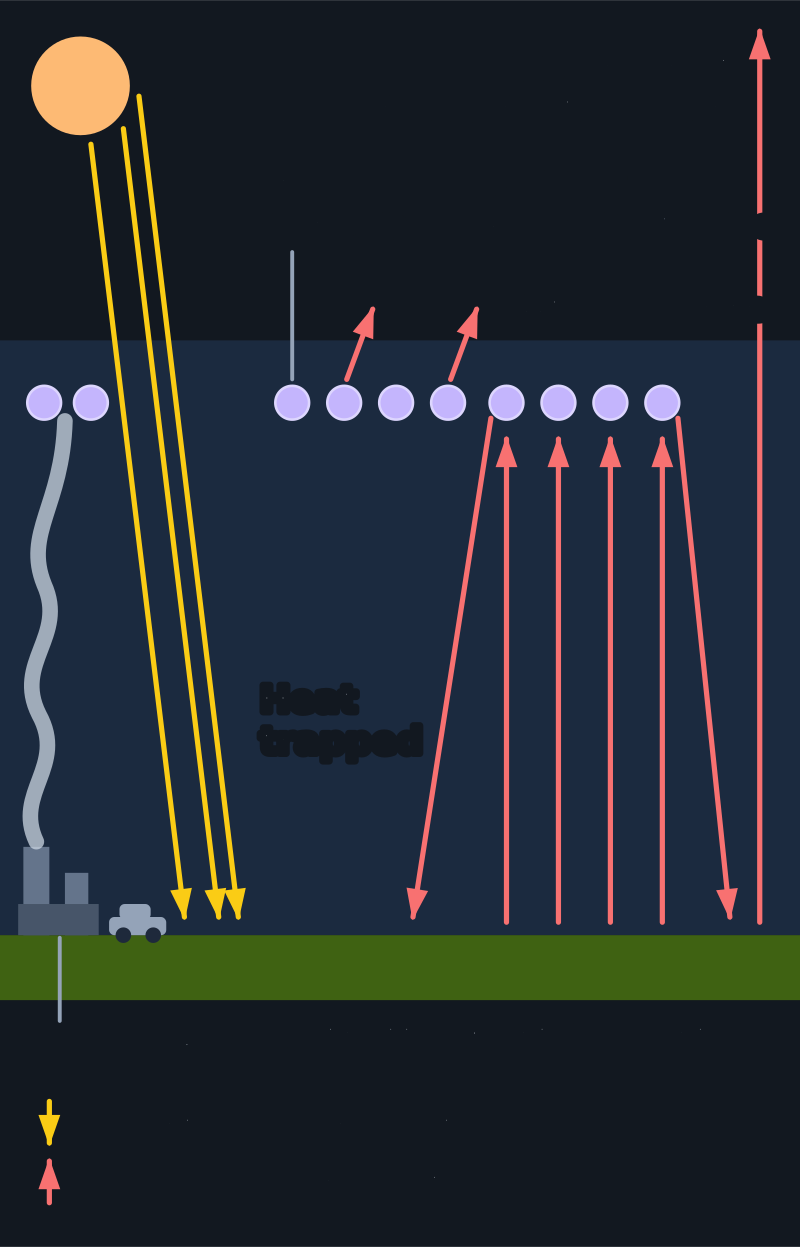
Figure 1: The Enhanced Greenhouse Effect. Human emissions of CO₂, methane and nitrous oxide trap more outgoing heat, raising global temperatures above natural levels.
Not to scale. Some long-wave radiation passes through to space. The rest is absorbed by greenhouse gases and sent back in all directions, including down to the surface.
To understand climate change, you must understand the distinction between the natural greenhouse effect and the enhanced greenhouse effect.
The Natural Greenhouse Effect
Without any greenhouse effect, Earth's average surface temperature would be approximately -18°C — far below freezing. The actual average is approximately +15°C. This difference of 33°C is entirely due to the natural greenhouse effect, which has existed throughout Earth's history and makes the planet habitable. Here is how it works:
The Enhanced Greenhouse Effect
Human activities — primarily burning fossil fuels and deforestation — have increased the concentration of greenhouse gases in the atmosphere far above their natural levels. More greenhouse gas molecules mean more infrared radiation is absorbed and re-radiated back to Earth. The planet's energy budget becomes unbalanced: more energy arrives from the Sun than can escape back to space. The result is a gradual build-up of heat in the Earth system — measured as rising surface temperatures, warming oceans, and melting ice.
Key Greenhouse Gases and Their Warming Potential
| Gas | Main Human Source | Global Warming Potential (vs CO₂ over 100 years) | Atmospheric lifetime |
|---|---|---|---|
| Carbon dioxide (CO₂) | Fossil fuel burning, deforestation, cement | 1 (baseline) | Hundreds to thousands of years |
| Methane (CH₄) | Livestock digestion, rice paddies, gas leaks, landfill | 28× | ~12 years (shorter but more potent) |
| Nitrous oxide (N₂O) | Nitrogen fertilisers, livestock manure | 265× | ~114 years |
| CFCs and HFCs | Refrigerants, aerosols (many now banned under Montreal Protocol) | 4,000–15,000× | Varies; decades to centuries |
The long atmospheric lifetime of CO₂ means that emissions today will continue to trap heat for centuries. Even if all human CO₂ emissions stopped tomorrow, the warming already "locked in" from past emissions would continue for decades. This is why early action on mitigation is so much more effective than waiting.
Quick Check: Explain the difference between the natural greenhouse effect and the enhanced greenhouse effect.
The natural greenhouse effect is the process by which greenhouse gases in the atmosphere — CO₂, methane, water vapour — absorb outgoing infrared (heat) radiation from Earth's surface and re-emit it in all directions, including back towards the surface. This keeps Earth approximately 33°C warmer than it would otherwise be, making the planet habitable. The enhanced greenhouse effect occurs when human activities — burning fossil fuels, deforestation, agriculture — increase the concentration of greenhouse gases above natural levels. Higher concentrations trap more outgoing heat, creating an energy imbalance where more energy enters the Earth system than escapes. This drives global warming. CO₂ has risen from 280 ppm pre-industrially to 421 ppm today, and the IPCC states with unequivocal certainty that this human-caused enhancement is the dominant driver of warming since 1950.
Make this stick
Signing in gives access to all PrepWise features.