Test yourself on Coastal Processes and Landforms with exam style questions, marked instantly.
Flashcards that come back just before you would forget them.
A revision plan that remembers what you know and shows what to do next.
See which topics you have nailed and which need another look.
Quiz yourself on Coastal Processes and LandformsGet your flashcardsBuild my revision planTrack my progress🏖️ Transportation and Depositional Landforms: When the Coast Builds
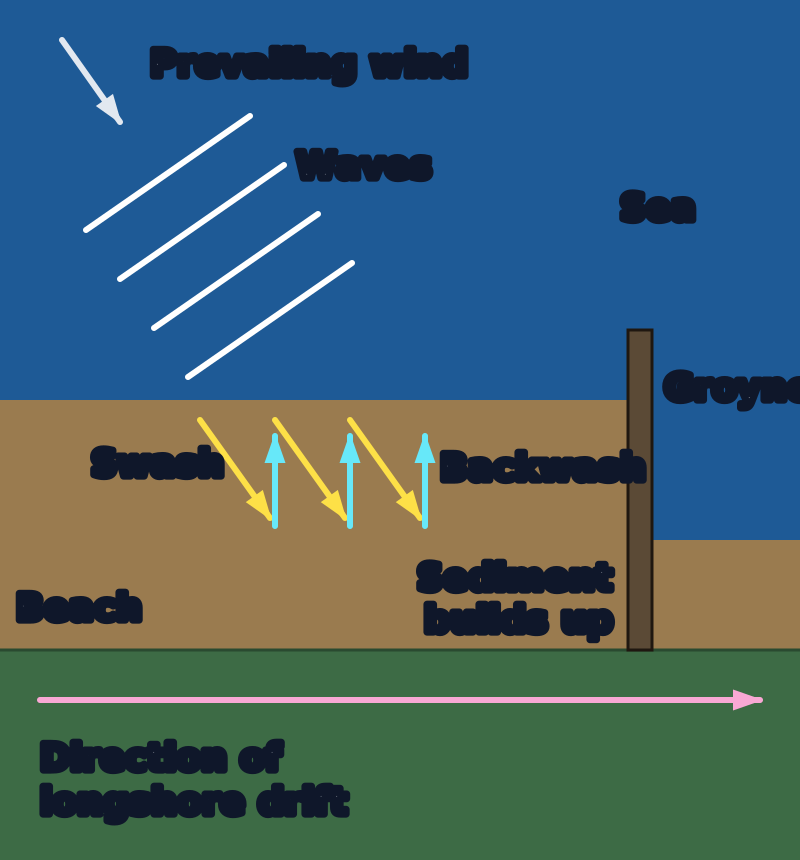
Figure 3: Longshore drift. Waves arrive at an angle, so the swash carries sediment up the beach at an angle and the backwash returns it straight down. Sediment moves along the coast in a zigzag.
A groyne traps sediment on the side the drift comes from, and the beach on the far side is left with less. Here the wind and waves come from the top left, so the drift moves to the right. Not to scale.
Erosion destroys; deposition builds. The material that waves remove from one section of coast is transported elsewhere and eventually deposited where wave energy drops below the threshold needed to keep it moving. The result is a collection of depositional landforms that can appear and disappear on human timescales — far faster than erosional landforms form.
Longshore Drift: The Engine That Drives It All
Most waves do not approach the shore perfectly head-on — they approach at an angle, matching the direction of the prevailing wind. On the east coast of England, the prevailing wind is from the north-east; on the south-west coast of England, it blows from the south-west. This angle of approach governs everything that follows.
When a wave breaks and rushes up the beach — the swash — it pushes sediment up the beach at the same angle as the wave approached. Then gravity takes over: the backwash drains straight back down the beach, perpendicular to the waterline, taking sediment with it. The sediment has moved a short distance along the coast. The next wave does exactly the same. The result is a zigzag movement of sediment along the coast in the direction of the prevailing wind — this is longshore drift.
On the Holderness coast, longshore drift moves sediment southward. Over thousands of years, this material has accumulated at the tip of the headland formed by the chalk wolds — building and rebuilding Spurn Head, the narrow spit that extends 5 km into the mouth of the Humber estuary. Spurn Head is one of Britain's most dynamic landforms: it has been breached by storms, rebuilt, and has migrated westward over centuries as the cliff material feeding it shifts.
Beaches: The Coast's Shock Absorber
A beach forms where wave energy is sufficient to transport sediment but drops enough for deposition to occur — typically in sheltered bays, in areas of lower fetch, or where longshore drift deposits material in calmer water. Constructive waves build beaches; destructive waves strip them. In many parts of the UK, beaches change dramatically between summer (built up by the lower-energy conditions) and winter (stripped back by storms). A beach is not a fixed structure — it is a constantly moving store of sediment.
Spits: Where the Coast Changes Direction
A spit forms where the coastline changes direction — at a river mouth, a bay, or a sudden bend. Longshore drift carries sediment along the coast, but when the land ends and open water begins, there is nothing to support the continued movement of sediment. Instead, material is deposited in the open water, extending outward as a narrow ridge of sand or shingle. The spit grows longer with each wave season.
The curved tip that most spits develop is caused by wave refraction: secondary waves approach the tip of the spit from a different angle to the dominant waves, bending the end of the spit landward. Hurst Castle Spit in Hampshire — extending across the western entrance to the Solent — shows this classic recurved tip. Spurn Head on the Humber demonstrates how spits depend on a constant supply of sediment from updrift erosion: interrupt that supply (as happens when sea walls protect cliffs north of Spurn), and the spit begins to erode and narrow.
Bars and Tombolos
If a spit extends entirely across a bay, cutting it off from the open sea, it becomes a bar — with a lagoon of sheltered water behind it. Slapton Sands in Devon is a classic example, enclosing Slapton Ley. A tombolo forms when a spit or bar connects the mainland to an offshore island — the Isle of Portland in Dorset is connected to the mainland by Chesil Beach, a 29-km shingle tombolo that also forms a bar enclosing the Fleet Lagoon.
Quick Check: Explain how a spit forms. Name a UK example and explain why it has a curved tip.
A spit forms where longshore drift carries sediment along a coast and the coastline changes direction — at a river mouth or a bend in the coast. When the land ends, there is nothing to support the sediment in transit, so it is deposited in open water, extending outward as a narrow ridge of sand or shingle. The spit grows longer over time as more material is added by longshore drift. The curved tip forms because secondary waves approach the end of the spit from a different angle, bending the growing end of the spit back towards the land. Example: Spurn Head (East Yorkshire) extends 5 km into the Humber estuary, formed by southward longshore drift of material eroded from the Holderness cliffs to the north.
Make this stick
Signing in gives access to all PrepWise features.