Test yourself on Coastal Processes and Landforms with exam style questions, marked instantly.
Flashcards that come back just before you would forget them.
A revision plan that remembers what you know and shows what to do next.
See which topics you have nailed and which need another look.
Quiz yourself on Coastal Processes and LandformsGet your flashcardsBuild my revision planTrack my progress🌊 Wave Energy: Where It Comes From and Why It Matters
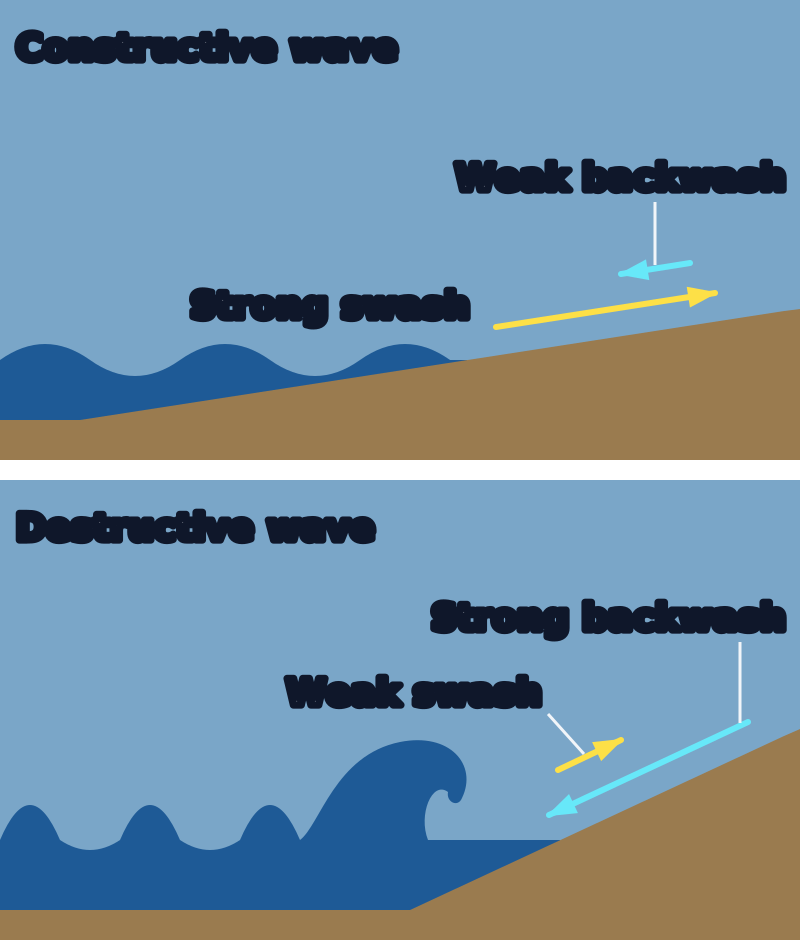
Figure 1: Constructive and destructive waves. A constructive wave has a strong swash and a weak backwash, so it builds up the beach. A destructive wave has a strong backwash and a weak swash, so it wears the beach away.
Constructive waves arrive about 6 to 8 times a minute and destructive waves about 10 to 14 times a minute.
Every wave that crashes against a British cliff started as a tiny ripple hundreds or even thousands of miles away. When wind blows across open water, friction between the air and the water surface transfers energy into the ocean. The water particles begin to move in circular orbits — they don't actually travel with the wave, they rotate in place like wheels turning. It's the energy that moves forward, not the water itself. When that energy eventually reaches the shallow water near the coast, the circular motion is disrupted, the wave slows at its base and topples forward — and everything the wave has stored from hundreds of miles of open ocean is released against the land in a fraction of a second.
The amount of energy in a wave depends primarily on fetch — the distance of open water over which the wind has been blowing. The longer the fetch, the bigger the waves. This explains a striking geographical pattern in the UK: the Atlantic coast of Cornwall and Wales faces winds blowing uninterrupted from North America — a fetch of over 3,000 km. Waves here are enormous and powerful. The English Channel coast of Sussex and Kent has a maximum fetch of a few hundred kilometres. Waves are smaller. The rocks, beaches and landforms of each coast reflect this difference in wave energy — and it is why the wild, dramatic sea stacks of the far north of Scotland look nothing like the gentle shingle beaches of the Solent.
Constructive vs Destructive Waves: The Two Types That Shape Everything
Not all waves behave the same way when they reach the shore, and the distinction between the two main types is one of the most fundamental ideas in coastal geography.
Constructive waves form in calm conditions, often far from the shore. They are long, low, and gentle — imagine a slow rolling swell, not a crashing breaker. Their key characteristic is that their swash (the rush of water up the beach after the wave breaks) is stronger than their backwash (the water draining back down the beach under gravity). The wave deposits more material on the beach than it removes. Think of constructive waves as a gentle push: they nudge sediment up the beach and leave it there, gradually building up the beach profile. These waves break at a frequency of around 6–8 per minute.
Destructive waves form during storms, or when wind has blown hard over a long fetch. They are tall, steep, and crash down onto the beach with tremendous force — like a punch rather than a push. Their backwash is stronger than their swash: water rushes back down the beach pulling sediment seaward before the next wave arrives. Destructive waves have a frequency of 10–14 per minute, meaning the next wave arrives before the previous one has fully retreated — each new wave hits water already flowing back, which increases the chaos and erosive power. These are the waves that eat cliffs.
The beach slope reflects which wave type dominates. Where constructive waves prevail, beaches are wide, gently sloping, and built up. Where destructive waves dominate, beaches are narrow, steep, and constantly being stripped of material. A wide beach is not just aesthetically pleasing — it is a form of natural coastal protection, absorbing wave energy before it can reach the cliff behind.
Quick Check: Explain why the Atlantic coast of Cornwall receives bigger waves than the coast of Kent.
The Atlantic coast of Cornwall has a much longer fetch — the distance of open water over which wind has blown. Winds blowing from North America have over 3,000 km of open ocean to transfer energy into waves before reaching Cornwall. The coast of Kent faces the English Channel, which has a maximum fetch of a few hundred kilometres, so waves have much less energy when they arrive. Longer fetch = more wind energy transferred to the water = bigger, more powerful waves arriving at the coast.
Make this stick
Signing in gives access to all PrepWise features.