Test yourself on Development Gap and Global Development with exam style questions, marked instantly.
Flashcards that come back just before you would forget them.
A revision plan that remembers what you know and shows what to do next.
See which topics you have nailed and which need another look.
Quiz yourself on Development Gap and Global DevelopmentGet your flashcardsBuild my revision planTrack my progress🔍 What Is Development — and Why Don't All Countries Develop at the Same Rate?
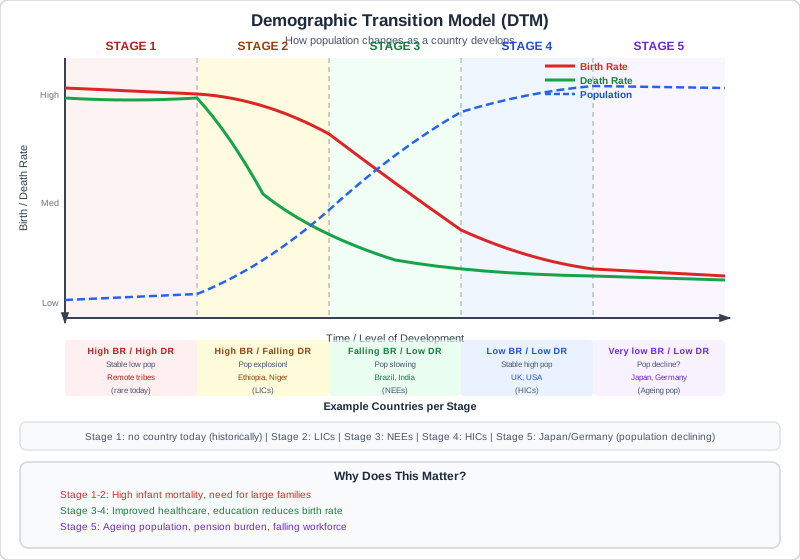
Figure 1: The Demographic Transition Model — how birth rates, death rates and population change as countries develop
Development refers to the process by which a country improves the quality of life of its people — economically (rising incomes), socially (better health and education), and politically (stronger institutions and freedoms). But here is the key thing that most students miss: development is not just about money. A country can have oil wealth — like Nigeria — and still have millions living in extreme poverty. Development is about how wealth is created, distributed, and translated into real improvements in people's lives.
Think of it this way: development is like building a house. You need the raw materials (natural resources, land, labour), the tools (technology, infrastructure, education), and a stable environment to build in (peace, effective government, rule of law). Countries that have all three build quickly. Countries that are missing one or more struggle — or see their progress collapse entirely when conflict or disaster strikes.
Why don't all countries develop at the same speed? There is no single answer — and any exam answer that suggests there is will lose marks. Instead, development is shaped by a web of interacting causes: the physical geography of the land (is it landlocked? prone to drought?), the country's history (was it colonised? what trade patterns were established?), its political stability (can the government collect taxes and invest them?), and its position in the global economy (does it export raw materials for low prices, or manufactured goods for high ones?).
The Poverty Trap: Why Being Poor Makes It Hard to Stop Being Poor
One of the most important ideas in this topic is the cycle of poverty — the idea that low development creates conditions that make further development harder. It works like this:
The Demographic Transition Model (DTM) and Development
The Demographic Transition Model is one of the most useful tools in geography because it connects population change to development level. It shows that as countries develop, they move through five stages — from high birth rates and high death rates (Stage 1, pre-industrial) to low birth rates and low death rates (Stage 5, post-industrial).
The critical insight is that death rates fall first (as medical care, clean water, and food security improve) while birth rates remain high for a generation. This gap produces rapid population growth — a "population explosion" — which is precisely what many LIDCs are experiencing today. Countries like Ethiopia are in Stage 2–3: death rates have fallen significantly, but birth rates are still high, producing a young, rapidly growing population that puts enormous pressure on schools, hospitals, and food supply.
HICs (High-Income Countries) like the UK and Japan are in Stage 4–5: both birth and death rates are low, populations are stable or even declining, and the workforce is ageing. This creates different challenges — like funding pensions and care for a large elderly population. Understanding where a country sits on the DTM gives you a shortcut to explaining its development challenges.
Quick Check: Explain what is meant by the "cycle of poverty" and why it makes development difficult.
The cycle of poverty is the idea that low development creates conditions that prevent further development. Low incomes mean families cannot afford healthcare or education; without education, workers lack skills; without skilled workers, the economy stays in low-productivity activities; low economic output means low tax revenue; without tax revenue the government cannot invest in schools, hospitals or infrastructure. Each factor reinforces the others, making it very hard for countries to escape poverty without multiple simultaneous interventions. For example, improving schools alone does little if children are too malnourished to concentrate — so health and food security must improve at the same time.
Make this stick
Signing in gives access to all PrepWise features.