Test yourself on Development Gap and Global Development with exam style questions, marked instantly.
Flashcards that come back just before you would forget them.
A revision plan that remembers what you know and shows what to do next.
See which topics you have nailed and which need another look.
Quiz yourself on Development Gap and Global DevelopmentGet your flashcardsBuild my revision planTrack my progress🌍 Born One Second Apart, Worlds Apart
The other baby is born in Chad, in central Africa. He has a 10% chance of dying before his fifth birthday. If he survives childhood, he will probably live to 53 — three decades less than his Japanese counterpart born at the same second. He will grow up in a country where the average person earns less than $700 a year, where one in four adults cannot read, and where a drought can wipe out a family's entire food supply in a single season.
No choice was made. No effort was required. Simply being born in the wrong place — by perhaps a few hundred miles — determines access to healthcare, education, safety, and opportunity on a scale that would be hard to believe if the data did not confirm it.
This is the development gap: the enormous and persistent difference in quality of life between the world's richest and poorest countries. Understanding why it exists, how we measure it, and whether we can close it is what this topic is all about. And it matters — because in the real world, these numbers represent real lives.
🔍 What Is Development — and Why Don't All Countries Develop at the Same Rate?
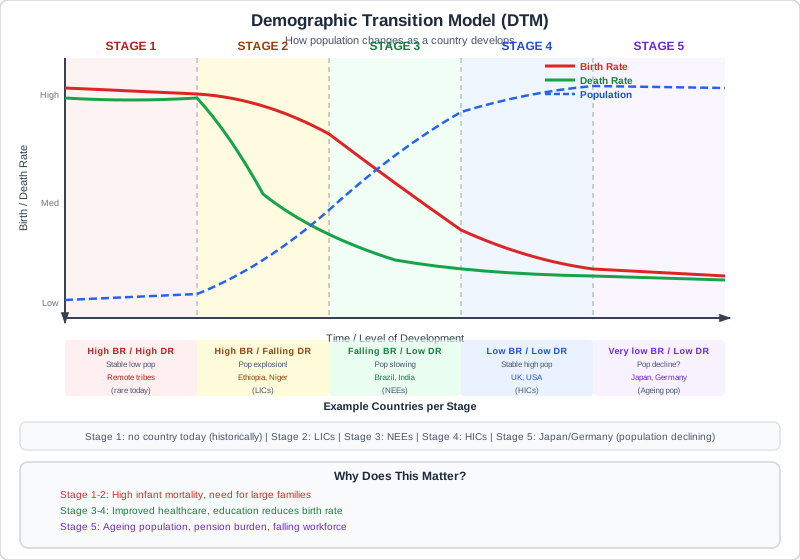
Figure 1: The Demographic Transition Model — how birth rates, death rates and population change as countries develop
Development refers to the process by which a country improves the quality of life of its people — economically (rising incomes), socially (better health and education), and politically (stronger institutions and freedoms). But here is the key thing that most students miss: development is not just about money. A country can have oil wealth — like Nigeria — and still have millions living in extreme poverty. Development is about how wealth is created, distributed, and translated into real improvements in people's lives.
Think of it this way: development is like building a house. You need the raw materials (natural resources, land, labour), the tools (technology, infrastructure, education), and a stable environment to build in (peace, effective government, rule of law). Countries that have all three build quickly. Countries that are missing one or more struggle — or see their progress collapse entirely when conflict or disaster strikes.
Why don't all countries develop at the same speed? There is no single answer — and any exam answer that suggests there is will lose marks. Instead, development is shaped by a web of interacting causes: the physical geography of the land (is it landlocked? prone to drought?), the country's history (was it colonised? what trade patterns were established?), its political stability (can the government collect taxes and invest them?), and its position in the global economy (does it export raw materials for low prices, or manufactured goods for high ones?).
The Poverty Trap: Why Being Poor Makes It Hard to Stop Being Poor
One of the most important ideas in this topic is the cycle of poverty — the idea that low development creates conditions that make further development harder. It works like this:
The Demographic Transition Model (DTM) and Development
The Demographic Transition Model is one of the most useful tools in geography because it connects population change to development level. It shows that as countries develop, they move through five stages — from high birth rates and high death rates (Stage 1, pre-industrial) to low birth rates and low death rates (Stage 5, post-industrial).
The critical insight is that death rates fall first (as medical care, clean water, and food security improve) while birth rates remain high for a generation. This gap produces rapid population growth — a "population explosion" — which is precisely what many LIDCs are experiencing today. Countries like Ethiopia are in Stage 2–3: death rates have fallen significantly, but birth rates are still high, producing a young, rapidly growing population that puts enormous pressure on schools, hospitals, and food supply.
HICs (High-Income Countries) like the UK and Japan are in Stage 4–5: both birth and death rates are low, populations are stable or even declining, and the workforce is ageing. This creates different challenges — like funding pensions and care for a large elderly population. Understanding where a country sits on the DTM gives you a shortcut to explaining its development challenges.
Quick Check: Explain what is meant by the "cycle of poverty" and why it makes development difficult.
The cycle of poverty is the idea that low development creates conditions that prevent further development. Low incomes mean families cannot afford healthcare or education; without education, workers lack skills; without skilled workers, the economy stays in low-productivity activities; low economic output means low tax revenue; without tax revenue the government cannot invest in schools, hospitals or infrastructure. Each factor reinforces the others, making it very hard for countries to escape poverty without multiple simultaneous interventions. For example, improving schools alone does little if children are too malnourished to concentrate — so health and food security must improve at the same time.
📊 How Do We Measure Development — and Why Is One Indicator Never Enough?
If you want to know how developed a country is, where do you start? The most obvious answer is income. But income alone is deeply misleading — and understanding why is essential for exam answers.
Imagine two countries, both with an average income of $5,000 per person. In Country A, most people earn close to $5,000. In Country B, a handful of billionaires earn $5 million each, and the rest of the population earns $500. The average is the same. The reality is completely different. This is why geographers use multiple development indicators — different measurements that each capture a different aspect of people's lives.
The Key Indicators — and What They Actually Measure
Why the HDI Is Better — But Still Not Perfect
The HDI is better than GNI per capita alone because it captures multiple dimensions of human wellbeing. But it still has limitations. It does not measure inequality within a country — a country with an HDI of 0.700 might have half its population at 0.900 and half at 0.500. It does not measure environmental sustainability — a country can boost its HDI by burning coal and depleting forests, leaving future generations worse off. And it does not capture political freedom, personal security, or happiness.
For really advanced answers, you can mention the Gini coefficient (a measure of income inequality within a country, from 0 = perfect equality to 1 = one person owns everything) or the Palma ratio (the ratio of the income of the richest 10% to the poorest 40%). These capture what HDI misses: how fairly development is shared.
⚖️ Development Indicators — Comparing Four Countries
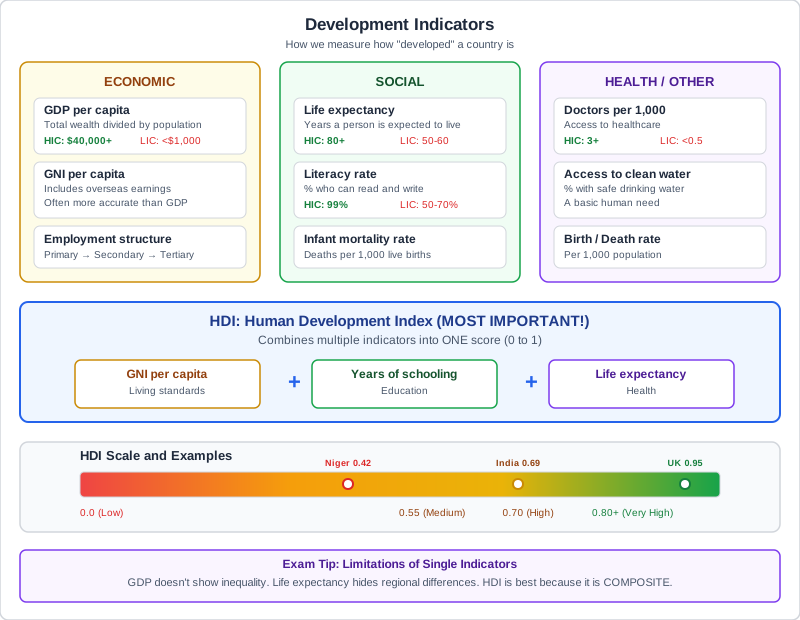
Figure 2: Development Indicators — how LIDCs, NEEs, and HICs compare across key measures
| Indicator | Ethiopia (LIDC) | Nigeria (NEE) | Brazil (NEE) | UK (HIC) |
|---|---|---|---|---|
| HDI (2023) | 0.497 (low) | 0.560 (medium) | 0.786 (high) | 0.946 (very high) |
| GNI per capita (USD) | ~$1,000 | ~$2,000 | ~$14,000 | ~$46,000 |
| Life expectancy | 67 years | 54 years | 76 years | 81 years |
| Adult literacy rate | ~51% | ~62% | ~93% | ~99% |
| Infant mortality (per 1,000) | ~38 | ~55 | ~13 | ~4 |
| % below $3.20/day | ~68% | ~42% | ~9% | <1% |
| Development category | LIDC | NEE | NEE | HIC |
Note: LIDC = Low-Income Developing Country; NEE = Newly Emerging Economy; HIC = High-Income Country. Statistics are approximate and change year to year — use these as approximate anchors in your exam answers.
Quick Check: Explain why GNI per capita is an incomplete measure of development. Use an example in your answer.
GNI per capita is an average that hides inequality within a country. Nigeria's GNI per capita of approximately $2,000 suggests a moderate standard of living, but this figure masks extreme inequality: oil wealth is concentrated among a small elite while over 42% of Nigerians live below $3.20 per day. A country can have high average income and deep poverty at the same time. The HDI is more useful because it combines income with life expectancy and education into a single composite score — though even this does not fully capture inequality within countries or environmental sustainability.
🇪🇹 Ethiopia — LIDC Case Study
Imagine a country about the size of France and Spain combined, home to 120 million people — the second-most populous nation in Africa. Its capital, Addis Ababa, means "New Flower" in Amharic. The country is ancient: it was never colonised by Europe (a remarkable exception we will come back to), has some of the oldest Christian churches on Earth, and gave the world coffee — the very plant now consumed in 2.25 billion cups every single day. This is Ethiopia: one of the world's oldest civilisations, and one of its poorest countries.
Ethiopia is classified as an LIDC (Low-Income Developing Country). Its HDI of 0.497 (2023) places it in the bottom 20% of countries globally. Around 68% of its population lives below $3.20 per day. Life expectancy is 67, a decade less than the global average. Why? The answer requires looking at both the physical environment Ethiopia was born into and the human decisions made across centuries.
Physical Factors Limiting Development
- Landlocked country: Ethiopia has no coastline. This is a significant economic disadvantage. Seaports are the cheapest way to trade internationally — shipping a container by sea costs a fraction of shipping it overland. Ethiopia must route all its imports and exports through neighbouring countries, primarily Djibouti, adding cost, time, and political risk to every transaction. Studies estimate landlocked countries have 30–40% lower trade volumes than comparable coastal nations.
- Drought-prone climate: Ethiopia lies on the fringe of the Sahel — a semi-arid belt stretching across Africa just south of the Sahara. Rainfall is unpredictable and can fail entirely for months. The country has experienced repeated famines: 1984 saw approximately 1 million people die of starvation, an event that shocked the world and prompted the Band Aid charity single. Climate change is making droughts more frequent and severe.
- Terrain challenges: The Ethiopian Highlands — a vast, rugged plateau broken by deep river gorges and the Great Rift Valley — make road construction enormously expensive. Isolated highland communities struggle to access markets, schools, and hospitals. The terrain that makes the landscape strikingly beautiful also makes basic economic connectivity extremely difficult.
- Locust plagues: In 2020, Ethiopia experienced its worst locust infestation in 25 years, with swarms of up to 150 billion insects devastating crops across the eastern regions. Locusts are not a development problem in themselves — but they expose how little buffer an LIDC has against shock. When one harvest fails in a wealthy country, food is imported. When it fails in Ethiopia, people go hungry.
Human Factors Limiting Development
- History of conflict: Ethiopia spent the late 20th century in devastating civil wars. The 1984 famine was made catastrophically worse by a military government (the Derg) that actively blocked international food aid in rebel-controlled areas, using hunger as a weapon. The wars of the 1970s–1980s destroyed infrastructure, displaced millions, and caused a "lost generation" of Ethiopians who grew up without adequate education or healthcare.
- The Tigray conflict (2020–2022): Just as Ethiopia appeared to be on a sustained growth trajectory, war returned. The Tigray conflict — fought between the federal government and the Tigray People's Liberation Front in the northern region — is estimated to have killed 300,000–500,000 people (including through famine as a deliberate weapon), displaced millions, and set Ethiopia's development back by years. This is the most recent example of conflict destroying development progress.
- Debt burden: Ethiopia borrowed heavily to fund infrastructure projects, particularly from China. By 2022, external debt exceeded $55 billion — about 60% of GDP. Debt repayments consume government revenue that could otherwise fund schools and hospitals, and make the country vulnerable to economic shocks.
- Brain drain: Ethiopia trains doctors and engineers at great cost to the state, only to see many emigrate to Europe, North America, or the Gulf for higher salaries. This "brain drain" deprives Ethiopia of exactly the skilled workers it needs most, while enriching the wealthy countries that receive them.
- The colonial exception — and why it did not help as much as expected: Ethiopia was never colonised (except for a brief Italian occupation 1936–1941). You might expect this to be a major advantage — no colonial exploitation, no artificially imposed borders, no imposed trade patterns. In reality, Ethiopia's experience shows that avoiding colonialism does not automatically produce development. Internal governance challenges, conflict, and geographic disadvantages still had to be overcome. However, Ethiopia did retain its own land tenure systems, cultural institutions, and national identity — which some argue gave it stronger social cohesion than many colonised neighbours.
Quick Check: Explain two physical factors that have limited Ethiopia's development. Use evidence in your answer.
First, Ethiopia is landlocked — it has no coastline and must route all trade through neighbouring countries, primarily Djibouti. This adds significant cost to every import and export, with studies suggesting landlocked countries trade 30–40% less than comparable coastal nations. Second, Ethiopia has a drought-prone climate on the fringe of the Sahel belt. Unpredictable rainfall has caused repeated famines — approximately 1 million people died in the 1984 famine — and climate change is making droughts more frequent and severe, threatening the agricultural base that most Ethiopians depend on for survival. Both factors interact with each other: when drought destroys crops, the cost of importing emergency food is higher precisely because of the landlocked geography.
📈 Ethiopia's Recent Progress — and What Is Still Holding It Back
Here is something most students do not realise: Ethiopia is also, paradoxically, one of the world's fastest-growing economies of the 2010s. Between 2004 and 2019, its economy grew at an average of 9–10% per year — one of the highest growth rates anywhere on Earth during that period. This is real progress. But it needs to be understood carefully, because growth is not the same as development, and progress is not the same as escape from poverty.
Signs of Progress
- The Addis Ababa Light Rail: In 2015, Addis Ababa opened sub-Saharan Africa's first urban light rail system — a 31 km network of trams connecting the city's main arteries, built with Chinese investment and technology. It carries around 50,000 passengers per day. This is not just infrastructure — it is a symbol that Ethiopian cities are beginning to resemble those of middle-income countries.
- Ethiopian Airlines: While much of Africa's airline industry struggles, Ethiopian Airlines is one of the continent's most profitable and fastest-growing carriers, connecting Addis Ababa to over 125 destinations globally. It employs 18,000 people directly and is a rare example of African state-owned enterprise competing successfully on the world stage.
- The Grand Ethiopian Renaissance Dam: Under construction on the Blue Nile, this $5 billion hydroelectric dam will be the largest in Africa when fully operational, with a capacity of 5,150 MW. It will dramatically increase Ethiopia's electricity supply — currently, 45% of Ethiopians have no access to electricity — and potentially allow Ethiopia to export power to neighbouring countries for revenue. However, it has caused diplomatic tension with Egypt and Sudan, who depend on the Nile's flow.
- Chinese investment: China has invested approximately $12 billion in Ethiopian infrastructure since 2000, including the Addis Ababa–Djibouti railway (a 759 km electrified rail line completed in 2017), roads, industrial parks, and the light rail. This investment has created construction jobs and improved connectivity — but it has also increased Ethiopia's debt and created concerns about dependency on Chinese finance.
- Poverty reduction: The percentage of Ethiopians in extreme poverty fell from around 55% in 2000 to around 22% in 2019 — a significant improvement, though still representing tens of millions of people.
What Is Still Holding Ethiopia Back
The Tigray conflict (2020–2022) is the starkest illustration of how fragile development progress can be. An estimated 300,000–500,000 people died — through fighting, famine, and atrocities — making it one of the deadliest conflicts anywhere in the world since World War II. Agricultural land was destroyed. Roads, hospitals, and schools were bombed. Around 2.5 million people were displaced. Years of poverty reduction were erased in months.
Quick Check: Describe one way Ethiopia has made development progress and explain one factor that continues to limit it.
Progress: Ethiopia opened sub-Saharan Africa's first urban light rail system in Addis Ababa in 2015, built with Chinese investment. The 31 km network carries approximately 50,000 passengers per day, improving urban connectivity and representing a significant step towards middle-income city infrastructure. Continuing limitation: the Tigray conflict (2020–2022) caused catastrophic setbacks, with an estimated 300,000–500,000 deaths and 2.5 million displaced. Farming was disrupted across northern Ethiopia, causing acute food insecurity and malnutrition that will reduce workforce productivity for years. Foreign investors withdrew, reversing a decade of economic growth. This demonstrates that political instability is one of the most powerful barriers to sustained development.
⛓️ Why Does the Development Gap Persist? The Colonial Trade Trap
One of the most powerful and exam-relevant explanations for the development gap is the way global trade patterns were set up during the colonial era — and how they continue to disadvantage LIDCs today. This is not just history: it is the economic architecture of the present world.
During the colonial period (roughly 1500–1960), European powers organised their colonies as suppliers of raw materials: cotton, rubber, cocoa, coffee, minerals, timber. Manufactured goods — clothing made from the cotton, chocolate made from the cocoa, machinery, tools — were produced in Europe and sold back to the colonies. This created a fundamental inequality in the trade relationship that persists long after political independence.
☕ Closing the Gap — Strategies, Evidence, and Hard Questions
There is no shortage of proposed solutions to the development gap. The harder question is which ones actually work, and why. For top-grade answers, you need to be able to evaluate — weighing genuine benefits against real limitations and reaching a judgement about effectiveness.
Strategy 1: Aid
Aid is money, goods, or services given by one country or organisation to another. It comes in several forms: emergency aid (food, medicine, and shelter after disasters or famines — vital for immediate survival but does not produce long-term development), development aid (funding schools, hospitals, wells, and training programmes — more likely to produce lasting improvement), and bilateral aid (government to government, sometimes with political strings attached) versus multilateral aid (channelled through the UN, World Bank, or similar organisations).
The case for aid: it saves lives. In emergencies, there is no alternative. Development aid, when well-designed, builds capacity — a new medical school trains doctors who treat patients for decades. The Global Fund has provided antiretroviral treatment to over 20 million HIV-positive people in sub-Saharan Africa, many of them through aid-funded programmes.
The case against relying on aid: tied aid is a serious problem. "Tied" aid requires the recipient country to spend the money on goods or services from the donor country — meaning American tied aid funds American contractors, not Ethiopian ones. Aid can also create dependency, substituting for the tax-raising and governance reforms that would produce more sustainable funding. Perhaps most fundamentally, the total flow of aid into Africa is dwarfed by the flow of money out of Africa through debt repayments, tax avoidance by multinationals, and unfair trade — some estimates suggest Africa "loses" $80 billion more than it receives in aid each year.
Strategy 2: Fair Trade
Fair trade is a trading partnership that guarantees producers in LIDCs a minimum price for their goods — one that covers their production costs — plus an additional "social premium" paid to the farming cooperative to invest in community projects. Ethiopia is particularly relevant here: Ethiopia is the birthplace of coffee, and around 12 million Ethiopians depend on coffee farming for their livelihoods.
When world coffee prices fall below the cost of production — which happened repeatedly in the 1990s and 2000s — ordinary coffee farmers face a choice between selling at a loss or not selling at all. Fairtrade guarantees a minimum price of $1.40 per pound (compared to a world price that sometimes fell below $0.50), protecting farmers from the worst volatility. The Fairtrade premium — currently $0.20 per pound above the minimum — goes to the cooperative, which farmers vote on how to spend: typically clean water, health clinics, school materials, or crop diversification.
The limitation: fair trade reaches only a small fraction of the world's farmers (1.9 million in the Fairtrade system, out of hundreds of millions of smallholder farmers globally). It does not change the fundamental trade architecture — Ethiopia still exports raw beans while the roasting, packaging, and branding happens in Europe. And while the Fairtrade premium is genuinely helpful, it is a small intervention in a large structural problem.
Strategy 3: Investment (FDI and Chinese Belt and Road)
Foreign Direct Investment (FDI) is when companies or governments from one country invest in building factories, infrastructure, or businesses in another. The Chinese "Belt and Road Initiative" has been the most significant source of FDI for many African LIDCs, including Ethiopia, in the 2010s.
Chinese investment in Ethiopia includes: the Addis Ababa–Djibouti railway ($4 billion, completed 2017), the Addis Ababa light rail ($475 million), industrial parks in cities including Hawassa (employing 25,000 workers in garment manufacturing), road construction, and the Grand Ethiopian Renaissance Dam financing. This investment has created jobs, improved connectivity, and transferred some technical skills.
The limitations are significant. China's loans come with interest — and Ethiopia's total debt (much of it to China) reached $55 billion by 2022, consuming a growing share of government revenue in repayments. Profits from Chinese-built factories often return to China rather than circulating in the Ethiopian economy. Critics describe this as "debt trap diplomacy" — though others argue the infrastructure benefits are real regardless of the financing terms. The jobs created in garment factories often pay low wages for long hours — better than subsistence farming, but not the path to high-productivity economic development.
Strategy 4: Debt Relief
When a country owes so much debt that repayments consume most of its government revenue, development becomes almost impossible. The Heavily Indebted Poor Countries (HIPC) initiative, launched in 1996 by the IMF and World Bank, allows qualifying countries to have their debt cancelled or reduced in exchange for commitments to spend the freed-up money on poverty reduction.
Ethiopia qualified for HIPC relief, having $1.9 billion of debt cancelled in 2004. The freed resources were directed to health (reducing child mortality) and education (building schools). Similar debt relief across sub-Saharan Africa freed up an estimated $1 billion per year for social spending — genuinely significant. Oxfam and the Jubilee Debt Campaign argue that much more extensive debt cancellation is needed, given that Africa continues to pay approximately $45 billion per year in debt interest.
The limitation: debt relief is politically difficult (creditor countries must accept a loss) and tends to be partial rather than comprehensive. It also does not address the trade patterns and governance issues that caused the debt in the first place — without structural change, LIDCs may simply accumulate new debt.
Quick Check: Explain one strength and one weakness of fair trade as a strategy to reduce the development gap. Use Ethiopia as your example.
Strength: Fair trade guarantees Ethiopian coffee farmers a minimum price of $1.40 per pound, protecting them from price crashes on world markets (the price fell below $0.50 per pound during the 2000s coffee crisis). The Fairtrade social premium — $0.20 per pound above the minimum — goes to the farming cooperative to invest in schools, clean water, and healthcare, directly improving community development. Weakness: fair trade reaches only a small fraction of global farmers — 1.9 million are in the Fairtrade system, while hundreds of millions of smallholders are not. It also does not change the fundamental trade structure: Ethiopia still exports low-value raw coffee beans while roasting, packaging, and branding — which captures most of the product's value — happen in wealthy countries. Fair trade slightly improves returns within an unfair system, but does not change the system itself.
🧠 Exam Framework: CHILD
Use CHILD to remember the factors that cause the development gap. In exam answers, try to explain how these factors interact rather than listing them separately — top marks go to answers that show how one cause leads to another.
Remember the country categories:
- LIDC = Low-Income Developing Country (Ethiopia, Chad, Niger) — lowest HDI, largely agricultural, most dependent on aid
- NEE = Newly Emerging Economy (Nigeria, India, Brazil, China) — rapidly industrialising, growing middle class, significant manufacturing
- HIC = High-Income Country (UK, Germany, Japan, USA) — post-industrial, service-led, high HDI
🎯 Exam Connection — GCSE Geography
Paper: examined across all major boards — AQA (Paper 2, Section B: Changing Economic World), Edexcel (Development Dynamics / Global Development), and OCR B (Paper 2 — People and Society, Component 2: Dynamic Development).
Exam frequency: Very high across every board. Expect questions on development indicators, causes of uneven development, a named LIC/LIDC or NEE case study, and strategies to reduce the gap in virtually every sitting.
OCR B requirement — board-specific, does not apply to AQA or Edexcel: OCR B students MUST have both an NEE case study (Nigeria — covered in Topic 2) AND a separate LIDC case study (Ethiopia — this topic); questions asking specifically for an LIDC example require Ethiopia, not Nigeria. AQA and Edexcel students should follow their own centre's chosen case study for this topic — Nigeria (the linked topic) is the case study PrepWise teaches in depth for those boards, and Ethiopia is not a required addition for them.
Typical Question Types (OCR B-style below; the same command-word skills — state/identify, explain, evaluate — are assessed identically by AQA and Edexcel):
- "State two development indicators used to measure quality of life." [2 marks] — Simply name two: HDI, life expectancy, infant mortality rate, literacy rate, GNI per capita. No explanation needed.
- "Explain why GNI per capita alone is not a reliable measure of development." [4 marks] — Two explained reasons. Key argument: it is an average that hides inequality; it measures income but not health, education or freedom. Use Nigeria as an example (high GNI average, high poverty rate).
- "Explain why some countries remain Low-Income Developing Countries." [6 marks] — Use Ethiopia with the CHILD framework. Give at least two explained causes and show how they interact. Aim for a cause-chain not a list.
- "Evaluate strategies used to reduce the development gap." [8 marks] — This is the classic top-mark question. You need: specific named examples, at least two strategies compared, strengths and limitations of each, and a supported judgement about which is most effective. Use Ethiopia (fair trade for coffee, Chinese infrastructure investment, HIPC debt relief).
What Gets You to Level 3 (Top Marks) on the Evaluate Question:
Most students can write Level 1 and 2 answers. Top marks require specific evidence, comparison, and a genuine judgement. Here is what that progression looks like:
Command Words (used the same way across AQA, Edexcel and OCR B):
- State / Identify: Give the fact directly — no explanation needed
- Explain: Give reasons WITH mechanisms — "because" is essential
- Assess / Evaluate: Weigh strengths against limitations, reach a supported judgement
- Compare: Explicitly show similarities AND differences; use "whereas" and "in contrast"
- Suggest: Give a possible reason or explanation — more than one answer is acceptable
💡 Exam Tips for the Development Gap
🎯 Always Use Ethiopia as Your LIDC
- Every time a question mentions "LIDC" or "low-income developing country," use Ethiopia
- Key statistics to memorise: HDI 0.497, GNI per capita ~$1,000, life expectancy 67, infant mortality 38 per 1,000, ~68% below $3.20/day
- Key case study facts: landlocked, coffee-exporting, Addis Ababa light rail (2015), Tigray conflict (2020–2022), HIPC debt relief ($1.9bn cancelled, 2004)
- Never say "a country in Africa" — say "Ethiopia" and add a statistic
📝 Evaluate = Weigh + Judge, Not Just List
- Listing three strategies with brief descriptions is Level 1–2
- Comparing strategies and explaining which is MORE effective is Level 3
- Conclude your evaluate answers: "Overall, X is most effective because..."
- Use "however," "in contrast," "whereas" to signal comparison
⚠️ Common Mistakes to Avoid
- Confusing Ethiopia (LIDC) with Nigeria (NEE) — they are used for different case study requirements
- Using GNI per capita as the only development indicator — always use at least two, explaining why each matters
- Writing that "aid solves poverty" — it is much more complicated; tied aid, dependency, and scale are all limitations
- Forgetting to explain HOW a cause leads to underdevelopment, not just naming it — "Ethiopia is landlocked" scores 1 mark; "Ethiopia's landlocked geography means all trade must be routed through Djibouti, adding significant cost that reduces trade volumes and makes imports of technology and manufactured goods more expensive" scores 3 marks
- Ignoring the interaction between causes — the best answers show how conflict leads to food insecurity which reduces school attendance which reduces productivity
⚠️ Common Misconceptions
Misconception 1: "Aid is the main solution to the development gap."
Aid is important — especially emergency aid in crises — but it is not the main driver of development. The total flow of capital out of sub-Saharan Africa through debt repayments, profit repatriation by multinationals, and trade imbalances significantly exceeds the flow of aid in. Many development economists argue that trade reform, debt cancellation, and governance improvement matter far more than aid volume. Ethiopia illustrates this: its biggest development challenge is not a lack of aid, but the structural position of coffee exporting that leaves most of the value of its main product in the hands of rich-country roasters and retailers.
Misconception 2: "Countries are poor because of geography alone."
Geography matters — being landlocked, drought-prone, or in a malaria belt creates real disadvantages. But geography is not destiny. Botswana is landlocked and arid, yet has one of the highest HDI scores in sub-Saharan Africa thanks to diamond revenue, stable governance, and investment in education. Rwanda — small, landlocked, and recovering from genocide — has grown at 7%+ per year since 2000. Geography shapes the challenges; human decisions determine whether those challenges are overcome. Geography-only explanations are both factually incomplete and, some argue, implicitly deterministic in ways that ignore the role of colonialism, trade rules, and governance.
Misconception 3: "Fast economic growth means the development gap is closing."
Economic growth and development are not the same thing. Ethiopia's economy grew at 9–10% per year in the 2010s — but 68% of the population still lived below $3.20 per day. Growth can be concentrated in a small elite (oil revenue in Nigeria) or in a sector that does not employ most workers (Chinese-built infrastructure). For the development gap to close, growth must be inclusive — widely shared, reaching the rural poor, and invested in public services. Ethiopia's Tigray conflict (2020–2022) shows that even a decade of strong growth can be rapidly reversed by conflict, leaving the structural gap as wide as before.
📖 Key Terms
- Development gap
- The difference in levels of development between the world's richest and poorest countries, measured using indicators such as HDI, life expectancy, and GNI per capita. The gap reflects historical, political, economic, and physical causes and is both large and persistent.
- GNI per capita
- Gross National Income per person — the total income earned by a country's residents divided by the population. A useful economic baseline but hides inequality within countries. Ethiopia's GNI per capita is approximately $1,000; the UK's is approximately $46,000.
- HDI (Human Development Index)
- A composite UN measure combining GNI per capita, life expectancy, and education (mean and expected years of schooling) into a score between 0 and 1. More rounded than income alone. Ethiopia: 0.497; UK: 0.946 (2023).
- Infant mortality rate (IMR)
- Deaths per 1,000 live births before age one. Reflects quality of healthcare, nutrition, and sanitation. Ethiopia: ~38. UK: ~4.
- LIDC
- Low-Income Developing Country: the lowest category of development. Characterised by HDI below approximately 0.550, GNI per capita below ~$1,000, largely agricultural economies, and high dependence on aid and commodity exports. OCR B requires one LIDC case study; your school chooses the country, and Ethiopia is the one we use here.
- NEE
- Newly Emerging Economy — countries undergoing rapid industrialisation and economic growth, with rising incomes and a growing middle class but persistent inequality. Examples: Nigeria, India, China, Brazil.
- DTM (Demographic Transition Model)
- A model showing how birth and death rates change as countries develop, moving from high birth/death rates (Stage 1) to low birth/death rates (Stage 5). Countries at different development levels occupy different stages — LIDCs are typically Stage 2–3 with rapid population growth.
- Cycle of poverty
- The self-reinforcing set of conditions by which poverty makes further development difficult: low incomes → limited education and healthcare → low productivity → low tax revenue → limited public services → next generation faces same barriers.
- Tied aid
- Aid that requires the recipient to spend the money on goods or services from the donor country, reducing its effectiveness for local development. Estimated to cost recipient countries 15–30% of the aid's potential value.
- Fair trade
- A trading system guaranteeing producers in LIDCs a minimum price for their goods plus a social premium for community development. Ethiopia is the birthplace of coffee; 12 million Ethiopians depend on coffee farming. Fairtrade minimum price: $1.40 per pound.
- FDI (Foreign Direct Investment)
- Investment by companies or governments in one country into businesses or infrastructure in another. Chinese FDI in Ethiopia (~$12 billion since 2000) includes the Addis Ababa light rail and Djibouti railway. Creates jobs but may increase debt and return profits to the investing country.
- HIPC initiative
- Heavily Indebted Poor Countries initiative — IMF/World Bank programme that cancels or reduces debt for qualifying LIDCs in exchange for commitments to invest freed resources in poverty reduction. Ethiopia had $1.9 billion cancelled in 2004.
Make this stick
Signing in gives access to all PrepWise features.