Test yourself on Urban Growth and the Global Urban World with exam style questions, marked instantly.
Flashcards that come back just before you would forget them.
A revision plan that remembers what you know and shows what to do next.
See which topics you have nailed and which need another look.
Quiz yourself on Urban Growth and the Global Urban WorldGet your flashcardsBuild my revision planTrack my progress🌆 The Greatest Migration in Human History
Today, more than half of humanity lives in cities. By 2050, it will be 7 in every 10 people. Somewhere right now, in Lagos or Dhaka or Mumbai or Kinshasa, a family is packing their possessions, saying goodbye to the village where their grandparents were born, and boarding a bus to a city where they have never lived. They are joining the greatest voluntary mass migration in human history — and it is happening, every single day, at a pace that the industrial revolution never came close to matching.
Consider this: every single week, 1.4 million people in the developing world move to a city. That is the entire population of Greater Manchester arriving in urban areas — every seven days. The scale is almost impossible to comprehend. And it is reshaping the world — creating extraordinary opportunity, spectacular wealth, cultural energy, and at exactly the same time, some of the most severe poverty, overcrowding, and environmental pressure the planet has ever seen.
This topic is about understanding why that is happening, where it is concentrated, and what it actually looks and feels like on the ground in one of its most dramatic locations: Lagos, Nigeria.
🔍 What Is Urbanisation and Why Is It Happening?
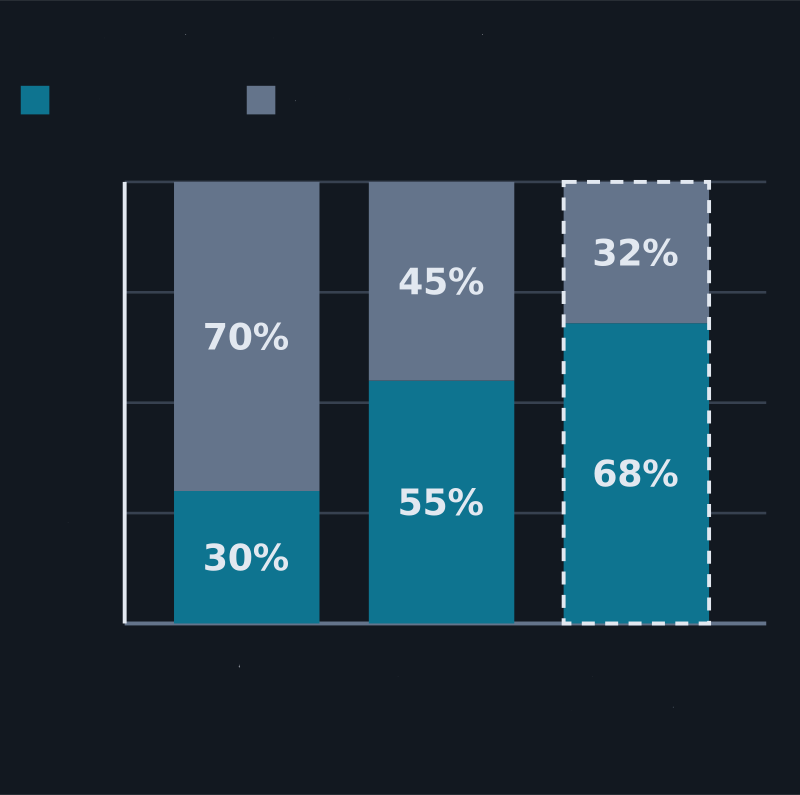
Figure 1: Urbanisation is a rising share. A bigger share of the world's people live in towns and cities each time, and the share is still projected to rise.
Source: United Nations, World Urbanization Prospects 2018. The 2050 bar is a projection.
Urbanisation is the increase in the proportion of a country's population that lives in towns and cities, rather than rural areas. Notice that it is a proportion, not an absolute number — a country's urban population can grow while its rural population also grows, but if urban areas are growing faster, urbanisation is occurring.
Two things drive urbanisation. The first is rural-to-urban migration — people physically moving from the countryside to cities. The second is natural increase — the fact that within cities, birth rates often exceed death rates, so the urban population grows even without new arrivals. In many rapidly urbanising cities, both forces are acting simultaneously, which is why growth can be so dramatic.
Why Do People Leave Rural Areas? Push Factors
No one leaves their home village because they feel like a change of scenery. They leave because something is pushing them out — making rural life difficult, insecure or unrewarding. The most powerful push factors are:
Why Do Cities Attract? Pull Factors
Push factors explain why people leave. Pull factors explain why cities specifically become the destination. The key word here is perceived — cities often appear more attractive from the outside than the reality migrants actually find. But the perception is powerful enough to drive migration regardless.
The Urbanisation Spiral
These forces combine into a self-reinforcing process. Understanding this chain is essential for exam answers:
Quick Check: Explain the difference between push factors and pull factors in rural-to-urban migration. Give two examples of each.
Push factors drive people away from rural areas — they make rural life difficult, unsafe or economically unviable. Examples: mechanisation of farming (reduces agricultural jobs); drought and desertification (crops fail, survival becomes impossible). Pull factors attract people towards cities — they make urban life appear more rewarding or secure. Examples: perceived higher wages and employment opportunities; better access to services such as hospitals and schools. It is important to use the word "perceived" for pull factors, as the reality migrants find is often much harsher than expected — many end up in informal settlements with very limited access to services.
🗺️ Where Urbanisation Is Happening — and Why the Pattern Matters
Urbanisation is not happening everywhere at the same pace. The global pattern tells a story about where in the world development is currently occurring most rapidly — and that pattern has shifted dramatically in recent decades.
High-Income Countries (HICs) — Urbanisation Already Complete
In the United Kingdom, the United States, Japan, Germany and other HICs, urbanisation largely happened during the 18th and 19th centuries, driven by the industrial revolution. In the UK, the proportion of the population living in cities went from around 20% in 1800 to over 70% by 1900. Today, 83% of the UK population is urban — this proportion is growing only very slowly. The same is true across Western Europe, North America, Japan and Australia. Urban growth in HICs is mostly a thing of the past.
Low-Income Countries and NEEs — Where Growth Is Happening Now
The fastest urbanisation in the world today is concentrated in sub-Saharan Africa and South Asia. Countries like Nigeria, Ethiopia, Democratic Republic of Congo, Bangladesh, India and Pakistan are experiencing the same transformation that Britain went through in the industrial revolution — but compressed into a far shorter timeframe, with far larger populations, and often without the equivalent infrastructure investment.
This difference in pace matters. Britain's urbanisation took over a century. Nigeria's is happening in decades. The result is that cities cannot build roads, sewers, schools and hospitals fast enough to keep up with incoming populations — which is why informal settlements grow so rapidly.
The Rise of Megacities
A megacity is defined as an urban area with a population exceeding 10 million people. In 1950, only two cities on Earth met this threshold: New York City and Tokyo. By 2020, there were over 30 megacities worldwide. And crucially, the geography of megacities has completely shifted. In 1950, the dominant megacities were in North America and Europe — the rich world. Today, the majority are in Asia, South America and Africa.
| City | Population ~1950 | Population ~2020 | World Region |
|---|---|---|---|
| Tokyo | 11.3 million | 37.4 million | East Asia (HIC) |
| New York | 12.3 million | 18.8 million | North America (HIC) |
| Delhi | 1.4 million | 30.3 million | South Asia (NEE) |
| Shanghai | 6.1 million | 27.1 million | East Asia (NEE) |
| São Paulo | 2.3 million | 22.0 million | South America (NEE) |
| Lagos | 0.3 million | ~15–21 million | West Africa (NEE) |
| Kinshasa | 0.2 million | 14.0 million | Central Africa (LIC) |
| London | 8.4 million | 9.0 million | Western Europe (HIC) |
The table tells the whole story: Delhi grew by 2,000%, Lagos by over 6,000%. London barely moved.
This shift — from European/North American megacities to Asian and African megacities — is not just a demographic curiosity. It reflects the entire arc of global development. As economic growth and industrialisation spread to South Asia and sub-Saharan Africa, the same urbanisation forces that built New York and London in the 19th century are now building Delhi and Lagos in the 21st.
🌍 Lagos, Nigeria: Africa's Megacity in Full Throttle
If you want to understand what rapid urbanisation looks like in reality — the chaos, the opportunity, the inequality, the ingenuity, the sheer overwhelming scale of it — Lagos is the place to look. There is no city on Earth quite like it.
Lagos sits on the south-west coast of Nigeria, on a peninsula and network of islands jutting into the Atlantic Ocean along the Gulf of Guinea. At independence in 1960, the city had around 760,000 people. Today, official figures put the population at around 15 million, but unofficial estimates — accounting for the millions living in informal settlements who are never counted — reach 21 million or more. Lagos is almost certainly the largest city in Africa, and one of the fastest-growing cities anywhere on Earth.
The city is Nigeria's economic capital (the political capital is Abuja, 500 km to the north), its main port, and its cultural heartland. Nigeria is Africa's most populous country with over 220 million people, and Africa's largest economy by GDP. Lagos is the engine of all of that.
Why Lagos Grew So Fast — The Causes of Its Growth
Lagos's extraordinary growth is the product of several converging forces, all acting simultaneously:
Quick Check: Explain two reasons why Lagos has grown so rapidly since 1950.
1. Rural-to-urban migration — push factors such as drought, desertification and agricultural job losses in northern Nigeria have driven millions southward to Lagos, where pull factors including employment in Nigeria's largest economy, the port, the financial sector, and perceived better services attract migrants. 2. Natural increase — Nigeria has one of the world's highest birth rates (~38–40 per 1,000), meaning the existing urban population grows rapidly from within, independently of migration. Both forces have acted simultaneously. Lagos grew from approximately 300,000 in 1950 to an estimated 15–21 million today — a 70-fold increase in 70 years.
💼 The Opportunities Urban Growth Creates in Lagos
It would be easy to describe Lagos purely through the lens of its challenges — the traffic, the flooding, the informal settlements. But that would be deeply misleading. Lagos is also a place of extraordinary energy, cultural production, technological innovation, and economic aspiration. For millions of its residents, the city genuinely represents a better life than what they left behind.
Economic Opportunities
Lagos generates approximately 25% of Nigeria's GDP despite containing only 7% of its population. This concentration of economic activity creates opportunities at every level of the income spectrum.
Nollywood — Nigeria's film industry, largely based in Lagos — produces over 2,500 films a year and generates approximately $1 billion annually, making it the second-largest film industry in the world by volume (after India's Bollywood, ahead of Hollywood). Nollywood employs hundreds of thousands of Nigerians directly and millions more indirectly, from costume-makers to cinema operators. It is also a source of enormous national pride — Nigerian stories, Nigerian faces, for Nigerian and global audiences.
Lagos is developing into a technology hub. The Yaba district — nicknamed "Yabacon Valley" — is home to hundreds of Nigerian tech start-ups developing fintech (financial technology), e-commerce, and mobile payment systems. Companies like Flutterwave and Paystack (acquired by Stripe for $200 million in 2020) have emerged from Lagos. In a country where over 40% of adults were previously unbanked, mobile banking and fintech start-ups have expanded financial inclusion dramatically. Lagos's young, ambitious population is driving a genuine tech revolution.
The Lagos Stock Exchange is sub-Saharan Africa's largest, and the city hosts the headquarters of most of Nigeria's major banks, insurance companies, and multinational offices. For workers in formal finance and business services, Lagos salaries are among the highest in Africa.
Social Opportunities
Even for Lagosians who are not working in Nollywood or tech, the city offers social improvements over rural alternatives. Lagos State has a higher density of hospitals, clinics, secondary schools, and universities than any rural area of Nigeria. Lagos University Teaching Hospital provides specialist medical care unavailable in most of Nigeria. The University of Lagos offers higher education to tens of thousands of students. For a family migrating from a remote village in Kano State where the nearest secondary school is 30 km away, Lagos represents genuine educational opportunity for their children.
Women in Lagos have access to formal employment, education, and economic independence at levels not available in many rural areas where traditional gender roles are more rigidly enforced. Urban life, for many Nigerian women, represents emancipation.
Infrastructure Improvements
Lagos State Government has invested significantly in infrastructure. The Bus Rapid Transit (BRT) system launched in 2008, now carries approximately 200,000 passengers per day along dedicated lanes that bypass normal traffic. It is one of the most successful BRT systems in Africa. The Lagos Light Rail project, under construction, will add further mass transit capacity.
The most spectacular infrastructure project is Eko Atlantic City — a land reclamation project off Victoria Island creating 10 square kilometres of new land from the Atlantic Ocean, designed to house a modern financial district and residential area for Lagos's growing middle class, while simultaneously acting as a coastal barrier against sea-level rise and erosion. It is one of the most ambitious urban development projects anywhere in the world.
⚠️ The Challenges of Rapid Urban Growth in Lagos
For all its energy and opportunity, Lagos also faces challenges that are the direct consequence of growth outstripping the infrastructure available to support it. These are not inevitable features of cities — they are the result of a city growing faster than any planned system can accommodate.
Housing and Informal Settlements
Between 60 and 70% of Lagos's population live in informal housing — dwellings built without planning permission, often from salvaged materials, without mains water or sewerage connections, and at densities far beyond what any housing code would permit. Ajegunle, Mushin, Agege, Bariga — these are neighbourhoods where entire families of six share a single room, where the narrow alleyways between dwellings never receive direct sunlight, and where landlords charge for every bucket of water because there is no running tap.
The most famous of Lagos's informal settlements — and one of the most remarkable communities anywhere on Earth — is Makoko. Built on stilts over Lagos Lagoon, Makoko is a floating community of approximately 100,000 people living in wooden houses on stakes driven into the lagoon floor. Residents fish, trade, cook, sleep, and raise children on the water. There is no mains water, no sewerage system, no formal electricity grid. Children paddle canoes to school. Waste goes directly into the water. Cholera and other waterborne diseases are a constant risk.
In 2012, Lagos State Government issued an eviction notice to Makoko, demolishing houses and displacing approximately 30,000 people in a single operation, describing the settlement as a health hazard and an obstacle to development. The evictions were immediately controversial — 30,000 people lost their homes in days, with no alternative housing provided. Makoko has since partially rebuilt. The episode illustrates the brutal tension at the heart of urban development in Lagos: the government wants a modern city; a third of its residents live in informal settlements.
Traffic and Transport
Lagos is, by most international measures, one of the worst cities in the world for traffic congestion. The Oshodi area near the central market creates gridlock that can trap vehicles for four to six hours. Workers in Lagos commonly spend three to five hours per day commuting — time that cannot be spent earning, caring for children, or sleeping. The economic cost of Lagos's congestion is estimated at over $1 billion per year in lost productivity.
The root cause is straightforward: a city that grew from 300,000 to 21 million people in 70 years, in a physical geography of narrow peninsulas and lagoon islands that makes road building difficult, and where most of that growth happened in informal settlements with no road planning. The result is a city whose road network cannot cope with its population at almost any hour of the day.
Sanitation and Water
Approximately 40% of Lagos residents lack access to safe, piped drinking water. Most of the city's informal settlements have no sewerage connection — waste goes into open drains, which empty into the lagoon and ocean. The Lagos Lagoon, which should be one of the city's great assets, receives enormous quantities of untreated sewage and industrial waste, making it one of the most polluted bodies of water in West Africa.
Cholera outbreaks occur periodically, particularly during heavy rains when flood water mixes with open drains and overwhelms the informal drainage systems. In 2021, a cholera outbreak in Lagos killed over 100 people and infected thousands. Waterborne disease disproportionately affects the poorest residents living in the most densely crowded informal settlements.
Flooding and Environmental Hazards
Lagos is one of the world's most flood-vulnerable cities. Its physical geography — low-lying, on a lagoon, adjacent to the Atlantic Ocean — makes it inherently exposed to both coastal flooding and river flooding. Victoria Island, the wealthiest part of the city, floods regularly during intense rainfall because its storm drainage system cannot handle extreme rainfall events. Climate change is making this worse: sea levels are rising, rainfall is becoming more intense, and the Atlantic coastline is eroding.
In informal settlements built on low-lying land, flooding is annual and devastating. Homes are inundated, possessions destroyed, diseases spread through flood water. Residents of Makoko experience this as a routine feature of their lives, not an exceptional disaster.
Lagos is also grappling with e-waste — electronic waste from discarded computers, phones and electrical equipment shipped illegally from Europe and North America. Agbogbloshie in Ghana is the most famous example in West Africa, but Lagos also receives significant volumes of e-waste, which is often processed by hand-burning in informal areas, releasing toxic heavy metals into the soil and air.
Inequality and Crime
Perhaps the sharpest challenge in Lagos is the coexistence of extreme wealth and extreme poverty within the same city. Victoria Island and Ikoyi — the wealthy islands at the south of the city — contain gated housing estates, luxury shopping malls, five-star hotels, and restaurants where a meal costs more than a week's wages for most Lagosians. Drive 15 minutes north across Third Mainland Bridge and you are in Mushin or Ajegunle, where open sewers run alongside unpaved alleys and a family of six shares a room the size of a large bathroom.
This inequality generates social tension. Lagos has high rates of petty crime, and armed robbery — known locally as "one-chance" schemes where taxi passengers are robbed — is a well-known risk. The wealthy response is to retreat behind ever-higher walls and hire private security, which further deepens the social distance between communities.
⛓️ The Poverty Trap — How Rapid Growth Creates a Cycle
The challenges of rapid urban growth in Lagos are not independent problems — they feed into each other in a damaging cycle that makes it very hard for the poorest residents to escape poverty.
This is not unique to Lagos — it is the defining challenge of rapid urbanisation everywhere in sub-Saharan Africa and South Asia. And it is why the geography of cities matters: physical location, infrastructure capacity, and planning decisions shape human lives and opportunities in ways that personal effort alone cannot always overcome.
⚖️ Lagos vs Bristol — NEE Megacity and HIC City Compared
OCR B Component 2 asks you to understand both a major NEE city and a major UK city. Comparing them directly makes the key differences immediately clear.
| Factor | Lagos, Nigeria (NEE) | Bristol, UK (HIC) |
|---|---|---|
| Population | ~15–21 million (estimated) | ~470,000 |
| Growth rate | ~3% per year (very rapid) | <1% per year (very slow) |
| Main driver of growth | Rural-to-urban migration + high natural increase | International in-migration + modest natural increase |
| Stage of urbanisation | Rapid urbanisation underway — still accelerating | Urbanisation complete — now urban regeneration focus |
| Main urban challenge | Informal housing; sanitation; congestion; flooding | Housing affordability; inequality between inner city and suburbs; regeneration of deindustrialised areas |
| Informal housing | 60–70% of population in informal settlements (Makoko, Ajegunle) | Minimal — most housing is formal and regulated |
| Key economic sectors | Oil; film (Nollywood); finance; tech; port; informal economy | Financial services; aerospace (Airbus); creative industries; higher education |
| Key environmental challenge | Coastal flooding; lagoon pollution; e-waste; air pollution | Air quality (traffic); River Avon flooding; brownfield land remediation |
| Government response capacity | Limited by resources; dependent on state government; international aid | High capacity; local council + central government funding; significant investment |
| Inequality | Extreme — Victoria Island luxury estates vs. Makoko stilt settlement | Significant — St Pauls/Easton deprived vs. Clifton wealthy; but less extreme than Lagos |
The fundamental difference: Lagos is managing the challenges of rapid growth in a context of limited resources. Bristol is managing the aftermath of deindustrialisation in a context of relative wealth. Both are urban challenges — but different in character, scale, and available responses.
Quick Check: Describe two challenges that rapid urban growth creates in Lagos. For each challenge, give a specific piece of evidence.
1. Housing shortage and informal settlements — Lagos cannot build formal housing fast enough to accommodate its growing population. Between 60–70% of residents live in informal settlements without planning permission, piped water, or sewerage. Makoko, a settlement of approximately 100,000 people built on stilts over Lagos Lagoon, has no mains water or sewerage connection and is at constant risk of waterborne disease. 2. Traffic congestion — Lagos is one of the world's worst cities for congestion. The narrow peninsula geography and inadequate road network mean that commuters can spend three to five hours per day travelling. Congestion costs the city an estimated $1 billion per year in lost productivity. The Oshodi area near the central market regularly sees vehicles trapped for four to six hours.
📖 Key Terms
- Urbanisation
- The increase in the proportion of a country's population living in towns and cities rather than rural areas. Driven by rural-to-urban migration and natural increase within cities. Globally, 55% of the population was urban in 2018, projected to reach 68% by 2050.
- Rural-to-urban migration
- The movement of people from rural areas (countryside, villages) to urban areas (towns, cities). The main driver of urbanisation in LICs and NEEs, triggered by a combination of push factors (poverty, job losses, drought, conflict) and pull factors (employment, services, social networks).
- Push factors
- Conditions that drive people away from their home area. Examples: agricultural job losses due to mechanisation, drought and desertification, lack of services (schools, hospitals), conflict and insecurity. Push factors make staying in rural areas economically or physically impossible.
- Pull factors
- Conditions that attract people towards a destination area. Examples: employment opportunities (even in the informal economy), better wages, access to healthcare and education, existing social networks (chain migration). Note: pull factors are often "perceived" — the reality migrants find can be harsher than expected.
- Natural increase
- Population growth resulting from birth rate exceeding death rate. In LIC and NEE cities, high natural increase adds to migration as a driver of urban growth. Nigeria's national birth rate is approximately 38–40 per 1,000, one of the world's highest.
- Megacity
- An urban area with a total population exceeding 10 million people. In 1950 only two megacities existed (New York, Tokyo). By 2020, over 30 megacities exist, the majority in Asia, South America and Africa — reflecting where rapid urbanisation is currently occurring.
- Informal settlement (squatter settlement)
- Housing built without planning permission, usually from salvaged or low-cost materials, without legal land tenure, and often without access to mains water, sewerage or electricity. In Lagos, 60–70% of the population lives in informal settlements. Also called squatter settlements or (in Brazil) favelas.
- Desertification
- The process by which fertile land becomes desert, typically as a result of drought, deforestation, or inappropriate agriculture. In the Sahel region of Nigeria, desertification is advancing the Sahara southward, destroying agricultural livelihoods and acting as a powerful push factor for migration to Lagos.
- Eko Atlantic
- A major land reclamation project off Victoria Island, Lagos, creating 10 sq km of new land from the Atlantic Ocean. Designed to provide a new financial district and residential area, while acting as a coastal barrier against sea-level rise. One of Africa's largest urban development projects.
- BRT (Bus Rapid Transit)
- A high-capacity bus system that runs along dedicated lanes, separated from normal traffic, with frequent services and modern stations. Lagos's BRT, launched 2008, carries approximately 200,000 passengers daily and is one of the most successful in Africa.
⚠️ Common Misconceptions
Misconception 1: "Urbanisation is just about people moving to cities."
Urbanisation is the increase in the proportion of people living in cities. It has two distinct drivers: rural-to-urban migration (people moving in) AND natural increase (more births than deaths within the city itself). In many rapidly growing cities like Lagos, natural increase is now as significant as migration. A student who only mentions migration will miss marks on a "why do cities grow?" question.
Misconception 2: "Lagos is just a city of poverty and problems."
Lagos is simultaneously one of Africa's most challenging and most exciting cities. Exam mark schemes specifically reward balanced answers that acknowledge both opportunities and challenges. Lagos generates 25% of Nigeria's GDP, hosts Africa's largest stock exchange, produces $1 billion per year of film through Nollywood, and is developing into a tech hub (Yabacon Valley). Answers that treat Lagos as purely problematic will not reach the top mark band. The skill is recognising both sides and then making a supported judgement.
Misconception 3: "Informal settlements are just slums — dirty and dangerous."
This framing misses geography's central insight about informal settlements. They are the result of people doing the best they can within constraints set by rapid urban growth and inadequate infrastructure — not evidence of failure or disorder. Makoko, for example, is a complex, functional community with its own economy, social networks, schools, and cultural life, built on the water because that was the only available space. The challenge is inadequate sanitation and insecurity of tenure, not the people themselves. Geography rewards analytical answers that understand structural causes, not moral judgements about residents.
Misconception 4: "Urbanisation in LICs and NEEs is the same as it was in Victorian Britain."
There are similarities — rapid rural-to-urban migration driven by agricultural change and industrial pull factors — but also crucial differences. The rate is much faster today (Britain's urbanisation took a century; Nigeria's is happening in decades). The population base is much larger. And Victorian Britain's industrial revolution was generating formal employment on a large scale; today's urban growth in LICs often outstrips formal employment creation, pushing people into the informal economy. The challenges are therefore more acute than Victorian Britain faced, even though the fundamental process is similar.
🧠 Remember Lagos With TOSH + OPEN
Two mnemonics to organise your Lagos knowledge for the exam.
TOSH — The Four Challenges of Rapid Urban Growth in Lagos:
- T — Traffic — some of the worst congestion on Earth; 3–5 hours commuting per day; $1bn/year productivity loss
- O — Overcrowding and informal housing — 60–70% in informal settlements; Makoko (100,000 on stilts); 30,000 evicted 2012
- S — Sanitation and water — 40% lack clean water; open drains; cholera outbreaks; lagoon pollution
- H — Hazards (flooding and environment) — Victoria Island floods; sea-level rise; e-waste; coastal erosion
OPEN — The Four Opportunities Urban Growth Creates in Lagos:
- O — One billion dollars — Nollywood generates $1bn/year; world's second-largest film industry
- P — Port and finance — Africa's largest stock exchange; leading financial centre; major port
- E — Education and services — Lagos University; teaching hospitals; far better access than rural Nigeria
- N — New tech (Yabacon Valley) — Flutterwave, Paystack; fintech revolution; 200,000 BRT passengers/day
In the exam, TOSH gives you your challenges; OPEN gives you your opportunities. A balanced 8-mark answer uses both.
Push and Pull — remember the key distinction: Push factors are about what you're escaping from (drought, job losses, conflict). Pull factors are about what you're drawn towards (wages, services, networks). Push comes first in time — something has to make you leave before you decide where to go.
🎯 Exam Connection — Urban World
Frequency: This topic appears in every OCR B Component 2 Paper 2 sitting. Urban Futures is one of the two compulsory themes for OCR B. For AQA, urban issues is a compulsory unit. For Edexcel (1GA0 Paper 1, Component 3: Diverse Places), urban growth and urbanisation is core examined content. This is non-optional content for virtually all GCSE Geography students.
Typical question formats:
- "Define the term megacity." (1 mark)
- "Explain why cities in LICs/NEEs are growing rapidly." (4 marks)
- "Using a named example, describe the opportunities created by urban growth." (4 marks)
- "Explain the challenges that rapid urban growth creates in a city you have studied." (6 marks)
- "'Urban growth in LICs/NEEs creates more challenges than opportunities.' Assess this statement with reference to a named city." (8 marks)
- "Compare the challenges of urban growth in a NEE city with those of a HIC city." (6 marks)
Level 1 → 2 → 3 progression for the 8-mark 'assess' question:
"Lagos has lots of challenges. There are traffic jams and informal housing. But it also has opportunities like Nollywood. So it creates both."
Why this fails: No specific evidence. No cause-and-effect reasoning. No judgement about which outweighs the other.
"Urban growth in Lagos has created significant challenges. Around 60–70% of the population lives in informal settlements without mains water or sanitation — for example, Makoko, a community of 100,000 people living on stilts in Lagos Lagoon. However, there are also opportunities — Nollywood generates $1 billion annually and employs hundreds of thousands. Lagos also has Africa's largest stock exchange."
Why this is better: Specific evidence and figures used. Both sides addressed. Still missing: cause-effect chains and a supported overall judgement.
"Urban growth in Lagos has created serious challenges, many of which fall disproportionately on the poorest residents. Rapid rural-to-urban migration has overwhelmed housing capacity, leaving an estimated 60–70% of the population in informal settlements without sewerage or clean water — 40% of Lagosians lack access to safe piped water. This leads directly to cholera outbreaks (most recently 2021, 100+ deaths) and reduces productivity through illness. Meanwhile, traffic congestion (estimated cost: $1 billion per year in lost productivity) is worsened by the city's narrow peninsula geography and informal settlement patterns that pre-date any road planning.
However, the same growth has created genuine economic and social opportunity. Nollywood generates $1 billion annually; Yabacon Valley tech start-ups like Flutterwave are transforming financial inclusion; and for migrants from rural Nigeria, Lagos's hospitals and schools represent an access to services simply unavailable in their communities of origin.
Overall, I would argue that urban growth has created more challenges than opportunities, but this depends significantly on which residents you are examining. For those in Victoria Island's gated communities, growth has been enormously beneficial. For those in Makoko, the challenges clearly dominate. This inequality — not just the absolute challenges — is arguably the most significant consequence of rapid urban growth in Lagos."
Why this reaches Level 3: Cause-effect chains ('migration → overwhelmed housing → no sanitation → disease → productivity loss'). Specific named evidence throughout. Balanced. Supported overall judgement that acknowledges complexity.
💡 Exam Tips for Urban World
🎯 Common Question Types:
- "Explain why cities grow rapidly in LICs/NEEs" (4–6 marks) — always include both migration AND natural increase
- "Using a named city, assess the challenges of urban growth" (6–8 marks) — always name Lagos and use specific evidence
- "Compare the challenges in a NEE city with a HIC city" (4–6 marks) — use the Lagos vs Bristol contrast
- "Define megacity / urbanisation / push factor" (1 mark) — learn precise definitions
📝 Key Command Words:
- Define: Give a precise one-sentence definition using key geographical terminology.
- Explain: Give reasons using cause-and-effect language — "this leads to...", "because of this..."
- Describe: State what something is like — use evidence and named examples.
- Assess/Evaluate: Weigh both sides, reach a supported judgement. "Overall I argue that... because..."
- Compare: Identify both similarities AND differences — use words like "whereas", "in contrast", "similarly".
⚠️ Common Mistakes to Avoid:
- Forgetting natural increase — many students only mention migration as a cause of urban growth and miss an easy mark point.
- Writing only about challenges — examiners want balanced answers. OPEN + TOSH gives you both sides.
- Vague references — "Lagos has poverty" scores no marks. "40% of Lagos residents lack access to safe piped water" scores marks.
- Listing without linking — don't just list challenges one after another. Show how they connect: housing shortage → no sanitation → disease → reduced productivity.
- Forgetting the judgement at the end of 8-mark answers — state which side you think outweighs the other and why.
- Saying "pull factors are good things and push factors are bad things" — this is oversimplified. Push factors are reasons to leave; pull factors are reasons to go towards a specific place. Both can involve positive or negative motivations.
Quick Check: Write a Level 2 paragraph evaluating whether urban growth in Lagos creates more opportunities than challenges. Include at least two specific pieces of evidence.
Model Level 2 answer: "Urban growth in Lagos has created significant economic and social opportunities. Nollywood, Nigeria's film industry largely based in Lagos, generates approximately $1 billion annually and employs hundreds of thousands of people. Lagos also hosts Africa's largest stock exchange and is developing a tech sector in Yaba district, known as 'Yabacon Valley'. These opportunities have helped Lagos generate 25% of Nigeria's GDP with only 7% of its population. However, rapid growth has also created serious challenges. An estimated 60–70% of Lagos residents live in informal settlements without reliable access to clean water or sanitation, which has led to cholera outbreaks. Extreme traffic congestion costs the city $1 billion a year in lost productivity. Overall, whilst growth has created real opportunities, the challenges are borne disproportionately by the poorest residents, suggesting that growth has been highly unequal in its impact." — To upgrade to Level 3: add a cause-effect chain (e.g. rapid migration → informal housing → no sanitation → disease → reduced productivity) and a clearer final judgement about which side outweighs the other.
Make this stick
Signing in gives access to all PrepWise features.