AQA GCSE Mathematics Paper 3Calculator (Higher Tier): every question, answered
AQA GCSE Mathematics (8300) Higher Tier Paper 3 is the final calculator paper of the three. We analysed every sitting we could obtain the real question paper and mark scheme for: June 2018, June 2019, June 2022 and June 2023 (June 2020 and June 2021 do not exist as normal exam sittings, since GCSE exams were cancelled in both years because of the pandemic). Paper 3 covers the same broad spread of number, algebra, ratio, geometry, probability and statistics skills as Paper 2, and a calculator being allowed still does not mean working can be skipped: the real mark schemes below repeatedly withhold method marks from students who show no working, even when a calculator got them to the right number. Below is what each recurring skill has actually asked across the four sittings we have, with a complete worked answer written to the mark scheme for each one, every paragraph explained.
Questions © AQA, quoted for analysis. Diagrams and figures described or recreated in our own words, not reproduced verbatim. Mark scheme content translated into plain English, not copied. PrepWise is independent and not endorsed by AQA.
The paper is a template
Same 20 question types, every sitting“Two of the four sittings we have full papers for present two different growth offers side by side and ask which one is actually worth more, or whether a claim about them is true.”
Each version needs both offers calculated in full using their own separate growth rules, then compared numerically, either finding exactly how many pounds more one option is worth (June 2018) or testing whether a claim that two different interest structures give the same result is actually true (June 2019).
1×asked“Investment A: save £150 every month for 2 years, then 2.5% interest is added to the total amount saved. Investment B: invest £3500 at 3% compound interest per year. After 2 years, how much more is Investment B worth than Investment A? [4 marks]”
“Investment A: save £150 every month for 2 years, then 2.5% interest is added to the total amount saved. Investment B: invest £3500 at 3% compound interest per year. After 2 years, how much more is Investment B worth than Investment A? [4 marks]”
What it’s really asking
Work out Investment A's total by adding up the monthly savings and applying the one-off interest, work out Investment B's total using compound interest over 2 years, then subtract to find the difference.
The full worked answer — June 2018
Investment A is saved over 2 years at £150 a month, which is 24 months, giving a total saved of 24 times £150, which is £3600. Adding the one-off 2.5% interest to this total, £3600 times 1.025, gives a final value of £3690 for Investment A.
Investment B grows by compound interest at 3% a year. After 2 years, its value is £3500 times 1.03 squared, which is £3500 times 1.0609, giving a final value of £3713.15 for Investment B.
The difference between the two investments is £3713.15 minus £3690, which is £23.15. Investment B is worth £23.15 more than Investment A after 2 years.
Could you have written this? Every fact in this answer is drilled in our quizzes — the writing is the easy part once the evidence is automatic.
Practise compound interest questionsWhat the mark scheme rewarded
- 1 mark for a correct method reaching £3690 or an equivalent value for Investment A, 1 mark for a correct method reaching Investment B's value after 1 year, 1 mark (dependent) for extending this to Investment B's value after 2 years, and 1 mark for the final difference, £23.15.
- Investment A's growth is a one-off percentage increase applied to a fixed total saved, not compound interest, since the interest is only added once at the end
- Investment B's compound growth over 2 years is found by multiplying by 1.03 squared, not by multiplying the single-year rate by 2, since interest is earned on the interest already added in year 1
Traps examiners saw
- Applying 2.5% interest to each monthly payment separately instead of to the final total of £3600 saved
- Doubling the 3% rate to get 6% for 2 years, instead of squaring the growth multiplier 1.03
Full-mark self-check 0 of 3
1×asked“Mia wants to borrow £6000 and repay it, with interest, after 2 years. Offer 1: compound interest at 3% per year. Offer 2: compound interest at 1% in the first year and 5% in the second year. Mia says she will pay back the same amount with each offer, because the average of 1% and 5% is 3%. Is she correct? [3 marks]”
“Mia wants to borrow £6000 and repay it, with interest, after 2 years. Offer 1: compound interest at 3% per year. Offer 2: compound interest at 1% in the first year and 5% in the second year. Mia says she will pay back the same amount with each offer, because the average of 1% and 5% is 3%. Is she correct? [3 marks]”
What it’s really asking
Work out the total repayment under each offer separately, using compound interest for both, then compare the two totals to see whether Mia's claim that averaging the rates gives the same answer is actually true.
The full worked answer — June 2019
Under Offer 1, £6000 grows by 3% compound interest for 2 years, giving £6000 times 1.03 squared, which is £6000 times 1.0609, equal to £6365.40.
Under Offer 2, £6000 grows by 1% in the first year and then 5% in the second year, giving £6000 times 1.01 times 1.05, equal to £6363.
Since £6365.40 is not equal to £6363, the two offers do not give the same repayment amount, so Mia is not correct.
Could you have written this? Every fact in this answer is drilled in our quizzes — the writing is the easy part once the evidence is automatic.
Practise compound interest questionsWhat the mark scheme rewarded
- 1 mark for a correct method reaching £6365.40 (or an equivalent unrounded value) for Offer 1, 1 mark (dependent) for a correct method reaching £6363 for Offer 2, and 1 mark for correctly concluding that the two amounts are different, so Mia is not correct.
- Compound interest at a single fixed rate over 2 years is found by squaring the growth multiplier, so Offer 1 is £6000 times 1.03 squared
- Averaging two different percentage rates and applying the average once does not give the same result as applying each rate separately, since compound growth is multiplicative, not additive, across years
Traps examiners saw
- Assuming Mia's reasoning about averaging the rates must be correct without actually calculating both totals
- Working out simple interest instead of compound interest for either offer
Full-mark self-check 0 of 3
The method for every Q7 (Jun18) / Q10 (Jun19) — same every sittingMark bands, steps, timing
What this question type rewards
The topic changes by sitting — the mark scheme never does. Learn this once, then open your question above for that sitting’s sources and a full worked answer.
- Calculating each offer's own total correctly using its own separate growth rule
- Applying compound interest correctly across more than one year by multiplying by the same growth factor once per year
- Reaching a genuine numerical comparison between the two totals and stating the correct conclusion
The steps
- Work out the first offer's final total using its own stated growth rule
- Work out the second offer's final total, applying compound growth once for each year separately
- Compare the two totals and state which is greater, by how much, or whether a claim about them is true
Which formula correctly calculates the amount A after compound interest at rate r% per year for n years on principal P?
Comparing two growth offers using compound interest comes up in two of the four sittings we have. Practise applying a compound growth multiplier separately for each year, never by averaging rates.
Practise compound interest questions“Two of the four sittings we have full papers for ask for a single percentage change to be applied repeatedly over several years to find a future value.”
Each version applies the same growth or decay multiplier once per year for several years in a row, either building up a savings account from a known first year's growth (June 2022) or reducing a population by the same percentage every year for five years (June 2023).
1×asked“£2448 is invested in an account at a rate of compound interest. One year after the investment there is £2496.96 in the account. How much is in the account four years after the investment? [3 marks]”
“£2448 is invested in an account at a rate of compound interest. One year after the investment there is £2496.96 in the account. How much is in the account four years after the investment? [3 marks]”
What it’s really asking
Work out the yearly growth multiplier from the amount after 1 year, then apply that same multiplier four times over to find the amount after 4 years.
The full worked answer — June 2022
Dividing the amount after 1 year by the starting amount, £2496.96 divided by £2448, gives a yearly multiplier of 1.02, so the account grows by 2% each year.
Applying this multiplier four times, £2448 times 1.02 to the power of 4, gives £2448 times 1.08243216.
This gives a final value of £2649.79 in the account four years after the investment.
Could you have written this? Every fact in this answer is drilled in our quizzes — the writing is the easy part once the evidence is automatic.
Practise growth and decay questionsWhat the mark scheme rewarded
- 1 mark for correctly finding the yearly multiplier, 1.02, 1 mark (dependent) for a full method that raises this multiplier to the power of 4, and 1 mark for the final value, £2649.79 (accept values between £2649.77 and £2649.79).
- A single year's growth reveals the yearly multiplier directly, by dividing the new amount by the starting amount
- Compound growth across n years means raising the yearly multiplier to the power of n, not multiplying the percentage rate by n
Traps examiners saw
- Multiplying the 2% rate by 4 to get 8%, then applying that as a single increase, instead of raising 1.02 to the power of 4
- Using £2496.96 as the starting value for all four years, instead of the original £2448
Full-mark self-check 0 of 3
1×asked“The number of hedgehogs in England is expected to reduce by 4% each year. Assuming there are now 1,000,000 hedgehogs in England, work out the expected number of hedgehogs in England after five years. [3 marks]”
“The number of hedgehogs in England is expected to reduce by 4% each year. Assuming there are now 1,000,000 hedgehogs in England, work out the expected number of hedgehogs in England after five years. [3 marks]”
What it’s really asking
Work out the yearly decay multiplier for a 4% reduction, then apply it five times over to find the population after five years.
The full worked answer — June 2023
A 4% reduction each year means the population is multiplied by 1 minus 0.04, which is 0.96, every year.
Applying this multiplier five times, 1,000,000 times 0.96 to the power of 5, gives 1,000,000 times 0.8153726976.
This gives an expected population of approximately 815,373 hedgehogs after five years.
Could you have written this? Every fact in this answer is drilled in our quizzes — the writing is the easy part once the evidence is automatic.
Practise growth and decay questionsWhat the mark scheme rewarded
- 1 mark for correctly finding the yearly multiplier, 0.96, from the 4% reduction, 1 mark (dependent) for a full method that raises this multiplier to the power of 5, and 1 mark for a final value in the range 800,000 to 820,000 (a more precise value is approximately 815,373).
- A repeated percentage decrease of r% each year means multiplying by (1 minus r divided by 100) once per year, raised to the power of the number of years
- Reducing the original total by 4% five separate times (5 times 4% equals 20%) is not the same as five separate compound reductions, since each year's 4% is taken from a smaller starting amount
Traps examiners saw
- Subtracting 20% (5 times 4%) from the original total in one step, instead of applying 0.96 five separate times
- Rounding the multiplier or an intermediate year's population too early, which AQA's mark schemes generally penalise as premature approximation
Full-mark self-check 0 of 3
The method for every Q20 (Jun22) / Q5 (Jun23) — same every sittingMark bands, steps, timing
What this question type rewards
The topic changes by sitting — the mark scheme never does. Learn this once, then open your question above for that sitting’s sources and a full worked answer.
- Identifying the correct single-year growth or decay multiplier from the given information
- Applying that multiplier the correct number of times by raising it to a power, not by multiplying by the number of years
- Reaching the correct final value to an appropriate degree of accuracy
The steps
- Work out the single-year multiplier from the given rate of increase or decrease
- Raise the multiplier to the power of the number of years that have passed
- Multiply the starting value by this result to find the final value
A quantity increases by 8% each year. Which multiplier should be used for each year?
Applying a repeated percentage change over several years comes up in two of the four sittings we have. Practise raising the yearly multiplier to the correct power, never multiplying the rate by the number of years.
Practise growth and decay questions“Three of the four sittings we have full papers for give a histogram and ask for a frequency, a missing total, or a scaled-up estimate to be worked out from it.”
Each version needs frequency density multiplied by class width to recover a frequency, either finding the number of cars in one bar when the vertical scale itself is missing (June 2018), estimating how many items fall below a value that sits partway through a bar (June 2022), or subtracting an estimated total from a known overall total (June 2023).
1×asked“A histogram shows the speeds of 480 cars passing a checkpoint, grouped into three classes. The scale on the frequency density axis is missing. How many cars does the first bar represent? [4 marks]”
“A histogram shows the speeds of 480 cars passing a checkpoint, grouped into three classes. The scale on the frequency density axis is missing. How many cars does the first bar represent? [4 marks]”
What it’s really asking
Use the fact that the three bars' frequencies must add up to 480 cars to work out the actual, unscaled frequency density values, then apply frequency density times class width to the first bar alone.
What the sources actually showed — June 2018
A histogram with three bars showing speed in mph on the horizontal axis, confirmed against the real diagram: axis marked at 0, 15, 20, 25, 30, 35, 40, 45 and 50 mph. The frequency density axis has no scale marked on it. The three bars span 15 to 30 mph, 30 to 35 mph and 35 to 50 mph, with unscaled bar heights of 5, 6.6 and 0.8 units respectively. The histogram represents 480 cars in total.
| Bar | Class width (mph) | Unscaled height (before recovering the true scale) |
|---|---|---|
| First bar | 15 | 5 |
| Second bar | 5 | 6.6 |
| Third bar | 15 | 0.8 |
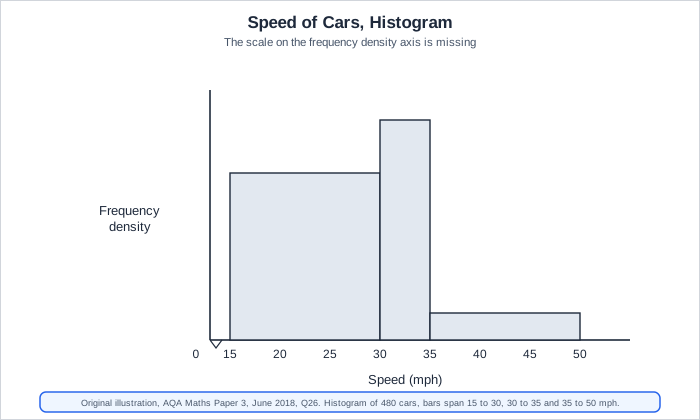
The full worked answer — June 2018
If the missing scale factor is x, the three bars represent 5x times 15, 6.6x times 5, and 0.8x times 15 cars, which simplify to 75x, 33x and 12x. Adding these together, 75x plus 33x plus 12x equals 120x.
Since the three bars must represent all 480 cars, 120x equals 480, so x equals 4. The true frequency density of the first bar is therefore 5 times 4, which is 20.
The first bar's frequency is its frequency density multiplied by its class width, 20 times 15, which is 300 cars.
Could you have written this? Every fact in this answer is drilled in our quizzes — the writing is the easy part once the evidence is automatic.
Practise histogram questionsWhat the mark scheme rewarded
- 1 mark for expressing each bar's frequency in terms of an unknown scale factor, 1 mark (dependent) for setting the sum of all three bars equal to 480 and solving for the scale factor, 1 mark (dependent) for applying frequency density times class width to the first bar with the recovered scale, and 1 mark for the final frequency, 300.
- Frequency equals frequency density multiplied by class width for every bar of a histogram, whether or not the vertical scale is actually marked
- When a frequency density scale is missing, every bar's frequency can still be expressed as a multiple of the same unknown scale factor, which can then be solved for using a known overall total
Traps examiners saw
- Treating the unscaled bar heights, 5, 6.6 and 0.8, as if they were already the true frequency densities, without recovering the missing scale factor first
- Adding the three unscaled heights directly instead of multiplying each one by its own class width before adding
Full-mark self-check 0 of 3
1×asked“A company makes tubes of toothpaste. The masses of 80 tubes are checked and a histogram is drawn to represent the data. The company makes 28,000 tubes each day. Estimate how many tubes each day have a mass less than 122 grams. [4 marks]”
“A company makes tubes of toothpaste. The masses of 80 tubes are checked and a histogram is drawn to represent the data. The company makes 28,000 tubes each day. Estimate how many tubes each day have a mass less than 122 grams. [4 marks]”
What it’s really asking
Add up the frequencies of every bar entirely below 122 grams, then add only the correct proportion of the one bar that 122 grams falls inside, and finally scale the resulting sample estimate up from 80 tubes to 28,000 tubes.
What the sources actually showed — June 2022
A histogram showing the masses, in grams, of 80 sampled tubes of toothpaste, confirmed against the real diagram: axis marked at 0, 110, 120, 130, 140 and 150 grams, frequency density axis marked 0 to 8. Four unequal-width classes: 110 to 120 g with frequency density 0.6, 120 to 125 g with frequency density 4, 125 to 130 g with frequency density 7.6, and 130 to 140 g with frequency density 1.6.
| Class (g) | Class width (g) | Frequency density |
|---|---|---|
| Up to 120 | 10 | 0.6 |
| 120 to 125 | 5 | 4 |
| 125 to 130 | 5 | 7.6 |
| 130 to 140 | 10 | 1.6 |
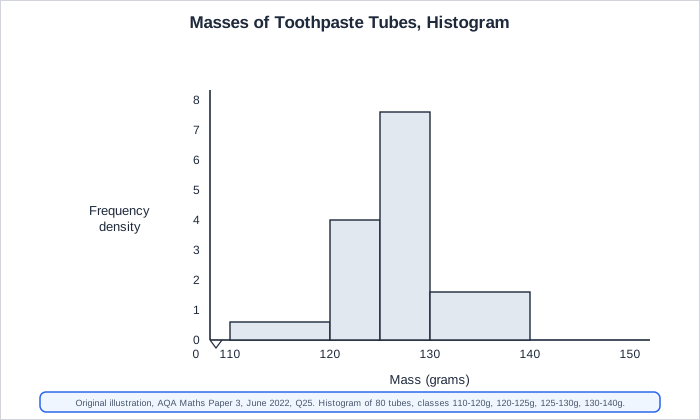
The full worked answer — June 2022
The class below 120 g has frequency density 0.6 and width 10 g, giving a frequency of 0.6 times 10, which is 6 tubes. This whole class is entirely below 122 g, so all 6 tubes count.
The next class, from 120 g to 125 g, has frequency density 4. Only the first 2 g of this 5 g wide class, up to 122 g, should be counted, giving 2 times 4, which is 8 tubes.
Adding these together, 6 plus 8 gives 14 tubes out of the sample of 80 with a mass below 122 g. Scaling this up to the full daily production, 14 divided by 80, multiplied by 28,000, gives an estimate of 4900 tubes each day.
Could you have written this? Every fact in this answer is drilled in our quizzes — the writing is the easy part once the evidence is automatic.
Practise histogram questionsWhat the mark scheme rewarded
- 1 mark for a correct frequency from any one relevant class, 1 mark (dependent) for correctly combining the fully-below class and the correct proportion of the partly-below class to reach 14, 1 mark (dependent) for a full method scaling 14 out of 80 up to 28,000, and 1 mark for the final estimate, 4900.
- When a target value sits partway through a class, only the matching proportion of that class's width should be counted, found using its own frequency density
- Scaling a sample estimate up to a larger population is done by finding the sample proportion first, then multiplying that proportion by the larger total
Traps examiners saw
- Counting the whole 120 g to 125 g class, all 20 tubes, instead of only the 2 g worth that falls below 122 g
- Scaling up using the wrong sample size, for example dividing by the total number of classes instead of the total number of tubes sampled, 80
Full-mark self-check 0 of 3
1×asked“180 runners started a marathon. Some did not complete it. A histogram represents the times of the runners who did complete the marathon, grouped into five unequal-width classes. How many runners did not complete the marathon? [3 marks]”
“180 runners started a marathon. Some did not complete it. A histogram represents the times of the runners who did complete the marathon, grouped into five unequal-width classes. How many runners did not complete the marathon? [3 marks]”
What it’s really asking
Add up the frequency of every bar in the histogram to estimate how many runners completed the marathon, then subtract this from the 180 runners who started to find how many did not finish.
What the sources actually showed — June 2023
A histogram showing the completion times, in minutes, of the runners who finished the marathon, confirmed against the real diagram: axis marked at 0, 140, 160, 180, 220, 260 and 320 minutes, frequency density axis marked 0 to 2.0. Five unequal-width classes: 140 to 160 with frequency density 0.8, 160 to 180 with frequency density 1.8, 180 to 220 with frequency density 1.2, 220 to 260 with frequency density 0.7, and 260 to 320 with frequency density 0.4.
| Class width (minutes) | Frequency density |
|---|---|
| 20 | 0.8 |
| 20 | 1.8 |
| 40 | 1.2 |
| 40 | 0.7 |
| 60 | 0.4 |
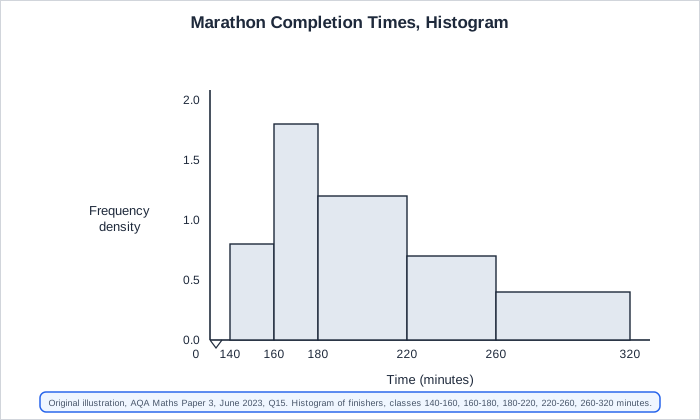
The full worked answer — June 2023
Working out frequency density times class width for each of the five bars gives frequencies of 16, 36, 48, 28 and 24 runners.
Adding these five frequencies together, 16 plus 36 plus 48 plus 28 plus 24, gives an estimated total of 152 runners who completed the marathon.
Since 180 runners started the marathon, the number who did not complete it is 180 minus 152, which is 28 runners.
Could you have written this? Every fact in this answer is drilled in our quizzes — the writing is the easy part once the evidence is automatic.
Practise histogram questionsWhat the mark scheme rewarded
- 1 mark for any one bar's correct frequency, 1 mark (dependent) for the sum of all five bars, 152, allowing one error or omission, and 1 mark for the final answer, 28.
- A histogram of only the runners who finished does not include the runners who did not finish, so its total must be subtracted from the known number of starters, not treated as the full 180
- Every bar's frequency must be found separately using its own frequency density and class width before the bars can be added together
Traps examiners saw
- Treating the histogram's total, 152, as if it already represented all 180 runners, and forgetting to subtract
- Making an arithmetic slip in one bar's frequency and not checking that the final total is sensible against 180
Full-mark self-check 0 of 3
The method for every Q26 (Jun18) / Q25 (Jun22) / Q15a (Jun23) — same every sittingMark bands, steps, timing
What this question type rewards
The topic changes by sitting — the mark scheme never does. Learn this once, then open your question above for that sitting’s sources and a full worked answer.
- Knowing that frequency equals frequency density multiplied by class width for every bar
- Correctly finding a partial frequency when a target value sits partway through a bar, not just at a bar's own boundary
- Combining every relevant bar's frequency correctly to reach the frequency, total, or scaled estimate that the question actually asks for
The steps
- Work out the frequency of each relevant bar as frequency density multiplied by class width
- If the value needed falls partway through a bar, use only the matching proportion of that bar's width
- Add or subtract the frequencies found to answer exactly what the question asks, scaling up if a larger population is involved
A histogram shows the heights (cm) of plants in a garden with the following frequency densities: - 0 =< h < 5: frequency density = 4 - 5 =< h < 15: frequency density = 3 - 15 =< h < 25: frequency density = 6 - 25 =< h < 40: frequency density = 2 What is the modal class?
Using a histogram to estimate a frequency comes up in three of the four sittings we have. Practise multiplying frequency density by class width, including when a value cuts through the middle of a bar.
Practise histogram questions“Two of the four sittings we have full papers for give summary statistics and ask for a full box plot to be constructed from them.”
Each version needs the five box plot values, the lowest value, the lower quartile, the median, the upper quartile and the highest value, worked out and then drawn accurately, either building some of the values from a second data set's own box plot (June 2022) or reading every value directly from a table (June 2023).
1×asked“Students in two classes, A and B, raised money for charity. The box plot for Class A is already shown on a grid. For Class B: the lowest amount was £3 and the highest amount was £26, the lower quartile was £11, the median was £2 greater than the Class A median, and the interquartile range was 1.5 times greater than the Class A interquartile range. Draw the box plot for Class B on the grid. [4 marks]”
“Students in two classes, A and B, raised money for charity. The box plot for Class A is already shown on a grid. For Class B: the lowest amount was £3 and the highest amount was £26, the lower quartile was £11, the median was £2 greater than the Class A median, and the interquartile range was 1.5 times greater than the Class A interquartile range. Draw the box plot for Class B on the grid. [4 marks]”
What it’s really asking
Read the Class A median and interquartile range from the already-drawn box plot, use them to work out the Class B median and upper quartile, then draw a complete box plot for Class B using all five values.
What the sources actually showed — June 2022
A grid with a money scale from £0 to £30, showing the Class A box plot already drawn, confirmed against the real diagram: lowest value £5, lower quartile £9, median £12, upper quartile £17, highest value £22 (interquartile range £8).
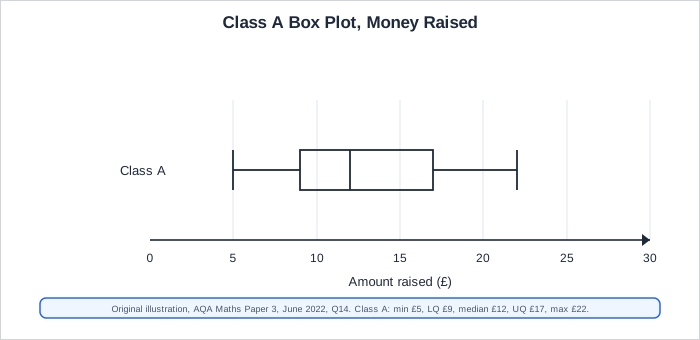
The full worked answer — June 2022
Class B's median is £2 more than the Class A median of £12, giving a Class B median of £14.
Class B's interquartile range is 1.5 times the Class A interquartile range of £8, giving £12. Since the lower quartile is given as £11, the upper quartile is £11 plus £12, which is £23.
The Class B box plot has whiskers running from £3 to £26, a box drawn from the lower quartile of £11 to the upper quartile of £23, with a line inside the box at the median, £14.
Could you have written this? Every fact in this answer is drilled in our quizzes — the writing is the easy part once the evidence is automatic.
Practise box plot questionsWhat the mark scheme rewarded
- 1 mark for a rectangular box plot with whiskers running to £3 and £26, 1 mark for the lower quartile line at £11, 1 mark for the median line at £14, and 1 mark (follow-through, based on the student's own lower quartile plus £12) for the upper quartile line.
- The upper quartile is not always given directly; it can be found by adding the lower quartile to the interquartile range
- A relationship stated relative to a second data set, such as £2 more or 1.5 times greater, must be applied to the first data set's own actual value, read from its box plot, not guessed
Traps examiners saw
- Drawing the box using the interquartile range as if it were the upper quartile itself, instead of adding it to the lower quartile
- Misreading Class A's median or interquartile range from the grid before applying the given relationships
Full-mark self-check 0 of 3
1×asked“180 runners started a marathon and some did not complete it. The table gives summary statistics for the runners who did not complete: least distance run 5 miles, greatest distance run 23 miles, lower quartile 11 miles, median 18 miles, interquartile range 9 miles. Draw a box plot to represent this information. [3 marks]”
“180 runners started a marathon and some did not complete it. The table gives summary statistics for the runners who did not complete: least distance run 5 miles, greatest distance run 23 miles, lower quartile 11 miles, median 18 miles, interquartile range 9 miles. Draw a box plot to represent this information. [3 marks]”
What it’s really asking
Work out the upper quartile by adding the lower quartile and the interquartile range, then draw all five box plot values, the two whiskers, the box and the median line, accurately on a grid.
What the sources actually showed — June 2023
A table recreated from the real data, giving the least distance, greatest distance, lower quartile, median and interquartile range for the distances run by the marathon runners who did not complete the race.
| Statistic | Distance (miles) |
|---|---|
| Least distance | 5 |
| Greatest distance | 23 |
| Lower quartile | 11 |
| Median | 18 |
| Interquartile range | 9 |
The full worked answer — June 2023
The interquartile range is the upper quartile minus the lower quartile. Since the interquartile range is 9 miles and the lower quartile is 11 miles, the upper quartile is 11 plus 9, which is 20 miles.
The box plot has whiskers running from the least distance, 5 miles, to the greatest distance, 23 miles, with a box drawn from the lower quartile, 11 miles, to the upper quartile, 20 miles, and a line inside the box at the median, 18 miles.
Could you have written this? Every fact in this answer is drilled in our quizzes — the writing is the easy part once the evidence is automatic.
Practise box plot questionsWhat the mark scheme rewarded
- 1 mark for a rectangular box plot with whiskers running to 5 and 23, 1 mark for the lower quartile line at 11 and the median line at 18, and 1 mark (follow-through, based on the student's own lower quartile plus 9) for the upper quartile line at 20.
- The interquartile range is defined as the upper quartile minus the lower quartile, so the upper quartile can always be recovered by adding the interquartile range to the lower quartile
- All five box plot values, the lowest value, the lower quartile, the median, the upper quartile and the highest value, must be drawn accurately for full marks, not just the three given directly in the table
Traps examiners saw
- Drawing the upper quartile at 9 miles, mistaking the interquartile range itself for the upper quartile's actual position
- Placing the median line outside the box, rather than between the lower and upper quartiles
Full-mark self-check 0 of 3
The method for every Q14 (Jun22) / Q15b (Jun23) — same every sittingMark bands, steps, timing
What this question type rewards
The topic changes by sitting — the mark scheme never does. Learn this once, then open your question above for that sitting’s sources and a full worked answer.
- Correctly identifying or working out all five values needed for a box plot: the lowest value, the lower quartile, the median, the upper quartile and the highest value
- Finding the upper quartile by adding the lower quartile and the interquartile range, when it is not given directly
- Drawing the whiskers, the box and the median line accurately and in the right positions on the grid
The steps
- List the five box plot values needed, working out any that are not given directly
- Work out the upper quartile as the lower quartile plus the interquartile range, if it is not stated
- Draw the box from the lower to the upper quartile with a line at the median, and whiskers out to the lowest and highest values
On a box plot, what does the box (the rectangle) represent?
Constructing a box plot from summary statistics comes up in two of the four sittings we have. Practise finding the upper quartile by adding the lower quartile and the interquartile range whenever it is not given directly.
Practise box plot questions“Two of the four sittings we have full papers for build up a money answer through several separate ratio-based steps, then ask for it to be checked against a stated amount.”
Each version needs a genuine multi-step calculation, working out a cost per unit before combining it with a given ratio, either to price a product for a target profit (June 2019) or to share out an amount of money and check whether each share clears a stated threshold (June 2023).
1×asked“Hanif makes green paint by mixing blue paint and yellow paint in the ratio blue : yellow = 7 : 3. He buys blue paint in 50-litre containers costing £225 each, and yellow paint in 20-litre containers costing £80 each. He wants to sell the green paint in 5-litre tins and make 40% profit on each tin. How much should he sell each tin for? [5 marks]”
“Hanif makes green paint by mixing blue paint and yellow paint in the ratio blue : yellow = 7 : 3. He buys blue paint in 50-litre containers costing £225 each, and yellow paint in 20-litre containers costing £80 each. He wants to sell the green paint in 5-litre tins and make 40% profit on each tin. How much should he sell each tin for? [5 marks]”
What it’s really asking
Work out the cost of blue and yellow paint per litre, combine them using the 7:3 ratio to find the cost of a 5-litre tin of green paint, then add 40% profit to reach the selling price.
The full worked answer — June 2019
Blue paint costs £225 for 50 litres, which is £4.50 per litre. Yellow paint costs £80 for 20 litres, which is £4.00 per litre.
In the ratio 7:3, 10 litres of green paint uses 7 litres of blue and 3 litres of yellow. This costs 7 times £4.50 plus 3 times £4.00, which is £31.50 plus £12, giving £43.50 for 10 litres.
A 5-litre tin is half of this 10-litre batch, so it costs half of £43.50, which is £21.75. Adding 40% profit, £21.75 times 1.4, gives a selling price of £30.45.
Could you have written this? Every fact in this answer is drilled in our quizzes — the writing is the easy part once the evidence is automatic.
Practise ratio word problemsWhat the mark scheme rewarded
- 1 mark for the cost per litre of blue and yellow paint, 1 mark (dependent) for combining both colours using the 7:3 ratio to find the cost of a batch of green paint, 1 mark (dependent) for scaling this down to the cost of one 5-litre tin, 1 mark (dependent) for adding 40% profit, and 1 mark for the final selling price, £30.45.
- Cost per litre must be found separately for each colour before the ratio can be applied, since blue and yellow paint have different prices
- Adding a percentage profit is the very last step, applied to the cost of the actual quantity being sold, not to the cost of an intermediate batch
Traps examiners saw
- Applying the 7:3 ratio directly to the two container prices, £225 and £80, instead of to the cost per litre
- Adding the 40% profit before scaling down from the 10-litre batch to the actual 5-litre tin
Full-mark self-check 0 of 3
1×asked“Jing has £2450. She saves some and gives the rest to her four brothers, in the ratio money saved : money given to brothers = 2 : 5. She gives each of her four brothers the same amount. Does each brother receive more than £430? You must show your working. [4 marks]”
“Jing has £2450. She saves some and gives the rest to her four brothers, in the ratio money saved : money given to brothers = 2 : 5. She gives each of her four brothers the same amount. Does each brother receive more than £430? You must show your working. [4 marks]”
What it’s really asking
Split £2450 in the ratio 2:5 to find the amount given to the brothers in total, divide this equally between the four brothers, then compare the result to £430.
The full worked answer — June 2023
The ratio 2:5 has 7 parts in total, so £2450 divided by 7 gives £350 for one part.
The amount given to the brothers is the 5 parts of the ratio, 5 times £350, which is £1750.
Dividing £1750 equally between the four brothers gives £1750 divided by 4, which is £437.50 each. Since £437.50 is more than £430, each brother does receive more than £430.
Could you have written this? Every fact in this answer is drilled in our quizzes — the writing is the easy part once the evidence is automatic.
Practise ratio word problemsWhat the mark scheme rewarded
- 1 mark for finding one part of the ratio, £350, 1 mark (dependent) for the total given to the brothers, £1750, 1 mark (dependent) for dividing this by 4 to reach £437.50, and 1 mark for the final comparison and conclusion, that each brother does receive more than £430.
- Only the 5 parts of the 2:5 ratio represent money given to the brothers; the other 2 parts represent money saved and are not part of this calculation
- Dividing a shared amount equally between a stated number of people is a separate final step, done after the ratio has already been applied
Traps examiners saw
- Dividing £2450 by 4 directly, without first splitting off the correct 5 parts given to the brothers
- Comparing £1750, the total given to all four brothers, against £430, instead of the £437.50 each brother actually receives
Full-mark self-check 0 of 3
The method for every Q21 (Jun19) / Q8 (Jun23) — same every sittingMark bands, steps, timing
What this question type rewards
The topic changes by sitting — the mark scheme never does. Learn this once, then open your question above for that sitting’s sources and a full worked answer.
- Working out a cost, value or share per unit correctly before combining it using the given ratio
- Carrying every intermediate value through the full multi-step calculation without rounding too early
- Comparing the final money value against the stated threshold and giving a clear final conclusion
The steps
- Work out a cost or value per unit from the given prices or amounts
- Combine this with the given ratio to build up the total or share needed
- Apply any remaining step, such as a profit percentage or a division between people, then compare against the threshold
A recipe uses flour and sugar in the ratio 5:2. What fraction of the mixture is flour?
Multi-stage ratio word problems involving money come up in two of the four sittings we have. Practise finding a cost or value per unit first, then applying the ratio and any final profit or division step.
Practise ratio word problems“Three of the four sittings we have full papers for state that one quantity is directly proportional to a power or root of another, then ask for the constant of proportionality and a further value to be found.”
Each version needs the same two-stage method, finding the constant of proportionality from one known pair of values, then using it to find a new value or ratio, whether the power is a cube (June 2018), a square (June 2019), or a square root expressed as a ratio (June 2023).
1×asked“The mass of an ornament, m grams, is directly proportional to the cube of its height, h centimetres. m = 1600 when h = 8. Work out an equation connecting m and h, then work out the mass of an ornament of height 12 centimetres. [5 marks]”
“The mass of an ornament, m grams, is directly proportional to the cube of its height, h centimetres. m = 1600 when h = 8. Work out an equation connecting m and h, then work out the mass of an ornament of height 12 centimetres. [5 marks]”
What it’s really asking
Write m equals a constant times h cubed, substitute the given pair of values to find the constant, then substitute h equals 12 into the completed equation to find the new mass.
The full worked answer — June 2018
Since m is directly proportional to the cube of h, m equals k times h cubed, for some constant k. Substituting m = 1600 and h = 8, 1600 equals k times 8 cubed, which is k times 512.
Dividing, k equals 1600 divided by 512, which is 3.125. The completed equation is m equals 3.125 times h cubed.
Substituting h = 12, m equals 3.125 times 12 cubed, which is 3.125 times 1728, giving a mass of 5400 grams.
Could you have written this? Every fact in this answer is drilled in our quizzes — the writing is the easy part once the evidence is automatic.
Practise direct proportion questionsWhat the mark scheme rewarded
- 1 mark for the correct proportionality equation, 1 mark (dependent) for substituting the given values and finding the constant, 3.125, 1 mark for the completed equation, 1 mark (dependent) for substituting h = 12, and 1 mark for the final mass, 5400 grams.
- Directly proportional to the cube of a quantity means m equals k times h cubed, not m equals k times h, or m equals k times 3h
- The constant of proportionality is found from the one given matching pair of values before the equation can be used for any other value
Traps examiners saw
- Writing the equation as m equals k times h, missing the cube stated in the question
- Substituting h = 12 into the original ratio 1600:8 directly, instead of into the completed equation with the constant already found
Full-mark self-check 0 of 3
1×asked“d is directly proportional to the square of v. d = 6 when v = 20. Work out an equation connecting d and v, then work out the value of d when v = 30. [5 marks]”
“d is directly proportional to the square of v. d = 6 when v = 20. Work out an equation connecting d and v, then work out the value of d when v = 30. [5 marks]”
What it’s really asking
Write d equals a constant times v squared, substitute the given pair of values to find the constant, then substitute v equals 30 into the completed equation to find the new value of d.
The full worked answer — June 2019
Since d is directly proportional to the square of v, d equals k times v squared, for some constant k. Substituting d = 6 and v = 20, 6 equals k times 20 squared, which is k times 400.
Dividing, k equals 6 divided by 400, which is 0.015. The completed equation is d equals 0.015 times v squared.
Substituting v = 30, d equals 0.015 times 30 squared, which is 0.015 times 900, giving d = 13.5.
Could you have written this? Every fact in this answer is drilled in our quizzes — the writing is the easy part once the evidence is automatic.
Practise direct proportion questionsWhat the mark scheme rewarded
- 1 mark for the correct proportionality equation, 1 mark (dependent) for substituting the given values and finding the constant, 0.015, 1 mark for the completed equation, 1 mark (dependent) for substituting v = 30, and 1 mark for the final value, d = 13.5.
- Directly proportional to the square of a quantity means d equals k times v squared, not d equals k times v
- The constant of proportionality only needs to be found once, from the one given matching pair of values, and can then be reused for any further value
Traps examiners saw
- Writing the equation as d equals k times v, missing the square stated in the question
- Substituting v = 30 before the constant k has actually been found
Full-mark self-check 0 of 3
1×asked“G is directly proportional to the square root of H. G : H = 3 : 2 when H = 16. Work out G : H when H = 100. [4 marks]”
“G is directly proportional to the square root of H. G : H = 3 : 2 when H = 16. Work out G : H when H = 100. [4 marks]”
What it’s really asking
Use the given ratio at H = 16 to find the actual value of G at that point, use it to find the constant of proportionality for the square root relationship, then use the completed equation to find G when H = 100 and write the new ratio.
The full worked answer — June 2023
Since G is directly proportional to the square root of H, G equals k times the square root of H, for some constant k. The ratio G : H = 3 : 2 when H = 16 means G equals 1.5 times 16, which is 24.
Substituting G = 24 and H = 16, 24 equals k times the square root of 16, which is k times 4, so k equals 24 divided by 4, which is 6.
When H = 100, G equals 6 times the square root of 100, which is 6 times 10, giving G = 60. The ratio G : H is therefore 60 : 100, which simplifies to 3 : 5.
Could you have written this? Every fact in this answer is drilled in our quizzes — the writing is the easy part once the evidence is automatic.
Practise direct proportion questionsWhat the mark scheme rewarded
- 1 mark for a correct proportionality equation or for correctly finding G = 24 from the given ratio, 1 mark (dependent) for finding the constant, k = 6, 1 mark (dependent) for finding G = 60 when H = 100, and 1 mark for the final ratio, 60 : 100 or 3 : 5.
- A ratio such as G : H = 3 : 2 gives the actual value of G at that specific point, since G divided by H must equal 3 divided by 2 there
- Directly proportional to the square root of a quantity means G equals k times the square root of H, not k times H
Traps examiners saw
- Treating the ratio 3:2 itself as the constant of proportionality, without converting it into an actual value of G first
- Forgetting to simplify the final ratio, 60:100, down to 3:5
Full-mark self-check 0 of 3
The method for every Q21 (Jun18) / Q20 (Jun19) / Q20b (Jun23) — same every sittingMark bands, steps, timing
What this question type rewards
The topic changes by sitting — the mark scheme never does. Learn this once, then open your question above for that sitting’s sources and a full worked answer.
- Writing the correct proportionality equation using the stated power or root
- Substituting the one known pair of values to find the constant of proportionality
- Using the completed equation correctly to find the new value or ratio asked for
The steps
- Write the equation as one quantity equals a constant times the power or root of the other
- Substitute the given matching pair of values and solve for the constant
- Substitute the new given value into the completed equation to find the answer
Which of the following correctly reads the mathematical statement y ∝ x?
Direct proportion to a power comes up in three of the four sittings we have. Practise finding the constant of proportionality from one known pair of values before using the equation for anything else.
Practise direct proportion questions“Three of the four sittings we have full papers for combine two functions given in function notation, then use the result to solve an equation or identify the correct composite expression.”
Each version needs one function substituted inside the other in the correct order, either to solve for an unknown input (June 2019), to identify the correct composite expression from a set of options (June 2022), or to show that the composite function matches a given expanded expression before solving a further equation (June 2023).
1×asked“g(x) = 16 - x and h(x) = x cubed. Solve gh(x) = 24. [3 marks]”
“g(x) = 16 - x and h(x) = x cubed. Solve gh(x) = 24. [3 marks]”
What it’s really asking
Substitute h(x), which is x cubed, into g in place of x, set the resulting expression equal to 24, then solve for x.
The full worked answer — June 2019
gh(x) means g applied to h(x). Since h(x) is x cubed, substituting this into g gives gh(x) equals 16 minus x cubed.
Setting this equal to 24, 16 minus x cubed equals 24, so x cubed equals 16 minus 24, which is negative 8.
Taking the cube root of both sides, x equals the cube root of negative 8, which is negative 2.
Could you have written this? Every fact in this answer is drilled in our quizzes — the writing is the easy part once the evidence is automatic.
Practise composite function questionsWhat the mark scheme rewarded
- 1 mark for the correct composite expression, 16 minus x cubed, 1 mark (dependent) for setting this equal to 24 and rearranging to isolate x cubed, and 1 mark for the final value, x = negative 2.
- In gh(x), the function h is applied first and its whole output is then substituted into g, not the other way round
- Solving for x once the composite equation is set up may require taking a cube root, which can give a negative answer
Traps examiners saw
- Substituting g into h instead of h into g, which reverses the intended order of gh(x)
- Losing the negative sign when rearranging 16 minus x cubed equals 24
Full-mark self-check 0 of 3
1×asked“f(x) = 3x and g(x) = x squared. Circle the expression for fg(x). [1 mark]”
“f(x) = 3x and g(x) = x squared. Circle the expression for fg(x). [1 mark]”
What it’s really asking
Substitute g(x), which is x squared, into f in place of x, and identify which of the given expressions correctly matches the result.
What the sources actually showed — June 2022
Four possible expressions to choose from: 3x squared, 9x squared, 3x cubed, and 9x to the power of 4.
The full worked answer — June 2022
fg(x) means f applied to g(x). Since g(x) is x squared, substituting this into f, which multiplies its input by 3, gives fg(x) equals 3 times x squared, which is 3x squared.
Could you have written this? Every fact in this answer is drilled in our quizzes — the writing is the easy part once the evidence is automatic.
Practise composite function questionsWhat the mark scheme rewarded
- 1 mark for the correct expression, 3x squared.
- fg(x) substitutes g(x) into f, so only the x inside f is affected by the multiplication by 3, while g's own squaring is carried across unchanged
Traps examiners saw
- Multiplying the whole expression by 3 and then squaring it, reaching 9x squared instead of 3x squared
- Substituting f into g instead of g into f, which would give a different, incorrect expression
Full-mark self-check 0 of 2
1×asked“f(x) = x squared + 6x and g(x) = 2x + 4. Show that fg(x) = 4x squared + 28x + 40, then solve fg(x) = -5. [6 marks]”
“f(x) = x squared + 6x and g(x) = 2x + 4. Show that fg(x) = 4x squared + 28x + 40, then solve fg(x) = -5. [6 marks]”
What it’s really asking
Substitute g(x) into f, expand and simplify fully to confirm the given expression, then set the composite function equal to -5 and solve the resulting quadratic equation.
The full worked answer — June 2023
fg(x) means f applied to g(x). Substituting g(x), which is 2x + 4, into every occurrence of x in f gives (2x + 4) squared plus 6 times (2x + 4).
Expanding, (2x + 4) squared is 4x squared plus 16x plus 16, and 6 times (2x + 4) is 12x plus 24. Adding these, 4x squared plus 16x plus 16 plus 12x plus 24 simplifies to 4x squared plus 28x plus 40, matching the given expression.
Setting fg(x) = -5, 4x squared plus 28x plus 40 equals -5, so 4x squared plus 28x plus 45 equals 0. Using the quadratic formula, x equals negative 28 plus or minus the square root of (28 squared minus 4 times 4 times 45), all divided by 8, which is negative 28 plus or minus 8, all divided by 8.
This gives x equals negative 2.5 or x equals negative 4.5.
Could you have written this? Every fact in this answer is drilled in our quizzes — the writing is the easy part once the evidence is automatic.
Practise composite function questionsWhat the mark scheme rewarded
- For showing fg(x): 1 mark for the correct substitution, 1 mark (dependent) for a fully expanded expression allowing one arithmetic slip, and 1 mark for reaching exactly 4x squared plus 28x plus 40. For solving: 1 mark for the correct quadratic equation, 4x squared plus 28x plus 45 = 0, 1 mark (dependent) for a correct application of the quadratic formula or factorisation, and 1 mark for both final values, x = -2.5 and x = -4.5.
- A show that question must display every step of the expansion, since the final expression is already given and cannot itself be used as evidence
- Once fg(x) has been shown to equal 4x squared plus 28x plus 40, this confirmed expression, not the original unexpanded substitution, should be used to set up the equation for the second part
Traps examiners saw
- Only partially expanding (2x + 4) squared, for example forgetting the middle term, 16x
- Making an arithmetic slip when moving -5 across to reach 4x squared plus 28x plus 45 equals 0, for example writing plus 35 instead of plus 45
Full-mark self-check 0 of 3
The method for every Q26 (Jun19) / Q22 (Jun22) / Q18 (Jun23) — same every sittingMark bands, steps, timing
What this question type rewards
The topic changes by sitting — the mark scheme never does. Learn this once, then open your question above for that sitting’s sources and a full worked answer.
- Substituting the inner function's whole expression into the outer function in the correct order
- Expanding and simplifying the resulting expression correctly
- Using the completed composite function correctly to solve the equation or identify the answer asked for
The steps
- Identify which function is applied first, the inner function, and which is applied second, the outer function
- Substitute the inner function's whole expression into every occurrence of x in the outer function
- Expand, simplify, and use the result to answer exactly what the question asks
The composite function fg(x) means: A) Apply g first, then apply f to the result B) Apply f first, then apply g to the result C) Multiply f(x) by g(x) D) Add f(x) to g(x)
Combining two functions using function notation comes up in three of the four sittings we have. Practise substituting the whole inner function into the outer function, in the correct order.
Practise composite function questions“Two of the four sittings we have full papers for require one vector to be recognised as a scalar multiple of another, either to show two vectors are parallel or to express one vector directly in terms of another.”
Each version needs a vector calculation followed by spotting that the result is a scalar multiple of a second given vector, either working out a combination of column vectors first and showing it is a multiple of a given vector (June 2018), or reading two vectors directly off a grid and expressing one in terms of the other (June 2019).
1×asked“a = (6, -10), b = (-1, 2), c = (-4, 7), written as column vectors. Show that a + 2c is parallel to b. [2 marks]”
“a = (6, -10), b = (-1, 2), c = (-4, 7), written as column vectors. Show that a + 2c is parallel to b. [2 marks]”
What it’s really asking
Work out a + 2c as a single column vector, then show that it is a scalar multiple of b, which proves the two vectors are parallel.
The full worked answer — June 2018
a + 2c is (6, -10) plus 2 times (-4, 7), which is (6, -10) plus (-8, 14), giving (-2, 4).
Since b is (-1, 2), and (-2, 4) is exactly 2 times (-1, 2), a + 2c equals 2b. Because a + 2c is a scalar multiple of b, the two vectors are parallel.
Could you have written this? Every fact in this answer is drilled in our quizzes — the writing is the easy part once the evidence is automatic.
Practise vector questionsWhat the mark scheme rewarded
- 1 mark for correctly working out a + 2c as (-2, 4), and 1 mark for a valid reason, such as stating a + 2c equals 2b, or that (-2, 4) is a multiple of (-1, 2), correctly showing the two vectors are parallel.
- Two vectors are parallel exactly when one is a scalar multiple of the other, so finding that multiple is both the method and the proof
- Column vector addition and scalar multiplication are both carried out component by component, so 2c doubles both the x and y parts of c
Traps examiners saw
- Forgetting to double both components of c before adding it to a
- Stopping at the combined vector (-2, 4) without explicitly stating the scalar multiple relationship to b, which is needed for the second mark
Full-mark self-check 0 of 3
1×asked“Vectors a and b are drawn on a grid. Write b in terms of a. [1 mark]”
“Vectors a and b are drawn on a grid. Write b in terms of a. [1 mark]”
What it’s really asking
Compare the length and direction of b to a as drawn on the grid, and express b as a scalar multiple of a.
What the sources actually showed — June 2019
A grid with vectors a and b drawn on it as arrows, confirmed against the real diagram: vector a is the shorter arrow, pointing up and to the right, and vector b is the longer arrow, pointing down and to the left.
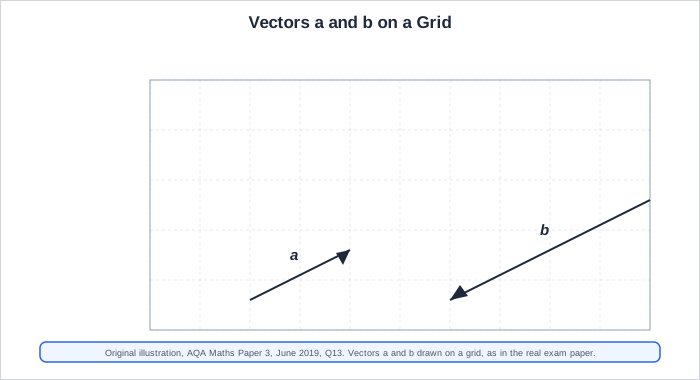
The full worked answer — June 2019
Comparing the two arrows on the grid, b is twice as long as a and points in the opposite direction, so b equals negative 2 times a.
Could you have written this? Every fact in this answer is drilled in our quizzes — the writing is the easy part once the evidence is automatic.
Practise vector questionsWhat the mark scheme rewarded
- 1 mark for the correct expression, b = -2a.
- Expressing one vector in terms of another on a grid requires comparing both the relative length, the scale factor, and the relative direction, whether it is reversed
Traps examiners saw
- Giving only the scale factor, 2a, and missing the negative sign that shows b points the opposite way to a
- Writing the answer as a column vector instead of in terms of a, when the question asks for it in terms of a
Full-mark self-check 0 of 3
The method for every Q11b (Jun18) / Q13a (Jun19) — same every sittingMark bands, steps, timing
What this question type rewards
The topic changes by sitting — the mark scheme never does. Learn this once, then open your question above for that sitting’s sources and a full worked answer.
- Carrying out any vector arithmetic, such as addition or scalar multiplication, correctly using column vectors
- Recognising that two vectors are parallel exactly when one is a scalar multiple of the other
- Stating the scalar multiple relationship clearly as the final justification or answer
The steps
- Work out any vector combination needed using column vector arithmetic
- Compare the resulting vector to the second given vector to find the scalar multiple connecting them
- State the relationship clearly, for example that one vector equals a number times the other
A column vector is written as (3 / −2) (3 on top, −2 on bottom). What does this vector represent?
Recognising one vector as a scalar multiple of another comes up in two of the four sittings we have. Practise checking both the scale factor and the direction, not just the length.
Practise vector questions“Two of the four sittings we have full papers for require the sine rule or cosine rule to be used to find a missing angle in a triangle that is not right-angled.”
Each version needs the correct rule chosen from the given information and rearranged to isolate the unknown angle, either using the cosine rule with three known side lengths inside a circle geometry context (June 2019), or using the sine rule with two known sides and one known angle (June 2022).
1×asked“A is a point on a circle, centre O. B is a point on a different circle, also centre O. AB = 20 cm. The equation of the larger circle is x squared + y squared = 144. The radius of the smaller circle to the radius of the larger circle is in the ratio 4 : 5. Work out the size of angle AOB. [5 marks]”
“A is a point on a circle, centre O. B is a point on a different circle, also centre O. AB = 20 cm. The equation of the larger circle is x squared + y squared = 144. The radius of the smaller circle to the radius of the larger circle is in the ratio 4 : 5. Work out the size of angle AOB. [5 marks]”
What it’s really asking
Find both radii from the circle equation and the given ratio, then use the cosine rule in the triangle formed by the two radii and the 20 cm line AB to find angle AOB.
The full worked answer — June 2019
The larger circle's equation, x squared + y squared = 144, gives a radius of the square root of 144, which is 12 cm. Since the radius of the smaller circle to the radius of the larger circle is 4 : 5, the smaller radius is 4 divided by 5 times 12, which is 9.6 cm.
Triangle AOB has OA = 9.6 cm, OB = 12 cm, and AB = 20 cm, all three sides known, so the cosine rule is used to find angle AOB: cos AOB equals 9.6 squared plus 12 squared minus 20 squared, all divided by 2 times 9.6 times 12.
This gives cos AOB equals negative 163.84 divided by 230.4, which is approximately negative 0.711. Taking the inverse cosine, angle AOB is approximately 135.3 degrees.
Could you have written this? Every fact in this answer is drilled in our quizzes — the writing is the easy part once the evidence is automatic.
Practise sine and cosine rule questionsWhat the mark scheme rewarded
- 1 mark for the larger radius, 12 cm, 1 mark for the smaller radius, 9.6 cm, 1 mark for a correct cosine rule expression using all three sides, 1 mark (dependent) for a correct value of cos AOB, and 1 mark for the final angle, approximately 135.3 degrees.
- The cosine rule is used when all three sides of a triangle are known and an angle is required, since the sine rule needs a known angle to start from
- A negative value for cosine correctly indicates that the angle being found is obtuse, greater than 90 degrees
Traps examiners saw
- Using the ratio 4:5 directly as the two radii, 4 cm and 5 cm, instead of scaling it to the actual radius of 12 cm found from the circle equation
- Attempting to use the sine rule, which cannot be applied directly here since no angle is known until after the cosine rule has been used
Full-mark self-check 0 of 3
1×asked“In a triangle, one angle is 64 degrees. The side opposite the 64 degree angle is 23 cm, and the side opposite the unknown angle x is 17 cm. Use the sine rule to work out the size of angle x. [3 marks]”
“In a triangle, one angle is 64 degrees. The side opposite the 64 degree angle is 23 cm, and the side opposite the unknown angle x is 17 cm. Use the sine rule to work out the size of angle x. [3 marks]”
What it’s really asking
Set up the sine rule using the known angle and its opposite side together with the unknown angle and its opposite side, then rearrange to find x.
The full worked answer — June 2022
Using the sine rule, sin x divided by 17 equals sin 64 degrees divided by 23, since x is opposite the side of length 17 cm and 64 degrees is opposite the side of length 23 cm.
Rearranging, sin x equals 17 times sin 64 degrees, divided by 23, which is approximately 0.664.
Taking the inverse sine, x is approximately 41.6 degrees.
Could you have written this? Every fact in this answer is drilled in our quizzes — the writing is the easy part once the evidence is automatic.
Practise sine and cosine rule questionsWhat the mark scheme rewarded
- 1 mark for a correct sine rule expression pairing each angle with its opposite side, 1 mark (dependent) for a correct value of sin x, approximately 0.664, and 1 mark for the final angle, in the range 41.29 to 41.64 degrees.
- The sine rule pairs each angle with the side directly opposite it, so the 17 cm side must be paired with x, and the 23 cm side with 64 degrees
- The sine rule can be used whenever a matching angle-and-opposite-side pair is known alongside one further side, which is exactly the case here
Traps examiners saw
- Pairing the sides and angles the wrong way round, for example writing sin x divided by 23 instead of sin x divided by 17
- Forgetting to take the inverse sine at the end and leaving the answer as a decimal instead of an angle
Full-mark self-check 0 of 3
The method for every Q27 (Jun19) / Q21 (Jun22) — same every sittingMark bands, steps, timing
What this question type rewards
The topic changes by sitting — the mark scheme never does. Learn this once, then open your question above for that sitting’s sources and a full worked answer.
- Choosing the correct rule, sine rule or cosine rule, based on which sides and angles are actually known
- Substituting the given values into the rule correctly and rearranging to isolate the unknown angle
- Using the inverse sine or inverse cosine function correctly to reach the final angle
The steps
- Decide whether the sine rule or the cosine rule fits the given information
- Substitute the known values and rearrange to isolate the sine or cosine of the unknown angle
- Use the inverse trigonometric function to find the final angle
Which of the following is the sine rule?
Using the sine rule or cosine rule to find a missing angle comes up in two of the four sittings we have. Practise choosing the correct rule based on which sides and angles are actually known.
Practise sine and cosine rule questions“Two of the four sittings we have full papers for give a right-angled triangle and ask for a missing angle or a missing side to be found using trigonometry.”
Each version needs the correct trigonometric ratio identified from the two known measurements, either finding a missing angle from two known sides (June 2022) or finding a missing side from one known angle and one known side (June 2023).
1×asked“In a right-angled triangle, the side opposite angle x is 10 cm and the side adjacent to angle x is 4 cm. Use trigonometry to work out the size of angle x. [3 marks]”
“In a right-angled triangle, the side opposite angle x is 10 cm and the side adjacent to angle x is 4 cm. Use trigonometry to work out the size of angle x. [3 marks]”
What it’s really asking
Identify that the two known sides are opposite and adjacent relative to angle x, use tangent to set up an equation, then take the inverse tangent to find x.
The full worked answer — June 2022
The two known sides, 10 cm and 4 cm, are opposite and adjacent to angle x, so tangent is the correct ratio to use, since tangent equals opposite divided by adjacent.
This gives tan x equals 10 divided by 4, which is 2.5.
Taking the inverse tangent, x is approximately 68.2 degrees.
Could you have written this? Every fact in this answer is drilled in our quizzes — the writing is the easy part once the evidence is automatic.
Practise trigonometry questionsWhat the mark scheme rewarded
- 1 mark for identifying tangent as the correct ratio, 1 mark (dependent) for a correct equation, tan x = 2.5, and 1 mark for the final angle, in the range 68 to 68.2 degrees.
- Tangent is the ratio to use whenever the two known sides of a right-angled triangle are the opposite and adjacent sides, since it does not involve the hypotenuse at all
- The inverse tangent function undoes tangent to convert a ratio of sides back into an angle
Traps examiners saw
- Using sine or cosine instead of tangent, when neither the hypotenuse is known nor needed here
- Inverting the fraction, working out 4 divided by 10 instead of 10 divided by 4, which finds the wrong angle in the triangle
Full-mark self-check 0 of 3
1×asked“In a right-angled triangle, the side adjacent to the 58 degree angle is 46 cm. Use trigonometry to work out the value of x, the side opposite the 58 degree angle. [3 marks]”
“In a right-angled triangle, the side adjacent to the 58 degree angle is 46 cm. Use trigonometry to work out the value of x, the side opposite the 58 degree angle. [3 marks]”
What it’s really asking
Identify which sides are known and which trigonometric ratio links the 58 degree angle to the known side and the unknown side x, then rearrange to find x.
The full worked answer — June 2023
The side of 46 cm is adjacent to the 58 degree angle, and x is opposite it, so tangent is the correct ratio to use, since tangent equals opposite divided by adjacent.
This gives tan 58 degrees equals x divided by 46, so x equals 46 times tan 58 degrees.
Since tan 58 degrees is approximately 1.6, x is approximately 46 times 1.6, which is approximately 73.6 cm.
Could you have written this? Every fact in this answer is drilled in our quizzes — the writing is the easy part once the evidence is automatic.
Practise trigonometry questionsWhat the mark scheme rewarded
- 1 mark for identifying tangent as the correct ratio, 1 mark (dependent) for a correct equation, x = 46 times tan 58 degrees, and 1 mark for the final side, in the range 73.6 to 74 cm.
- The side described as adjacent to a given angle is the one next to it that is not the hypotenuse, while the opposite side is across from the angle
- When an angle and one side are known and a second side is needed, the ratio is rearranged to make the unknown side the subject before calculating
Traps examiners saw
- Treating 46 cm as the hypotenuse and using sine instead of tangent, when 46 cm is actually adjacent to the given angle here
- Dividing 46 by tan 58 degrees instead of multiplying, which inverts the correct rearrangement
Full-mark self-check 0 of 3
The method for every Q4 (Jun22) / Q10 (Jun23) — same every sittingMark bands, steps, timing
What this question type rewards
The topic changes by sitting — the mark scheme never does. Learn this once, then open your question above for that sitting’s sources and a full worked answer.
- Correctly labelling the sides of the right-angled triangle as opposite, adjacent and hypotenuse relative to the angle involved
- Choosing the correct trigonometric ratio, sine, cosine or tangent, based on which two sides or which side and angle are known
- Rearranging and calculating correctly to reach the final angle or side
The steps
- Label the sides of the triangle as opposite, adjacent and hypotenuse relative to the angle being used
- Choose sine, cosine or tangent based on which two measurements are known and which is needed
- Substitute the known values, rearrange if needed, and calculate the final angle or side
Which trigonometric ratio connects the opposite side and the hypotenuse in a right-angled triangle?
Right-angled trigonometry to find a missing angle or side comes up in two of the four sittings we have. Practise labelling opposite, adjacent and hypotenuse correctly before choosing sine, cosine or tangent.
Practise trigonometry questions“Two of the four sittings we have full papers for require a quadratic equation to be formed from a given context, before it can be solved.”
Each version needs an expression rearranged or expanded into the standard quadratic form ax squared plus bx plus c equals 0, then solved, either rearranging a given equation and using the quadratic formula (June 2019), or expanding an area made of algebraic rectangles and factorising the result (June 2022).
1×asked“Write x(3x - 9) = 4 in the form ax squared + bx + c = 0, where a, b and c are integers, then solve x(3x - 9) = 4, giving your answers to 2 decimal places. [3 marks]”
“Write x(3x - 9) = 4 in the form ax squared + bx + c = 0, where a, b and c are integers, then solve x(3x - 9) = 4, giving your answers to 2 decimal places. [3 marks]”
What it’s really asking
Expand the brackets and rearrange the equation so everything is on one side equal to 0, then apply the quadratic formula, since the equation does not factorise neatly.
The full worked answer — June 2019
Expanding the brackets, x(3x - 9) is 3x squared minus 9x. Setting this equal to 4 and rearranging so everything is on one side, 3x squared minus 9x minus 4 equals 0.
Using the quadratic formula with a = 3, b = -9 and c = -4, x equals 9 plus or minus the square root of (81 plus 48), all divided by 6, which is 9 plus or minus the square root of 129, all divided by 6.
This gives x = 3.39 or x = -0.39, both to 2 decimal places.
Could you have written this? Every fact in this answer is drilled in our quizzes — the writing is the easy part once the evidence is automatic.
Practise solving quadratics questionsWhat the mark scheme rewarded
- 1 mark for the correct standard form, 3x squared minus 9x minus 4 = 0, 1 mark for a correct application of the quadratic formula using these coefficients, and 1 mark for both final values, x = 3.39 and x = -0.39, correctly rounded to 2 decimal places.
- Expanding x(3x - 9) must be done carefully to avoid a sign error, since 9x is being subtracted, not added
- When a quadratic equation does not factorise neatly with integer values, the quadratic formula is the reliable method, and the discriminant, here 129, does not need to be a perfect square
Traps examiners saw
- Writing 3x squared minus 9x equals 4 as the final standard form, forgetting to move the 4 across to reach minus 4 equals 0
- Rounding only one of the two solutions, or rounding to the wrong number of decimal places
Full-mark self-check 0 of 3
1×asked“Here is the plan of the floor of an L-shaped room, with all lengths in metres given in terms of x. The floor is made up of two rectangles, one measuring x by (x - 2), and one measuring 3 by (x - 5). The total area of the floor is 75 square metres. Show that x squared + x - 90 = 0, then factorise to work out the value of x. [5 marks]”
“Here is the plan of the floor of an L-shaped room, with all lengths in metres given in terms of x. The floor is made up of two rectangles, one measuring x by (x - 2), and one measuring 3 by (x - 5). The total area of the floor is 75 square metres. Show that x squared + x - 90 = 0, then factorise to work out the value of x. [5 marks]”
What it’s really asking
Add the areas of the two rectangles that make up the L-shape, set the total equal to 75, and rearrange to reach the given quadratic, then factorise it to find x.
What the sources actually showed — June 2022
A floor plan split into two rectangles, one measuring x by (x - 2), and one measuring 3 by (x - 5), confirmed against the real diagram: the L-shape has a top edge of (x - 5), a short vertical drop of 3, a horizontal step of 5, a left side of (x + 1), a right side of (x - 2), and a bottom edge of x. The diagram is marked not drawn accurately.
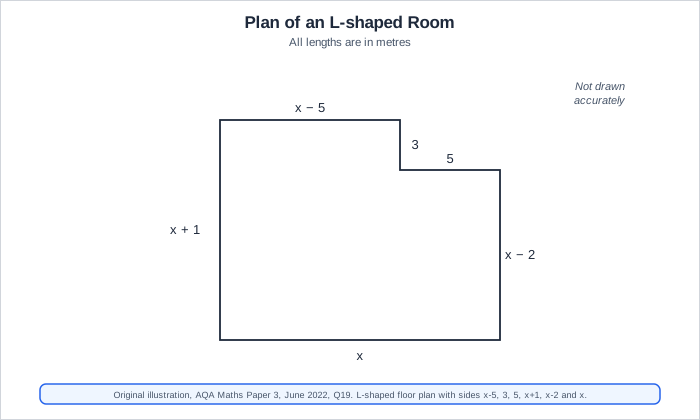
The full worked answer — June 2022
The total floor area is the sum of the two rectangles: x times (x - 2), plus 3 times (x - 5).
Expanding, x times (x - 2) is x squared minus 2x, and 3 times (x - 5) is 3x minus 15. Adding these, x squared minus 2x plus 3x minus 15 simplifies to x squared plus x minus 15.
Setting this equal to the given total area, x squared plus x minus 15 equals 75, and rearranging, x squared plus x minus 90 equals 0, matching the given equation.
Factorising, x squared plus x minus 90 is (x - 9)(x + 10). Setting each bracket to 0 gives x = 9 or x = -10. Since x is a length, only x = 9 makes sense.
Could you have written this? Every fact in this answer is drilled in our quizzes — the writing is the easy part once the evidence is automatic.
Practise solving quadratics questionsWhat the mark scheme rewarded
- For showing the equation: 1 mark for a correct expression for the two rectangle areas, 1 mark (dependent) for a fully expanded expression allowing one arithmetic slip, and 1 mark for reaching exactly x squared + x - 90 = 0 with full working shown. For solving: 1 mark for the correct factorisation, (x - 9)(x + 10), and 1 mark for the final answer, x = 9, correctly rejecting the negative solution.
- A show that question needs every expansion step displayed, since the final equation is already given and cannot itself be used as evidence
- When x represents a real physical length, a negative solution to the quadratic equation must be rejected, even though it is mathematically valid
Traps examiners saw
- Only writing the final equation without showing the expansion of both rectangles, which loses marks even if the given equation is correctly stated
- Giving both x = 9 and x = -10 as final answers, without rejecting the negative one as physically impossible for a length
Full-mark self-check 0 of 3
The method for every Q18 (Jun19) / Q19 (Jun22) — same every sittingMark bands, steps, timing
What this question type rewards
The topic changes by sitting — the mark scheme never does. Learn this once, then open your question above for that sitting’s sources and a full worked answer.
- Expanding or rearranging the given context fully and correctly into the standard quadratic form
- Choosing an appropriate method, factorising or the quadratic formula, to solve the resulting equation
- Reaching both correct solutions, or the one solution that makes sense in context
The steps
- Expand or rearrange the given information into the form ax squared plus bx plus c equals 0
- Solve the resulting quadratic equation by factorising or using the quadratic formula
- State both solutions, or select the one that makes sense given the context of the question
The equation x² + 5x + 10 = 0 has:
Forming a quadratic equation from a given context comes up in two of the four sittings we have. Practise expanding and rearranging fully into standard form before choosing how to solve it.
Practise solving quadratics questions“Two of the four sittings we have full papers for embed a right-angled triangle inside a 3D solid and require trigonometry, sometimes with Pythagoras' theorem too, to find a length or a volume.”
Each version needs the correct right-angled triangle identified inside the 3D solid before any calculation can begin, either finding a vertical height directly using a given angle of elevation (June 2018), or finding a height from a diagonal and an angle, then using it to find a volume (June 2019).
1×asked“ABCDEF is a triangular prism representing part of a hill. ABCF is the horizontal rectangular base, and D is vertically above C. The horizontal distance is 500 m, and the angle of elevation to D is 6 degrees. Work out the height CD. [2 marks]”
“ABCDEF is a triangular prism representing part of a hill. ABCF is the horizontal rectangular base, and D is vertically above C. The horizontal distance is 500 m, and the angle of elevation to D is 6 degrees. Work out the height CD. [2 marks]”
What it’s really asking
Use the right-angled triangle formed by the horizontal distance, the vertical height CD, and the given 6 degree angle of elevation, applying tangent to find CD.
What the sources actually showed — June 2018
A triangular prism, ABCDEF, with ABCF as the horizontal rectangular base and D vertically above C, confirmed against the real diagram: the 500 m distance labels the horizontal base edge BC, the 6 degree angle of elevation is marked at vertex B between BC and the sloped edge BD, and the 400 m distance labels the horizontal base edge AB.
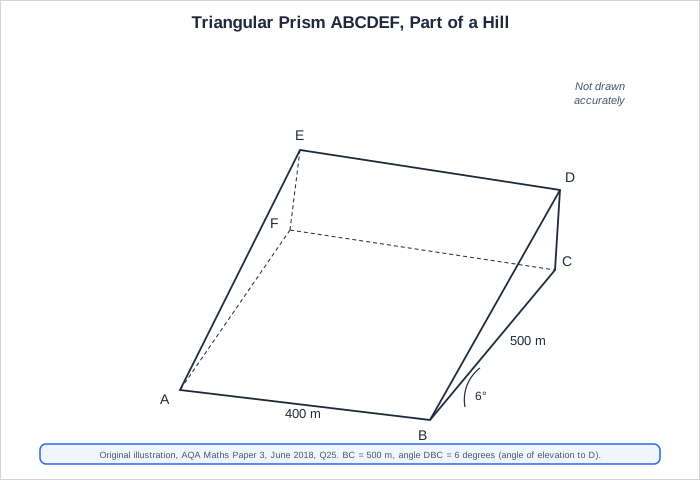
The full worked answer — June 2018
In the right-angled triangle formed by the horizontal distance and the vertical height CD, tan 6 degrees equals CD divided by 500.
Rearranging, CD equals 500 times tan 6 degrees, which is approximately 52.6 m.
Could you have written this? Every fact in this answer is drilled in our quizzes — the writing is the easy part once the evidence is automatic.
Practise 3D trigonometry questionsWhat the mark scheme rewarded
- 1 mark for a correct tangent equation, tan 6 degrees = CD / 500, and 1 mark for the final height, in the range 52.5 to 53 m.
- An angle of elevation is measured from the horizontal up to a point above it, so the vertical rise is the side opposite the angle and the horizontal distance is the side adjacent to it
- Once one right-angled triangle within a larger 3D solid is correctly identified, it can be treated exactly like any 2D right-angled triangle
Traps examiners saw
- Confusing which side is opposite and which is adjacent to the 6 degree angle, leading to the reciprocal ratio being used by mistake
- Rounding the height too early if it is needed again in a later part of the same question
Full-mark self-check 0 of 3
1×asked“The length of a diagonal of a cuboid is 20 cm. The diagonal makes an angle of 24 degrees with the base. The area of the base is 150 square centimetres. Work out the volume of the cuboid. [3 marks]”
“The length of a diagonal of a cuboid is 20 cm. The diagonal makes an angle of 24 degrees with the base. The area of the base is 150 square centimetres. Work out the volume of the cuboid. [3 marks]”
What it’s really asking
Use the right-angled triangle formed by the diagonal, the vertical height, and the 24 degree angle to find the cuboid's height, then multiply by the base area to find the volume.
The full worked answer — June 2019
The diagonal of 20 cm is the hypotenuse of a right-angled triangle formed with the vertical height of the cuboid, and the height is opposite the 24 degree angle the diagonal makes with the base. So sin 24 degrees equals height divided by 20.
Rearranging, height equals 20 times sin 24 degrees, which is approximately 8.13 cm.
The volume of the cuboid is the base area multiplied by the height, 150 times 8.13, which is approximately 1220 cubic centimetres.
Could you have written this? Every fact in this answer is drilled in our quizzes — the writing is the easy part once the evidence is automatic.
Practise 3D trigonometry questionsWhat the mark scheme rewarded
- 1 mark for a correct sine equation, sin 24 degrees = height / 20, 1 mark (dependent) for the correct height, approximately 8.13 cm, and 1 mark for the final volume, in the range 1215 to 1221 cubic centimetres.
- The diagonal of a cuboid, together with its vertical height, forms a right-angled triangle in which the diagonal is always the hypotenuse
- The volume of any prism, including a cuboid, is the area of its base multiplied by its height, once that height has been found
Traps examiners saw
- Using cosine instead of sine, which would find the horizontal projection of the diagonal rather than the vertical height
- Forgetting the final step, multiplying the height by the base area, and stopping at the height alone
Full-mark self-check 0 of 3
The method for every Q25a (Jun18) / Q24 (Jun19) — same every sittingMark bands, steps, timing
What this question type rewards
The topic changes by sitting — the mark scheme never does. Learn this once, then open your question above for that sitting’s sources and a full worked answer.
- Identifying the correct right-angled triangle within the 3D solid, and which sides and angles are known within it
- Applying the correct trigonometric ratio or Pythagoras' theorem to that triangle
- Using any length found correctly in a further step, such as combining it with a given area to find a volume
The steps
- Identify the right-angled triangle inside the 3D solid that connects the known and unknown measurements
- Apply trigonometry or Pythagoras' theorem to that triangle to find the missing length or angle
- Use the result in any further step the question requires, such as finding a volume
To find the angle between a line and a horizontal plane in a 3D problem, which technique is typically used?
Using trigonometry and Pythagoras' theorem inside a 3D solid comes up in two of the four sittings we have. Practise identifying the correct right-angled triangle hidden within the solid before calculating.
Practise 3D trigonometry questions“Two of the four sittings we have full papers for require bounds or an error interval to be worked out from values given to a stated accuracy.”
Each version needs the correct upper and lower bound identified from a stated rounding accuracy, either combining two people's bounds to find a maximum possible total (June 2019), or writing the correct error interval notation directly for a single rounded value (June 2022).
1×asked“To the nearest pound, Jon has £9. To the nearest 50p, Ellie has £6.50. Work out the maximum possible total amount of money. [3 marks]”
“To the nearest pound, Jon has £9. To the nearest 50p, Ellie has £6.50. Work out the maximum possible total amount of money. [3 marks]”
What it’s really asking
Work out the upper bound of Jon's amount, rounded to the nearest pound, and the upper bound of Ellie's amount, rounded to the nearest 50p, then add them together.
The full worked answer — June 2019
Jon's amount is rounded to the nearest pound, so it could be anywhere from £8.50 up to, but not including, £9.50. The greatest value it could practically take is £9.49.
Ellie's amount is rounded to the nearest 50p, so it could be anywhere from £6.25 up to, but not including, £6.75. The greatest value it could practically take is £6.74.
Adding these two greatest possible values, £9.49 plus £6.74, gives a maximum possible total of £16.23.
Could you have written this? Every fact in this answer is drilled in our quizzes — the writing is the easy part once the evidence is automatic.
Practise bounds and error interval questionsWhat the mark scheme rewarded
- 1 mark for either correct upper bound, £9.49 or £6.74, 1 mark (dependent) for adding both correct upper bounds together, and 1 mark for the final total, £16.23.
- Rounding to the nearest pound means the true value could be up to 50p above or below the stated amount, while rounding to the nearest 50p means the true value could be up to 25p above or below
- A maximum possible total is found by adding the upper bound of every individual amount, not the stated values themselves
Traps examiners saw
- Using £9.50 and £6.75 as the upper bounds, rather than the greatest value achievable in pence, £9.49 and £6.74
- Using the nearest pound rounding accuracy, 50p either way, for Ellie's amount as well, instead of the nearest 50p accuracy she was actually given, which is 25p either way
Full-mark self-check 0 of 3
1×asked“The mass of a baby is 3.6 kilograms to 1 decimal place. What is the error interval for the mass in kilograms? [1 mark]”
“The mass of a baby is 3.6 kilograms to 1 decimal place. What is the error interval for the mass in kilograms? [1 mark]”
What it’s really asking
Work out the lower and upper bound for a value rounded to 1 decimal place, and write them as a correct error interval, using a strict inequality at the upper end.
What the sources actually showed — June 2022
Four possible error intervals to choose from: 3.5 to 3.6 inclusive at both ends, 3.55 to 3.65 inclusive at both ends, 3.5 up to but not including 3.6, and 3.55 up to but not including 3.65.
The full worked answer — June 2022
Rounding to 1 decimal place means the true mass could be anywhere from half of 0.1 below to half of 0.1 above 3.6, which is 3.55 up to, but not including, 3.65.
Could you have written this? Every fact in this answer is drilled in our quizzes — the writing is the easy part once the evidence is automatic.
Practise bounds and error interval questionsWhat the mark scheme rewarded
- 1 mark for the correct error interval, 3.55 is less than or equal to mass, which is less than 3.65.
- An error interval for a value rounded to 1 decimal place always spans a total width of 0.1, split evenly as 0.05 above and below the stated value
- The upper bound of an error interval always uses a strict inequality, less than, not less than or equal to, since the upper bound value itself would round to the next figure up
Traps examiners saw
- Using a rounding accuracy of a whole unit instead of 0.1, giving the wrong bounds of 3.5 and 3.6
- Using less than or equal to at both ends of the error interval, instead of a strict inequality at the upper end
Full-mark self-check 0 of 3
The method for every Q6 (Jun19) / Q10 (Jun22) — same every sittingMark bands, steps, timing
What this question type rewards
The topic changes by sitting — the mark scheme never does. Learn this once, then open your question above for that sitting’s sources and a full worked answer.
- Correctly identifying the rounding accuracy a value has been given to, such as the nearest pound or the nearest 50p
- Working out the upper and lower bound for each value using half of the rounding accuracy
- Combining or stating the bounds correctly to answer exactly what the question asks
The steps
- Identify the degree of accuracy each value has been rounded to
- Work out the upper and lower bound for each value, using half the rounding accuracy above and below
- Combine the bounds, or state the error interval, to answer the question
A length is 240 cm to the nearest 10 cm. What is the lower bound of the length?
Using bounds from rounded values comes up in two of the four sittings we have. Practise finding half of the rounding accuracy correctly before working out each bound.
Practise bounds and error interval questions“Two of the four sittings we have full papers for give a relative frequency and ask for an actual frequency, or a comparison between several actual frequencies, to be worked out from it.”
Each version needs relative frequency multiplied by sample size to recover an actual whole-number frequency, either comparing several samples to find the range between them (June 2019), or using the fact that two outcomes must together account for the whole sample to find a remaining frequency (June 2023).
1×asked“A factory makes kettles. Four samples of kettles are tested for faults. Each sample has size 200. The relative frequencies of faulty kettles in the samples are: Sample P, 0.03; Sample Q, 0.035; Sample R, 0.015; Sample S, 0.01. Work out the range of the number of faulty kettles in the four samples. [3 marks]”
“A factory makes kettles. Four samples of kettles are tested for faults. Each sample has size 200. The relative frequencies of faulty kettles in the samples are: Sample P, 0.03; Sample Q, 0.035; Sample R, 0.015; Sample S, 0.01. Work out the range of the number of faulty kettles in the four samples. [3 marks]”
What it’s really asking
Multiply each relative frequency by 200 to find the actual number of faulty kettles in each sample, then subtract the smallest from the largest to find the range.
What the sources actually showed — June 2019
A table recreated from the real data, giving the relative frequency of faulty kettles in four samples of 200 kettles each.
| Sample | Relative frequency |
|---|---|
| P | 0.03 |
| Q | 0.035 |
| R | 0.015 |
| S | 0.01 |
The full worked answer — June 2019
Multiplying each relative frequency by the sample size, 200, gives actual frequencies of 6 for Sample P, 7 for Sample Q, 3 for Sample R, and 2 for Sample S.
The highest actual frequency is 7, from Sample Q, and the lowest is 2, from Sample S. The range is 7 minus 2, which is 5.
Could you have written this? Every fact in this answer is drilled in our quizzes — the writing is the easy part once the evidence is automatic.
Practise relative frequency questionsWhat the mark scheme rewarded
- 1 mark for any one correct actual frequency, 1 mark (dependent) for correctly identifying the highest actual frequency, 7, and the lowest, 2, and 1 mark for the final range, 5.
- An actual frequency is always recovered by multiplying a relative frequency by the size of the sample it came from
- The range of a set of values is the highest value minus the lowest value, not the highest relative frequency minus the lowest relative frequency
Traps examiners saw
- Working out the range of the relative frequencies themselves, 0.035 minus 0.01, instead of the range of the actual whole-number frequencies
- Making an arithmetic slip in one of the four multiplications and not noticing the final range looks too small or too large
Full-mark self-check 0 of 3
1×asked“Elena spins a biased spinner 125 times. The relative frequency of red is 0.32. Work out how many times the spinner landed on green, given that every spin lands on either red or green. [2 marks]”
“Elena spins a biased spinner 125 times. The relative frequency of red is 0.32. Work out how many times the spinner landed on green, given that every spin lands on either red or green. [2 marks]”
What it’s really asking
Work out the relative frequency of green as 1 minus the relative frequency of red, then multiply by the total number of spins to find the actual number of green spins.
The full worked answer — June 2023
Since every spin lands on either red or green, the relative frequency of green is 1 minus 0.32, which is 0.68.
Multiplying this by the total number of spins, 125 times 0.68, gives 85 spins landing on green.
Could you have written this? Every fact in this answer is drilled in our quizzes — the writing is the easy part once the evidence is automatic.
Practise relative frequency questionsWhat the mark scheme rewarded
- 1 mark for a correct method, such as 125 times 0.32 to find red, or 125 times (1 minus 0.32) to find green directly, and 1 mark for the final answer, 85.
- When only two outcomes are possible, their relative frequencies must add up to exactly 1, so one can always be found from the other by subtraction
- The final answer must be a whole number of spins, since it counts an actual number of trials, not a probability
Traps examiners saw
- Finding the number of red spins, 125 times 0.32, which is 40, and stopping there instead of continuing to find green
- Forgetting that green's relative frequency is 1 minus 0.32, and instead trying to use 0.32 directly for green
Full-mark self-check 0 of 3
The method for every Q17 (Jun19) / Q12c (Jun23) — same every sittingMark bands, steps, timing
What this question type rewards
The topic changes by sitting — the mark scheme never does. Learn this once, then open your question above for that sitting’s sources and a full worked answer.
- Correctly recovering an actual frequency by multiplying a relative frequency by its own sample size
- Combining several recovered frequencies correctly to answer exactly what the question asks
- Reaching a sensible whole-number frequency, since a frequency must be a whole number of trials
The steps
- Multiply each relative frequency by its own sample size to recover the actual frequency
- Compare or combine the recovered frequencies as the question requires
- State the final whole-number answer
Which formula correctly gives the expected frequency of an event?
Using relative frequency to estimate an actual frequency comes up in two of the four sittings we have. Practise multiplying relative frequency by sample size to recover a whole-number frequency.
Practise relative frequency questions“Two of the four sittings we have full papers for ask for a single transformation between two shapes to be described fully, with every required detail.”
Each version needs the correct type of transformation identified first, then every one of its required details given in full, either identifying a reflection and its mirror line from given coordinates (June 2019), or identifying an enlargement, including a negative scale factor, and its centre (June 2023).
1×asked“ABCD is a square with A(-2, 1), B(0, -1), C(2, 1) and D(0, 3). A single transformation of ABCD is such that B is mapped to D, D is mapped to B, and A and C are invariant points. Describe fully the transformation. [2 marks]”
“ABCD is a square with A(-2, 1), B(0, -1), C(2, 1) and D(0, 3). A single transformation of ABCD is such that B is mapped to D, D is mapped to B, and A and C are invariant points. Describe fully the transformation. [2 marks]”
What it’s really asking
Recognise that a transformation swapping two points while leaving two others unchanged is a reflection, and use the invariant points, which lie on the mirror line, to state the line's equation.
The full worked answer — June 2019
Since B and D swap places while A and C stay fixed, this is a reflection, since a reflection is the only single transformation that swaps two points while leaving others unchanged.
The invariant points, A(-2, 1) and C(2, 1), both lie on the mirror line, since a mirror line always passes through every invariant point. Both points have a y-coordinate of 1, so the mirror line is y = 1.
Could you have written this? Every fact in this answer is drilled in our quizzes — the writing is the easy part once the evidence is automatic.
Practise transformation questionsWhat the mark scheme rewarded
- 1 mark for correctly identifying the transformation as a reflection, and 1 mark for the correct mirror line, y = 1.
- A transformation that swaps two points while leaving two others fixed is always a reflection, since rotations and enlargements do not leave two separate points both individually fixed in this way
- Every invariant point of a reflection lies exactly on the mirror line, so two invariant points are enough to identify the line
Traps examiners saw
- Describing the transformation as a rotation, since B and D do swap places, without checking that two points also stay completely fixed, which rules out a rotation
- Stating only reflection without giving the mirror line, y = 1, which loses the second mark
Full-mark self-check 0 of 3
1×asked“Shape A and shape B are shown on a grid. Describe the single transformation that maps shape A to shape B. [3 marks]”
“Shape A and shape B are shown on a grid. Describe the single transformation that maps shape A to shape B. [3 marks]”
What it’s really asking
Recognise that shape B is an inverted and resized copy of shape A, identify this as an enlargement with a negative scale factor, and find its centre by tracing lines through matching corresponding points on both shapes.
What the sources actually showed — June 2023
A grid showing shape A and shape B, confirmed against the real diagram: both axes run from 0 to 10. Shape A has vertices at (1, 10), (5, 8), (5, 4) and (1, 4). Shape B has vertices at (10, 1), (8, 2), (8, 4) and (10, 4).
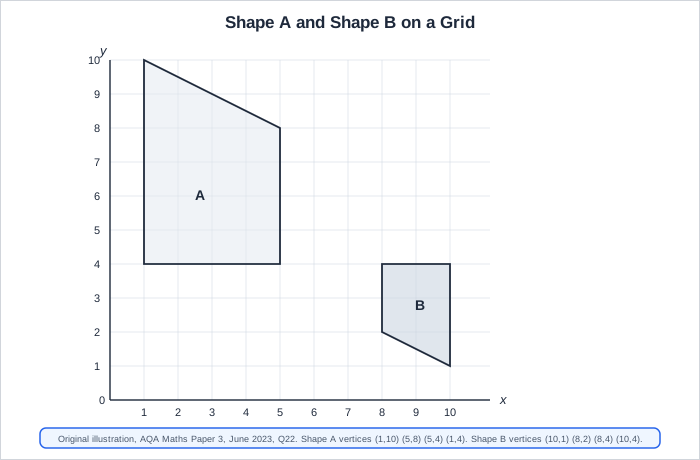
The full worked answer — June 2023
Shape B is the same overall proportions as shape A but smaller and turned through 180 degrees relative to it, which is the signature of an enlargement with a negative scale factor, rather than a straightforward reflection or rotation.
Comparing the size of shape B to shape A, shape B is half the size, so the scale factor is negative one half, with the negative sign showing the shape has also been inverted.
Drawing straight lines through each pair of corresponding vertices on shape A and shape B, all of these lines meet at a single point, the centre of enlargement, (7, 4).
Could you have written this? Every fact in this answer is drilled in our quizzes — the writing is the easy part once the evidence is automatic.
Practise transformation questionsWhat the mark scheme rewarded
- 1 mark for correctly identifying the transformation as an enlargement, 1 mark for the correct scale factor, negative one half, and 1 mark for the correct centre, (7, 4).
- A negative scale factor both resizes a shape and rotates it 180 degrees about the centre of enlargement, all in a single transformation
- The centre of enlargement is found by drawing straight lines through each pair of corresponding vertices on the object and the image; every one of these lines passes through the same single point
Traps examiners saw
- Describing the transformation as a combination of an enlargement and a separate rotation, when it is correctly a single enlargement with a negative scale factor
- Giving the scale factor as one half, missing the negative sign that accounts for the shape's inversion
Full-mark self-check 0 of 3
The method for every Q25a (Jun19) / Q22 (Jun23) — same every sittingMark bands, steps, timing
What this question type rewards
The topic changes by sitting — the mark scheme never does. Learn this once, then open your question above for that sitting’s sources and a full worked answer.
- Correctly identifying the type of transformation: reflection, rotation, or enlargement
- Giving every detail that type of transformation requires: a mirror line for a reflection, a centre and angle for a rotation, or a centre and scale factor for an enlargement
- Describing only one single transformation, never a combination of more than one
The steps
- Identify which single type of transformation maps the first shape onto the second
- Work out every detail that type of transformation requires
- State the transformation fully, including every required detail, as a single transformation
Which of the following statements correctly describes an enlargement?
Describing a single transformation fully comes up in two of the four sittings we have. Practise checking whether a scale factor should be negative before finalising an enlargement's description.
Practise transformation questions“Three of the four sittings we have full papers for give a compound measure formula and ask for it to be applied, often together with its correct units.”
Each version applies the same underlying structure, one quantity divided by another, either to find pressure and state its units (June 2018), to complete a table linking mass, volume and density for two objects of the same density (June 2019), or to find a population density before and after a population change (June 2022).
1×asked“Pressure equals force divided by area. A force of 40 Newtons is applied to an area of 3.2 square metres. Work out the pressure, giving the units of your answer. [2 marks]”
“Pressure equals force divided by area. A force of 40 Newtons is applied to an area of 3.2 square metres. Work out the pressure, giving the units of your answer. [2 marks]”
What it’s really asking
Divide the given force by the given area to find the pressure, then state the correct units for pressure, which follow directly from the units used for force and area.
The full worked answer — June 2018
Using pressure equals force divided by area, pressure equals 40 divided by 3.2, which is 12.5.
Since force is measured in Newtons and area in square metres, the units of pressure are Newtons per square metre, which can also be written as N/m squared or pascals.
Could you have written this? Every fact in this answer is drilled in our quizzes — the writing is the easy part once the evidence is automatic.
Practise compound measure questionsWhat the mark scheme rewarded
- 1 mark for the correct value, 12.5, and 1 mark for the correct units, Newtons per square metre (or an equivalent form such as N/m squared or pascals).
- The units of a compound measure are always built from the units of the two quantities it combines, here Newtons and square metres
- Both the numerical value and the units are marked independently, so a correct value with missing or wrong units does not earn full marks
Traps examiners saw
- Multiplying force by area instead of dividing, reversing the given formula
- Giving the units as square metres per Newton, inverting the correct compound unit
Full-mark self-check 0 of 2
1×asked“Two solids, J and K, have the same density. Solid J has mass 48 g and volume 8 cubic centimetres. Solid K has mass 78 g. Complete the table to find the density of both solids and the volume of solid K, including units in your answers. [3 marks]”
“Two solids, J and K, have the same density. Solid J has mass 48 g and volume 8 cubic centimetres. Solid K has mass 78 g. Complete the table to find the density of both solids and the volume of solid K, including units in your answers. [3 marks]”
What it’s really asking
Find solid J's density from its known mass and volume, apply this same density to solid K since they are stated to be equal, then rearrange the density formula to find solid K's volume.
What the sources actually showed — June 2019
A table recreated from the real data, showing the mass and volume for solids J and K, with density and K's volume left to be completed.
| Solid J | Solid K | |
|---|---|---|
| Mass | 48 g | 78 g |
| Volume | 8 cm cubed | to find |
| Density | to find | same as J |
The full worked answer — June 2019
Using density equals mass divided by volume, solid J's density is 48 divided by 8, which is 6 grams per cubic centimetre. Since both solids have the same density, solid K's density is also 6 grams per cubic centimetre.
Rearranging the formula to make volume the subject, volume equals mass divided by density. Solid K's volume is 78 divided by 6, which is 13 cubic centimetres.
Could you have written this? Every fact in this answer is drilled in our quizzes — the writing is the easy part once the evidence is automatic.
Practise compound measure questionsWhat the mark scheme rewarded
- 1 mark for solid J's density, 6 grams per cubic centimetre (applied correctly to solid K too), 1 mark for solid K's volume, 13 cubic centimetres, and 1 mark for using correct units, grams per cubic centimetre for both densities and cubic centimetres for the volume, throughout the completed table.
- When two objects are stated to have the same density, a density found from one object can be applied directly to the other, without needing to be recalculated
- Rearranging density equals mass divided by volume to make volume the subject gives volume equals mass divided by density, not mass times density
Traps examiners saw
- Multiplying solid K's mass by the density instead of dividing, when finding its volume
- Missing or inconsistent units in the completed table, which can lose the units mark even if both numerical values are correct
Full-mark self-check 0 of 3
1×asked“A town has a population density of 278 people per square kilometre and a population of 158,460, using population density equals population divided by area. The population increases to 168,720. Work out the population density after the increase. [3 marks]”
“A town has a population density of 278 people per square kilometre and a population of 158,460, using population density equals population divided by area. The population increases to 168,720. Work out the population density after the increase. [3 marks]”
What it’s really asking
Work out the town's fixed area from the original population density and population, then use this same area with the new, larger population to find the new population density.
The full worked answer — June 2022
Rearranging population density equals population divided by area, area equals population divided by population density. This gives 158,460 divided by 278, which is 570 square kilometres.
Using the same area with the new population, the new population density is 168,720 divided by 570.
This gives a new population density of 296 people per square kilometre.
Could you have written this? Every fact in this answer is drilled in our quizzes — the writing is the easy part once the evidence is automatic.
Practise compound measure questionsWhat the mark scheme rewarded
- 1 mark for correctly finding the area, 570 square kilometres, 1 mark (dependent) for a correct method dividing the new population by this area, and 1 mark for the final density, 296 people per square kilometre.
- A town's area does not change when its population changes, so the area found from the original figures can be reused directly for the new population
- Rearranging population density equals population divided by area to make area the subject gives area equals population divided by density
Traps examiners saw
- Trying to find the new density directly from the new and old populations without first finding the fixed area
- Dividing the new population by the old population density directly, instead of by the area found from it
Full-mark self-check 0 of 3
The method for every Q12 (Jun18) / Q7 (Jun19) / Q15 (Jun22) — same every sittingMark bands, steps, timing
What this question type rewards
The topic changes by sitting — the mark scheme never does. Learn this once, then open your question above for that sitting’s sources and a full worked answer.
- Substituting the given values correctly into the compound measure formula
- Rearranging the formula correctly when a different quantity, such as volume or area, needs to be found instead
- Giving the correct units for any compound measure calculated, not just a numerical answer
The steps
- Identify which compound measure formula applies and which quantity is missing
- Substitute the known values, rearranging the formula first if the missing quantity is not the subject
- Calculate the final value and give the correct units where they are asked for
Which formula correctly gives speed in terms of distance and time?
Applying a given compound measure formula comes up in three of the four sittings we have. Practise rearranging the formula when the quantity you need is not already the subject.
Practise compound measure questions“Two of the four sittings we have full papers for give a speed, distance and time word problem that needs converting between units before a final comparison can be made.”
Each version needs speed, distance and time combined correctly after converting to consistent units, either comparing two people's speeds given in different units to decide a winner (June 2022), or working out a total journey time across two different average speeds to check against a target arrival time (June 2023).
1×asked“Tom and Adil are the two runners in a 200-metre race. Tom completes the race in 24 seconds. Adil completes the race at an average speed of 28.8 kilometres per hour. Who wins the race? [3 marks]”
“Tom and Adil are the two runners in a 200-metre race. Tom completes the race in 24 seconds. Adil completes the race at an average speed of 28.8 kilometres per hour. Who wins the race? [3 marks]”
What it’s really asking
Work out both runners' speeds in the same units, then compare them directly, since the runner with the greater speed over the same 200 metre distance finishes first.
The full worked answer — June 2022
Tom's speed is distance divided by time, 200 metres divided by 24 seconds, which is approximately 8.33 metres per second.
Adil's speed, 28.8 kilometres per hour, converts to metres per second by multiplying by 1000 and dividing by 3600, giving 28.8 times 1000 divided by 3600, which is 8 metres per second.
Since 8.33 metres per second is greater than 8 metres per second, Tom is running faster, so Tom wins the race.
Could you have written this? Every fact in this answer is drilled in our quizzes — the writing is the easy part once the evidence is automatic.
Practise speed, distance and time questionsWhat the mark scheme rewarded
- 1 mark for Tom's speed, approximately 8.33 metres per second, 1 mark for Adil's speed converted to the same units, 8 metres per second, and 1 mark for correctly identifying Tom as the winner, with both speeds correctly compared.
- Two speeds cannot be compared fairly until they are converted into the same units, since kilometres per hour and metres per second are on very different scales
- Over the same fixed distance, the runner with the greater speed always finishes in less time, so comparing speeds directly answers who wins
Traps examiners saw
- Comparing 8.33 directly to 28.8 without converting Adil's speed into metres per second first
- Converting kilometres per hour to metres per second incorrectly, for example dividing by 3.6 the wrong way round
Full-mark self-check 0 of 3
1×asked“Charlie is driving 293 miles home. He leaves at 9:00 am, travels the first 176 miles at an average speed of 48 mph, and drives the rest of the way at an average speed of 65 mph. Will he be home by 2:30 pm? [4 marks]”
“Charlie is driving 293 miles home. He leaves at 9:00 am, travels the first 176 miles at an average speed of 48 mph, and drives the rest of the way at an average speed of 65 mph. Will he be home by 2:30 pm? [4 marks]”
What it’s really asking
Work out the time taken for each of the two parts of the journey separately, add them together to find the total journey time, then add this to the 9:00 am start time to find the arrival time and compare it to 2:30 pm.
The full worked answer — June 2023
Time equals distance divided by speed. For the first 176 miles at 48 mph, time is 176 divided by 48, which is approximately 3.67 hours, or 3 hours 40 minutes.
The remaining distance is 293 minus 176, which is 117 miles, driven at 65 mph. Time is 117 divided by 65, which is 1.8 hours, or 1 hour 48 minutes.
The total journey time is 3 hours 40 minutes plus 1 hour 48 minutes, which is 5 hours 28 minutes. Adding this to the 9:00 am start time gives an arrival time of 2:28 pm, which is before 2:30 pm, so yes, Charlie will be home by 2:30 pm.
Could you have written this? Every fact in this answer is drilled in our quizzes — the writing is the easy part once the evidence is automatic.
Practise speed, distance and time questionsWhat the mark scheme rewarded
- 1 mark for the first part's time, approximately 3 hours 40 minutes, 1 mark for the second part's time, 1 hour 48 minutes, 1 mark (dependent) for the total journey time, approximately 5 hours 28 minutes, and 1 mark for correctly comparing the resulting arrival time, approximately 2:28 pm, to 2:30 pm and concluding yes.
- Each part of a journey driven at a different average speed must have its own time worked out separately, using time equals distance divided by time for that part alone
- Converting a decimal number of hours into hours and minutes, for example 0.67 hours into 40 minutes, is necessary before the total time can be sensibly added to a clock time
Traps examiners saw
- Using the full 293 miles at just one of the two speeds, instead of splitting the journey into its two separate parts
- Adding the decimal hours directly to the clock time without converting them into minutes first, for example treating 5.47 hours as 5 hours 47 minutes
Full-mark self-check 0 of 3
The method for every Q9 (Jun22) / Q13 (Jun23) — same every sittingMark bands, steps, timing
What this question type rewards
The topic changes by sitting — the mark scheme never does. Learn this once, then open your question above for that sitting’s sources and a full worked answer.
- Converting all given values into consistent units before comparing or combining them
- Applying speed equals distance divided by time correctly, rearranging where a different quantity is needed
- Reaching a clear final comparison or conclusion that directly answers the question
The steps
- Convert every given value into the same, consistent set of units
- Use speed equals distance divided by time, rearranged if necessary, for each part of the journey or each person involved
- Combine or compare the results to reach the final answer the question asks for
Which formula correctly shows the relationship between speed (S), distance (D), and time (T)?
Speed, distance and time word problems come up in two of the four sittings we have. Practise converting every value into consistent units before comparing or combining them.
Practise speed, distance and time questions“Two of the four sittings we have full papers for require the product rule for counting, multiplying together the number of options at each independent stage of a choice.”
Each version needs the number of options at every independent stage multiplied together correctly, either comparing two entirely different counting methods to see which gives more possible codes (June 2018), or multiplying three independent choices directly to find a total number of combinations (June 2022).
1×asked“Two methods make a 4-digit code, and codes can have repeated digits. Method A: use an odd number between 30 and 100 for the first two digits, then a multiple of 11 for the last two digits. Method B: use four digits in the order even, odd, even, odd, not using the digit zero. Which method gives the greater number of possible codes? [3 marks]”
“Two methods make a 4-digit code, and codes can have repeated digits. Method A: use an odd number between 30 and 100 for the first two digits, then a multiple of 11 for the last two digits. Method B: use four digits in the order even, odd, even, odd, not using the digit zero. Which method gives the greater number of possible codes? [3 marks]”
What it’s really asking
Work out the total number of possible codes each method can produce, using the product rule for each one separately, then compare the two totals.
The full worked answer — June 2018
For Method A, there are 35 odd numbers between 30 and 100 for the first two digits, and 9 multiples of 11 from 11 to 99 for the last two digits. The total number of codes is 35 times 9, which is 315.
For Method B, each of the four digit positions has its own independent choice: 4 even digits (2, 4, 6, 8, since 0 is not allowed) or 5 odd digits (1, 3, 5, 7, 9), in the pattern even, odd, even, odd. The total number of codes is 4 times 5 times 4 times 5, which is 400.
Since 400 is greater than 315, Method B gives the greater number of possible codes.
Could you have written this? Every fact in this answer is drilled in our quizzes — the writing is the easy part once the evidence is automatic.
Practise counting and combined events questionsWhat the mark scheme rewarded
- 1 mark for either method's correct total, 315 for Method A or 400 for Method B, 1 mark (dependent) for both totals correctly found, and 1 mark for correctly identifying Method B as giving the greater number of codes.
- The product rule for counting multiplies the number of options at every independent stage together; it does not add them
- Excluding a specific digit, such as 0, from one stage changes the number of options at that stage and must be accounted for before multiplying
Traps examiners saw
- Counting 5 even digits for Method B instead of 4, forgetting that 0 is specifically excluded
- Adding the two methods' totals together instead of comparing them separately to see which is greater
Full-mark self-check 0 of 3
1×asked“In a video game, players make their own character, choosing one of each from 8 faces, 4 bodies and 5 hairstyles. How many different characters can be made? [2 marks]”
“In a video game, players make their own character, choosing one of each from 8 faces, 4 bodies and 5 hairstyles. How many different characters can be made? [2 marks]”
What it’s really asking
Multiply the number of options for faces, bodies and hairstyles together, since each choice is made independently of the other two.
The full worked answer — June 2022
There are three independent choices: 8 faces, 4 bodies, and 5 hairstyles, each chosen separately from the others.
The total number of different characters is 8 times 4 times 5, which is 160.
Could you have written this? Every fact in this answer is drilled in our quizzes — the writing is the easy part once the evidence is automatic.
Practise counting and combined events questionsWhat the mark scheme rewarded
- 1 mark for a correct method, 8 times 4 times 5, and 1 mark for the final total, 160.
- When several choices are made independently of each other, the total number of combinations is found by multiplying the number of options at each stage together
Traps examiners saw
- Adding 8, 4 and 5 together instead of multiplying them, which vastly undercounts the true total
- Only multiplying two of the three choices together and forgetting the third
Full-mark self-check 0 of 3
The method for every Q17 (Jun18) / Q17a (Jun22) — same every sittingMark bands, steps, timing
What this question type rewards
The topic changes by sitting — the mark scheme never does. Learn this once, then open your question above for that sitting’s sources and a full worked answer.
- Correctly identifying every independent stage of choice and how many options each stage has
- Multiplying the number of options at every stage together, rather than adding them
- Comparing or combining totals correctly to answer exactly what the question asks
The steps
- Identify each independent stage of choice and how many options it has
- Multiply the number of options at every stage together to find the total number of combinations
- Compare totals or use the result as the question requires
A fair coin is flipped and a fair die is rolled. What rule is used to find P(heads AND rolling a 3)?
Using the product rule for counting comes up in two of the four sittings we have. Practise identifying every independent stage of choice before multiplying the options together.
Practise counting and combined events questions“Two of the four sittings we have full papers for ask for reasoning about whether an estimate is too high, too low, or could be either, without actually calculating the exact value.”
Each version needs the direction of every rounding or simplifying assumption tracked through to its effect on the final estimate, either judging how two combined assumptions about a reservoir's shape affect a volume estimate (June 2022), or explaining why rounding two numbers down must make an estimate too high (June 2023).
1×asked“Virat estimates the volume of a reservoir by assuming it is a cylinder of depth 17 metres. In fact, the reservoir's actual depth is 13.8 metres, and the reservoir is not a cylinder; its actual cross-section is larger than the circle Virat used. Which statement about the actual volume of the reservoir is correct: less than Virat's estimate, greater than Virat's estimate, or could be either? Give a reason for your answer. [2 marks]”
“Virat estimates the volume of a reservoir by assuming it is a cylinder of depth 17 metres. In fact, the reservoir's actual depth is 13.8 metres, and the reservoir is not a cylinder; its actual cross-section is larger than the circle Virat used. Which statement about the actual volume of the reservoir is correct: less than Virat's estimate, greater than Virat's estimate, or could be either? Give a reason for your answer. [2 marks]”
What it’s really asking
Work out that the wrong depth assumption alone would make Virat's estimate too high, while the wrong cross-section assumption alone would make it too low, and recognise that these two opposing effects mean the actual volume could be either greater or less than the estimate.
The full worked answer — June 2022
Virat used a depth of 17 metres, but the actual depth is only 13.8 metres, which is smaller. Using too great a depth on its own would make his volume estimate too high.
Virat also assumed the cross-section was a circle, but the actual cross-section is larger than this circle. Using too small a cross-sectional area on its own would make his volume estimate too low.
Since one assumption makes the estimate too high and the other makes it too low, and neither effect is known to be bigger than the other, the actual volume could be either less than or greater than Virat's estimate.
Could you have written this? Every fact in this answer is drilled in our quizzes — the writing is the easy part once the evidence is automatic.
Practise rounding and estimation questionsWhat the mark scheme rewarded
- 1 mark for ticking that the actual volume could be less than or greater than Virat's estimate, and 1 mark (dependent) for a reason correctly referring to both the smaller actual depth and the larger actual cross-sectional area.
- Each simplifying assumption in an estimate should be considered separately first, to work out which direction it alone pushes the final answer
- When two assumptions push a combined estimate in opposite directions and neither effect is known to be larger, the only fully justified conclusion is that it could go either way
Traps examiners saw
- Considering only one of the two assumptions, the depth or the cross-section, and reaching a one-sided conclusion instead of recognising the two opposing effects
- Ticking the correct box, could be either, but giving a reason that only refers to one of the two assumptions
Full-mark self-check 0 of 3
1×asked“Millie estimates the value of an expression by rounding both numbers involved down to 1 significant figure. Without working out the exact value, give a reason how she can know her estimate must be more than the exact value. [1 mark]”
“Millie estimates the value of an expression by rounding both numbers involved down to 1 significant figure. Without working out the exact value, give a reason how she can know her estimate must be more than the exact value. [1 mark]”
What it’s really asking
Explain that because both numbers were rounded down before being used, and the expression involves dividing, the resulting estimate must be greater than the true value, without needing to calculate either value.
The full worked answer — June 2023
Since both numbers were rounded down before being used in the calculation, and rounding down makes a denominator smaller, dividing by this smaller, rounded-down denominator gives a result that is larger than dividing by the true, larger value would give, so the estimate must be more than the exact value.
Could you have written this? Every fact in this answer is drilled in our quizzes — the writing is the easy part once the evidence is automatic.
Practise rounding and estimation questionsWhat the mark scheme rewarded
- 1 mark for a valid reason, such as stating that both numbers were rounded down, which makes a denominator smaller and so the result of the division larger than the true value.
- Rounding down every value used inside a division makes the denominator smaller than its true value, and dividing by a smaller number gives a larger result
- This kind of reasoning question is testing understanding of the direction an approximation moves the final answer, not the ability to calculate the answer itself
Traps examiners saw
- Giving a reason that only states the numbers were rounded down, without explaining why this makes the overall estimate too high
- Attempting to calculate the exact value first, which the question specifically says not to do
Full-mark self-check 0 of 3
The method for every Q16b (Jun22) / Q11b (Jun23) — same every sittingMark bands, steps, timing
What this question type rewards
The topic changes by sitting — the mark scheme never does. Learn this once, then open your question above for that sitting’s sources and a full worked answer.
- Identifying every rounding or simplifying assumption that was made in reaching the estimate
- Reasoning correctly about which direction, up or down, each assumption pushes the final estimate
- Reaching a conclusion that is fully justified by the direction of every assumption identified, without calculating an exact value
The steps
- List every rounding or simplifying assumption used to reach the estimate
- Work out whether each assumption on its own makes the estimate too high or too low
- Combine the directions of every assumption to reach a final, justified conclusion
Round 4.673 to 1 decimal place.
Reasoning about whether an estimate is too high or too low comes up in two of the four sittings we have. Practise tracking the direction every rounding or simplifying assumption pushes the final answer.
Practise rounding and estimation questions“Two of the four sittings we have full papers for require the area under a speed-time graph to be estimated using a combination of triangles and trapezia.”
Each version needs the graph split into sections that are each either a triangle or a trapezium, the area of every section found separately, then all the areas added together, either to estimate a total distance directly (June 2018) or to show that a total distance is less than a stated value (June 2019).
1×asked“A speed-time graph shows 20 seconds of a car journey. Harry estimates the distance the car travels using a triangle for the first 10 seconds, where speed rises from 0 to 20 metres per second, and a trapezium for the next 10 seconds, where speed rises from 20 to 30 metres per second. Complete Harry's method to estimate the distance the car travels. [3 marks]”
“A speed-time graph shows 20 seconds of a car journey. Harry estimates the distance the car travels using a triangle for the first 10 seconds, where speed rises from 0 to 20 metres per second, and a trapezium for the next 10 seconds, where speed rises from 20 to 30 metres per second. Complete Harry's method to estimate the distance the car travels. [3 marks]”
What it’s really asking
Find the area of the triangle covering the first 10 seconds, find the area of the trapezium covering the next 10 seconds, then add both areas together to estimate the total distance.
What the sources actually showed — June 2018
A speed-time graph covering 20 seconds, confirmed against the real diagram: the actual journey is drawn as a smooth curve from (0, 0) rising to (10, 20) and continuing to (20, 30). Harry's straight-line approximation is drawn as a dashed triangle from (0, 0) to (10, 20) for the first 10 seconds, and a dashed trapezium from (10, 20) to (20, 30) for the next 10 seconds.
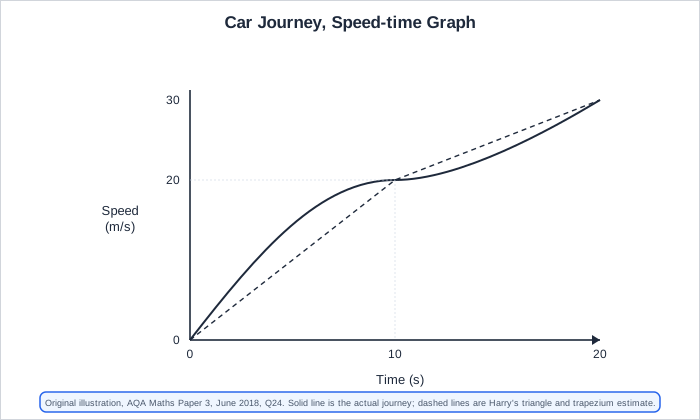
The full worked answer — June 2018
The area of the triangle covering the first 10 seconds is one half times base times height, one half times 10 times 20, which is 100.
The area of the trapezium covering the next 10 seconds is one half times the sum of the parallel sides times the width, one half times (20 plus 30) times 10, which is 250.
Adding both areas together, 100 plus 250 gives an estimated total distance of 350 metres.
Could you have written this? Every fact in this answer is drilled in our quizzes — the writing is the easy part once the evidence is automatic.
Practise real-life graph questionsWhat the mark scheme rewarded
- 1 mark for the triangle's area, 100, 1 mark for the trapezium's area, 250, and 1 mark for the final total distance, 350 metres.
- The area under a speed-time graph represents distance travelled, so splitting it into triangles and trapezia and adding the areas gives an estimate of the total distance
- A trapezium's area uses the average of its two parallel sides multiplied by its width, which here are the speeds at the start and end of the section and the time interval
Traps examiners saw
- Using the wrong pair of values as the parallel sides of the trapezium, for example using the two time values, 10 and 20, instead of the two speed values, 20 and 30
- Forgetting to add both section areas together and only giving one of them as the final answer
Full-mark self-check 0 of 3
1×asked“Leo runs for 12 seconds. A speed-time graph shows his speed. Show that the distance he runs is less than 67.5 metres. [4 marks]”
“Leo runs for 12 seconds. A speed-time graph shows his speed. Show that the distance he runs is less than 67.5 metres. [4 marks]”
What it’s really asking
Split the area under the graph into several triangle and trapezium sections, find each section's area, add them all together, and confirm the resulting total is less than 67.5 metres.
What the sources actually showed — June 2019
A speed-time graph covering 12 seconds of Leo's run. The graph rises in straight lines from (0, 0) to (5, 8) and from (5, 8) to (9, 9), then curves back down to (12, 0) for the last 3 seconds. Because this final part is a genuine curve rather than a straight line, values can be read off it at 1-second intervals to estimate its area using narrower trapezia and a triangle.
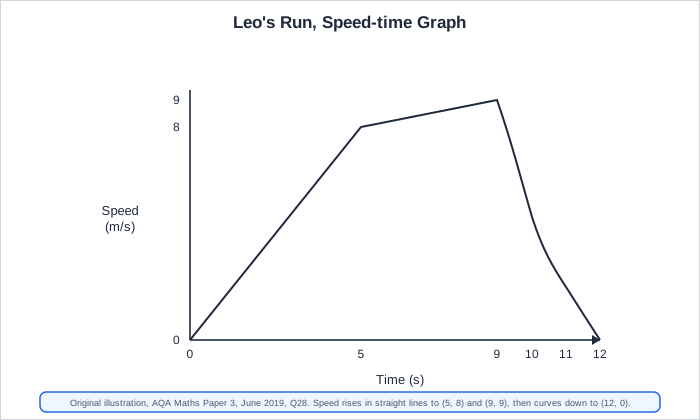
The full worked answer — June 2019
Splitting the graph into sections and finding each one's area using the triangle and trapezium area formulas gives a first section of area 20 and a second section of area 34.
The final part of the graph is split into three smaller pieces, with areas of one half times (9 plus 4.6) times 1, which is 6.8, one half times (4.6 plus 2) times 1, which is 3.3, and one half times 1 times 2, which is 1. These three pieces add up to 11.1.
Adding all the sections together, 20 plus 34 plus 11.1 gives a total estimated distance of 65.1 metres, which is less than 67.5 metres, confirming what was asked to be shown.
Could you have written this? Every fact in this answer is drilled in our quizzes — the writing is the easy part once the evidence is automatic.
Practise real-life graph questionsWhat the mark scheme rewarded
- 1 mark for a correct area from the first main section, 20, 1 mark for a correct area from the second main section, 34, 1 mark for correctly finding the total of the finer final pieces, 11.1, and 1 mark for correctly adding all sections to reach a total less than 67.5, with the comparison stated.
- A show that question needs every section's area displayed and added, since the final comparison alone, without the working, does not earn full marks
- Splitting a sharply curving part of a speed-time graph into several smaller trapezia, rather than one large one, gives a more accurate estimate of the area beneath it
Traps examiners saw
- Combining the final three pieces into 67.5 minus the first two areas instead of calculating them independently and confirming the total genuinely comes out below 67.5
- Making an error in one section's area and not noticing the final total no longer clearly supports the show that statement
Full-mark self-check 0 of 3
The method for every Q24a (Jun18) / Q28a (Jun19) — same every sittingMark bands, steps, timing
What this question type rewards
The topic changes by sitting — the mark scheme never does. Learn this once, then open your question above for that sitting’s sources and a full worked answer.
- Splitting the graph into an appropriate combination of triangles and trapezia that together cover the whole area needed
- Finding the area of every triangle and trapezium section correctly, using half times base times height, or half times the sum of the parallel sides times the width
- Adding every section's area together correctly to reach the final total distance
The steps
- Split the area under the graph into sections that are each a triangle or a trapezium
- Find the area of every section separately, using the correct formula for a triangle or a trapezium
- Add every section's area together to find the total estimated distance
On a distance-time graph, what does a horizontal (flat) section represent?
Estimating the area under a speed-time graph comes up in two of the four sittings we have. Practise splitting a graph into triangles and trapezia, using smaller pieces wherever the curve changes sharply.
Practise real-life graph questionsWhat is guaranteed to come up, and what genuinely varies
Across the four sittings we have full papers for, Paper 3's overall structure and total marks (80) never changed, and the same handful of skills recur every year, though the exact numbers and context are different every time.
Not seen as a standalone, cleanly repeating question on Paper 3 in the four sittings we have full papers for
Working out the next values in an iterative process, tested only in June 2018 · Reading a pie chart to find a missing quantity, tested only in June 2023 · Reasoning about whether a claim linking surface area and volume scale factors is correct, tested only in June 2023 · Making a criticism of an examiner's working using a circle theorem, tested only in June 2018 · Using a circle theorem to show a ratio between two angles, tested only in June 2022 · Judging whether a straight line of best fit is appropriate, or spotting an outlier, on a scatter graph, tested only in June 2022 · Finding an unknown prime number from two numbers given as algebraic products of prime factors, tested only in June 2022 · Expanding and simplifying a product of three linear brackets, tested only in June 2022 · Working backwards from an increased value to find an original value using reverse percentages, tested only in June 2018 on this paper · Solving simultaneous equations formed from a quadratic graph and a straight line, tested only in June 2022 · Drawing or sketching an exponential graph, tested in both June 2018 and June 2019, but in different forms, plotting from a table in one and sketching by comparison to a given curve in the other · Working out a percentage increase where the underlying values are given as mixed numbers of hours, tested only in June 2022 · Proving algebraically that a result is always a square number, tested only in June 2023 · Working out the maximum and minimum possible number of cubes in a 3D solid from its plan and elevations, tested only in June 2023 · Combining an arithmetic and a geometric progression to find an unknown term number, tested only in June 2022 · Simplifying an expression by collecting like surds, tested only in June 2022 · Solving a linear equation with fractional coefficients on both sides, tested only in June 2023 · Making two criticisms of an already-drawn box plot, tested only in June 2019 on this paper
These topics genuinely appeared in at least one of the four sittings, but we could not find a single sub-question shape that repeated across sittings with a diagram or structure we could verify from the real paper, so there is no dedicated cluster on this page for them. Do not assume any of the specific facts below are safe to skip, only that we have not found clean repeat evidence, or a diagram we could confidently read, for a dedicated page section.
Before you revise
Does Paper 3 always have the same structure?
Yes, in all four sittings we have full papers for. Every sitting totalled 80 marks in 1 hour 30 minutes, and every paper covered a similarly broad spread of number, algebra, ratio, geometry, probability and statistics questions, mostly worth 1 to 5 marks each. Always check your own paper's front cover to confirm, since AQA can make real changes in any future series.
Is a calculator allowed on Paper 3?
Yes, in all four sittings we have full papers for. Paper 3 is explicitly a calculator paper. This does not mean working can be skipped, though: the real mark schemes below show that method marks are very often withheld from students who show no working, even on questions where a calculator gets the right number quickly.
Why is there no June 2020 or June 2021 paper on this page?
Because those sittings do not exist. GCSE exams were cancelled in both 2020 and 2021 due to the pandemic, so there are no real question papers or mark schemes to analyse from those years. Our four sittings, June 2018, June 2019, June 2022 and June 2023, are the most recent full sittings we could obtain both the real question paper and the real mark scheme for.
Was a formulae sheet always provided?
No. June 2022 and June 2023 both list a Formulae Sheet as an enclosed insert in the materials for this paper, but June 2018 and June 2019 do not mention one, meaning more formulae had to be memorised in those earlier years. Always check your own paper's materials list, since this has changed once already.
How is Paper 3 different from Paper 2, since both are calculator papers?
Paper 2 and Paper 3 are both calculator papers with the same total of 80 marks and the same broad spread of topics, but the exact questions and skills tested differ between them. Some skills, such as bounds and compound measures, appear on both papers across our four sittings, while others, such as combining two functions or using a histogram to estimate a frequency, are more prominent on Paper 3 in the sittings we have full papers for.
What is the single biggest way marks are lost on this paper?
According to the real mark schemes for these four sittings, marks are very often lost when a diagram-heavy question, such as a histogram or a 3D solid, is answered without correctly identifying the exact triangle, class, or bar being used, and by not showing enough working on show that questions, where the final expression is already given and the working itself carries most of the marks.
Practise the questions that are guaranteed to come up
Every skill on this page has practice questions waiting in the app, built the way AQA actually structures Paper 3.
Start revising free