Test yourself on Rounding & Estimation with exam style questions, marked instantly.
Flashcards that come back just before you would forget them.
A revision plan that remembers what you know and shows what to do next.
See which topics you have nailed and which need another look.
Quiz yourself on Rounding & EstimationGet your flashcardsBuild my revision planTrack my progressWhy Round Numbers?
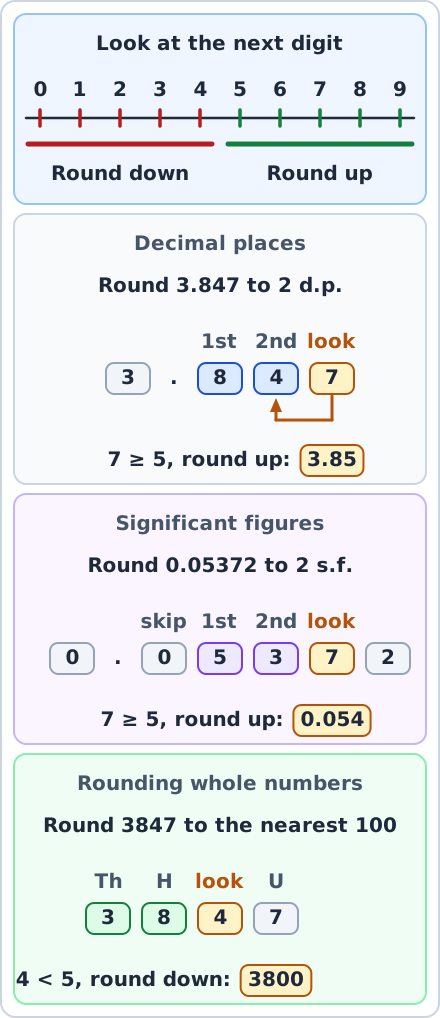
Digits 0 to 4 round down and digits 5 to 9 round up. Significant figures start from the first non-zero digit. When you round a whole number, replace the digits after with zeros.
The Key Rule
Look at the NEXT digit:
• 0, 1, 2, 3, 4 → Round DOWN (keep the digit the same)
• 5, 6, 7, 8, 9 → Round UP (add 1 to the digit)
Types of Rounding
| Type | What It Means | Example: 3.847 |
|---|---|---|
| 1 d.p. | 1 digit after decimal point | 3.8 (look at 4, round down) |
| 2 d.p. | 2 digits after decimal point | 3.85 (look at 7, round up) |
| 1 s.f. | 1 significant figure | 4 (from first non-zero) |
| 2 s.f. | 2 significant figures | 3.8 |
Worked Example: Significant Figures
Round 0.005372 to 2 significant figures
Step 1 Find first significant figure
Skip the zeros: 0.005372
5 is the 1st significant figure
Step 2 Identify 2nd s.f. and look at the next digit
0.005372 → 3 is 2nd s.f., look at 7
Step 3 Apply the rule
7 ≥ 5, so round UP: 3 becomes 4
Common Mistakes
- WRONG: Counting leading zeros as significant (0.005 has 1 s.f., not 3)
- WRONG: Forgetting trailing zeros matter in s.f. (3.50 has 3 s.f., not 2)
- RIGHT: For estimation, round to 1 s.f. to make calculation easy
Make this stick
Signing in gives access to all PrepWise features.